A Gladiator Dies Only Once vs Lays of ancient Rome: Which Should You Read?
Both live on shelves: Rome, History
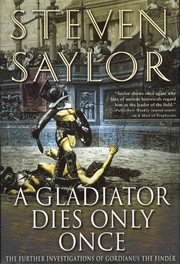 A Gladiator Dies Only Once
More
Set against the backdrop of the later Roman Republic, a collection of short mystery tales featuring ancient Roman sleuth Gordianus the Finder follows the early career of the classical sleuth.
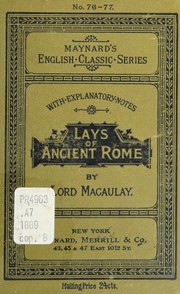 Lays of ancient Rome
More
Noteworthy among Macaulay's works are his poems, of which the 'Lays of Ancient Rome' are chief. Here his purpose is to embody his conception of the heroic historical ballads which must have been current among the early…
Side by side
The verdict
- Ratings are close across the board — any is a safe pick by score.
- Lays of ancient Rome is the quickest read — about 1 hours vs 5 for A Gladiator Dies Only Once.
- Lays of ancient Rome has the widest readership — 27 ratings behind its score.
Affiliate links: we may earn a commission on purchases.
How to choose
Scores by source
| A Gladiator Dies Only Once | Lays of ancient Rome | |
|---|---|---|
| Goodreads | — | 4.1 (7) |
| Hardcover | 3.2 (11) | 4.0 (1) |
| Apple Books | 4.5 (23) | 4.0 (27) |
| Check price → | Check price → |
Reception
| A Gladiator Dies Only Once | Lays of ancient Rome | |
|---|---|---|
| Ratings | 23 | 27 |
| Editions | 11 | 176 |
| Film adaptations | 1 | 1 |
| Want to read | — | 4 |
| Written reviews | — | 2 |
| Wikipedia attention | 38 | 3659 |
| Pages | 288 | 95 |
| Check price → | Check price → |
Questions readers ask
Which is rated higher: A Gladiator Dies Only Once or Lays of ancient Rome?
A Gladiator Dies Only Once has the higher combined reader rating across sources (A Gladiator Dies Only Once 4.0/5, Lays of ancient Rome 4.0/5).
Which is shorter to read: A Gladiator Dies Only Once or Lays of ancient Rome?
Lays of ancient Rome is the quickest read. Estimated at 225 words per minute: Lays of ancient Rome (95 pages, ≈ 1 h 46 m); A Gladiator Dies Only Once (288 pages, ≈ 5 h 20 m).
Which is harder to read: A Gladiator Dies Only Once or Lays of ancient Rome?
Estimated difficulty, based on era, reader shelves and length — A Gladiator Dies Only Once: Moderate; Lays of ancient Rome: Demanding.