18 books like De anima
Selections
In this extraordinary volume of selections from Aristotle—culled from the monumental Oxford translation by authorities including W.D. Ross, Benjamin Jowett, and Ingram Bywater—editor Justin D. Kaplan has included the most widely read, studied, and quoted works of the great philosopher.Informative notes give the reader a convenient and concise review of each work, illuminating the main ideas.…
Shares: Early works to 1850, Philosophy of mind, Soul, Theory of Knowledge
Elements of the philosophy of the human mind
The HISTORY OF PHILOSOPHY & ETHICS collection includes books from the British Library digitised by Microsoft. The works in this collection include expositions and scholarly analyses of philosophy and ethics for the earliest recorded Western religious and secular works. Documents concern prehistoric, medieval, and modern times, with background and historical narratives on Western thought. The…
Shares: Early works to 1850, Philosophy of mind, Early works to 1800, Psychology
Self-knowledge
published 1813. covered in brown (leather or paper?) Hardbound, abt 51/2 by 31/2" written in old fashioned type; f's look like s's
Shares: Early works to 1850, Early works to 1800, Psychology
The analysis of mind
The book is mind blowing. It gives you insight of how mind works. You will know the more about how we understand, remember, dream, recollect and worry. You can't read fast as it is a mind stretching subject !!!.
Shares: Philosophy of mind, Theory of Knowledge, Psychology

The science of living
The Science of Living (Published in 1930) looks at Individual Psychology as a science. Adler discusses the various elements of Individual Psychology and its application to everyday life. This book includes sections on the inferiority complex, the superiority complex, and other related aspects like love, marriage, sex and sexuality, and the education of children. Concrete, particular, unique…
Shares: Philosophy of mind, Psychology
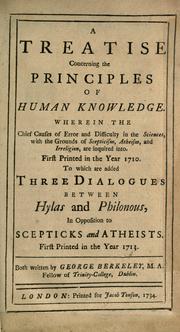
A Treatise Concerning the Principles of Human Knowledge
In this exceptional work, Berkeley makes the striking claim that physical things consist of nothing but ideas and therefore do not exist outside the mind. This claim establishes him as the founder of the idealist tradition in philosophy. The text printed in the volume is the 1734 edition of the Principles, which represents Berkeley's mature thought. Also included are four important letters…
Shares: Soul, Theory of Knowledge
Inquiries concerning the intellectual powers, and the investigation of truth
Book digitized by Google from the library of Harvard University and uploaded to the Internet Archive by user tpb.
Shares: Early works to 1850, Theory of Knowledge, Psychology

Συμπόσιον
One of the most famous works of literature in the Western world, Plato's Symposium is also one of the most entertaining. The scene is a dinner party in Athens in 416 B.C. at which the guests - including the comic poet Aristophanes and Plato's mentor, Socrates - playfully discuss the nature of eros, or love. By turns earthly and sublime, the dialogue culminates with Socrates's famous account of…
Shares: Soul, Theory of Knowledge, Early works to 1800
Philosophical Perspectives
Philosophical Perspectives is an annual peer-reviewed academic journal of philosophy. Each annual volume is dedicated to a specific theme addressing philosophical problems. The founding editor-in-chief was James E. Tomberlin, who edited the series from 1987 to 2002. Philosophical Perspectives became a supplement to Noûs in 1996 and is currently published by Wiley-Blackwell.
Shares: Philosophy of mind, Theory of Knowledge
La Poetica
Few, if any, writers in history have made major contributions to as many fields of knowledge as Aristotle...
'If there are two definitive features of ancient Greek civilization,' writes Hugh Lawson-Tancred in his wide-ranging Introduction, 'they are articulacy and competition.' In the city-states oratorical competence was an essential asset for politicians in the Assemblies and Councils and even…
Shares: Aristotle, Early works to 1800, Psychology
Nicomachean Ethics
An detailed examination of what the best life might be for human beings. In order to anwer this question, Aristotle finds he also has to examine what virtue itself is and all of the various virtues that might make up the best life.
Shares: Aristotle, Early works to 1800
The anatomy of melancholy
Burton examines humanity through the lens of melancholy.
Shares: Early works to 1850, Early works to 1800, Psychology
An Essay on the Nature and Conduct of the Passions and Affections, With Illustrations on the Moral Sense
"Francis Hutcheson is one of the central figures in eighteenth-century moral philosophy. Read widely in Britain, France, Germany, and America, he influenced philosophers ranging from his student Adam Smith to Kant. After the initial reaction to his first major work, Inquiry into the Original of Our Ideas of Beauty and Virtue (1725), Hutcheson took stock of his critics and wrote An Essay on the…
Shares: Early works to 1850, Early works to 1800
Φαίδων
After an interval of some months or years, and at Phlius, a town of Peloponnesus, the tale of the last hours of Socrates is narrated to Echecrates and other Phliasians by Phaedo the 'beloved disciple.' The Dialogue necessarily takes the form of a narrative, because Socrates has to be described acting as well as speaking. The minutest particulars of the event are interesting to distant friends,…
Shares: Soul, Early works to 1800

Χαρμίδης
"Crois-tu qu'une ville serait bien gouvernée, si la loi ordonnait à chacun de tisser et de laver son vêtement, de tisser ses chaussures, sa burette à huile, son étrille et le tout le reste de même, sans mettre la main aux affaires d'autrui..." L'évocation de la priorité donnée aux affaires privées n'a rien d'étonnant dans le Charmide pour qui connaît l'entêtement de Platon à souligner l'état…
Shares: Theory of Knowledge, Early works to 1800
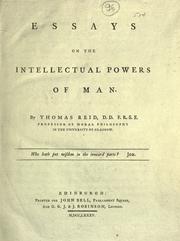
Essays on the intellectual powers of man
Shares: Theory of Knowledge, Psychology
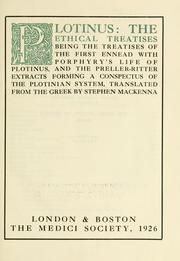
Enneads
The Six Enneads Plotinus - The Six Enneads is the collection of writings of Plotinus, edited and compiled by his student Porphyry. After correcting and naming each treatise, Porphyry wrote a biography of his master, Life of Plotinus, intended to be an Introduction to the Enneads. Porphyry's edition does not follow the chronological order in which Enneads were written, but responds to a plan of…
Shares: Soul, Early works to 1800
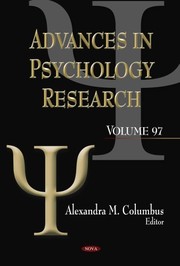
Advances in Psychology Research
"Advances in Psychology Research" presents original research results on the leading edge of psychology research. Each article has been carefully selected in an attempt to present substantial psychology advances across a broad spectrum.
Shares: Psychology