18 books like Elements of the philosophy of the human mind
The analysis of mind
The book is mind blowing. It gives you insight of how mind works. You will know the more about how we understand, remember, dream, recollect and worry. You can't read fast as it is a mind stretching subject !!!.
Shares: Philosophy of mind, Intellect, Philosophy, Psychology
De anima
For the Pre-Socratic philosophers the soul was the source of movement and sensation, while for Plato it was the seat of being, metaphysically distinct from the body that it was forced temporarily to inhabit. Plato's student Aristotle was determined to test the truth of both these beliefs against the emerging sciences of logic and biology. His examination of the huge variety of living organisms -…
Shares: Early works to 1850, Philosophy of mind, Early works to 1800, Psychology
Self-knowledge
published 1813. covered in brown (leather or paper?) Hardbound, abt 51/2 by 31/2" written in old fashioned type; f's look like s's
Shares: Early works to 1850, Early works to 1800, Psychology
Selections
In this extraordinary volume of selections from Aristotle—culled from the monumental Oxford translation by authorities including W.D. Ross, Benjamin Jowett, and Ingram Bywater—editor Justin D. Kaplan has included the most widely read, studied, and quoted works of the great philosopher.Informative notes give the reader a convenient and concise review of each work, illuminating the main ideas.…
Shares: Early works to 1850, Philosophy of mind, Early works to 1800, Philosophy
Inquiries concerning the intellectual powers, and the investigation of truth
Book digitized by Google from the library of Harvard University and uploaded to the Internet Archive by user tpb.
Shares: Early works to 1850, Intellect, Philosophy, Psychology

The science of living
The Science of Living (Published in 1930) looks at Individual Psychology as a science. Adler discusses the various elements of Individual Psychology and its application to everyday life. This book includes sections on the inferiority complex, the superiority complex, and other related aspects like love, marriage, sex and sexuality, and the education of children. Concrete, particular, unique…
Shares: Philosophy of mind, Psychology
Essays on the intellectual powers of man
Shares: Intellect, Psychology
The anatomy of melancholy
Burton examines humanity through the lens of melancholy.
Shares: Early works to 1850, Early works to 1800, Psychology
The mechanical mind
How can the human mind represent the external world? What is thought, and can it be studied scientifically? Should we think of the mind as a kind of machine? Is the mind a computer? Can a computer think? Tim Crane sets out to answer these questions and more in a lively and straightforward way, presuming no prior knowledge of philosophy or related disciplines. Since its first publication, The…
Shares: Philosophy of mind, Philosophy
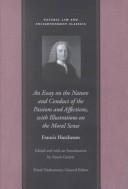
An Essay on the Nature and Conduct of the Passions and Affections, With Illustrations on the Moral Sense
"Francis Hutcheson is one of the central figures in eighteenth-century moral philosophy. Read widely in Britain, France, Germany, and America, he influenced philosophers ranging from his student Adam Smith to Kant. After the initial reaction to his first major work, Inquiry into the Original of Our Ideas of Beauty and Virtue (1725), Hutcheson took stock of his critics and wrote An Essay on the…
Shares: Early works to 1850, Early works to 1800
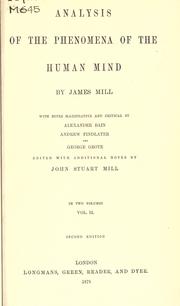
Analysis of the phenomena of the human mind
IN the study of Nature, either mental or physical, the aim of the scientific enquirer is to diminish as much as possible the catalogue of ultimate truths. When, without doing violence to facts, he is able to bring one phenomenon within the laws of another; when he can shew that a fact or agency, which seemed to be original and distinct, could have been produced by other known facts and agencies,…
Shares: Intellect, Psychology
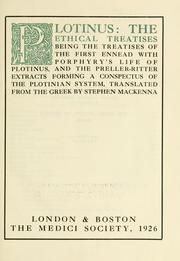
Enneads
The Six Enneads Plotinus - The Six Enneads is the collection of writings of Plotinus, edited and compiled by his student Porphyry. After correcting and naming each treatise, Porphyry wrote a biography of his master, Life of Plotinus, intended to be an Introduction to the Enneads. Porphyry's edition does not follow the chronological order in which Enneads were written, but responds to a plan of…
Shares: Intellect, Early works to 1800, Philosophy
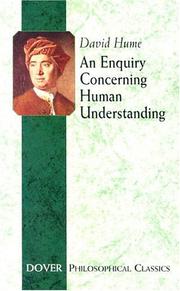
Philosophical essays concerning human understanding
"Over a series of elegantly written, engaging essays, the Enquiry examines the experiential and psychological sources of meaning and knowledge, the foundations of reasoning about matters that lie beyond the scope of our sensory experience and memory, the nature of belief, and the limitations of our knowledge. The positions Hume takes on these topics have been described as paradigmatically…
Shares: English Philosophy, Early works to 1800, Philosophy
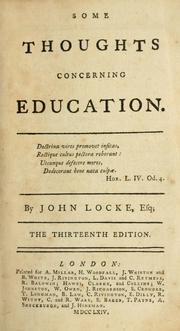
Some thoughts concerning education
This volume offers two complementary works by John Locke, unabridged, in modernized, annotated texts - the only available edition priced for classroom use. Of interest to students and instructors of philosophy, political theory, and education, these important works shed light on conceptions of reason and freedom essential for understanding Locke's philosophy. With renewed interest in the…
Shares: Intellect, Early works to 1800, Philosophy
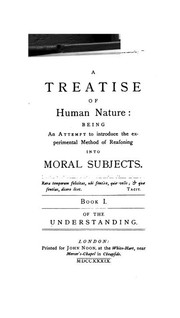
A treatise of human nature
The eighteenth-century Scottish philosopher's classic work on human understanding and morals.
Shares: English Philosophy, Early works to 1800, Philosophy
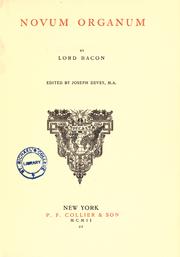
Novum organum
"When The New Organon appeared in 1620, as part of a six-part programme of scientific inquiry entitled 'The Great Renewal of Learning', Francis Bacon was at the high point of his political career, and his ambitious work was groundbreaking in its attempt to give formal philosophical shape to a new and rapidly emerging experimentally based science. Bacon combines theoretical scientific epistemology…
Shares: English Philosophy, Early works to 1800, Philosophy
Philosophical Perspectives
Philosophical Perspectives is an annual peer-reviewed academic journal of philosophy. Each annual volume is dedicated to a specific theme addressing philosophical problems. The founding editor-in-chief was James E. Tomberlin, who edited the series from 1987 to 2002. Philosophical Perspectives became a supplement to Noûs in 1996 and is currently published by Wiley-Blackwell.
Shares: Philosophy of mind, Philosophy
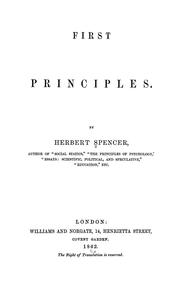
First principles
Herbert Spencer was an English philosopher, biologist, anthropologist, sociologist, and prominent classical liberal political theorist of the Victorian era. Spencer developed an all-embracing conception of evolution as the progressive development of the physical world, biological organisms, the human mind, and human culture and societies. As a polymath, he contributed to a wide range of subjects,…
Shares: English Philosophy, Philosophy
About the book Elements of the philosophy of the human mind →