18 books like Mein Weltbild
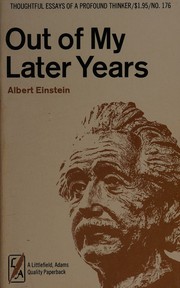
Out of my later years
Albert Einstein, among the greatest scientists of all time, was also a man of profound thought and deeply humane feelings. His collected essays offer a fascinating and moving look at one of the twentieth century's leading minds.
Covering a fifteen year period from 1934 to 1950, the contents of this book have been drawn from Einstein's articles, addresses, letters and assorted papers. Through his…
Shares: Physicists, Political and social views, Physics, Science
Progress in optics
Principles of Optics is one of the most highly cited and most influential physics books ever published, and one of the classic science books of the twentieth century. To celebrate the 60th anniversary of this remarkable book's first publication, the seventh expanded edition has been reprinted with a special foreword by Sir Peter Knight. The seventh edition was the first thorough revision and…
Shares: Physics, Science
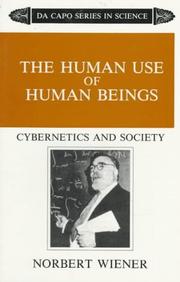
The Human Use of Human Beings
"Only a few books stand as landmarks in social and scientific upheaval. Norbert Wiener's classic is one in that small company. Founder of the science of cybernetics--the study of the relationship between computers and the human nervous system--Wiener was widely misunderstood as one who advocated the automation of human life. As this book reveals, his vision was much more complex and interesting.…
Shares: Social aspects of Science, Social aspects, Science
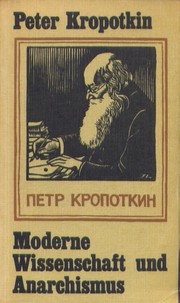
Science moderne et l’anarchie
L'Anarchie : Articles, Conférences et discours par Kropotkine, Reclus et Malatesta.
Qu'est-ce que l'anarchie ? quelle est sa philosophie, son idéal et sa morale ? Sur quels principes l'anarchie est-elle basée ? Afin de répondre à ces questions, nous avons effectué une sélection d'articles, de conférences et de discours réalisés par trois des figures historiques du mouvement anarchiste : Pierre…
Shares: Social aspects of Science, Social aspects, Science, Philosophy
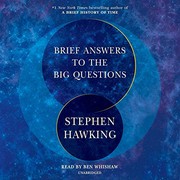
Brief Answers to the Big Questions
Stephen Hawking was recognized as one of the greatest minds of our time and a figure of inspiration after defying his ALS diagnosis at age twenty-one. He is known for both his breakthroughs in theoretical physics as well as his ability to make complex concepts accessible for all, and was beloved for his mischievous sense of humor. At the time of his death, Hawking was working on a final project:…
Shares: Religion and science, Science, Philosophy
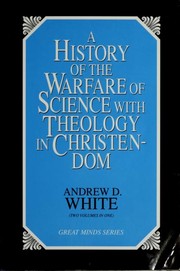
A history of the warfare of science with theology in Christendom
In this important work, which spawned a great deal of controversy at its appearance, White exhaustively documents the battle between science and religion in matters of creation versus evolution, the geocentric versus the heliocentric universe, and the "fall of man" versus anthropology. The struggle of science over outmoded medieval concepts is still emerging.
Shares: Religion and science, Science
Science and the human temperament
Shares: Physics, Science, Philosophy
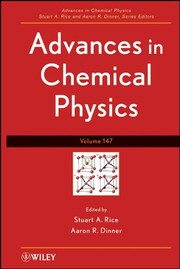
Advances in Chemical Physics
The Advances in Chemical Physics series provides the chemical physics field with a forum for critical, authoritative evaluations of advances in every area of the discipline. This volume explores the following topics: Thermodynamic Perturbation Theory for Associating Molecules Path Integrals and Effective Potentials in the Study of Monatomic Fluids at Equilibrium Sponteneous Symmetry Breaking in…
Shares: Physics, Science
The Subjection of Women
On equality and women's rights.
Shares: Legal status, Social aspects, Philosophy
"Surely You're Joking, Mr. Feynman"
The biography of the physicist and Nobel prize winner Richard P. Feynman - a collection of short stories, chapters told to and written down by Ralph Leighton.
Feynman tells of his childhood and youth and goes into his adult life, both personally and professionally.
Shares: Physicists, Science
Progress in Optics
Principles of Optics is one of the most highly cited and most influential physics books ever published, and one of the classic science books of the twentieth century. To celebrate the 60th anniversary of this remarkable book's first publication, the seventh expanded edition has been reprinted with a special foreword by Sir Peter Knight. The seventh edition was the first thorough revision and…
Shares: Physics, Science
The ABC of atoms
The British philosopher, logician and social reformer Bertrand Russell was a founding figure of the analytic movement in Western philosophy. His contributions to logic, epistemology and the philosophy of mathematics established him as one of the twentieth century’s foremost philosophers. Russell was also a fierce campaigner for peace and championed anti-imperialism and chaired the India League.…
Shares: Physics, Science
Physical science
top: diagram of the structure of the Earth including its atmosphere in Earth sciences and a diamond cuboctahedron in materials science
Shares: Physics, Science
Meaning of Relativity
pages cm
Shares: Physics, Science
The common sense of science
Discusses science as a characteristic part of human activity and as an effort to render the world predictable.
Shares: Science, Philosophy
College physics
Building on the research-proven instructional techniques introduced in Knight's Physics for Scientists and Engineers, the most widely adopted new physics text in more than 30 years, College Physics: A Strategic Approach set a new standard for algebra-based introductory physics--gaining widespread critical acclaim from professors and students alike. For the Second Edition, Randy Knight, Brian…
Shares: Physics, Science
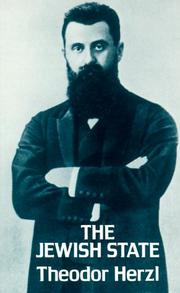
Der Judenstaat
Theodor Herzl’s “Der Judenstaat” is considered one of the most important texts of early Zionism. Herzl envisioned the founding of an independent Jewish state as the best way to avoid anti-Semitism in Europe. The book was published by M. Breitenstein in Vienna on February 14, 1896. Translations into Hebrew, English, French, Russian, and Rumanian appeared in the course of the same year. Altogether…
Shares: Legal status, Jews
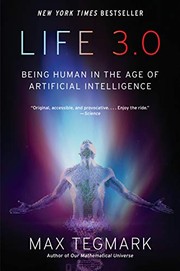
Life 3.0
"How will artificial intelligence affect crime, war, justice, jobs, society and our very sense of being human? The rise of AI has the potential to transform our future more than any other technology--and there's nobody better qualified or situated to explore that future than Max Tegmark, an MIT professor who's helped mainstream research on how to keep AI beneficial. How can we grow our prosperity…
Shares: Ethics, Social aspects, Science, Philosophy