18 books like Narratives of the religious self in early-modern Scotland
The journey to Rome
This title, first published in 1988, examines accounts of religious conversion contained in the personal narratives of nineteenth-century American coverts to Roman Catholicism. Given their newly acquired status as members of an unpopular religious minority, a number of converts recorded their conversion stories in an effort to justify becoming Catholic and to defend the teaching and practice of…
Shares: Christian biography, Autobiographie, Christianity, Histoire et critique
Redeeming Flesh
This book -- part social analysis, part theological critique, and part devotional -- considers how the zombie can be a way to critically situate our culture, awash with consumer products. Matthew Tan considers how zombies are the endpoint of social theory's exploration of consumer culture and its postsecular turn towards an earthly immortality, enacted on the flesh of consumers.
Shares: Aspect religieux, Christianisme, Christianity
Orthodoxy
Orthodoxy is G. K. Chesterton’s response to his critics’ assertion that his earlier collection of essays, Heretics, had “merely criticised current philosophies without offering any alternative philosophy.” In his intellectual journey from pagan to agnostic to positivist philosopher, he had attempted to build a philosophy “some ten minutes in advance of the truth.” But when he compared his modern…
Shares: Christianisme, Christianity, Religion, Biography & Memoir
British autobiography in the seventeenth century
"Few works of a personal or self-revelatory nature were published before 1700. On the other hand, we see in seventeenth century literature many kinds of autobiographical writings, to which their authors gave such titles as Journal of the life of me, Confessions, etc. This present work is a study of nearly two hundred of those, published and unpublished."--Page 2 of cover.
Shares: Autobiografie, Autobiographie, Histoire et critique, History and criticism
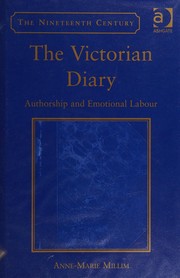
Victorian Diary
In her examination of neglected diaristic texts, Anne-Marie Millim expands the field of Victorian diary criticism by complicating the conventional notion of diaries as mainly private sources of biographical information. She argues that for Elizabeth Rigby Eastlake, Henry Crabb Robinson, George Eliot, George Gissing, John Ruskin, Edith Simcox and Gerard Manley Hopkins, the exposure or publication…
Shares: Autobiographie, Histoire et critique, Histoire, History and criticism
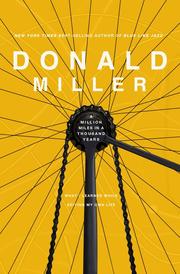
A million miles in a thousand years
After writing a successful memoir, Donald Miller's life stalled. During what should have been the height of his success, he found himself unwilling to get out of bed, avoiding responsibility, even questioning the meaning of life. But when two movie producers proposed turning his memoir into a movie, he found himself launched into a new story filled with risk, possibility, beauty, and meaning.A…
Shares: Christian biography, Biography & Memoir
Design and truth in autobiography
Originally published in 1960. Is there an art of autobiography? What are its origins and how has it come to acquire the form we know today? For what does the autobiographer seek, and why should it be so popular? This study suggests some of the answers to these questions. It takes the view that autobiography is one of the dominant and characteristic forms of literary self-expression and deserves…
Shares: Autobiographie, Biography & Memoir
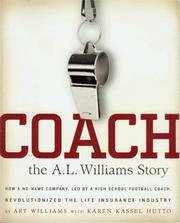
Coach
Now, for the first time, the complete story of A.L. Williams, told by the Coach himself!
Art Williams shares the inspirational story of what it took to build a tiny "peanut" of a company into an industry giant. Full of heroes and villains, amazing victories and dashing defeats, this book is a must-read for anyone who's ever dreamed of building a team, of winning big, of doing what others said…
Shares: Histoire, Biography & Memoir, History
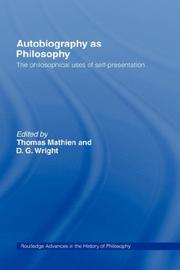
Autobiography as philosophy
Most philosophical writing is impersonal and argumentative, but many important philosophers have nevertheless written accounts of their own lives. Filling a gap in the market for a text focusing on autobiography as philosophy, this collection discusses several such autobiographies in the light of their authors' broader work, and considers whether there are any philosophical tasks for which life…
Shares: Autobiographie, Histoire et critique, History and criticism, Biography & Memoir
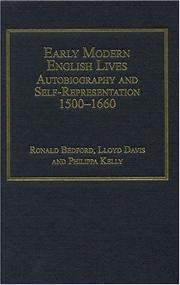
Early modern English lives
How did early modern English people write about themselves, and how do we listen to their voices four centuries later? The authors of Early Modern English Lives: Autobiography and Self-Representation 1500-1660 argue that identity is depicted through complex, subtle, and often contradictory social interactions and literary forms. Diaries, letters, daily spiritual reckonings, household journals,…
Shares: Autobiographie, Histoire et critique, History and criticism, Biography & Memoir
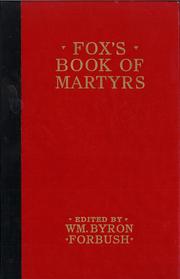
Fox's book of martyrs
Through the centuries, Christians have endured times of persecution, torture, and even death for daring to take a stand for their beliefs. These individuals were martyrs for the cause of Christ and have become an important part of our Christians heritage.
Shares: Christian biography, Histoire, Biography & Memoir, History
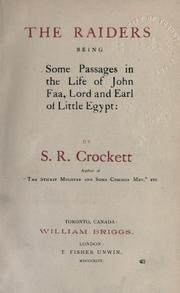
The raiders, being some passages in the life of John Faa, Lord and Earl of Little Egypt
Crockett’s ‘breakthrough’ and most famous novel, first published in 1894, this is part of a loose trilogy of smugglers and gypsies stories featuring the Herons, the Maxwells and the Faas. Stevensonesque in style, it is unique in its descriptions of Galloway’s coast and hills and still thrills a modern audience.
‘'The Raiders ' vibrates with sufficient dramatic action for a dozen ordinary…
Shares: Scotland, History
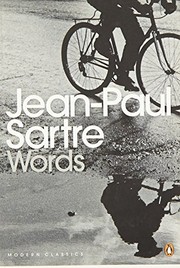
Words
The book, consisting of Sartre distancing himself from writing and making his farewells to literature was very successful for the author and was hailed nearly unanimously as a "literary success"[citation needed]. In November of the same year, 1964, he refused the Nobel Prize for Literature awarded for his work, described as "rich in ideas and filled with the spirit of freedom and the quest for…
Shares: Autobiografie, History and criticism, Biography & Memoir
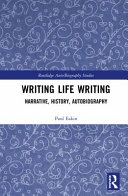
Writing Life Writing
Why do we endlessly tell the stories of our lives? And why do others pay attention when we do? The essays collected here address these questions, focusing on three different but interrelated dimensions of life writing. The first section, "Narrative," argues that narrative is not only a literary form but also a social and cultural practice, and finally a mode of cognition and an expression of our…
Shares: Autobiographie, Biography & Memoir
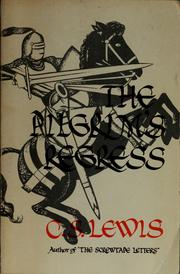
The pilgrim's regress
One of Lewis's earlier works, this book is a similar parable to Bunyan's "The Pilgrim's Progress"; while "Pilgrim's Progress" describes the journey of a non-Christian coming into Christianity, "The Pilgrim's Regress" describes the journey of a man from a Christian background leaving Christianity and then coming back again. As Lewis takes us through this abstract tale, we are left wondering what…
Shares: Christianisme, Christianity
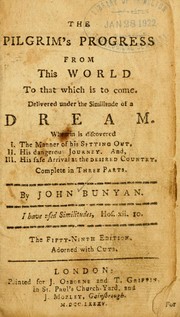
The Pilgrim's Progress
Bunyan's allegory uses the everyday world of common experience as a metaphor for the spiritual journey of the soul toward God. The hero, Christian, encounters many obstacles in his quest: the Valley of the Shadow of Death, Vanity Fair, Doubting Castle, the Wicket Gate, as well as those who tempt him from his path (e.g., Talkative, Mr. Worldly Wiseman, the Giant Despair). But in the end he reaches…
Shares: Christian biography, Religion, Biography & Memoir
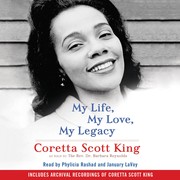
My Life, My Love, My Legacy
The life story of Coretta Scott King—wife of Martin Luther King Jr., founder of the Martin Luther King Jr. Center for Nonviolent Social Change (The King Center), and singular twentieth-century American civil and human rights activist—as told fully for the first time, toward the end of her life, to Rev. Dr. Barbara Reynolds.
Born in 1927 to daringly enterprising parents in the Deep South, Coretta…
Shares: Christian biography, Biography & Memoir, History
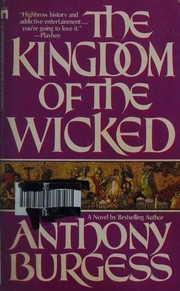
The Kingdom of the Wicked
A Roman saga, taking in the excesses of Tiberius, Caligula and Nero and an irreverent account of the early days of Christianity. Sadoc, a dying shipping clerk, sets down for future generations a tale of epic proportions: he is charged with recounting no less an event than the birth of Christianity.
Shares: Christianisme, Christianity, History
About the book Narratives of the religious self in early-modern Scotland →