18 books like Novum organum
Fundamentals of engineering thermodynamics
Using a classical viewpoint, this Second Edition offers a comprehensive treatment of engineering thermodynamics in order to provide a sound basis for subsequent courses in heat transfer and fluid mechanics and to prepare students to use thermodynamics in professional practice. New features include more than 1300 end–of–chapter problems ranging from confidence–building exercises to more…
Shares: Heat, Science
The advancement of learning
The Advancement of Learning (full title: Of the Proficience and Advancement of Learning, Divine and Human) is a 1605 book by Francis Bacon. It inspired the taxonomic structure of the highly influential Encyclopédie by Jean le Rond d'Alembert and Denis Diderot, and is credited by Bacon's biographer-essayist Catherine Drinker Bowen with being a pioneering essay in support of empirical philosophy.
Shares: Induction, Logic, Methodology, Early works to 1800

An introduction to logic and scientific method
Much as he considered himself a philosopher, Morris Raphael Cohen was also immersed in the machinery of social life. From his first years of "engagement" as a volunteer teacher in Thomas Davidson's school for working-class people, to his last as professor of philosophy at New York's City College and at the University of Chicago, he constantly sought to understand the underlying…
Shares: Logic, Methodology, Science, Philosophy

The principles of science
With centuries of literature, it's inevitable that some will fall through the cracks. We hunt down public domain works and restore them so they're not lost to the world.
Who are we? We're Cairn Press. Our background is in design, publishing, typography, and technology. These skills fuel our mission to create the highest quality Public Domain eBooks available online, at an affordable price. We…
Shares: Logic, Methodology, Science

An Examination of Sir William Hamilton's Philosophy
"In this book, John Stuart Mill examines the philosophy of Sir William Hamilton and discusses the principal philosophical questions in his writings. The acknowledged position of Hamilton at the head of the school of philosophy to which he belongs, has principally determined Mill to connect with his name and writings the speculations and criticisms contained in the present work. The justification…
Shares: Logic, Methodology, Science, Philosophy
Natural philosophy
A celestial map from the 17th century, by the Dutch cartographer [[Frederik de Wit]]
Shares: Heat, Physics, Science
The idea of nature
The book propounds Collingwood's theory of philosophical method applied to the problem of the philosophy of nature. The book is divided into four major sections: Introduction, Greek Cosmology, The Renaissance View of Nature, and the Modern View of Nature.
Shares: Philosophy of nature, Science, Philosophy

Zombies and forces and motion
"In cartoon format, uses zombies to explain the science of forces and motion"--
Shares: Motion, Physics
Progress in optics
Principles of Optics is one of the most highly cited and most influential physics books ever published, and one of the classic science books of the twentieth century. To celebrate the 60th anniversary of this remarkable book's first publication, the seventh expanded edition has been reprinted with a special foreword by Sir Peter Knight. The seventh edition was the first thorough revision and…
Shares: Physics, Science
Physics
Nearly all the works Aristotle (384-322 BCE) prepared for publication are lost; the priceless ones extant are lecture-materials, notes, and memoranda (some are spurious). They can be categorized as practical; logical; physical; metaphysical; on art; other; fragments.
Shares: Philosophy of nature, Physics, Early works to 1800, Science

Meine Weltansicht
Shares: Philosophy of nature, Science, Philosophy
De rerum natura
This is regarded as a seminal text of Epicurean science and philosophy. Epicurians discarded both the idea of immortality and the superstitious worship of wilful gods for a life of serene contentment in the available pleasures of nature. Lucretius (c100-c55BC), in elucidating this belief, steers the reader through an extraordinary breadth of subject matter, ranging from the indestructibility of…
Shares: Philosophy of nature, Physics, Early works to 1800, Science
First principles
Herbert Spencer was an English philosopher, biologist, anthropologist, sociologist, and prominent classical liberal political theorist of the Victorian era. Spencer developed an all-embracing conception of evolution as the progressive development of the physical world, biological organisms, the human mind, and human culture and societies. As a polymath, he contributed to a wide range of subjects,…
Shares: English Philosophy, Motion, Philosophy
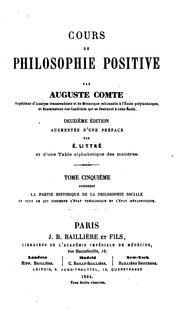
Cours de philosophie positive
Auguste Comte publie de 1830 à 1842 son Cours de philosophie positive, dont les quatre volumes constituent un système philosophique englobant l’ensemble des branches de la connaissance, parmi lesquelles la science ultime, la nouvelle « physique sociale », ou « sociologie », qui envisage de manière globale l’évolution de l’esprit humain.
Shares: Social sciences, Science, Philosophy
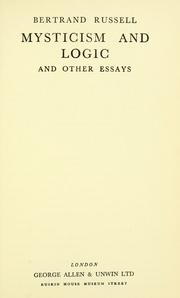
Philosophical essays
"This collection was first published in 1917 in Great Britain."
Shares: English Philosophy, Logic, Science, Philosophy
Essays
"Bacon's Essays have attracted an eager readership since their publication in 1625. They sum up a lifetime's observations on the whole range of human activity, by one of the keenest minds of the Renaissance. In their third and final revision Bacon designed the Essays to fill some of the gaps he had diagnosed in the study of mankind, such as the formative influences on individual behaviour of…
Shares: Logic, Methodology, Early works to 1800, Science
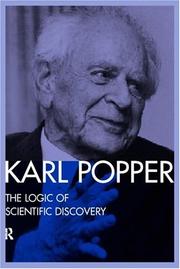
The Logic of Scientific Discovery
Described by the philosopher A.J. Ayer as a work of 'great originality and power', this book revolutionized contemporary thinking on science and knowledge. Ideas such as the now legendary doctrine of 'falsificationism' electrified the scientific community, influencing even working scientists, as well as post-war philosophy. This astonishing work ranks alongside The Open Society and Its Enemies as…
Shares: Logic, Methodology, Science, Philosophy

Science and the human temperament
Shares: Physics, Science, Philosophy