18 books like Philosophical essays
La valeur de la science
La recherche de la verite doit etre le but de notre activite ; c'est la seule fin qui soit digne d'elle. Sans doute nous devons d'abord nous efforcer de soulager les souffrances humaines, mais pourquoi ?
Shares: Filosofie, Mathematics, Philosophie, Science
Tractatus logico-philosophicus
Wittgenstein's book about the problems of language and his attempt of describing the world and an philosophical accurate and most of all logical language.
Shares: History & Surveys, Modern, Logic, Philosophie
My Philosophical Development
Russell gives an account of his philosophical development. He describes his Hegelian period and includes hitherto unpublished notes for a Hegelian philosophy of science. He deals next with the two-fold revolution involved with his abandonment of idealism and adoption of a mathematical logic founded upon that of Giuseppe Peano. After two chapters on Principia Mathematica (1910-1913), he passes to…
Shares: Filosofie, Philosophy
Unpopular Essays
A classic collection of Bertrand Russell's more controversial works, reaffirming his staunch liberal values, Unpopular Essays is one of Russell's most characteristic and self-revealing books. Written to "combat... the growth in Dogmatism", on first publication in 1950 it met with critical acclaim and a wide readership and has since become one of his most accessible and popular books.
Shares: History & Surveys, Modern, Philosophie, Philosophy
The fundamental questions of philosophy
Shares: Filosofie, Philosophie, Philosophy
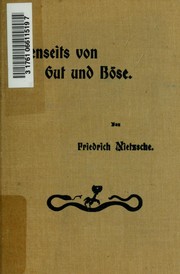
Jenseits von Gut und Böse
Since the French Revolution the influence of woman in Europe has DECLINED in proportion as she has increased her rights and claims; and the "emancipation of woman," insofar as it is desired and demanded by women themselves (and not only by masculine shallow-pates), thus proves to be a remarkable symptom of the increased weakening and deadening of the most womanly instincts.
Shares: History & Surveys, Modern, Philosophie, Philosophy
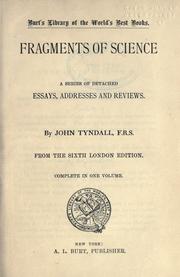
Fragments of science
For decades, John Tyndall's Fragments of Science was a fixture on the shelves of anyone who cared about the power and beauty of scientific thought. But its Victorian prose has become a barrier. This edition clears that obstacle. Here are Tyndall's most celebrated lectures and essays—on the scientific use of the imagination, the physical basis of life, the nature of matter and force, and the…
Shares: Addresses, Science
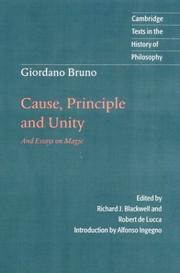
De la causa
Giordano Bruno's notorious public death in 1600, at the hands of the Inquisition in Rome, marked the transition from Renaissance philosophy to the Scientific Revolution of the seventeenth century. In his philosophical works he addressed such delicate issues as the role of Christ as mediator and the distinction, in human beings, between soul and matter. This volume presents new translations of…
Shares: History & Surveys, Modern, Philosophie, Philosophy
30-Second Coding
The successful 30-Second series tackles coding, the science of programming the technology which operates in almost every aspect of modern life.  Computer code operates behind nearly everything we do – from small calculations in the home to complex executions that drive the global economy. It influences who we see, follow, and like online and describes the websites we visit, the…
Shares: Mathematics, Science
Mathematical Essays and Recreations
http://uf.catalog.fcla.edu/uf.jsp?st=UF021014217&ix=pm&I=0&V=D&pm=1
Shares: Mathematics, Philosophy
The Complete Works of Friedrich Nietzsche
"The Complete Works of Friedrich Nietzsche" is an indispensable philosophical collection encompassing the full scope of one of history’s most groundbreaking and provocative thinkers, whose insights dramatically reshaped modern intellectual thought. Nietzsche, known for his penetrating critique of traditional morality, religion, and philosophical ideals, challenged foundational assumptions about…
Shares: Philosophie, Philosophy
Discours sur l'ensemble du positivisme
Positivism is a philosophy of science based on the view that information derived from sensory experience, logical and mathematical treatments is the exclusive source of all authoritative knowledge, that there is valid knowledge (truth) only in scientific knowledge. Verified data received from the senses is known as empirical evidence. This view, when applied to the social as to the natural…
Shares: History & Surveys, Philosophy
Cours de philosophie positive
Auguste Comte publie de 1830 à 1842 son Cours de philosophie positive, dont les quatre volumes constituent un système philosophique englobant l’ensemble des branches de la connaissance, parmi lesquelles la science ultime, la nouvelle « physique sociale », ou « sociologie », qui envisage de manière globale l’évolution de l’esprit humain.
Shares: Mathematics, Science, Philosophy
La science et l'hypothèse
"Science and Hypothesis is a classic text in history and philosophy of science. Widely popular since its original publication in 1902, this first new translation of the work in over a century features unpublished material missing from earlier editions. Addressing errors introduced by Greenstreet and Halsted in their early 20th-century translations, it incorporates all the changes, corrections and…
Shares: Mathematics, Philosophie, Science, Philosophy
Science and the human temperament
Shares: Addresses, Science, Philosophy
Novum organum
"When The New Organon appeared in 1620, as part of a six-part programme of scientific inquiry entitled 'The Great Renewal of Learning', Francis Bacon was at the high point of his political career, and his ambitious work was groundbreaking in its attempt to give formal philosophical shape to a new and rapidly emerging experimentally based science. Bacon combines theoretical scientific epistemology…
Shares: English Philosophy, Logic, Science, Philosophy
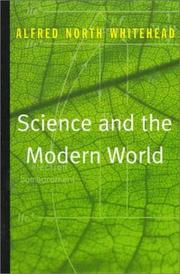
Science and the modern world
The famed mathematician and philosopher takes readers on a journey into a new scientific age, exploring topics from relativity to religion.
 
Alfred North Whitehead, one of the great figures in the philosophy of science, wrote this prescient work nearly a century ago. Yet, in an era that has us reckoning with science and technology's place and meaning in our lives, it remains as relevant as…
Shares: Filosofie, Addresses, Science, Philosophy

An introduction to logic and scientific method
Much as he considered himself a philosopher, Morris Raphael Cohen was also immersed in the machinery of social life. From his first years of "engagement" as a volunteer teacher in Thomas Davidson's school for working-class people, to his last as professor of philosophy at New York's City College and at the University of Chicago, he constantly sought to understand the underlying…
Shares: Logic, Science, Philosophy