18 books like The analysis of mind
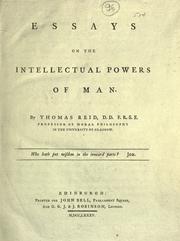
Essays on the intellectual powers of man
Shares: Intellect, Theory of Knowledge, Knowledge, Psychology
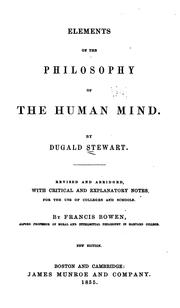
Elements of the philosophy of the human mind
The HISTORY OF PHILOSOPHY & ETHICS collection includes books from the British Library digitised by Microsoft. The works in this collection include expositions and scholarly analyses of philosophy and ethics for the earliest recorded Western religious and secular works. Documents concern prehistoric, medieval, and modern times, with background and historical narratives on Western thought. The…
Shares: Philosophy of mind, Intellect, Philosophy, Psychology
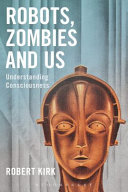
Robots, Zombies and Us
"Could robots be genuinely intelligent? Could they be conscious? Could there be zombies? Prompted by these questions Robert Kirk introduces the main problems of consciousness and sets out a new approach to solving them. He starts by discussing behaviourism, Turing's test of intelligence and Searle's famous Chinese Room argument, and goes on to examine dualism the idea that consciousness requires…
Shares: Consciousness, Knowledge

Inquiries concerning the intellectual powers, and the investigation of truth
Book digitized by Google from the library of Harvard University and uploaded to the Internet Archive by user tpb.
Shares: Intellect, Theory of Knowledge, Knowledge, Philosophy

Some thoughts concerning education
This volume offers two complementary works by John Locke, unabridged, in modernized, annotated texts - the only available edition priced for classroom use. Of interest to students and instructors of philosophy, political theory, and education, these important works shed light on conceptions of reason and freedom essential for understanding Locke's philosophy. With renewed interest in the…
Shares: Intellect, Theory of Knowledge, Knowledge, Philosophy
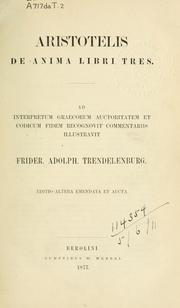
De anima
For the Pre-Socratic philosophers the soul was the source of movement and sensation, while for Plato it was the seat of being, metaphysically distinct from the body that it was forced temporarily to inhabit. Plato's student Aristotle was determined to test the truth of both these beliefs against the emerging sciences of logic and biology. His examination of the huge variety of living organisms -…
Shares: Philosophy of mind, Theory of Knowledge, Psychology

Χαρμίδης
"Crois-tu qu'une ville serait bien gouvernée, si la loi ordonnait à chacun de tisser et de laver son vêtement, de tisser ses chaussures, sa burette à huile, son étrille et le tout le reste de même, sans mettre la main aux affaires d'autrui..." L'évocation de la priorité donnée aux affaires privées n'a rien d'étonnant dans le Charmide pour qui connaît l'entêtement de Platon à souligner l'état…
Shares: Theory of Knowledge, Knowledge, Philosophy
Philosophical Perspectives
Philosophical Perspectives is an annual peer-reviewed academic journal of philosophy. Each annual volume is dedicated to a specific theme addressing philosophical problems. The founding editor-in-chief was James E. Tomberlin, who edited the series from 1987 to 2002. Philosophical Perspectives became a supplement to Noûs in 1996 and is currently published by Wiley-Blackwell.
Shares: Philosophy of mind, Theory of Knowledge, Philosophy
Stalking the Wild Pendulum
In his exciting and original view of the universe, Itzhak Bentov has provided a new perspective on human consciousness and its limitless possibilities. Widely known and loved for his delightful humor and imagination, Bentov explains the familiar world of phenomena with perceptions that are as lucid as they are thrilling. He gives us a provocative picture of ourselves in an expanded, conscious,…
Shares: Consciousness, Philosophy

The science of living
The Science of Living (Published in 1930) looks at Individual Psychology as a science. Adler discusses the various elements of Individual Psychology and its application to everyday life. This book includes sections on the inferiority complex, the superiority complex, and other related aspects like love, marriage, sex and sexuality, and the education of children. Concrete, particular, unique…
Shares: Philosophy of mind, Psychology
Die Welt als Wille und Vorstellung
The German philosopher explains his thoughts about intellectual perception and abstract representation and critically analyzes Kant's ideas and teachings. Bibliogs.
Shares: Theory of Knowledge, Knowledge, Philosophy
Selections
In this extraordinary volume of selections from Aristotle—culled from the monumental Oxford translation by authorities including W.D. Ross, Benjamin Jowett, and Ingram Bywater—editor Justin D. Kaplan has included the most widely read, studied, and quoted works of the great philosopher.Informative notes give the reader a convenient and concise review of each work, illuminating the main ideas.…
Shares: Philosophy of mind, Theory of Knowledge, Philosophy, Psychology
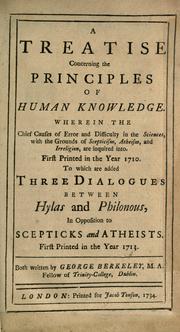
A Treatise Concerning the Principles of Human Knowledge
In this exceptional work, Berkeley makes the striking claim that physical things consist of nothing but ideas and therefore do not exist outside the mind. This claim establishes him as the founder of the idealist tradition in philosophy. The text printed in the volume is the 1734 edition of the Principles, which represents Berkeley's mature thought. Also included are four important letters…
Shares: Theory of Knowledge, Knowledge, Philosophy

Θεαίτητος
Some dialogues of Plato are of so various a character that their relation to the other dialogues cannot be determined with any degree of certainty. The Theaetetus, like the Parmenides, has points of similarity both with his earlier and his later writings. The perfection of style, the humour, the dramatic interest, the complexity of structure, the fertility of illustration, the shifting of the…
Shares: Theory of Knowledge, Knowledge, Philosophy
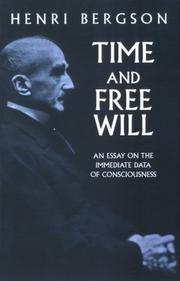
Time and free will
Bergson proposes a theory of time and freedom. Considered an influence on the French New Wave filmmakers, and a philosopher interested in humor and creativity, Bergson's works are generally a little awkward in translation (originals in French), but are well worth the effort. Bergson's basic argument here is that we (in literate Western cultures generally) use ideas and images associated with…
Shares: Consciousness, Theory of Knowledge, Philosophy
Phänomenologie des Geistes
At head of title: Hegel.Translations by Josiah Royce, J.B. Baillie, W. Wallace and others. "Short bibliography": [1] p. following p. xliii.
Shares: Consciousness, Theory of Knowledge, Philosophy
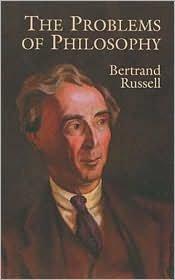
The Problems of Philosophy
In the following pages I have confined myself in the main to those problems of philosophy in regard to which I thought it possible to say something positive and constructive, since merely negative criticism seemed out of place. For this reason, theory of knowledge occupies a larger space than metaphysics in the present volume, and some topics much discussed by philosophers are treated very…
Shares: Theory of Knowledge, Knowledge, Philosophy, Psychology

The Knowledge Landscapes of Cyberspace
How is knowledge produced and used in cyberspace? David Hakken - a key figure in the anthropology of science and technology studies - approaches the study of cyberculture through the venue of knowledge production, drawing on critical theory from anthropology, philosophy and informatics (computer science) to examine how the character and social functions of knowledge change profoundly in…
Shares: Theory of Knowledge, Knowledge, Philosophy