18 books like The works of Francis Bacon
Novum organum
"When The New Organon appeared in 1620, as part of a six-part programme of scientific inquiry entitled 'The Great Renewal of Learning', Francis Bacon was at the high point of his political career, and his ambitious work was groundbreaking in its attempt to give formal philosophical shape to a new and rapidly emerging experimentally based science. Bacon combines theoretical scientific epistemology…
Shares: Philosophy of nature, Methodology, Early works to 1800, Science
The advancement of learning
The Advancement of Learning (full title: Of the Proficience and Advancement of Learning, Divine and Human) is a 1605 book by Francis Bacon. It inspired the taxonomic structure of the highly influential Encyclopédie by Jean le Rond d'Alembert and Denis Diderot, and is credited by Bacon's biographer-essayist Catherine Drinker Bowen with being a pioneering essay in support of empirical philosophy.
Shares: Methodology, Early works to 1800, Science, Philosophy
Gli eroici furori
The second part of The Heroic Enthusiasts which I am now sending to the press is on the same subject as the first, namely the struggles of the soul in its upward progress towards purification and freedom, and the author makes use of lower things to picture and suggest the higher. It is interesting to note that in the first part of The Heroic Enthusiasts (page 122), Bruno makes a distinct allusion…
Shares: Renaissance Philosophy, Ethics, Early works to 1800, Philosophy
The idea of nature
The book propounds Collingwood's theory of philosophical method applied to the problem of the philosophy of nature. The book is divided into four major sections: Introduction, Greek Cosmology, The Renaissance View of Nature, and the Modern View of Nature.
Shares: Philosophy of nature, Science, Philosophy
Essays
"Bacon's Essays have attracted an eager readership since their publication in 1625. They sum up a lifetime's observations on the whole range of human activity, by one of the keenest minds of the Renaissance. In their third and final revision Bacon designed the Essays to fill some of the gaps he had diagnosed in the study of mankind, such as the formative influences on individual behaviour of…
Shares: Renaissance Philosophy, Methodology, Early works to 1800, Science
Meine Weltansicht
Shares: Philosophy of nature, Science, Philosophy
Lives
Character studies comparing statesmen and generals of pre-Christian Greece and Rome.
Shares: Philosophers, Ethics, Early works to 1800, Philosophy
Memorabilia
The Memorabilia Xenophon - An essential text for understanding Socrates, Xenophon's Memorabilia is the compelling tribute of an affectionate student to his teacher, providing a rare firsthand account of Socrates' life and philosophy. The Memorabilia is invaluable both as a work of philosophy in its own right and as a complement to the study of Plato's dialogues. The longest of Xenophon's four…
Shares: Philosophers, Early works to 1800, Philosophy, Biography & Memoir
La Poetica
Few, if any, writers in history have made major contributions to as many fields of knowledge as Aristotle...
'If there are two definitive features of ancient Greek civilization,' writes Hugh Lawson-Tancred in his wide-ranging Introduction, 'they are articulacy and competition.' In the city-states oratorical competence was an essential asset for politicians in the Assemblies and Councils and even…
Shares: Philosophers, Ethics, Early works to 1800, Science
Self-knowledge
published 1813. covered in brown (leather or paper?) Hardbound, abt 51/2 by 31/2" written in old fashioned type; f's look like s's
Shares: Ethics, Conduct of life, Early works to 1800
Nova Atlantis
New Atlantis is an incomplete utopian novel by Sir Francis Bacon, published posthumously in 1626. It appeared unheralded and tucked into the back of a longer work of natural history, Sylva sylvarum (forest of materials). In New Atlantis, Bacon portrayed a vision of the future of human discovery and knowledge, expressing his aspirations and ideals for humankind. The novel depicts the creation of a…
Shares: Philosophy of nature, Early works to 1800, Science, Philosophy
Oeuvres de Descartes
6 Oeuvres de René Descartes
Ce livre numérique présente une collection des oeuvres majeures de René Descartes éditées en texte intégral. Une table des matières dynamique permet d'accéder directement aux différentes oeuvres.
Liste des oeuvres:
Correspondance
Discours de la méthode
Les méditations
Les météores
Les passions de l'âme
Principes de Philosophie - Préface
Shares: Philosophers, Early works to 1800, Science, Philosophy

An introduction to logic and scientific method
Much as he considered himself a philosopher, Morris Raphael Cohen was also immersed in the machinery of social life. From his first years of "engagement" as a volunteer teacher in Thomas Davidson's school for working-class people, to his last as professor of philosophy at New York's City College and at the University of Chicago, he constantly sought to understand the underlying…
Shares: Methodology, Science, Philosophy
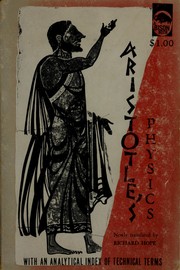
Physics
Nearly all the works Aristotle (384-322 BCE) prepared for publication are lost; the priceless ones extant are lecture-materials, notes, and memoranda (some are spurious). They can be categorized as practical; logical; physical; metaphysical; on art; other; fragments.
Shares: Philosophy of nature, Early works to 1800, Science, Philosophy
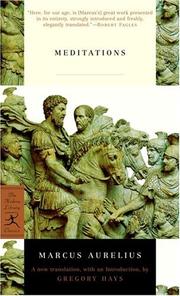
Meditations
Meditations is a collection of personal reflections and notes by the Roman Emperor Marcus Aurelius (reigned 161 to 180 AD), offering a profound look into the philosophy of Stoicism. It was never intended for publication, making it a raw and intimate self-help manual for the emperor during his campaigns and rule. The central theme revolves around living a good, rational, and virtuous life in…
Shares: Ethics, Conduct of life, Early works to 1800, Philosophy
De officiis
The most extraordinary and influential treatise ever written on political ethics. Though composed in late 44 B.C., it is relevant and applicable even today. Cicero has outlined all the aspects which aspiring politicians need to know and follow for an honorable career. He believes that justice, intelligence, nobility of character, and decorum are characteristics which guarantee success not only in…
Shares: Ethics, Conduct of life, Early works to 1800, Philosophy
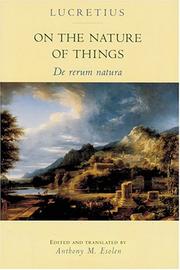
De rerum natura
This is regarded as a seminal text of Epicurean science and philosophy. Epicurians discarded both the idea of immortality and the superstitious worship of wilful gods for a life of serene contentment in the available pleasures of nature. Lucretius (c100-c55BC), in elucidating this belief, steers the reader through an extraordinary breadth of subject matter, ranging from the indestructibility of…
Shares: Philosophy of nature, Early works to 1800, Science, Philosophy
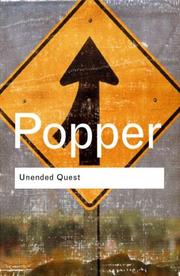
Unended quest
At the age of eight, Karl Popper was puzzling over the idea of infinity and by fifteen was beginning to take a keen interest in his father's well-stocked library of books. Unended Quest recounts these moments and many others in the life of one of the most influential thinkers of the twentieth century, providing an indispensable account of the ideas that influenced him most. As an introduction to…
Shares: Philosophers, Biography & Memoir