18 books like Θεαίτητος / Σοφιστής
Ἀπολογία Σωκράτους
There is a well-known saying that the whole of Western Philosophy is footnotes of Plato. This is because his writings have set the schema that philosophy can be said to have followed ever since. Following the teachings of Socrates, Plato's works are among the world's greatest literature. The Apology is the speech made by Socrates in his own defence at his trail, and his justification for his…
Shares: Plato, Ancient & Classical, Socrates, History & Surveys
The Knowledge Landscapes of Cyberspace
How is knowledge produced and used in cyberspace? David Hakken - a key figure in the anthropology of science and technology studies - approaches the study of cyberculture through the venue of knowledge production, drawing on critical theory from anthropology, philosophy and informatics (computer science) to examine how the character and social functions of knowledge change profoundly in…
Shares: Théorie de la connaissance, Epistemology, Theory of Knowledge, Knowledge

Κρίτων
The Critias is a fragment which breaks off in the middle of a sentence. It was designed to be the second part of a trilogy, which, like the other great Platonic trilogy of the Sophist, Statesman, Philosopher, was never completed. Timaeus had brought down the origin of the world to the creation of man, and the dawn of history was now to succeed the philosophy of nature. The Critias is also…
Shares: Ancient & Classical, Socrates, History & Surveys, Philosophy

Πρωταγόρας
Με τη λογοτεχνία αιώνων, είναι αναπόφευκτο ότι κάποιοι θα πέσουν στα σκαλιά. Κυνηγάμε έργα δημόσιου τομέα και τα αποκαθιστούμε για να μην χαθούν στον κόσμο.
Ποιοι είμαστε; Είμαστε η Cairn Press. Το υπόβαθρό μας είναι στο σχέδιο, τις εκδόσεις, την τυπογραφία και την τεχνολογία. Αυτές οι δεξιότητες τροφοδοτούν την αποστολή μας να δημιουργήσουμε τα υψηλότερης ποιότητας ηλεκτρονικά βιβλία δημόσιου…
Shares: Plato, Socrates, Philosophy
Knowledge spaces
Based on the formal concept of "knowledge structures" originally proposed by Jean-Claude Falmagne and Jean-Paul Doignon, this book contains descriptions of methodological developments and experimental investigations as well as applications for various knowledge domains. The authors address three main topics: theoretical issues and extensions of Doignon & Falmagne's theory of knowledge…
Shares: Théorie de la connaissance, Epistemology, Theory of Knowledge, Knowledge
Θεαίτητος
Some dialogues of Plato are of so various a character that their relation to the other dialogues cannot be determined with any degree of certainty. The Theaetetus, like the Parmenides, has points of similarity both with his earlier and his later writings. The perfection of style, the humour, the dramatic interest, the complexity of structure, the fertility of illustration, the shifting of the…
Shares: Epistemology, Theory of Knowledge, Knowledge, Philosophy
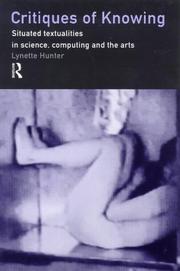
Critiques of knowing
Critiques of Knowing explores what happens to science and computing when we think of them as texts. Lynette Hunter elegantly weaves together vast areas of thought: rhetoric, politics, AI, computing, feminism, science studies, aesthetics and epistemology. Critiques of Knowing shows us that what we need is a radical shake-up of approaches to the arts if the critiques of science and computing are to…
Shares: Epistemology, Theory of Knowledge, Knowledge, Philosophy
Μένων
Text and essays edited by Malcom Brown: St. Augustine / From On the teacher; G.W. Leibniz / From Discourse on metaphysics; Friedrich Nietzsche / From Introduction to the study of the Platonic dialogues; F.M. Cornford / Anamnesis; Karl Popper / The nature of philosophical problems and their roots in science; H.-P. Stahl / beginnings of propositional logic in Plato; Malcolm Brown / Plato…
Shares: Plato, Socrates, Philosophy
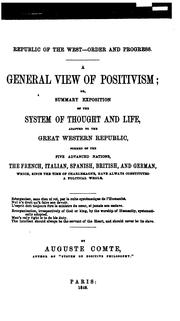
Discours sur l'ensemble du positivisme
Positivism is a philosophy of science based on the view that information derived from sensory experience, logical and mathematical treatments is the exclusive source of all authoritative knowledge, that there is valid knowledge (truth) only in scientific knowledge. Verified data received from the senses is known as empirical evidence. This view, when applied to the social as to the natural…
Shares: History & Surveys, Philosophy
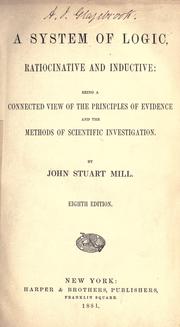
A System of Logic, Ratiocinative and Inductive
This book deals on self-belief that social planning and political action should rely primarily on scientific knowledge, not on authority, custom, revelation, or prescription.
Shares: Théorie de la connaissance, Theory of Knowledge, Knowledge
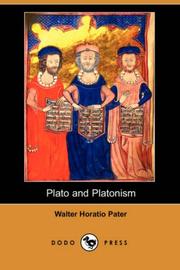
Plato and Platonism
Plato’s ideas have had an enduring and important impact on philosophy, science, and all people, from the ancient kings to modern day man and to all people in between. He passionately touches on the topics of love, virtue, politics, the soul, and ethics in his dialogues. Plato and Platonism demystifies the complex roots of Hellenic philosophy by explaining the impact Plato had on the world when he…
Shares: Plato, Philosophy
Χαρμίδης
"Crois-tu qu'une ville serait bien gouvernée, si la loi ordonnait à chacun de tisser et de laver son vêtement, de tisser ses chaussures, sa burette à huile, son étrille et le tout le reste de même, sans mettre la main aux affaires d'autrui..." L'évocation de la priorité donnée aux affaires privées n'a rien d'étonnant dans le Charmide pour qui connaît l'entêtement de Platon à souligner l'état…
Shares: Theory of Knowledge, Knowledge, Philosophy
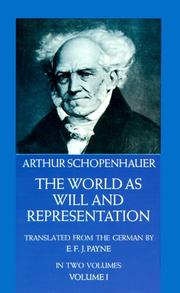
Die Welt als Wille und Vorstellung
The German philosopher explains his thoughts about intellectual perception and abstract representation and critically analyzes Kant's ideas and teachings. Bibliogs.
Shares: Theory of Knowledge, Knowledge, Philosophy
Memorabilia
The Memorabilia Xenophon - An essential text for understanding Socrates, Xenophon's Memorabilia is the compelling tribute of an affectionate student to his teacher, providing a rare firsthand account of Socrates' life and philosophy. The Memorabilia is invaluable both as a work of philosophy in its own right and as a complement to the study of Plato's dialogues. The longest of Xenophon's four…
Shares: Socrates, Philosophy
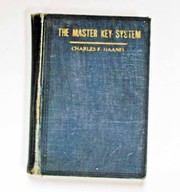
The master key system in twenty-four parts with questionnaire and glossary
The Master Key System is a personal development book by Charles F. Haanel that was published in 1912. Though originally a 24 week correspondence course, it was published in book form in 1917. Along with "The Science of Getting Rich", by Wallace D. Wattles, the Master Key System is the source of Rhonda Byrne's inspiration for the book and the film "The Secret" (2006).
Shares: Socrates, Knowledge, Philosophy
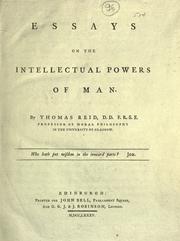
Essays on the intellectual powers of man
Shares: Theory of Knowledge, Knowledge
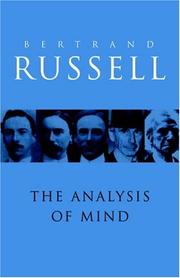
The analysis of mind
The book is mind blowing. It gives you insight of how mind works. You will know the more about how we understand, remember, dream, recollect and worry. You can't read fast as it is a mind stretching subject !!!.
Shares: Theory of Knowledge, Knowledge, Philosophy
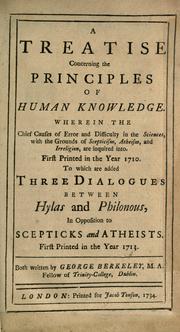
A Treatise Concerning the Principles of Human Knowledge
In this exceptional work, Berkeley makes the striking claim that physical things consist of nothing but ideas and therefore do not exist outside the mind. This claim establishes him as the founder of the idealist tradition in philosophy. The text printed in the volume is the 1734 edition of the Principles, which represents Berkeley's mature thought. Also included are four important letters…
Shares: Theory of Knowledge, Knowledge, Philosophy