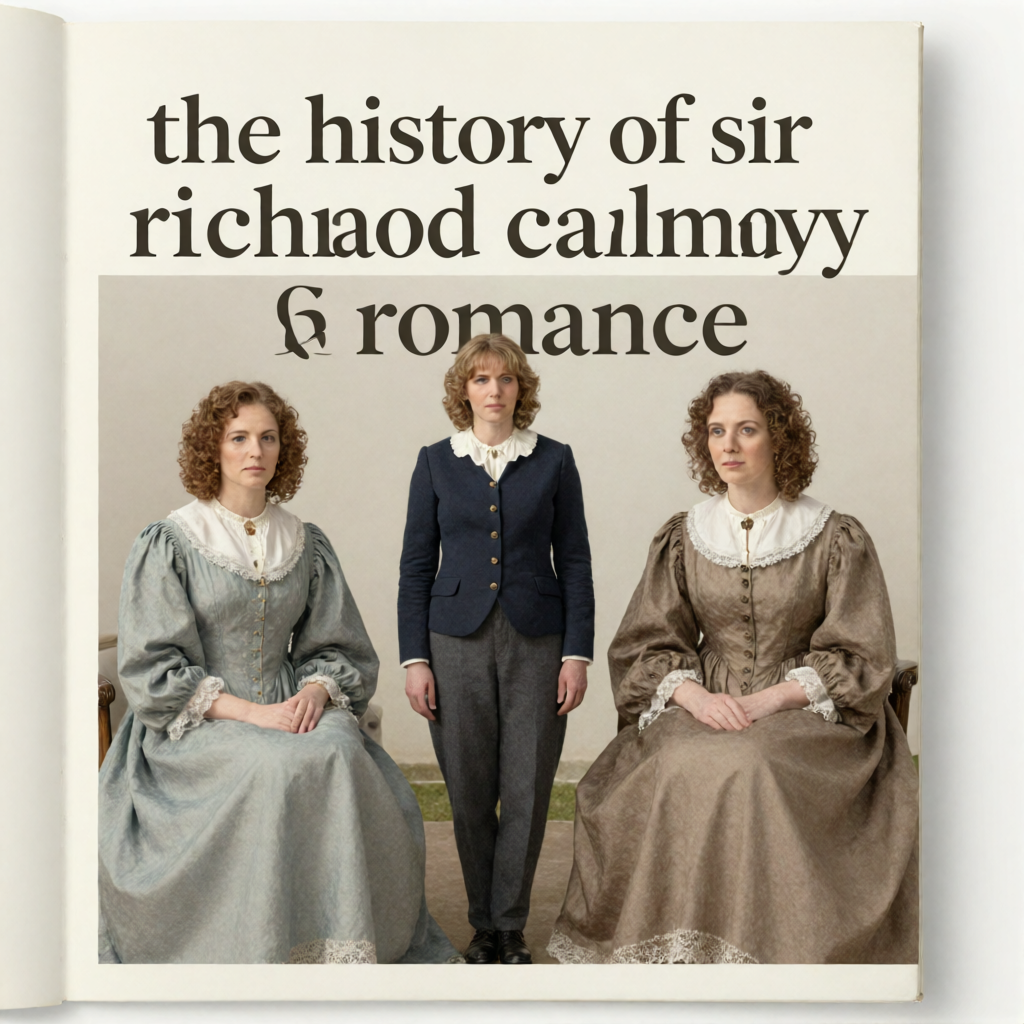
Chapter IV, “A Lesson Upon The Eleventh Commandment—‘Parents Obey Your Children’,” centers on the family council Louisa convenes in her white-and-gold Albert Gate boudoir to finalize the engagement. Louisa excludes her younger sisters Margaret and Emily, deeming them too indiscreet, and Lord Shotover avoids attending, still wary of Louisa’s coldness since the debt scandal. The council consists only of Louisa, her sister Alicia Winterbotham, Ludovic Quayle, and Lord Fallowfeild. Louisa and Alicia argue the match is ideal: Richard is wealthy, charming, and universally popular, and the union will provide financial stability for the entire Quayle family after Shotover’s debts drained their resources. They dismiss concerns about Richard’s deformity, insisting everyone gets used to it immediately, and that holding it against him is unchristian. Fallowfeild is hesitant, feeling he should have been consulted before the engagement was arranged, and worried the match is not right for his beloved youngest daughter. Ludovic defends Richard, calling him a heroic, lovable friend, but admits privately to himself that Constance is too young and simple to ever fully understand Richard’s complex, tormented nature. The discussion grows heated, with Louisa and Alicia pressuring Fallowfeild to agree, reminding him that Shotover’s selfishness has already cost the family dearly, and that Constance’s marriage to Richard will secure her future and benefit her siblings. Just as Fallowfeild is wavering, a servant announces Richard Calmady is waiting in the smoking room to see him.
The section closes with the announcement of the engagement in the morning papers two days later, and a survey of the varied reactions across the families’ social circle: Louisa is triumphant, Alicia worries Constance will be spoiled by wealth, Shotover vows to watch over his little sister, Honoria St. Quentin is distressed and avoids Ludovic, Lady Dorothy Hellard calls the match romantic, the Dowager Lady Combmartin dismisses it as a practical bargain where the bride gets the better deal, Mr. Decies takes furious rides in Hyde Park to work off his disappointment, Julius March mourns the end of Brockhurst’s quiet life, Mrs. Chifney the stable keeper rejoices, Sandyfield parish anticipates wedding celebrations, and Helen de Vallorbes cuts off contact with Richard, a silence he welcomes as he focuses on preparing for his marriage to Constance. Richard’s happiness is briefly tested when he waits for Constance to join him in the library after a family lunch, frustrated by his inability to go to her as he listens to an organ grinder and the roar of London traffic, but his doubts fade when Constance arrives, nervous and gauche, and he gives her a multi-stone necklace to replace one he accidentally frightened her with earlier when he stood up, revealing his deformity. Her gentle, dutiful nature softens his lingering frustrations, and he leaves their meeting more in love with her than ever.
(Word count: 1198)
CHAPTER VI – CHAPTER IX
The sequence opens in late July with the final arrangements for the wedding of Sir Richard Calmady, Bart., to Lady Constance Quayle, fixed for the first week of August at the private chapel of Brockhurst, the Calmady seat, rather than at the parish church at Whitney. Lord Fallowfeild, the bride’s father, confessed to his confidant Lord Shotover that he was uneasy about the hole-and-corner quality of the match but had given way to Lady Calmady. The household accordingly moved down to Brockhurst, while Richard remained in Lowndes Square under brown holland covers in company with his intended.
The social backdrop is supplied by Lady Louisa Barking’s annual ball in Albert Gate, given this year to demonstrate that the family took a calm view of Connie’s marriage and to distract attention from Lord Shotover’s debts. Honoria St. Quentin, the novel’s thoughtful observer-figure, withdrew early in the evening with Lord Shotover to a dim ante-chamber. The two formed a quick intimacy based on contrast: she was detached, anti-matrimonial, and morally exacting; he was an avowedly worthless younger son who yet recognised genuine devotion when he saw it. Shotover confided that he had smuggled in Captain Decies, a young Irish officer in love with Constance, and that he believed his family were selling the girl against her will in a ghastly mistake. Honoria, looking out on the moonlit Park, became conscious of the unreality of the gaslit world within and of her collision with “unknown and incalculable” human forces. When cries of distress reached her from the balcony, she barred the door against Shotover’s attempt to escape, declared that an unwilling marriage was the real disgrace, and compelled him to accompany her outside.
On the balcony they found Constance prostrate across the balustrade and Decies pleading. Honoria raised the girl, who sobbed out that she was engaged to Richard and would be good, but that Decies had that evening asked her to elope. Decies, in turn, declared his love and his income, named his heir Uncle Ulick, and announced that he had proposed an immediate flight to Gretna. Honoria, with uncharacteristic audacity, devised an alternative: the engagement must be broken openly and honourably. She insisted that Constance go that very night to Lowndes Square and tell Richard the truth herself, that Shotover wait with the carriage, and that she accompany the bride. Lord Shotover, having “chucked discretion,” agreed. They drove to Lowndes Square, where Richard’s valet eventually admitted Constance. Honoria paced among the shrouded furniture of Lady Calmady’s sitting-room for nearly half an hour, growing afraid of passion in some “active and violent form.” When at last the door opened, Constance came groping out, broken with weeping. At the far end of the hall, in full lamplight, stood the young baronet himself: his head poised proudly, his features those of his mother, but his body cruelly foreshortened, his hands nearly brushing the marble floor. Honoria, struck with “uncontrollable pity and horror,” hurried the girl to the carriage. Shotover, mounted on the box, restored a commonsense English tone by announcing that he was confoundedly hungry and would be glad of some supper.
Three weeks of dry July weather had meanwhile matured the country round Brockhurst. On the very evening of the Lowndes Square scene, Lady Katherine Calmady, alone on the troco-ground with only the ageing bulldog Camp for company, was moved by the heat, the scent of the gardens, and the song of a nightingale to pray passionately for a sight of her first husband, Richard Calmady the elder, dead these many years. Her prayer was granted. The spirit of her husband crossed the moonlit lawn towards her in everyday riding-dress, and she received a vision in which she understood that her love had never been taken from her, but endured as an eternal, ever-present fact of her being, and that her service was self-development rather than self-effacement. The vision faded only as Camp grew restless and the sound of an urgent horse and carriage came down the elm avenue. Winter, the butler, betraying unusual emotion, told her that Sir Richard had returned from the wars and awaited her in the Gun-Room.
The original text of this work is in the public domain. This page offers a compressed quick-read summary for educational purposes.