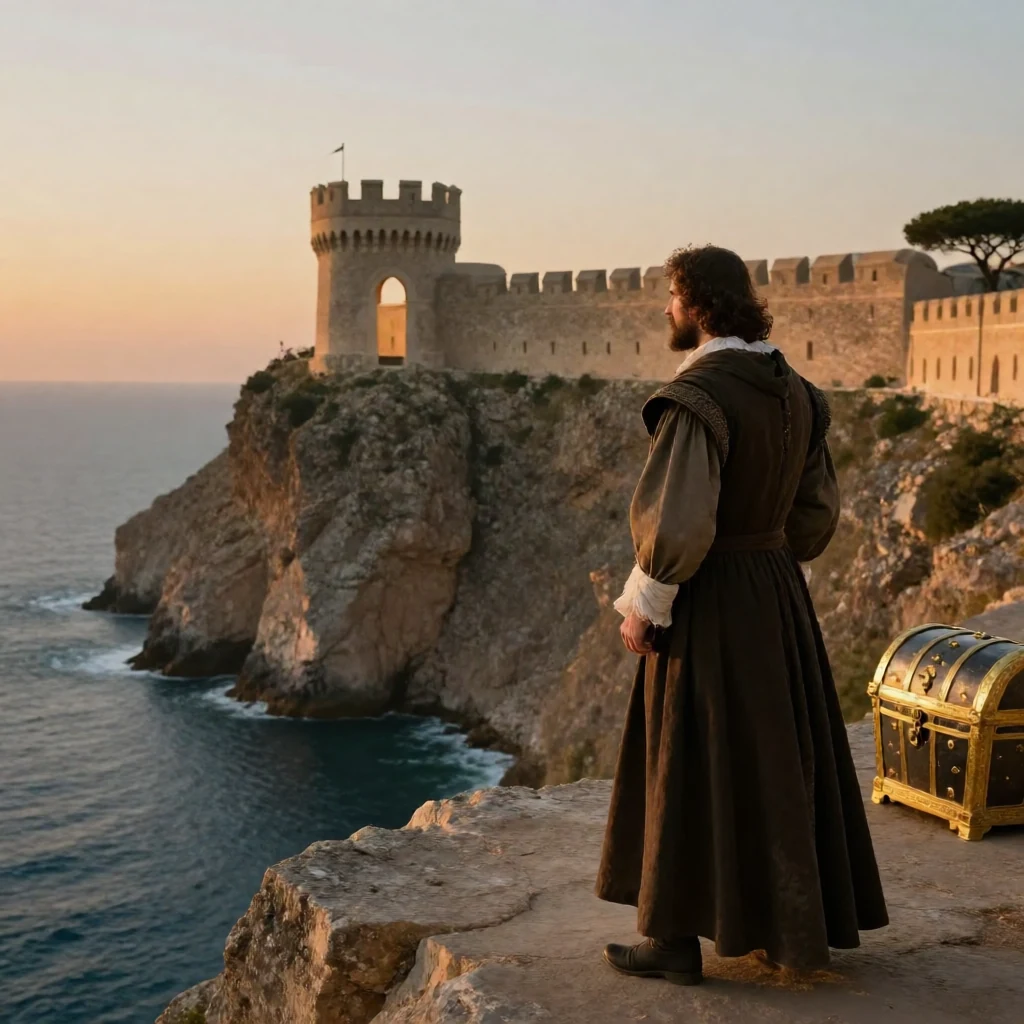
First Morning and the Governor Request
The jailer returns the next morning to find Dantès still standing, weeping, having spent the entire night without sleep. Dantès repeatedly asks to see the governor, but the jailer refuses, saying it violates prison rules. He offers Dantès basic allowances of better food, books, and walking privileges if he behaves, but Dantès insists he only wants to meet the governor.
Torment Over Missed Opportunities
Dantès is consumed by regret during his first full day of imprisonment, fixating on the fact that he could have escaped dozens of times during his boat journey by jumping overboard, given his renowned swimming skills. He laments that he could have fled to Spain or Italy, lived freely with Mercédès and his father, but instead trusted Villefort’s false promise and is now trapped in the impregnable fortress, with no idea of the fate of his loved ones.
Threat and Transfer to the Dungeon
When Dantès repeats his request to see the governor, the jailer threatens to stop bringing him food entirely, and tells Dantès of a previous prisoner who went mad begging for his freedom. In response, Dantès threatens to kill the jailer with a stool if he does not at least pass a message to Mercédès at the Catalans. The jailer, frightened, reports the threat to the governor, who orders Dantès transferred to a lower dungeon, as the jailer declares he is “mad enough to tie up.”
Chapter 9. The Evening of the Betrothal
This chapter unfolds on the evening of Gérard de Villefort’s betrothal to Renée de Saint-Méran, immediately after Villefort condemns the innocent Edmond Dantès to imprisonment to protect his father’s Bonapartist secrets. It tracks Villefort’s urgent preparations to travel to Paris to secure royal political favor, his first encounter with Dantès’ heartbroken fiancée Mercédès, his dawning, unshakable remorse over betraying an innocent man, his farewell to his betrothed and future in-laws, and the divergent immediate fates of all figures tied to Dantès in the wake of his arrest.
Villefort Secures Asset Liquidation and Royal Audience Access
Villefort returns to the Saint-Méran household on the Place du Grand Cours, where anxious guests are waiting for him after his abrupt departure earlier that day. He requests a private conversation with the marquis, Renée’s father, and reveals he must depart for Paris immediately on urgent state business. He urges the marquis to liquidate all of his investments held in funds without delay to avoid total financial loss, warning he may already be too late to act. He also secures a letter of introduction to King Louis XVIII from the marquis’s contact M. de Salvieux, which will grant him direct access to the Tuileries without the delays of formal audience protocols, so he can claim full credit for the intelligence he brings about the Bonapartist threat.
Villefort Rejects Mercédès and Experiences First Remorse
As Villefort steps outside his home to depart, he is stopped by Mercédès, Dantès’ fiancée, who has come unobserved seeking news of her missing lover. He recognizes her immediately from Dantès’ prior description, and coldly informs her Dantès is a dangerous criminal and he can offer her no help, then pushes past her to enter his house. Once inside, the weight of his actions crashes over him: he is struck by his first ever pangs of remorse, realizing he has sacrificed an innocent man to advance his own political career. He is tormented by visions of Dantès pale and threatening, accompanied by a slow, consuming guilt that grows more agonizing with each passing hour, a far cry from the fierce, brief regret he has felt over punishing guilty men he has condemned in court. He finds no relief in the fact that his fiancée Renée harbors no sympathy for Dantès, only distress that his departure will keep them apart on the eve of their wedding.
Villefort Bids Farewell and Departs for Paris
Overcome with vague dread and unable to shake his guilt, Villefort quickly gathers all the gold from his desk into his pockets. When his servant brings his cloak and informs him his carriage is ready, he springs from his chair and rushes out, ordering the postilions to drive to the Saint-Méran home. There, he embraces Renée, kisses the marquise’s hand, shakes the marquis’s hand, and departs for Paris along the Aix road, leaving the betrothal celebration behind.
The original text of this work is in the public domain. This page offers a compressed quick-read summary for educational purposes.