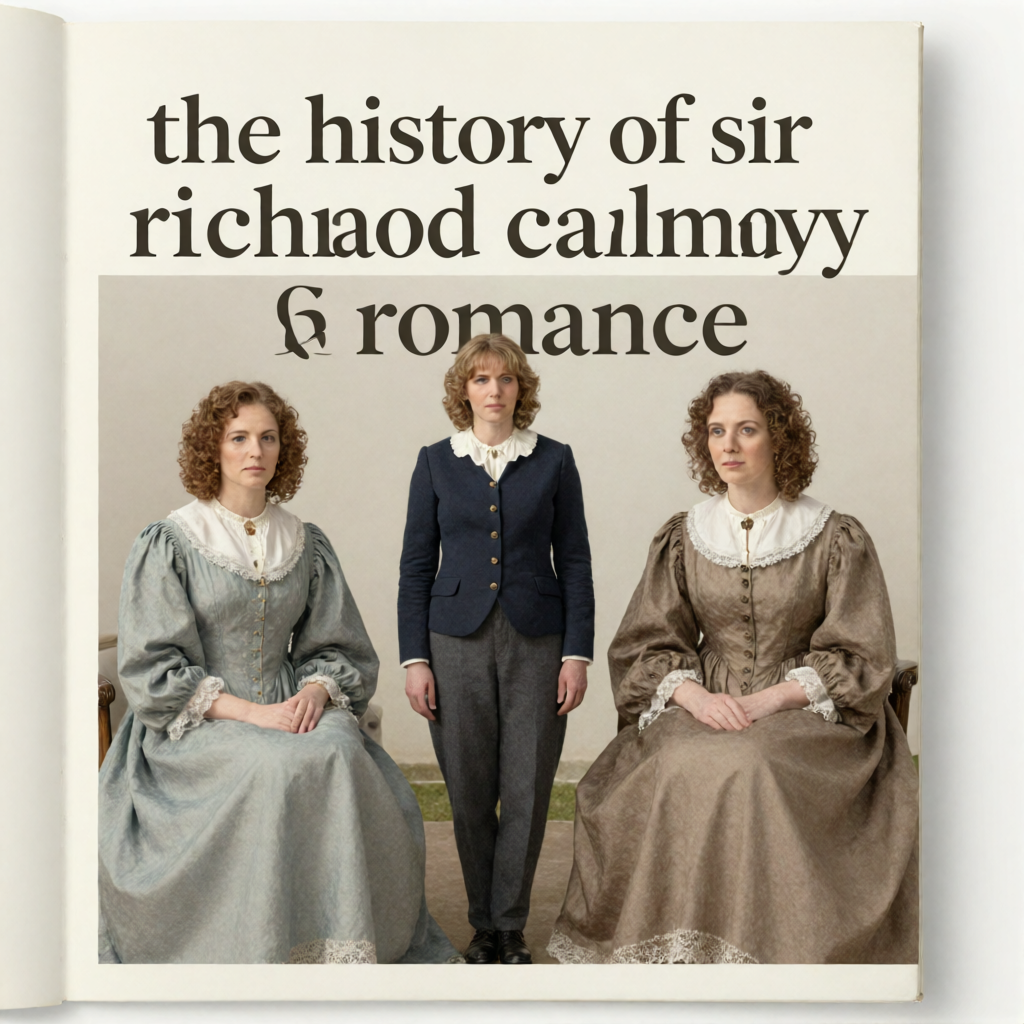
In the golden haze of the Brockhurst woods, Richard chances upon two trespassing women at the Temple: Honoria St. Quentin, in a gray-green boy’s jacket, and his cousin Helen, now Madame de Vallorbes, chic and worldly, cigarette in hand. Honoria recoils instinctively at the sight of Richard’s saddle; Helen, by contrast, advances with delight. She confesses that she has long feared to meet Katherine because of the family legend of her childhood cruelty, and begs Richard to “abolish” the memory. He complies with a cheerful lie, charmed and inwardly astonished. He invites her to Brockhurst, and as the women depart toward the park gate, Richard is left with a renewed sense that his world has grown “sensibly wider”—though whether wider toward consolation or toward fresh exposure remains unsettled.
CHAPTER IV – CHAPTER VI
Chapter IV opens on an autumn evening in the Gun-Room of Brockhurst, where Lady Calmady (Katherine) stands before a hearth of pine logs to question her son Richard about inviting his uncle William and cousin Helen de Vallorbes. The narrator attributes Katherine’s unusual restlessness to her brother’s recent arrival, which has stirred suppressed memories of a Paris and London youth, stirring vague ambitions and a longing for “a wider sphere of action.” Richard, sunk in a long armchair with a calf-bound volume — Burton’s Anatomy of Melancholy — and the old bulldog Camp at his feet, weighs the “two evils” of inviting guests against the risk of disappointment. Quoting Burton on the text’s claim that bodily imperfections “do not a whit blemish the soul,” Richard concedes bitterly that he is “some two or three decades on the near side of that comfortable conclusion.” He finally decides in favour of the visit, persuaded above all by the memory of Helen’s “silent flattery of intimate and fearless glances.” Katherine, having momentarily set aside her own ambitions, reassumes the maternal role, only to return anxiously to propose a further guest, Honoria St. Quentin, whom Richard curtly declines.
The chapter’s perspective then shifts to Julius March, the family chaplain. After his customary devotions before an image of the Virgin and the Dead Christ, he watches Katherine walking alone on the terrace and joins her beneath a star-blazing sky. The two pace the gray stone quarries in a long exchange that moves from cosmic meditation to intimate confession. Katherine complains of growing old, of her vanished youth, and of Richard’s unhappiness. Julius first offers theological consolation, then yields to “lively irritation” when she turns from her own concerns to Richard’s. The passage records a striking physical moment: Julius stands “arms extended wide, as once crucified,” gazing upward in an act of self-surrender. Katherine is moved and chastened. They speak of an “endless chain” of human sympathy whose last link is “riveted to the steps of the throne of God,” and Katherine refers to a “quarrel” with God begun nearly four-and-twenty years earlier — at Richard’s birth. Julius answers that “a miracle will be worked,” and Katherine retorts that for her the time is “at once too long and too short.”
Chapter V is structured around Helen de Vallorbes, who is introduced on the broad steps of Brockhurst feeding pea-fowl in October sunshine. The narrator portrays her as a connoisseur of the “great comedy of existence,” alert to “the echo of eternal laughter,” and conscious that Brockhurst holds “raw material” for a first-rate drama — chiefly her cousin Richard. The formal etiquette surrounding his disability, she laments, makes private encounter almost impossible. The chapter then recalls her stratagem: during a forenoon ride with her father and Richard, she arranges to view the treasures of the Long Gallery under Richard’s guidance alone. That evening the scene unfolds in the gallery, lit dimly and hung with turquoise satin curtains. Richard shows her a crystal ball mounted in a golden cage, said to have belonged to Mary, Queen of Scots. Their conversation — formally about the object — is in fact “a veil” for unspoken attraction. Helen, gazing into the sphere, sees “mist” rising within it, is seized by convent-bred superstitious terror, crosses herself, and pushes the ball away. It falls, rolls beneath the Pompeian bronze Antinous, and is lost in the shadow. Richard, intending to retrieve it, reveals the full extent of his deformity as he shifts in his high-backed chair; Helen restrains him with her hands upon his shoulders, and the two linger in silence until the distant dinner-bell rings and the valet Powell appears. Helen subsequently joins Lady Calmady to visit the conservatories; the old dog Camp, the chapter notes, sulks homeward in disapproval of the newcomer.
Chapter VI follows Richard at daybreak, riding out alone into fog as a corrective for a sleepless night inflamed by imagination and conscience. He resolves to avoid private hours with Helen, and to occupy himself with estate business and sport. At the stable yard he witnesses the rough training of stable-lads under Chifney and the head-lad Preiston, sending home one sick boy with a mixture of harshness and a softening smile that the boy interprets as a visitation of the gods. Richard breakfasts with the Chifneys, where Mrs. Chifney, childless, is moved by what she calls his “unearthly” beauty. Later, meeting Dr. Knott on the road, he invites the physician to luncheon. The chapter’s narrative spills into the opening of the formal meal, at which Lord Fallowfeild, his son Ludovic Quayle, Lady Louisa Barking, and Lady Constance Quayle are guests. Helen enters late, vexed by letters from Newlands, and her coldness draws a guarded, protective response from Richard against the cool disapproval of Lady Louisa and the watchful eyes of Dr. Knott. Lady Calmady, observing the laughing young pair at the far end of the table, is overcome by a vast weariness, fearing they unconsciously mock the conditions of their own lives. The summary’s evidence — dialogue, gesture, and reported speech — is preserved from the source; the assessments of motive and feeling that follow are the narrator’s interpretations.
The original text of this work is in the public domain. This page offers a compressed quick-read summary for educational purposes.