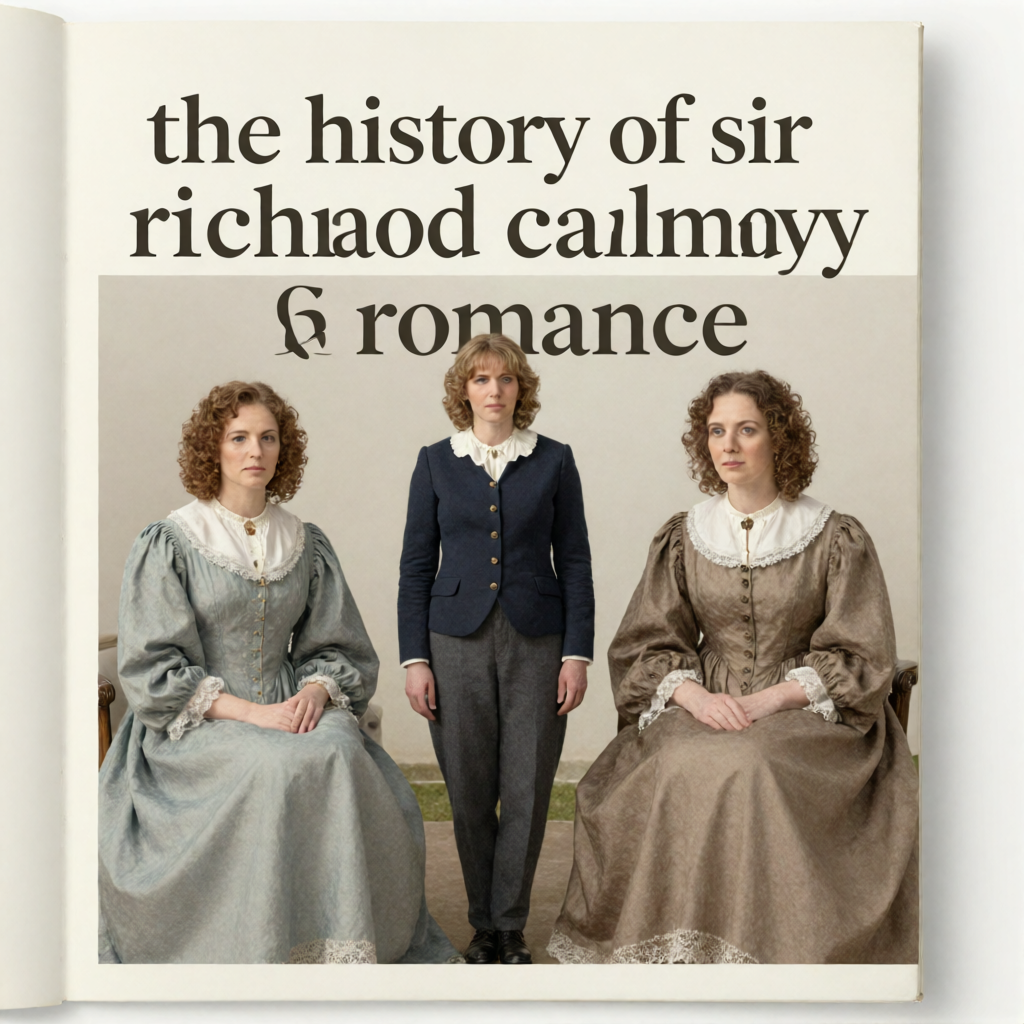
The narrative leaps forward to late March of the following year, with the birth of Katherine’s child at Brockhurst. There has been twenty-four hours of acute anxiety regarding the mother’s condition, and Mrs. Denny guards the door against visitors. The parish of Sandyfield rejoices; the rector, Thomas Caryll, rings the church bells and preaches on the text “For unto us a child is born, unto us a son is given.” Dr. Knott examines the baby but does not disclose his findings to the company at dinner. That evening, gathered in the tapestry-hung dining-room with the southeasterly gale rattling the casements, are Julius March, Captain Ormiston, his lively sister-in-law Mrs. William Ormiston (Charlotte), and Mary Cathcart of Newlands. Mrs. Ormiston raises a toast to the baby and, in the older ceremonial form, flings her wine-glass over her shoulder so that it shatters on the polished boards, “to ensure the fulfilment of the wish.” The section closes with her departure at cockcrow the next morning.
Enter a Child of Promise – CHAPTER III
The section opens with Captain Roger Ormiston reflecting uneasily in the wake of a dinner party at Brockhurst, fearing that his relationship with Mary Cathcart has suffered rather than improved. He resents that Dr. Knott pressed Julius March with questions about his parentage, considering the story of Julius’s origins unworthy of serious attention yet bristling at its discussion. When he remarks that the wind is rising and Dr. Knott will have a rough drive home, the doctor replies that his constitution has weathered worse journeys. The conversation then takes a darker turn: Dr. Knott reveals that Lady Calmady’s newborn son has suffered a form of spontaneous amputation, the leg missing from above the knee with the foot embedded in the stump. The doctor emphasizes that the child is otherwise healthy, strong, and beautiful, but the deformity is permanent. Ormiston is horrified, drinking port with shaking hands and pacing the room as the memory of a litter of puppies at the veterinary surgeon’s sanctum comes back to him. A discussion follows about who should break the news to Katherine; it must come from an educated equal, not a servant. Ormiston reluctantly accepts the role, agreeing to tell his sister if Dr. Knott is unavailable. Julius March, who has been silent, supports the doctor’s plan, having recognized the man’s underlying humanity beneath his rough exterior. After the men part, Julius kneels in the chapel to pray for Katherine and the child, wrestling with the problem of suffering and the body, while Dr. Knott drives home through the wild night to deliver illegitimate twins to a scrofulous servant girl in a rat-eaten cottage.
The narrative then moves to Katherine’s slow convalescence following the birth of her son. She rests in a great ebony half-tester bed with Queen Anne embroidered hangings depicting the Hart pursued by the Leopard through the Forest of This Life—a parable that mirrors her own situation. Ormiston visits her and, after more than a week, breaks the devastating news about the baby’s condition. Katherine is initially still, her face going ashen as the color and youthful roundness drain from it. She demands to see the child alone, locking the doors behind her. In a private, intense scene, she unwraps the infant, examines his perfect body and then his malformed limbs, and gradually understands the connection to her late husband’s accident with the horse. Her mother-love, previously an extension of her love for her dead husband, becomes its own fierce, ancient emotion. She kisses the shortened limbs many times, crooning to the child, and cries out in anguish and rebellion: “God is unjust! He takes pleasure in fooling us. God is unjust!”
In the days that follow, Katherine demands that Roger have the horse called the Clown—the animal that killed her husband—shot on the lawn before sunset that very evening. She is merciless, and Roger, already feeling like a hangman to his sister, agrees. The execution takes place as the spring evening descends, the blackbirds and thrushes falling silent at the sharp report of the pistol before resuming their song. Dr. Knott discovers the dead horse the next morning, torn at by carrion crows against the rising sun, and reflects that letting blood sometimes has its benefits, noting that Katherine shows no signs of going under.
A new era begins at Brockhurst. The narrator invokes the law of compensation, suggesting it works permanently in human affairs, and Julius March finds a measure of contentment through the sorrows of those he loves. Mrs. St. Quentin, Julius’s aunt, dies peacefully in her sleep, spared knowledge of Dickie’s condition. Mademoiselle de Mirancourt, a French Catholic friend of Katherine’s girlhood, closes her apartment in Paris and takes up permanent residence at Brockhurst, explaining that she has come to remain until she herself ends. Katherine refuses Ormiston’s offer to stay, urging him to pursue his military career. A singular quiet settles over the estate, a quiet of waiting and pause rather than accomplishment, broken only by the changing seasons and the local gentry’s discreet whispers about the family’s Romanizing tendencies and the little boy’s misfortune.
Dickie grows into a beautiful, spirited, if physically disabled child, the “child-king” of his small domain. His mind is fed on stories: sacred tales of St. Francis and St. Christopher told by Mademoiselle de Mirancourt on the sunny terrace, and gallant stories of Merlin, King Arthur, Sigurd and Brunhilda, and the Norse gods told by Katherine in winter twilights. Through these stories, Dickie begins to trace a recurrent idea—that all excellence demands payment in self-restraint, labor, or bodily pain. This idea fascinates him, leading him to sympathize with ill-favored creatures and to draw grotesque half-human monsters in the margins of his school-books. When Dickie is about thirteen, the sheltered world of dreams begins to give way. Roger Ormiston returns to Brockhurst after years of military service in the Sikh wars, China, and the Himalayas. Dickie is captivated by this “veritable demigod.” Katherine, moved by old memories and present anxieties, tells Dickie that one of the horses killed his father, that the accident happened even before Dickie was born. Dickie realizes for the first time that his mother has an existence apart from him, and he concludes bitterly that he is glad his father never saw him. His childhood’s content is over.
The original text of this work is in the public domain. This page offers a compressed quick-read summary for educational purposes.