Autumnal Sunday in the Weald
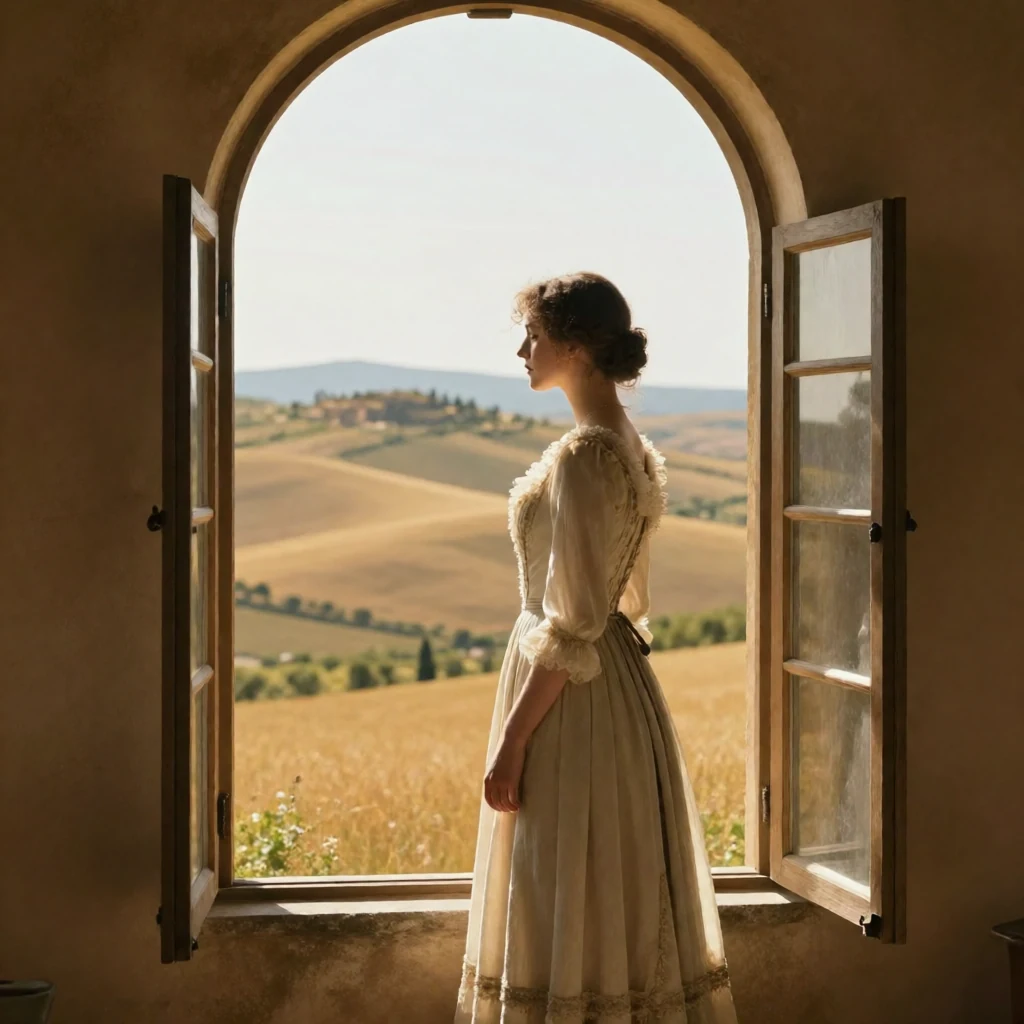
The chapter opens with a panoramic description of the Weald on a glorious Sunday as autumn begins to break the green monotony of summer. Mist softens the parks, beech-trees turn russet, oaks gleam gold, and black pines on the heights stand unchanged beneath a cloudless sky. From both countryside and town rises the tinkle of church bells, setting the rhythm for the day.
Sunday Morning at Windy Corners
At Windy Corners, the garden is deserted except for a red book lying on the gravel path. Inside the house, the ladies bustle incoherently as they prepare for church, debating whether the men should attend and urging Charlotte along. Miss Bartlett, dressed in the height of fashion, descends the stairs in her “best rags and tatters,” having no small change for the collection. Mrs. Honeychurch dispenses coins and instructions, and the victoria finally rattles off to church with Cecil calling a parting “Be good!”—a remark whose tone Lucy reads as sneering.
Lucy’s Anxiety and the Red Library Book
Lucy steps out of the drawing-room window into the morning light, wearing a cerise dress that proves a failure and a garnet brooch with a ruby engagement ring. She gazes at the Weald, frowning bravely, trying not to cry. Her mother summons her to fetch a sixpence for Minnie, and Lucy picks up the abandoned library book—Cecil’s copy of Under a Loggia—which she places under the Atlas to press. She broods over her lack of learning, having that morning confused Francesco Francia with Piero della Francesca, and feels the familiar anxiety about her engagement and her fading memory of Italy.
Post-Church Meeting with the Emersons
After church, the Honeychurches find the Emersons smoking in the garden of Cissie Villa. Old Mr. Emerson is warm and welcoming; George speaks coolly about their landlord’s disappointment at their tenancy and the awkwardness over the Miss Alans being displaced. George delivers his measured philosophy that wherever one stands one casts a shadow, urging them to choose a place and face the sunshine. Mrs. Honeychurch is charmed, Lucy is relieved that Cecil’s name never enters the conversation, and Mr. Beebe and Miss Bartlett linger nearby. Miss Bartlett greets the Emersons with stiff formality from the safety of the victoria, while George blushes and retreats indoors, his awkwardness touching Lucy deeply.
Lucy’s Relief Over George’s Secrecy
Driving home, Lucy’s spirits leap disproportionately at the realization that Mr. Emerson has not been told of the Florence escapade. The horses’ hoofs seem to sing “He has not told,” and her mind expands the tune into reassurance: George, who tells his father everything, has kept her secret, did not laugh at her, and does not love her—though the second point is almost as terrifying as the first. She greets Cecil with unusual radiance, tells him warmly that the Emersons have been nice and that George has improved, and inwardly recoils at his feudal notion of them as “protégés.”
Lunch and Musical Interlude
Lunch is unusually cheerful, and Lucy feels guaranteed against her usual mealtime depressions. Afterwards she plays from memory the enchanted-garden music from Gluck’s Armide—immortal, rippling music unsuitable for the piano—until Cecil, restive, calls for the Flower Maidens’ scene from Parsifal instead. She complies, but as she begins she discovers George has quietly entered the room. Flushing, she restarts the music for Cecil’s sake, plays a few bars badly, and stops. Freddy proposes tennis, and the household divides into players and readers.
Sunday Tennis at Windy Corners
The afternoon tennis finds Lucy partnered with Mr. Floyd, free at last from the piano’s restraint. George serves with surprising determination to win, and Lucy remembers his despairing cry by the Arno—“I shall want to live”—as he stands for all he is worth in the lowering sun. Cecil, in a critical mood, refuses to make up a fourth and instead strolls the precincts reading aloud from the bad novel he is forced to endure, even halting the game to share a murder scene and a triplet of split infinitives. The chapter closes with the Weald glowing like the Tuscan plain around them.
The original text of this work is in the public domain. This page focuses on a guided summary article, reading notes, selected quotes, and visual learning materials for educational purposes.