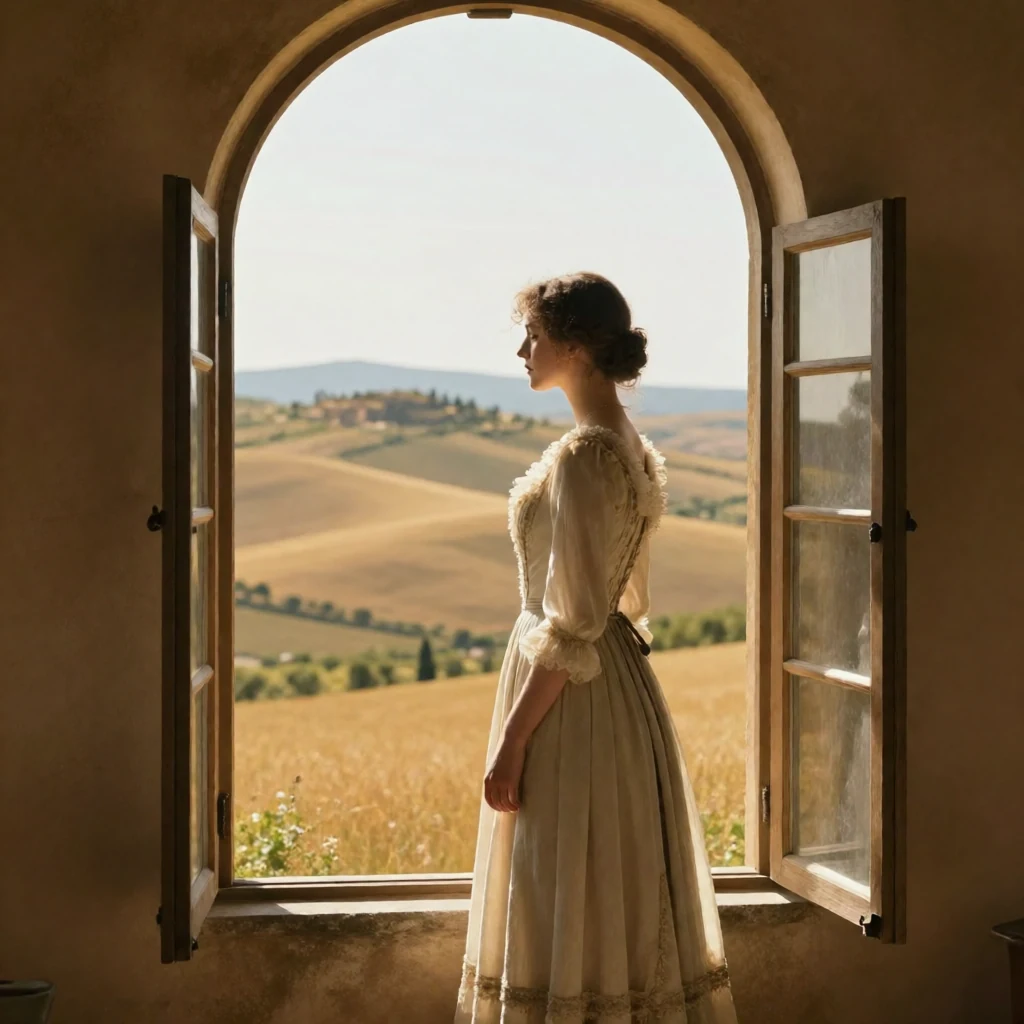
A Room with a View
A Room with a View by Forster, E. M. (Edward Morgan) unfolds through 19 chapters. Lucy Honeychurch awakens in her bright, bare room at the Pension Bertolini in Florence on her first morning there. The room features red tiles, a painted ceiling with pink griffins and blue amorini among musical instruments, and windows overlooking the Arno, hills, trees, and marble churches. Below her window, she observes the vibrant street life: workers on the riverbank, a mysteriously busy boat, and an electric tram packed with Italians who prefer standing to sitting. Soldiers march by with a band, and children try to cling to the back of the tram while the conductor spits at them to make them let go. Lucy becomes absorbed in these "trivialities," forgetting her intention to study Giotto and the corruption of the Papacy. Miss Bartlett arrives to催促 her to hurry, and a conversation ensues about whether Lucy should venture out alone. This chapter centers on Lucy's musical nature, the social dynamics at the Pension Bertolini, and the mysterious "S" that caused tension during dinner. The narrative interweaves Lucy's piano performance with gossip about Miss Lavish's novel-writing, the Emersons' social missteps, and Lucy's desire for independence as shown in her plan to ride the circular tram alone. This chapter tracks Lucy Honeychurch’s restless impulses after a music performance in Florence, her frustration with restrictive social ideals for women, an impulsive purchase of art photographs, a shocking public stabbing incident, her fainting and rescue by George Emerson, and their subsequent awkward, charged conversation along the Arno embankment.
In Santa Croce with No Baedeker
Lucy Honeychurch awakens in her bright, bare room at the Pension Bertolini in Florence on her first morning there. The room features red tiles, a painted ceiling with pink griffins and blue amorini among musical instruments, and windows overlooking the Arno, hills, trees, and marble churches. Below her window, she observes the vibrant street life: workers on the riverbank, a mysteriously busy boat, and an electric tram packed with Italians who prefer standing to sitting. Soldiers march by with a band, and children try to cling to the back of the tram while the conductor spits at them to make them let go. Lucy becomes absorbed in these "trivialities," forgetting her intention to study Giotto and the corruption of the Papacy. Miss Bartlett arrives to催促 her to hurry, and a conversation ensues about whether Lucy should venture out alone.
Morning Views and Street Activity in Florence
The morning scene in Florence captivates Lucy entirely. She watches from her window as various characters populate the street below: workers digging on the sandy foreshore of the Arno, an officer leading soldiers with their mangy-fur knapsacks, little boys performing somersaults in time with a band, and white bullocks emerging from an archway. An electric tram rushes underneath, its platforms overflowing with Italians who choose to stand rather than sit inside. The conductor keeps children from hanging on behind by spitting in their faces. The road becomes blocked by both the military procession and the bullocks, but an old man selling button-hooks helps clear the way. Lucy, like many travelers to Italy, finds herself slipping away into the beauty and vitality of ordinary scenes rather than pursuing her cultural studies.
Planning the Visit to Santa Croce
Miss Bartlett insists on accompanying Lucy everywhere, declaring "Of course she would accompany Lucy everywhere." When Lucy protests, Miss Bartlett concedes she could go alone, but immediately contradicts herself. A clever lady among the pension guests intervenes, suggesting they ignore Mrs. Grundy and that Lucy, being English, will be perfectly safe in Italy. She references Contessa Baroncelli's daughters who go about alone in sailor-hats and are mistaken for English. When Miss Bartlett remains unconvinced, the clever lady—Miss Lavish—offers to take Lucy to Santa Croce herself, promising to show her "a dear dirty back way" and promising an adventure. Lucy opens her Baedeker to check the location, but Miss Lavish snatches it away, declaring they must "emancipate" Lucy from the guidebook. She explains that Baedeker "does but touch the surface of things" and that the true Italy is found only through "patient observation." Lucy agrees eagerly, and they set off together, leaving behind "the Cockney Signora and her works."
Wandering Lost Through Florence
Miss Lavish leads Lucy along the sunny Lung'Arno, commenting on the warmth and the cutting wind in side streets. She points out landmarks—Ponte alle Grazie mentioned by Dante, San Miniato with its story of the crucifix that kissed a murderer. They pass men fishing on the river (though this is "untrue"). Miss Lavish darts through an archway and declares she has found "a true Florentine smell," explaining that every city has its own scent. Their conversation drifts from art and Italy to more personal matters: Lucy's Surrey home near Dorking, her father who voted for Mr. Gladstone, the Glass family property of thirty acres, and various aristocratic acquaintances like Sir Harry Otway and old Mrs. Butterworth. As they discuss these suburban matters, Miss Lavish suddenly realizes they have lost their way. The tower of Santa Croce, visible from Lucy's window, had been their intended destination, but Miss Lavish's confident declarations about knowing Florence have led them astray. She refuses to let Lucy consult the Baedeker, insisting they will "simply drift" instead. They wander through unremarkable grey-brown streets of the eastern quarter. Lucy glimpses the Square of the Annunziata with its terra-cotta babies, finding them more beautiful than any reproduction could convey, but Miss Lavish shrieks and drags her onward, declaring them "out of their path by at least a mile." They buy hot chestnut paste from a shop, which tastes of paper, hair oil, and "the great unknown," then drift into another dusty piazza where an ugly black-and-white facade reveals itself as Santa Croce. The adventure is over.
Entering Santa Croce Alone
At the church steps, Miss Lavish suddenly spots her "local-colour box"—an old man with white whiskers—and rushes off to speak with him, leaving Lucy waiting. After nearly ten minutes, Lucy descends into the piazza to rejoin her, only to see Miss Lavish disappear down a side street with the man, both gesticulating. Lucy feels tears of indignation—not only has Miss Lavish abandoned her, but she has taken Lucy's Baedeker. Without the guidebook, Lucy fears she cannot find her way home or navigate Santa Croce. Her first morning seems ruined. She enters the church depressed and humiliated, unable even to remember whether Santa Croce was built by Franciscans or Dominicans. Initially disdainful of the church's barn-like appearance and cold interior, Lucy begins to find pleasure in watching the tourists, reading Italian notices about dogs and spitting, and observing an Italian family begin their devotions at the Holy Water and Machiavelli memorial. The children perform elaborate rituals touching the memorial with fingers, handkerchiefs, and heads, apparently hoping to acquire virtue. When the smallest boy stumbles over a tombstone admired by Mr. Ruskin, falling heavily against a recumbent bishop's upturned toes, Lucy rushes forward but is too late.
Meeting the Emerson Family
Lucy helps the fallen child just as old Mr. Emerson does the same, and together they dust him off and tell him not to be superstitious. Mr. Emerson curses the bishop, declaring it "hard in life, hard in death," and tells the child to "kiss your hand to the sun." The Italian mother comes to the rescue and imparts strength to the boy's knees. Mr. Emerson compliments the woman, saying she has "done more than all the relics in the world." When Lucy mentions the Emersons' kind gift of their rooms the previous evening, Mr. Emerson suggests Lucy join them since she has no Baedeker. Lucy takes refuge in her dignity, declaring she could not think of joining them and thanking them for the rooms. Mr. Emerson calls her "tiresome," suggesting she is "repeating what you have heard older people say" and offering to show her whatever part of the church she wants to see. George, his son, invites Lucy to the Peruzzi Chapel, where a clergyman is lecturing on Giotto's frescoes, praising their majestic, pathetic beauty and truth. Mr. Emerson interrupts loudly, declaring the frescoes show no truth and mocking a figure "shooting into the sky like an air balloon." The lecturer falters, and the congregation shifts uneasily. Lucy feels "spellbound" by these serious, strange men. When asked if the Ascension happened, George replies he would "rather go up to heaven by myself than be pushed by cherubs," while Mr. Emerson believes they will "lie at peace in the earth" with their work surviving. The lecturer leaves frigidly with his flock, including the two Miss Alans from the pension. Mr. Emerson pursues him to apologize, leaving Lucy with George, who explains his father's effect on people—causing them to be offended or frightened. George has a rugged, hard face that softens in shadow, reminding Lucy of Michelangelo's figures in the Sistine Chapel. He carries "a burden of acorns," and Lucy feels a fleeting sense of tragedy that passes quickly. When Mr. Emerson returns, he reveals George's unhappiness despite his strength and health, asking Lucy to help him understand his son. George suffers from "things won't fit"—the things of the universe don't fit together. Mr. Emerson quotes Swinburne about life coming from the winds and returning to them, saying all life is "a knot, a tangle, a blemish in the eternal smoothness." He urges Lucy to let herself go and help George by understanding him. Lucy laughs at the idea of a young man melancholy because the universe is a tangle, and suggests George needs employment, hobbies, or the piano like she uses. She thinks Mr. Emerson is "a kind thing, but quite silly." George approaches with the news that Miss Bartlett is in the nave, and Lucy rushes to meet her cousin, declaring "A delightful morning! Santa Croce is a wonderful church."
Reuniting with Miss Bartlett
George spots Miss Bartlett in the nave and informs Lucy. Lucy collapses at this news, realizing the gossiping Miss Alans must have informed her. Mr. Emerson pities her, but Lucy objects to this pity, declaring herself "thoroughly happy" and "having a splendid time." She thanks the Emersons for their kindness and hurries to join her cousin. Miss Bartlett's arrival in Santa Croce marks the end of Lucy's encounter with the unconventional Emersons and restores her to the familiar world of propriety and cousinly supervision she knows best.
Chapter III: Music, Violets, and the Letter “S”
This chapter centers on Lucy's musical nature, the social dynamics at the Pension Bertolini, and the mysterious "S" that caused tension during dinner. The narrative interweaves Lucy's piano performance with gossip about Miss Lavish's novel-writing, the Emersons' social missteps, and Lucy's desire for independence as shown in her plan to ride the circular tram alone.
Lucy's Piano Performance and Mr. Beebe's Tunbridge Wells Recollection
Lucy finds solace and transformation through piano playing, entering what Forster describes as "a more solid world" when she opens the instrument. Unlike a dazzling executante, she possesses a quieter passion that slips between emotions like love, hatred, and jealousy. She chooses Beethoven sonatas and decides they shall triumph rather than despair. Mr. Beebe watches Lucy play at the Bertolini and recalls discovering her talent at Tunbridge Wells, where she performed the first movement of Opus 111—a choice the vicar considered "perversity" but which Mr. Beebe recognized as extraordinary. He initiated the stamping that followed her performance. When introduced, he found Lucy off the piano stool to be merely a young lady who loved concerts, iced coffee, and meringues. He later told her that if she ever lived as she played, it would be exciting both for them and for her. Lucy mentions her mother's disapproval of her getting excited about music, recalling that she once said she liked her own playing better than anyone's—a statement her mother never forgave.
Gossip on Miss Lavish, the Emersons, and the Santa Croce Incident
Miss Alan reveals that Miss Lavish is writing a novel about modern Italy, having lost her first attempt in a landslip at the Grotto of the Calvary in Amalfi. The historical novel was nearly finished when the grotto collapsed, and Miss Lavish can no longer remember what she wrote. She subsequently took up cigarettes in despair. Mr. Beebe refers to her as "a good fellow" who should start a pipe instead. The conversation turns to the Emersons, who have been socially unacceptable at the Bertolini. Old Mr. Emerson mentioned "S"—stomach acidity—to Miss Pole, causing embarrassment. At dinner, Miss Lavish, believing the Emersons to be commercial travelers ("drummers"), engaged them in conversation about commerce, claiming England rests on nothing but trade. Miss Alan, an early Victorian who defended Queen Victoria's Irish visit, and Mr. Emerson, who agreed with her, caused further social confusion. The Santa Croce incident involved the Emersons attempting to "annex" Lucy, showing her the world from their viewpoint and interesting her in their private matters—something Mr. Beebe found impertinent. Society has largely rejected the Emersons: Miss Lavish (intellect) is hostile, the Miss Alans (good breeding) follow suit, and Miss Bartlett is uncivil due to obligation. Only Mr. Beebe remains friendly, and Lucy admits she finds them nice though she rarely sees them now.
Lucy's Tram Ride Plan and Mr. Beebe's Concerns
Lucy announces her intention to ride the circular tram around town, standing on the platform by the driver. Both Mr. Beebe and Miss Alan look grave at this proposal. Mr. Beebe, responsible for Lucy in Miss Bartlett's absence, suggests she stay on her feet within tourist streets instead. Miss Alan invokes "Italians, dear, you know" as a warning. Lucy quips that perhaps she'll meet someone who reads her through and through, but ultimately concedes to a short walk on frequented tourist streets. After Lucy departs, Mr. Beebe observes to Miss Alan that she really shouldn't go out alone at all—and that she knows it. He attributes this rebellious impulse to "too much Beethoven," suggesting her musical passion is pushing her toward independence beyond what is socially acceptable for a young lady.
Chapter IV
This chapter tracks Lucy Honeychurch’s restless impulses after a music performance in Florence, her frustration with restrictive social ideals for women, an impulsive purchase of art photographs, a shocking public stabbing incident, her fainting and rescue by George Emerson, and their subsequent awkward, charged conversation along the Arno embankment.
Lucy's Post-Music Restlessness and the Medieval Lady Ideal
After listening to music, Lucy is sharply aware of her unfulfilled longing for meaningful, "big" experiences, and grows frustrated with the restrictive "medieval lady" ideal taught by her chaperone Charlotte Bartlett, which frames women’s proper role as inspiring others’ achievements rather than pursuing their own—a standard Lucy finds increasingly stifling as she craves experiences deemed unladylike by social convention.
Lucy's Defiant Impulse and Alinari's Shop Purchase
Feeling particularly restive and wanting to do something her well-wishers would disapprove of, Lucy visits Alinari’s photography shop and spends nearly seven lire buying a collection of famous art photographs, including works by Botticelli, Giorgione, and other renowned artists, though the purchase fails to soothe her persistent discontent and longing for novel, fulfilling experiences.
Piazza Signoria Experience and Public Stabbing Incident
Wandering the shadowy, twilight Piazza Signoria and still craving something out of the ordinary to happen, Lucy witnesses two Italian men bickering over a debt escalate into a stabbing; the injured man collapses near her, and she faints, only to be rescued by George Emerson, who carries her to the Uffizi arcade to recover.
Uffizi Arcade Interaction with George Emerson
Lucy regains consciousness in the Uffizi arcade with George Emerson, who reveals he retrieved her dropped art photographs but threw them into the Arno after they were stained with blood from the stabbing; anxious to avoid gossip about her fainting, Lucy asks him not to mention her embarrassing behavior to anyone, and he agrees, though his blunt, unchivalrous demeanor leaves her uncertain of his respect for her social standing.
Arno Embankment Conversation and Cryptic Response
As Lucy and George walk toward their pension, they stop at the parapet of the Arno embankment, where Lucy repeatedly apologizes for her foolish behavior and reiterates her request for discretion about the incident; when George cryptically replies "I shall probably want to live" instead of addressing her request directly, Lucy is left puzzled by his strange, earnest response.
Possibilities of a Pleasant Outing
The chapter opens with Lucy left to process her confusing encounter with George Emerson from the prior day alone, as none of her companions witnessed the incident in the Piazza Signoria or by the Arno embankment. Only Mr. Beebe noticed her flustered state at dinner, but attributed it to overstimulation from Beethoven rather than the encounter she had experienced. Lucy is unsettled by this solitude, as she is accustomed to having her thoughts confirmed or contradicted by others, and struggles to determine if her feelings about the event are appropriate.
Lucy's Decision to Accompany Charlotte
At breakfast the following morning, Lucy declines Mr. Beebe’s invitation to join his planned excursion to the Torre del Gallo with the Emersons and a group of American women, choosing instead to accompany Charlotte on her scheduled shopping and errand trips around Florence. She resolves to avoid the Emersons to spare herself the trouble of untangling the muddled emotions from their prior meeting, and vows to be consistently kind to Charlotte throughout their outing after feeling ashamed of how she had previously treated her cousin.
Miss Lavish's Literary Aspirations
While walking through Florence, Lucy and Charlotte encounter Miss Lavish in the Piazza Signoria, who is collecting material for a novel inspired by the previous day’s murder in the square. Miss Lavish explains she plans to adapt the real incident into a fictional tragic plot with a heroine named Leonora, full of local Florentine detail and satirical portrayals of British tourists, and admits she will pry into any secret of the human heart for her writing, an approach that makes Lucy uneasy.
Mr. Eager's Invitation and the Shopping Expedition
Mr. Eager soon approaches the pair and invites them to join a group drive in the hills outside Florence, with a stop for rambling and a potential visit to a Renaissance villa for tea, attended also by Mr. Beebe. The group then sets out on a shopping trip under Mr. Eager’s guidance, purchasing a variety of small souvenirs, though Lucy leaves the excursion feeling unsettled, having lost the high opinion she previously held of both Miss Lavish and Mr. Eager.
The Revelation About the Emersons
While browsing in a shop, Mr. Eager reveals unsubstantiated, disparaging details about Mr. Emerson, claiming he is the son of a laborer, a former socialist journalist, and that he has “murdered his wife” in the eyes of God, having previously snubbed him in Santa Croce. Lucy pushes back on the harsh, unproven accusation, frustrating Mr. Eager, while Charlotte attempts to defuse the tense, awkward exchange before they leave the shop.
Lucy's Restlessness and the Thought of Rome
Later, while at an English bank to exchange currency, Lucy reads letters from her mother and brother that remind her of her quiet, happy life at home in Sussex. She grows increasingly restless with Florence and the complicated social dynamics of her trip, and impulsively suggests she and Charlotte travel to Rome the next day to visit the Vyse family, an idea Charlotte laughs off as impractical given their scheduled hillside drive.
Chapter VI: Carriage Drive to Fiesole
Chapter VI follows a mixed party of English tourists and local Italian carriage drivers on a day trip from Florence to Fiesole. The group includes Reverend Arthur Beebe, Reverend Cuthbert Eager, Mr. Emerson, his son George Emerson, novelist Eleanor Lavish, Charlotte Bartlett, and Lucy Honeychurch, who is navigating complicated, unspoken feelings for George Emerson after an unsettling shared experience earlier in their trip. The chapter covers the chaotic drive up the hill to Fiesole, a public confrontation over the drivers’ open displays of affection, a search for the spot where Renaissance painter Alessio Baldovinetti stood to capture a famous valley view, the group’s split into smaller factions, and Lucy’s unplanned, emotionally charged encounter with George on a remote, violet-covered terrace.
Phaethon Picks Up Persephone Against Mr. Eager's Objections
The excursion begins with carriages driven by Phaethon, a reckless young driver whom Mr. Beebe recognizes immediately as a classic figure of unbridled youth, unmarked by either the Ages of Faith or modern doubt. Phaethon asks to pick up his “sister” Persephone, a tall, pale young woman he claims is returning to her mother’s cottage with the spring. Mr. Eager objects, calling the request the thin edge of a wedge and warning against imposition, but the other ladies intercede, and Persephone is granted permission to join the carriage after it is framed as a great favor.
Scrambled Seating and Lucy's Anxiety About George Emerson
Mr. Beebe had unexpectedly doubled the size of the party without consulting Mr. Eager, derailing the carefully planned seating arrangements made by Miss Bartlett and Miss Lavish that morning. At the last minute, Miss Lavish ends up in the first carriage with Lucy, while Miss Bartlett travels in the second carriage with George Emerson and Mr. Beebe. Lucy, dressed in crisp white, sits nervous and watchful through the drive, dreading the unavoidable time with George, whom she has been deliberately avoiding since an unclear, emotionally charged shared moment by the Arno river earlier in their stay in Florence.
Carriage Conversation and Indecent Driver Behavior
During the ascent, Mr. Eager makes condescending small talk with Lucy, mocking the superficiality of Anglo-Saxon tourists who “do” Fiesole in an hour to check it off a list, while name-dropping local Florentine residents and their connections to art history. Miss Lavish repeatedly tries to interject but is shut out of the conversation. In the front of the carriage, Phaethon has slipped Persephone’s left rein over her head so he can drive with his arm around her waist, and the pair soon begin openly kissing, oblivious to the passengers behind them as the carriage speeds toward Fiesole.
Confrontation Over Kissing Drivers and Persephone's Dismissal
Mr. Eager spots the drivers’ behavior, stops the carriage, and orders Phaethon and Persephone to separate, threatening to withhold their tip and force Persephone to dismount. Phaethon insists she is his sister, but Mr. Eager calls him a liar. Mr. Emerson, woken by the sudden stop, defends the couple passionately, arguing that separating two happy people is a form of sacrilege, while Miss Lavish initially praises the pair as a bohemian adventure before backing down as a crowd of onlookers begins to gather. Mr. Eager forces Persephone to get down from the carriage box, a move Mr. Emerson laments as a defeat rather than a moral victory.
Promontory Arrival, Art Search, and Group Split
The party arrives at an uncultivated, bushy promontory overlooking the Val d’Arno, which Mr. Eager and Miss Lavish believe may be the spot Renaissance painter Alessio Baldovinetti stood nearly 500 years prior to capture his famous view of the valley and distant Florence. Haze over the valley makes the art history search difficult, and the group’s clashing energies lead them to split into smaller factions: Lucy stays with Miss Bartlett and Miss Lavish, the Emersons hold a lengthy conversation with the carriage drivers, and the two clergymen are left to talk only to each other.
Lucy's Lost Wanderings and Encounter with George Emerson
Frustrated by Miss Bartlett and Miss Lavish’s gossip about George Emerson’s work in the railway industry, Lucy leaves the pair to search for Mr. Beebe and Mr. Eager. She asks a carriage driver for directions, and he leads her through thick undergrowth toward the edge of the promontory. Halfway there, the ground gives way and Lucy falls onto a small, open terrace completely covered in blue violets. George Emerson, who was already standing on the terrace, sees her and kisses her before Miss Bartlett’s distant calls for Lucy break the silence.
Chapter VII: They Return
The chapter opens with the group’s return from a picnic, marked by widespread confusion and disarray on the hillside as players scatter and social alignments are unclear. Lucy struggles to parse the tangled dynamics: Mr. Eager is rebuffed by Charlotte, Mr. Emerson is directed to find his son, and Mr. Beebe, acting as a neutral party, is tasked with gathering everyone for the return trip. The little god Pan, who presides over social mishaps and failed outings, is said to have been present: Mr. Beebe loses the group entirely and eats the entire surprise tea-basket alone, Miss Lavish loses Miss Bartlett, Lucy loses Mr. Eager, Mr. Emerson loses George, Miss Bartlett loses her mackintosh square, and Phaethon loses his game. Defeated and shivering, Phaethon climbs onto the carriage box, predicts imminent bad weather, and insists the group leave immediately, stating George will walk the full way back. Miss Bartlett dismisses Phaethon as a low-class cab driver whose insight will not trouble English ladies once they return to town, though she worries he might turn the incident into a tavern story. The group begins their descent toward Florence, with Lucy sitting beside Miss Bartlett and Mr. Eager sitting across from them, vaguely suspicious.
Post-Picnic Hillside Confusion
The immediate aftermath of the picnic is defined by groping and bewilderment as the group tries to account for missing people and untangle what happened during the outing. Phaethon’s loss of his game is confirmed when he climbs onto the carriage box, humiliated and refusing to meet anyone’s eye, convinced he is the only one who interpreted the situation correctly, including the message Lucy received from a dying man five days prior. Miss Bartlett dismisses him as harmless once they return to town, as “real menace belongs to the drawing-room,” and the group begins their journey down the hillside toward Florence as rain and darkness set in.
Carriage Ride to Florence and Phaethon’s Observations
As the carriages travel toward Florence, Phaethon watches the group from the box, convinced he alone used his full instinct to understand the situation, while the other English visitors relied only on scraps of intelligence. He is the only one who correctly interpreted the message Lucy received from the dying man, a skill Miss Bartlett compares to that of Persephone, who divides her time between the world and the grave. Miss Bartlett worries Phaethon will share what he saw, but writes him off as irrelevant once they are back in urban Florence. The group discusses Alessio Baldovinetti as they travel, with Mr. Eager trying unsuccessfully to catch Lucy’s eye.
Lightning Strike Near Miss and Group Emotional Outpouring
Rain and darkness fall as the carriages travel, and the two ladies huddle under an inadequate parasol. Miss Lavish screams at the first lightning flash, and Lucy screams at the next. Mr. Eager scolds Lucy for her fear, arguing from both religious and scientific standpoints that they face no real danger of being struck. Under the rug, Miss Bartlett squeezes Lucy’s hand to comfort her, gaining Lucy’s trust far more effectively than hours of preaching would. The carriages stop halfway into Florence when Mr. Beebe requests Mr. Eager’s translation help, and Mr. Emerson panics, worried George is lost or killed in the storm. Miss Bartlett insists Mr. Eager assist Mr. Beebe instead of checking on George, and when Lucy asks how much Mr. Eager knows, Miss Bartlett admits he knows nothing, then bribes the silent Phaethon with a franc to keep him quiet. An explosion up the road reveals the storm has struck a tramline support that would have injured them had they not stopped. The group interprets the near miss as miraculous, and a flood of unguarded emotion leads them to embrace, feeling forgiven for past unworthinesses. While the older party quickly regain their composure, Lucy pours out her guilt and turmoil to Miss Bartlett, confessing she feels partially to blame for the incident with George by the river, and vowing to be truthful about her feelings.
Evening Conversation and Miss Bartlett’s Manipulation
Once back in Florence, Lucy is shocked to find the others have already recovered their good humour: Mr. Emerson is calmer about his son, Mr. Beebe is cheerful again, and Mr. Eager is already snubbing Miss Lavish. Lucy is certain only Charlotte, who conceals great insight and affection, truly understands her. She spends the evening eager to confess all her confused sensations to her cousin, hoping to finally make sense of her emotions and avoid future unexplained turmoil. When asked to play piano, Lucy refuses, feeling music is a childish pursuit, and sits close to Miss Bartlett while she listens to a long story about lost luggage, growing increasingly hysterical at the delay. Finally, late in the evening, Miss Bartlett finishes her story and invites Lucy to her room to brush her hair before bed.
Lucy’s Turmoil and Departure for Rome
In her room, Miss Bartlett asks Lucy what they should do about the incident with George, catching Lucy off guard: she had planned only to confess her emotions to gain understanding, not to take concrete action. Miss Bartlett insists Lucy must silence George, warning her that unrefined men like him will brag about their exploits to others, and citing George’s earlier lunch argument that liking one person is an extra reason to like another as evidence of his poor character. Lucy initially suggests she will speak to George herself to settle the matter, but Miss Bartlett reacts with alarm, insisting Lucy is too young and inexperienced to handle such a man alone, and warning that without a male protector, she could be insulted with no one to defend her. After appealing for a “real man” to intervene, Miss Bartlett abruptly announces they will catch the morning train to Rome, brushing aside Lucy’s concerns about upsetting their hostess Signora Bertolini and the added cost of staying at the Vyses’ hotel. As they pack by candlelight, Lucy is overwhelmed with a sudden need for human affection and embraces Miss Bartlett, who responds but secretly knows Lucy does not love her, only needs her to offer love. Miss Bartlett then launches into a self-pitying monologue, painting herself as a failure who has neglected Lucy and will be disowned by Lucy’s mother, until Lucy, desperate to avoid conflict, promises she will never tell her mother about the incident, giving Miss Bartlett the leverage she wanted. Miss Bartlett ends the conversation abruptly, leaving Lucy shaken as she realizes Miss Bartlett has manipulated her sincerity and need for sympathy to control the situation, and vowing never to expose herself so recklessly again. Lucy hears Miss Bartlett call Mr. Emerson into the drawing-room, and though she considers slipping out to tell George their strange relationship is over, she hesitates. After Miss Bartlett dismisses Mr. Emerson, Lucy cries out that she wants to stop being muddled by the situation and grow up quickly, and Miss Bartlett tells her to go to bed. The next morning, the pair depart for Rome.
Chapter VIII
This chapter opens in the Windy Corner drawing room in August, where heavy curtains are drawn to protect a new carpet from the sun, casting soft, filtered light across the space. Nineteen-year-old Freddy Honeychurch struggles through an anatomy manual while his mother Mrs. Honeychurch drafts a letter to Mrs. Vyse. Their conversation turns to Cecil Vyse’s repeated proposals to Lucy Honeychurch, Freddy’s unspoken discomfort with Cecil, and Mrs. Honeychurch’s favorable view of Cecil as a suitable match for her daughter, including noting that Cecil sought both her and Freddy’s permission to propose.
The Drawing-Room at Windy Corner
The section establishes the domestic, sun-dappled atmosphere of the Windy Corner drawing room, introducing the casual, teasing dynamic between Mrs. Honeychurch and her son Freddy. They discuss Cecil’s pending third proposal to Lucy, with Mrs. Honeychurch openly approving of the match and Freddy expressing vague, unformed misgivings about Cecil that he cannot fully articulate. Mrs. Honeychurch shares that she is writing to Mrs. Vyse to share her support for the engagement, should Lucy accept.
Freddy's Blunder with Cecil
Freddy confesses to his mother that he gave Cecil a cold, unenthusiastic response when Cecil pressed him to say he was overjoyed at the prospect of the marriage, insisting he could not lie and say he approved. He fears his blunt response will offend Cecil, who will then tell Lucy and damage his standing with his sister. Mrs. Honeychurch scolds Freddy for his unkindness, dismissing his vague discomfort as petty jealousy over Cecil taking Lucy’s attention away from him, and Freddy struggles to name the small, intuitive reasons he dislikes Cecil’s condescending, self-important manner. Mrs. Honeychurch continues refining her letter to Mrs. Vyse, even as Freddy warns her Cecil may overhear the conversation.
Cecil Announces the Engagement
Cecil Vyse enters the drawing room, initially irritated by the drawn curtains before revealing that Lucy has accepted his marriage proposal. Mrs. Honeychurch and Freddy react with delight, and Cecil sends Lucy, Freddy, and Mrs. Honeychurch out into the garden to share the news with Lucy, while he stays behind to write a letter to his own mother to share the happy news.
Cecil's Reflections on Lucy
Left alone in the drawing room, Cecil reflects on his relationship with Lucy, from their first awkward meeting in Rome where he saw her as a crude, unremarkable tourist, to his growing fascination with her quiet, enigmatic nature during their time in Italy and the flower-clad Alps, where he asked her to marry him twice before. He brushes off his vague doubts about the Honeychurch family as evidence that Lucy, who he sees as more refined and sensitive than her relatives, will be better suited to his sophisticated social circle, and resolves to introduce her to more elevated circles as soon as possible.
Mr. Beebe's Arrival
Mr. Beebe, the new rector of Summer Street and Lucy’s friend from Florence, arrives at Windy Corner for tea. Cecil initially greets him critically, complaining about the messy state of the drawing room, including Freddy’s anatomy bone left on the piano and the cheap, mass-produced furniture. Mr. Beebe attempts small talk about local news, but Cecil is dismissive of local affairs and his own lack of a traditional profession, until they bond over complaining about the various faults of the Honeychurch household staff.
The Announcement to Mr. Beebe
Mr. Beebe shares his pet theory about Lucy: that her quiet, unremarkable surface will eventually break open to reveal a more vivid, passionate side, comparing her to a kite held by Miss Bartlett that is destined to break free. Cecil abruptly cuts him off to reveal that Lucy has accepted his marriage proposal, stating “the string has broken.” Mr. Beebe is initially disappointed, apologizing for having spoken so freely about Lucy to her new fiance, but eventually offers sincere, if formal, blessings for the couple, and agrees to set aside the serious tone for the upcoming celebratory tea.
The Engagement Tea Party
The group settles into a cheerful, lighthearted engagement tea party, with the warm, unifying mood of the occasion overriding any private doubts the attendees may hold. Servant Anne adds to the celebratory atmosphere by serving tea with a warm smile, Freddy jokes by referring to Cecil as the “Fiasco” (a pun on fiance), Mrs. Honeychurch is an amusing, doting future mother-in-law, and Lucy and Cecil join in the merriment while holding a quiet, expectant joy as the couple at the center of the celebration.
Chapter IX: Lucy As a Work of Art
Chapter IX opens in the days after Lucy Honeychurch and Cecil Vyse announce their engagement, tracing their social interactions, Cecil's growing frustration with local country society and their neighbors, a walk through the local woods, and an awkward romantic encounter that exposes underlying tensions in their relationship.
The Garden Party
Mrs. Honeychurch hosts a small neighborhood garden party to introduce Cecil to local society and show off her daughter's respectable fiancé. Cecil initially makes a strong impression, appearing distinguished as he interacts with guests, until a spilled cup of coffee ruins Lucy's dress, forcing her and her mother to leave Cecil alone with a group of stuffy local dowagers.
Cecil's Irritation Over Public Congratulations
When Lucy and her mother return from tending to Lucy's stained dress, Cecil is in a foul mood, and on the drive home he rants about the unsolicited public congratulations they received at the party. He insists an engagement is a private matter that should not be treated as a public occasion for strangers to offer vulgar, unwanted sentiment, dismissing the well-meaning congratulations from local older women as intrusive and inappropriate.
Discussion of Fences and Social Barriers
Cecil uses the conversation to argue that social "fences" are not all equal, claiming there is a meaningful difference between barriers people choose to put up around themselves and barriers others impose on them from the outside. Mrs. Honeychurch dismisses his distinction as irrelevant, stating flatly that all fences are the same regardless of their origin or intent.
Discussion of Mr. Beebe and Mr. Eager
The conversation shifts to clergy members the group knows, and Lucy launches into a sharp condemnation of Mr. Eager, the snobbish, insincere English chaplain she met while staying in Florence. She accuses him of spreading unsubstantiated, vicious slander about an elderly former guest at her hotel, claiming the man had "practically murdered his wife," which led to the man being ostracized by other guests despite Lucy's belief that he was kind and harmless. Cecil laughs off her moral outrage, finding her outburst incongruous with his image of her as a quiet, refined young woman.
Summer Street and the Ugly Villas
As the carriage travels through Summer Street, the group observes how the once-scenic, quiet neighborhood has been marred by two ugly new red and cream brick villas purchased by local landowner Sir Harry Otway on the very afternoon Lucy accepted Cecil's proposal. The villas, named "Cissie" and "Albert" in gothic lettering on their gates and porches, stand out sharply against the area's pretty cottages and natural landscape, with "Cissie" currently empty and available to let.
The Search for a Suitable Tenant for Cissie Villa
Sir Harry Otway, distressed by the villas' negative impact on the neighborhood and unable to evict the elderly, vulgar tenant living in "Albert," is desperate to find a respectable tenant for "Cissie," which he describes as an awkward size: too large for working-class renters and too small for genteel families like his own. Lucy suggests the genteel but down-on-their-luck Misses Alan, who she met abroad and who are currently homeless, as a potential solution, though both Cecil and Mrs. Honeychurch dismiss the pair as unsuitable.
Cecil's Contempt for Sir Harry Otway
After leaving Sir Harry, Cecil openly expresses his contempt for the landowner, dismissing him as the perfect example of the worst qualities of petty country gentry: foolish, easily manipulated, and obsessed with performing a false sense of gentility and aesthetic refinement while lacking any real intelligence or taste. Lucy is unsettled by his rant, worrying that Cecil will eventually extend the same dismissive contempt to her own family and friends, who do not fit his standards of cleverness and refinement.
Walking Through the Wood
Rather than taking the road back to Windy Corner, Lucy leads Cecil through the local pine woods, a path she has known since childhood. Cecil, still in a low mood, confronts her about a perceived distance between them in natural settings, noting that she has never once chosen to walk through the fields or woods with him since their engagement, and only seems comfortable with him in indoor or cultivated, man-made spaces.
Cecil's Observation That Lucy Associates Him with Rooms
Cecil explains that he has noticed Lucy associates him exclusively with indoor rooms, and wishes she would connect him with the open, natural world instead. Lucy laughs and agrees that she does think of him as being in a drawing room with no view, a response that frustrates Cecil further, as he wants to be associated with freedom and the outdoors rather than stuffy, confined indoor spaces.
The Sacred Lake
The pair comes across a small pine clearing holding a shallow pool Lucy calls the Sacred Lake, a spot she and her brother Freddy used to visit as children to swim when the pool swelled after heavy rain. Cecil, feeling a sudden surge of romantic impulse, tells Lucy he has never kissed her before and asks if he may now.
Cecil's Failed Attempt to Kiss Lucy
Cecil's attempt to kiss Lucy is a complete and awkward failure: he first asks for permission, ruining the spontaneity of the moment, and when he leans in to kiss her, his gold pince-nez gets dislodged and flattened between their faces. He considers the embrace a total failure, as he believes passion should be spontaneous and unselfconscious, not polite and hesitant.
Lucy Reveals the Old Man's Name Was Emerson
As the pair walks away from the pool in awkward, unspoken silence, Lucy offhandedly mentions that the name of the elderly man Mr. Eager slandered in Florence was Emerson, not the "Harris" she had previously said. This small, unplanned comment marks the first time she has shared the man's real name with Cecil, and is the only exchange they have during their silent walk home.
Cecil as a Humourist
The source text examines how Cecil Vyse approaches situations with a comedic yet often antagonistic disposition. His actions are driven by a desire to subvert social conventions and expose what he perceives as hypocrisy in the upper classes. The text establishes Cecil as someone who derives satisfaction from orchestrating situations that challenge conventional social arrangements, positioning himself as a kind of social satirist. His humor, however, tends to be at someone else's expense rather than universal.
The Honeychurches and Their Social World
Lucy Honeychurch comes from a family whose social position represents a fortunate accident rather than established pedigree. Her father, a local solicitor, built Windy Corner as a speculation and accidentally became rooted in the best society attainable. The family exists in an awkward middle position—above the original district families but below the London immigrants who mistook them for indigenous aristocracy. Mrs. Honeychurch navigated this social complexity with practical wisdom, making calls everywhere and ensuring her family was accepted before anyone realized she was not exactly of their milieu. When Mr. Honeychurch died, he left his family firmly established in local society.
Italy's Transformative Effect on Lucy and Cecil
Italy affected Lucy and Cecil in fundamentally different ways. For Lucy, Italy offered a revelation about social barriers—she discovered that people from different classes could warm themselves in equality, much like people sharing sunlight. She returned home with new eyes, seeing that social barriers, though irremovable, were not particularly high. Her heart had consecrated her environment through years of small civilities, and she realized she was too great for conventional society, desiring personal intercourse and equality beside the man she loved. Cecil, however, was quickened by Italy not to tolerance but to irritation. He saw the narrowness of local society and rebelled against it, attempting to substitute what he called "broad" society. He failed to understand that Lucy already possessed the deeper wisdom Italy had taught her about human equality.
The Bumble-Puppy Game
A chaotic tennis scene unfolds at Windy Corner involving Lucy, her brother Freddy, and young Minnie Beebe playing the ancient game of bumble-puppy—striking tennis balls high into the air so they bounce immoderately over the net. The sentence describing Lucy trying to talk to Mr. Beebe while playing illustrates her distracted state of mind. Balls named after literary and astronomical references—"Saturn," the "Beautiful White Devil," and "Vittoria Corombona"—fly across the court, hitting Mrs. Honeychurch and causing general mayhem. Freddy goads Minnie into fury while Lucy nursing the injured Minnie gets lifted off her feet by her brother. Cecil, though full of entertaining news, refuses to join the game because he hates physical violence of the young.
The Tenant Confusion: Miss Alans or Emersons
Confusion surrounds the new tenants of Cissie Villa, creating social anxiety for Mrs. Honeychurch. Initially, Mrs. Honeychurch expresses strong objections to the approaching Miss Alans, whom she considers tiresome old women who say "How sweet" without meaning it. Lucy had previously arranged for the Miss Alans to take the villa through Sir Harry Otway. Then Freddy arrives with contradictory information from Sir Harry—he says the tenants are "really desirable" but not the Miss Alans, possibly Anderson, then confirms the name as Emerson. This tenant confusion becomes significant when Lucy learns that the new tenants are friends of Cecil's, prompting her to exclaim with alarm. Mrs. Honeychurch becomes anxious about whether they are "the right sort," defending the existence of social distinctions while Lucy maintains that "Emerson's a common enough name."
Mr. Beebe's Diversion and the Florentine Connection
Mr. Beebe recognizes Lucy's distress and attempts to divert attention by reminiscing about the Emersons he knew in Florence—a father and son pair he describes with amused tolerance. The father was "such a sentimental darling" while the son was "a goodly, if not a good young man" marked by pessimism and immaturity. The story Beebe recalls involves the Florentine Emersons picking violets and filling all the vases in the room of the very Miss Alans who have now failed to come to Cissie Villa, creating an ironic connection. Beebe connects the Emersons with violets and recalls the story ending with the phrase "So ungentlemanly and yet so beautiful." He deliberately uses this gossip to shelter Lucy during her moment of distress about Cecil's tenant arrangement, though he would not normally repeat such stories.
Lucy's Lie and Her Confrontation with Cecil
Lucy's composure crumbles as she recalls having told a senseless lie that she never corrected. The lie has haunted her nerves and caused her to connect Cecil's tenants with nondescript tourists from her past. Hurrying up the garden to find Cecil, she expects a word from him to soothe her shame. When she calls out to him, Cecil is in high spirits and claims to have won "a great victory for the Comic Muse," invoking George Meredith's idea that the cause of Comedy and the cause of Truth are the same. He reveals he met the new tenants in the National Gallery's Umbrian Room, where they were admiring Luca Signorelli. When he learned they wanted a country cottage, he saw his opportunity to "score off Sir Harry" and arranged for them to take Cissie Villa. Lucy protests that this is unfair, that she took trouble for nothing and that her work has been undone. She accuses Cecil of being disloyal and making her look ridiculous. Cecil defends himself, arguing that anything is fair that punishes a snob and that the neighborhood will benefit from having more democratic tenants.
Cecil's Revelation and Lucy's Indignation
Cecil reveals the full extent of his scheme to bring the Emersons to the neighborhood as an experiment in social mixing. He dismisses Lucy's objections as snobbishness, insisting that "the classes ought to mix" and that there should be intermarriage and other progressive reforms. When Lucy snaps that he does not know what democracy means, Cecil feels disappointed that she has failed to be "Leonardesque"—that is, to match his ideal of enlightened understanding. He perceives her face as "inartistic—that of a peevish virago" and concludes she is being narrow-minded. After Lucy leaves in anger, Cecil determines that the new tenants might have educational value for the neighborhood. He plans to tolerate the father and draw out the son, who was silent, bringing them to Windy Corner in the interests of the Comic Muse and of Truth. His final attitude shows him viewing this entire situation through the lens of his own intellectual framework, completely missing Lucy's genuine distress and the emotional complexity of her position.
Chapter XI
The chapter continues Lucy Honeychurch's story following her engagement to Cecil Vyse, exploring her complex feelings about the Emersons' arrival at Windy Corner, her deepening relationship with Cecil in London, and the secret she continues to keep regarding George Emerson.
The Emersons' Move to Windy Corner
Mrs. Vyse proves an effective ally in the "comic Muse's" scheme, successfully orchestrating the Emersons' move to Windy Corner. Mr. Vyse handles the negotiations while Sir Harry Otway signs the agreement. The younger Mrs. Honeychurch's social circle responds predictably: Mr. Emerson is "duly disillusioned" to discover he must now be neighborly, while the Miss Alans take offense and blame Lucy for the arrangement's failure. Mr. Beebe, ever the thoughtful host, plans pleasant welcomes for the newcomers and instructs Freddy Honeychurch to call on them promptly. With her schemes proceeding smoothly, the Muse even allows the minor figure of Mr. Harris to fade from the narrative entirely, "to be forgotten, and to die."
Lucy's Reaction and Reunion with Cecil
Lucy initially feels "plunged into despair" upon learning the Emersons will live nearby, but after careful consideration, she convinces herself it need not matter. Since she is now engaged, the Emersons are unlikely to insult her and are welcome in the neighborhood. She extends this logic to Cecil: if he is welcome to bring anyone to Windy Corner, he is equally welcome to bring them. This rationalization, though it requires mental gymnastics, leaves the event feeling "rather greater and rather more dreadful than it should have done." She takes comfort in escaping to London, where the tenants have moved into Cissie Villa, placing her safely away from the unfolding situation. In Mrs. Vyse's flat, Lucy and Cecil reunite with newfound demonstrativeness, and Cecil sees that "the needful fire had been kindled" in his fiancée. Their romantic exchanges—"Cecil—Cecil darling"—reveal Lucy finally "longing for attention, as a woman should," and looking up to him "because he was a man."
Miss Bartlett's Warning Letter
A coolness has developed between Lucy and Miss Bartlett since their parting in August, stemming from events in Rome where Charlotte's disappointment with Lucy's behavior crystallized during their tour of classical sites. Miss Bartlett finally breaks the silence with a letter forwarded from Tunbridge Wells, apparently sent by Miss Lavish, who bicycled past Windy Corner. Miss Lavish reports seeing George Emerson emerge from the newly rented house, claiming ignorance of Lucy's proximity. Charlotte seizes this opportunity to renew her campaign against the Emersons, urging Lucy to inform her mother, Freddy, and Mr. Vyse about George's "past behaviour" and request his exclusion from the Honeychurch home. She expresses anxiety about Mr. Vyse's sensitivity, reminding Lucy that his nerves had been strained during their Roman acquaintance. The letter's tone mixes genuine concern with manipulative undertones, as Charlotte positions herself as Lucy's protective advisor while hinting at secrets she knows Lucy wishes to keep.
Lucy's Rebuttal
Lucy responds with pointed clarity, refusing Charlotte's counsel while inadvertently revealing the extent of her secrecy. She reminds Charlotte that when George "forgot himself" on the mountain, Charlotte had insisted Lucy promise not to tell her mother for fear of implicating Charlotte as Lucy's chaperone. Now bound by that earlier promise, Lucy cannot confess to her family. She claims to have already informed both her mother and Cecil that she met the Emersons in Florence and considers them respectable people, though she remains deliberately vague about the nature of this introduction. Lucy dismisses the lack of tea offered to Miss Lavish as irrelevant, suggesting the Emersons likely had none to offer and recommending the Rectory as an alternative. She refuses to "make a fuss," arguing that such complaints would only inflate the Emersons' sense of importance. Most significantly, she signs her letter "L. M. Honeychurch" rather than "Lucy Vyse," maintains her independent status, and pointedly notes that Cecil knows the Emersons socially, as though this association vindicates them.
The Burden of Secrecy
The narrator reflects on how secrecy distorts one's sense of proportion, making it impossible to judge whether a secret is truly significant or trivial. For Lucy, the question becomes acute: was she harboring something that would destroy Cecil's happiness if discovered, or merely a minor incident he would dismiss with laughter? Miss Bartlett, with her dramatic instincts, assumes the former. Perhaps she is correct—the secret has grown into something formidable. Left to her own devices, Lucy would have told both her mother and her fiancé honestly, and it would have remained a small matter. Only weeks ago, it was merely "Emerson, not Harris," a simple case of mistaken identity. Even now, Lucy attempts to broach the subject during light conversation, only to find her body betraying her with inexplicable behavior, forcing her to fall silent.
Life in London
Lucy and Cecil spend ten days in the "deserted Metropolis," exploring scenes that will become familiar to them. Cecil believes this exposure to London's social framework benefits Lucy, even though proper society itself is absent, having decamped to golf links and moors. The weather remains cool, and the experience proves instructive rather than harmful. Mrs. Vyse manages to assemble a dinner party from the "grandchildren of famous people," serving poor food but impressive conversation characterized by "witty weariness." The guests perform ennui skillfully, launching into enthusiasm only to collapse gracefully and recover amid sympathetic laughter. In this atmosphere of cultivated boredom, both the Pension Bertolini and Windy Corner seem "equally crude," and Lucy begins to perceive how her London career will gradually separate her from everything she loved in the past.
The Piano Performance
The dinner guests request that Lucy play, and she performs Schumann's works. When Cecil calls for Beethoven afterward, she shakes her head and returns to Schumann. The melody rises, "unprofitably magical," breaks, and resumes in fragments that never progress smoothly "from the cradle to the grave." The sadness of incompleteness—the sadness that characterizes life but should never appear in art—throbs through the disjointed phrases and affects the audience's nerves. She does not play as she once did on the little draped piano at the Bertolini, and Mr. Beebe is not present to pass his earlier judgment that "too much Schumann." After the guests depart, Mrs. Vyse and Cecil discuss the evening. Mrs. Vyse observes that Lucy is "becoming wonderful" and specifically notes that she is "purging off the Honeychurch taint"—the country family's charming but unfashionable habits of mentioning servants and asking about recipes. Cecil defends Lucy's musical choices, declaring she was right to play Schumann rather than Beethoven. He determines their future children will receive an education combining "honest country folks" for freshness, Italy for subtlety, and only then London for refinement, though he catches himself, remembering he received a London education himself.
Lucy's Nightmare
As Mrs. Vyse prepares for bed, a cry of nightmare rings from Lucy's room. Mrs. Vyse goes to her, finding the girl sitting upright, hand pressed to her cheek. Lucy apologizes and attributes the disturbance to "dreams." Mrs. Vyse, intending kindness, shares that she and Cecil had been discussing Lucy favorably—he admires her more than ever, she reports. Lucy reciprocates the kiss while maintaining her hand over one cheek. Mrs. Vyse retreats to bed, Cecil continues sleeping undisturbed, and darkness envelops the flat. The nightmare remains unexplained but seems connected to the secret Lucy cannot share, the weight of proportion lost, and the question of whether her engagement will survive the truth about George Emerson.
Chapter XII
Chapter XII depicts a Saturday afternoon excursion that begins with Mr. Beebe and Freddy Honeychurch visiting their new neighbors at Cissie Villa. The chapter progresses through the visit with the Emersons, philosophical discussions about nature and equality, a walk through pine woods to a pond, boisterous swimming and play, and concludes with the embarrassing arrival of Mrs. Honeychurch, Cecil Vyse, and Lucy Honeychurch, who catch the men in various states of undress. The narrative explores themes of youth, nature, social conventions, and the tension between intellectual philosophy and natural impulse, ending with a lyrical meditation on the pond as a temporary sanctuary for youth and spontaneity.
A Visit to the New Neighbours
Mr. Beebe and Freddy Honeychurch cross the triangular green to visit the new occupants of Cissie Villa, recently moved in with assistance from Cecil Vyse. They encounter George Emerson descending the stairs, and Freddy awkwardly invites him swimming with the simple greeting "How d'ye do? Come and have a bathe." The sitting room is cluttered with books—Byron, Housman, Schopenhauer, Nietzsche—and bears the inscription "Mistrust all enterprises that require new clothes" on a wardrobe cornice. Mr. Beebe examines the room's pictures, noting a Giotto print, while Freddy reveals that Lucy has returned from London and grows closer to Cecil.
Mr. Emerson on Nature and Equality
Old Mr. Emerson descends the stairs and delivers philosophical pronouncements on equality and nature. He declares that the sexes shall be comrades and that the Garden of Eden, rather than being placed in the past, is yet to come when humanity no longer despises the body. He distinguishes between returning to nature—impossible since humans have never truly been with her—and discovering nature through conquest leading to simplicity. Mr. Beebe challenges George Emerson's fatalistic views about their meeting, arguing that their shared interest in Italian culture explains their reunion, not fate. Mr. Emerson expresses approval of Lucy's impending marriage and reveals he met Mr. Vyse at the National Gallery, where he arranged for this house.
The Walk to the Pond
The three men depart for a nearby pond through pine woods. Mr. Beebe fills the silence with chatter about Florence and coincidental meetings, while George maintains his fatalistic worldview. Freddy leads them to a pond surrounded by pine-needles and willow-herb, apologetically noting he wishes it were larger. The waters have flooded the surrounding grass, creating an emerald pathway to the central pool. George sits down to unlacing his boots with apparent reluctance, and Mr. Beebe admiringly notes the pond's charm and the abrupt changes in vegetation between the water plants and the surrounding heather, bracken, and pines.
Bathing and Boisterous Play
Freddy splashes into the pond enthusiastically while George enters reluctantly, wet his hair first as a sign of apathy. Mr. Beebe initially refuses to bathe but soon acquiesces, and all three rotate in the pool breast-high. The atmosphere shifts from reluctance to exuberance—George abandons his world-weary demeanor, and the men begin playing vigorously. They splash each other, race around the pond, George takes a short cut and must bathe again, and they play at being Indians among the willow-herbs and bracken. Their discarded clothes on the sward become the subject of commentary about human vulnerability. Freddy and George become delirious, scattered clothing includes Mr. Beebe's clerical waistcoat and a wide-awake hat, and they dash about the dappled earth in youthful abandon.
Caught by the Ladies
Mr. Beebe warns of approaching ladies, but Freddy and George either don't hear or ignore him. Mrs. Honeychurch, Cecil, and Lucy arrive to call on old Mrs. Butterworth and witness the chaotic scene—Freddy dropping the waistcoat at their feet and diving into bracken, George whooping and running down the path wearing Mr. Beebe's hat. Cecil attempts to lead and protect the women while Lucy is all parasol and propriety. Freddy emerges with freckled face and bare shoulders, and Mr. Beebe is glimpsed crawling out of the pond with intimate garments floating on the water. George, still barefoot and bare-chested, calls out to Lucy with a cheerful "Hullo, Miss Honeychurch!" who bows in response. The chapter concludes with the water running away overnight, the pool shrinking to its old size, and the narrator reflecting on how the pond had served as a temporary benediction—a momentary chalice for youth.
How Miss Bartlett's Boiler Was So Tiresome
This chapter explores the mounting tensions at Windy Corner through the lens of an apparently trivial domestic matter—Charlotte's boiler repair—though this becomes merely a focal point for larger conflicts surrounding class, romance, and authenticity. The chapter chronicles the deterioration of Lucy's relationship with her family and her growing anxiety about her engagement to Cecil, while memories of Italy continue to haunt her. Mrs. Honeychurch serves as a mediating presence, attempting to maintain family harmony while privately questioning Cecil's suitability. The narrative demonstrates how the veneer of civilized behavior can mask deep incompatibilities, as Cecil's intellectual snobbery alienates the warm, practical Honeychurches. Freddy's simple goodness contrasts sharply with Cecil's elaborate contempt, and Lucy's position between these two worlds grows increasingly untenable.
Lucy's Rehearsed Meeting vs. Reality
Lucy reflects on how she had rehearsed meeting George Emerson—the proper bow, the dignified distance—only to encounter him in chaotic circumstances among scattered coats and boots at a social gathering. The carefully planned gestures she had prepared became meaningless in the messy reality of actual social interaction. She had imagined various versions of a young Mr. Emerson but never conceived of one who would be genuinely happy to see her. The gap between her rehearsed scenario and the actual encounter symbolizes the broader theme of trying to control life's outcomes through preparation, only to have reality disrupt all careful plans.
Cecil's Rudeness at Mrs. Butterworth's
During a tedious engagement call at Mrs. Butterworth's house, Cecil demonstrates his worst qualities. He is rude and dismissive toward the elderly woman, refusing to discuss hydrangeas or join charitable organizations. When challenged, he responds with elaborate, clever excuses where a simple "yes" or "no" would suffice. Lucy finds herself constantly soothing him and trying to repair the conversation, viewing this as good practice for married life. The scene establishes Cecil's pattern of being supercilious toward those he considers beneath him, while Lucy must perform the role of intermediary between her fiancé and her social world.
Mrs. Honeychurch Questions Cecil's Behavior
After returning home, Mrs. Honeychurch directly asks Lucy whether something is wrong with Cecil. She has noticed that since his return from London, nothing pleases him, and he winces whenever she speaks. She points out that he responded rudely to furniture and household matters, and she recognizes the contradiction between her daughter's defense of his "high ideals" and his actual rudeness. Mrs. Honeychurch, while acknowledging her own limitations in artistic and literary matters, refuses to accept that such rudeness can be excused by philosophical principles. Her inquiry marks a turning point in the family's perception of Cecil.
Lucy's Faltering Defense of Cecil's Ideals
Lucy attempts to defend Cecil by explaining that he has "high standards" for people and is "easily upset by ugly things." However, her arguments feel weak and unconvincing even to herself. She cannot adequately explain why Cecil behaves as he does, and she finds herself unable to present the case she had "mastered so perfectly in London." The clash between civilizations—Cecil's intellectual world and the Honeychurches' practical existence—leaves her "dazzled and bewildered." Her faltering defense suggests a growing awareness that her reasons for loving Cecil may be insufficient or that she cannot reconcile his values with her family's way of life.
Melancholy at the Landing Window
After the confrontation with her mother, Lucy goes to dress for dinner but instead loiters at the landing window, which faces north with no view of the sky. The pine trees hang close to her eyes, and the window connects in her mind with depression. She sighs "Oh, dear, what shall I do, what shall I do?" without any definite problem confronting her. This moment represents a turning point where Lucy's inner turmoil becomes physically manifested in her location and posture. She feels that everyone is behaving badly—Cecil, her mother, Freddy—and she regrets mentioning Miss Bartlett's letter, fearing her mother's curiosity about its contents.
Freddy's Tennis Invitation and Charlotte's Letter
Freddy bounds upstairs with the news that "those are topping people"—referring to the Emersons—and asks about inviting them to Sunday tennis. Lucy warns him not to do so given the current "muddle," but he doesn't understand what she means. He humorously grabs her by the elbows and dances her down the passage, causing chaos that brings Cecil's disapproval and impedes the maid Mary. This scene establishes the contrast between Freddy's easygoing nature and Cecil's refined sensibilities, while also introducing the topic of Charlotte's letter that will drive much of the chapter's conflict.
Mrs. Honeychurch Asks About Charlotte's Boiler
Mrs. Honeychurch asks Lucy about Charlotte's letter and specifically whether Charlotte mentioned her boiler. She explains that the boiler was to be drained in October, the bath cistern cleaned, and various repairs undertaken. When Lucy claims not to remember Charlotte's troubles, her mother suggests inviting Charlotte to Windy Corner for a holiday while the plumbers finish their work at Tunbridge Wells. Mrs. Honeychurch has not seen Charlotte for a long time and wants to give her "a nice holiday" as a return for her past kindness. This innocent domestic suggestion becomes the catalyst for a family debate that exposes deeper tensions.
A Moment of Reconciliation
Before the conflict can fully develop, Mrs. Honeychurch offers Lucy a moment of reconciliation. Rather than flaring out at Lucy's bitterness, she says "Come here, old lady—thank you for putting away my bonnet—kiss me." In this simple gesture, Lucy feels for a moment that her mother and Windy Corner and the Weald in the declining sun were perfect. The chapter notes that at Windy Corner, when the social machine becomes clogged, one member or another pours in "a drop of oil" to smooth things over—a method Cecil despises but which works. This moment provides temporary relief from the mounting tensions.
Dinner Conversation About the Emersons
At dinner, Freddy asks what Emerson is like, and Lucy, hoping to avoid detailed discussion, says she saw him in Florence. When asked how well Cecil knew the Emersons at the Bertolini, he admits "very slightly," noting that Charlotte knew them even less. The conversation circles around the absent Emersons, establishing that they occupy an ambiguous position in the family's knowledge—their background uncertain, their relationship to Lucy unexplained, and Cecil's connection to them vague. This sets up the tension around whether the Emersons should be invited to Sunday tennis.
Lucy Deflects Questions About Charlotte's Letter
When her mother asks what Charlotte said in her letter, Lucy gives a vague answer—"one thing and another"—and mentions that an "awful friend" of Charlotte's bicycled through Summer Street and wondered about visiting but "mercifully didn't." When her mother calls this unkind, Lucy craftily mentions that the woman was a novelist, which rouses her mother's well-known opposition to female novelists. Lucy artfully feeds this flames of her mother's wrath, successfully diverting attention from Charlotte's letter. However, this evasion establishes Lucy's pattern of avoiding direct answers about her past in Italy and suggests she is hiding something significant in the letter.
The Ghosts of Italy Return
As the dinner conversation winds down, "the ghosts began to gather in the darkness." Lucy thinks of too many ghosts—her mother's touch on her cheek from the mountain, Mr. Harris, Miss Bartlett's letter, Mr. Beebe's memories of violets. The original ghost, the kiss on the mountain, "had surely been laid long ago" but had "begotten a spectral family" of memories that now haunt her. Miss Bartlett's ghost returns "with appalling vividness," and Lucy wonders how she will fight against these ghosts. The visible world fades away, and memories and emotions alone seem real—the past in Italy beginning to usurp even the places of her childhood at Windy Corner.
The Debate Over Inviting Charlotte
Mrs. Honeychurch suggests inviting Charlotte for a holiday while her plumbing is being repaired. Lucy protests violently that this is "impossible" given the crowded house—Freddy has a friend coming Tuesday, Cecil is staying, and Minnie Beebe is arriving due to a diphtheria scare. When Lucy refuses to share her room with Minnie, her mother suggests alternative sleeping arrangements. Cecil moans "Miss Bartlett, Miss Bartlett, Miss Bartlett" at the mere idea. Lucy hardens her heart and admits she doesn't like Charlotte, though she acknowledges this is "horrid" of her. Mrs. Honeychurch makes an emotional appeal for kindness, noting that Lucy and Cecil have each other and beautiful woods, while "poor Charlotte has only the water turned off and plumbers."
Cecil's Contempt for the Honeychurches
Cecil crumbles his bread during the debate, his contempt for the family's concerns evident. Freddy mentions that Cousin Charlotte was kind to him once, boiling an egg for his tea, but Cecil frowns at this recollection. The chapter culminates with Cecil's barely veiled insolence as he asks to be excused from dessert, dismissing the family's concerns about eggs, boilers, and hydrangeas as trivial. His final question—"May me and Lucy get down from our chairs? We don't want no dessert"—reveals his contempt for the Honeychurches' way of life. The narrative notes that Cecil thinks the family's methods of resolving conflicts are beneath him, perhaps rightly, but they are not his own.
Chapter XIV: How Lucy Faced the External Situation Bravely
Lucy Honeychurch confronts the aftermath of her encounter with George Emerson in Florence, preparing to face both the social obligations and her own confused emotions as Miss Bartlett arrives for a visit. The chapter explores Lucy's tendency to rationalize genuine feelings as mere nervousness, her complicated relationship with Cecil, and the various small dramas that unfold during Miss Bartlett's somewhat chaotic visit to Summer Street.
Lucy's Bravado and Nerves
Lucy approaches the external situation with apparent bravery, though she confines her attention only to matters within her immediate grasp, never examining herself deeply. She attributes any strange feelings or images that rise from within to simple nerves—a comfortable explanation that allows her to avoid confronting what might actually be happening in her heart. When Cecil first brought the Emersons to Summer Street, it unsettled her nerves; when Charlotte threatened to bring up past foolishness, that might upset her nerves too; she was nervous at night; and when she talked to George at the Rectory, his voice moved her deeply, making her wish to remain near him. She found all these sensations easily explained away as nervous responses. Cecil had once explained psychology to her during a wet afternoon, offering a framework that allowed all the troubles of youth in an unknown world to be dismissed with a single word. The reader can easily perceive that Lucy loves young Emerson, but Lucy herself remains blind to what would be obvious to anyone in her position. Life proves easy to chronicle but bewildering to practice, and we all welcome "nerves" or any similar shibboleth that will cloak our personal desires. Lucy believes she loves Cecil and that George makes her nervous—the truth is precisely the opposite, though no one has explained this reversal to her yet.
The Meeting at the Rectory
The meeting at the Rectory passes off adequately enough for Lucy's purposes. She stands between Mr. Beebe and Cecil, making a few temperate allusions to Italy during conversation, and George responds in kind. She is determined to demonstrate that she is not shy, and finds relief in the fact that George does not appear shy either. Afterward, Mr. Beebe offers his assessment of the young man: "A nice fellow. He will work off his crudities in time. I rather mistrust young men who slip into life gracefully." When Lucy observes that George seems in better spirits and laughs more than before, the clergyman agrees, noting simply: "Yes. He is waking up." This unremarkable exchange constitutes the entirety of their direct interaction, yet as the week progresses, more of Lucy's defensive barriers gradually fall away, and she begins to entertain an image that carries physical beauty—though what precisely this means remains unspoken between them.
Miss Bartlett's Arrival
In spite of receiving the clearest possible directions, Miss Bartlett somehow manages to bungle her arrival spectacularly. She is due at the South-Eastern station at Dorking, where Mrs. Honeychurch has arranged to meet her, but instead she arrives at the London and Brighton station and must hire a cab up at considerable expense. No one is at home when she arrives except Freddy and his friend, who must abandon their tennis to entertain her for a solid hour. When Cecil and Lucy return at four o'clock, they join Miss Bartlett and little Minnie Beebe to form a somewhat lugubrious sextette upon the upper lawn for tea. Miss Bartlett immediately begins expressing her regret: "I shall never forgive myself. I have upset everything. Bursting in on young people! But I insist on paying for my cab up. Grant that, at any rate." Lucy points out that their visitors never do such dreadful things, while Freddy irritably reminds his cousin that he has spent the last half hour trying to convince Cousin Charlotte of this very point. Miss Bartlett insists she does not feel herself an ordinary visitor, and gazes at her frayed glove with evident discomfort. When informed the cab cost five shillings plus a shilling for the driver, she begins fumbling in her purse.
The Sovereign Exchange
Miss Bartlett discovers that she has only sovereigns and pennies in her purse, and asks if anyone can give her change. Freddy produces half a quid and his friend has four half-crowns, but the complication arises: who should receive the sovereign? Lucy suggests waiting until her mother returns to handle the matter, but Miss Bartlett refuses, insisting on the prompt settling of accounts. At this point, Mr. Floyd makes the one remark of his that deserves quoting: he offers to toss Freddy for Miss Bartlett's pound. Even Cecil, who has been ostentatiously drinking his tea while admiring the view, feels the eternal attraction of Chance and turns round with interest. Yet this solution falls through. Miss Bartlett cannot bear the thought of gambling: "Please—please—I know I am a sad spoil-sport, but it would make me wretched. I should practically be robbing the one who lost." Freddy mentions that he owes Cecil fifteen shillings, offering what seems like an elegant solution: give the pound to Cecil, and the accounts will all work out properly. Cecil frames it neatly: "Give me the pound, and we shall avoid this deplorable gambling." Miss Bartlett, who is poor at figures, becomes bewildered by the arithmetic and renders up the sovereign while the other young people suppress their gurgles of laughter. For a moment Cecil feels genuinely happy, playing at nonsense among his peers, though he glances at Lucy and sees petty anxieties that have marred her smiles. He reflects that in January he will rescue his Leonardo from this stupefying twaddle.
Minnie Beebe's Objections
Minnie Beebe has watched the transaction narrowly, and her young mind cannot follow the logic: "I don't see that! I don't see why Mr. Vyse is to have the quid." The others explain solemnly that fifteen shillings plus five shillings equals one pound, but Minnie remains unconvinced. "But I don't see—" They attempt to stifle her objections with cake. She refuses, still protesting: "No, thank you. I'm done. I don't see why—Freddy, don't poke me. Miss Honeychurch, your brother's hurting me. Ow! What about Mr. Floyd's ten shillings? Ow! No, I don't see and I never shall see why Miss What's-her-name shouldn't pay that bob for the driver." Miss Bartlett, blushing, admits she had forgotten the driver entirely. Lucy rises with decision to fetch change, and requests that Cecil surrender the sovereign so they can start the entire process properly. Miss Bartlett follows her across the lawn, protesting her nuisance status, while inside the house Minnie's protests continue and the other young men continue their games.
Lucy and Charlotte's Private Chat
When Lucy and Miss Bartlett are out of earshot on the lawn, the older woman's manner shifts abruptly from wailing to briskness. She asks directly: "Have you told him about him yet?" Lucy understands immediately what her cousin means by "him"—George Emerson and his behavior in Florence. She replies that she has not told Cecil or anyone, and requests change for the sovereign. Later, back in the drawing-room where Miss Bartlett gazes at the framed photograph of St. John ascending, she returns to the subject with urgency: "How dreadful! How more than dreadful, if Mr. Vyse should come to hear of it from some other source." Lucy dismisses this concern, arguing that no Florentine cab-driver could ever reach Cecil with such information. Miss Bartlett suggests other possibilities: "Or perhaps old Mr. Emerson knows. In fact, he is certain to know." Lucy remains unconcerned, insisting that even if the news spreads, she trusts Cecil to laugh at it. When pressed whether he would contradict it, she reaffirms that he would laugh at it—but she knows in her heart that she cannot truly trust him, for he desires her untouched.
The Secret of George Emerson
Miss Bartlett sighs, admitting she is no match for Lucy in conversation, and blushes to recall how she interfered at Florence when Lucy was so well able to look after herself and so much cleverer in all ways. Lucy takes charge, suggesting they go outside before the others smash all the china, but stops to ask the crucial question: "Have you seen the young one yet?" Lucy confirms that she has, and when asked what happened, explains that they met at the Rectory and George talked about Italy like any other person. She insists the situation is really all right: "What advantage would he get from being a cad, to put it bluntly?" She expresses frustration that she cannot make Charlotte see it her way. She emphasizes that George has improved significantly—he no longer looks perpetually about to burst into tears—and now works as a clerk in the General Manager's office at one of the big railways, not as a porter. His father had been in journalism but is now rheumatic and has retired. Lucy takes her guest's arm and proposes they stop talking about this silly Italian business, wanting Charlotte to enjoy a restful visit at Windy Corner with no worrying. Yet as they speak, the reader may detect an unfortunate slip in Lucy's speech—one that hints at the very secrets she believes she is keeping.
Defending George's Character
Lucy mounts a determined defense of George Emerson, drawing on what she believes to be Cecil's own wisdom: that there are two kinds of cads—the conscious and the subconscious. She explains that in Florence, George simply lost his head. She recalls how she fell into all those violets, and George was silly and surprised in the moment. Lucy does not think they ought to blame him very much, for it makes an enormous difference when you see a person against a backdrop of beautiful things unexpectedly. Through the window, Lucy glimpses Cecil himself, turning over the pages of a novel—a new one from Smith's library, suggesting her mother has returned from the station. Charlotte droned her own refrain: "Once a cad, always a cad." But Lucy pauses, feeling she has done justice to Cecil's profundity, and continues her defense. She insists George does not admire her or any such nonsense—not one straw. She notes that Freddy rather likes him and has invited him up for Sunday, so Charlotte can judge for herself. She emphasizes again that George has improved and no longer looks like he might cry. The chapter ends with Lucy escaping into the garden, the images throbbing a little more vividly in her brain—the very images she has tried so hard to dismiss as mere nerves.
The Disaster Within
This chapter explores the aftermath of Lucy Honeychurch's engagement to Cecil Vyse and the fateful events that unfold on a Sunday at Windy Corners. The narrative builds toward a moment of emotional crisis when a novel's contents threaten to expose Lucy's secret past, culminating in a second kiss from George Emerson.
Sunday Morning at Windy Corners
The chapter opens on a glorious autumn Sunday at Windy Corners. Lucy emerges from the drawing-room window wearing a new cerise dress that has proven disappointing, along with her garnet brooch and ruby engagement ring. She contemplates the Weald view while frowning slightly, almost as if fighting back tears. A red library book lies on the gravel path sunning itself. Inside the house, chaotic preparations for church unfold—female voices calling for pins and assistance, Mrs. Honeychurch working herself into a Sunday fluster, and Miss Bartlett announcing her intention to attend church. Lucy retrieves the red book, discovering it is a novel called "Under a Loggia" that Cecil has been reading. She has stopped reading novels herself, now devoted to solid literature to catch up with Cecil's knowledge, though she even forgets Italian painters like Francesco Francia. Her mother calls for sixpences and shillings for a special church collection.
The Church Departure
The household chaos continues with Mrs. Honeychurch desperately calling for everyone to hurry as the horse arrives. She expresses annoyance at Charlotte's tardiness and her habit of bringing only blouses. The Rector's niece is taken to church protesting, mocking young men who suggest she sit in the sun instead. Miss Bartlett descends the stairs dressed in the height of fashion, admitting she has no small change—only sovereigns and half crowns. Mrs. Honeychurch admiringly exclaims over her lovely frock. Miss Bartlett quotes reproachfully about wearing her "best rags and tatters," then takes her seat in the victoria facing backward. The carriage departs with Cecil calling out sarcastically, "Be good!" Lucy bites her lip at his sneering tone, having had an unsatisfactory conversation with him about "church and so on." Cecil believes people ought to overhaul themselves spiritually, but Lucy does not want to undergo such self-examination, though she fears she may need to before marrying him.
The Emersons After Church
After the church service, the Honeychurch carriage stops opposite Cissie Villa where Mr. Emerson and George are smoking in the garden. Mrs. Honeychurch asks Lucy to introduce her. Lucy formally introduces her mother to the Emersons, deliberately omitting reference to the Sacred Lake incident in Italy. Old Mr. Emerson warmly claims Lucy and expresses gladness about her upcoming marriage. When Lucy asks about their new house, Mr. Emerson mentions with offense that they have turned out the Miss Alans, who were expecting artistic tenants—a misunderstanding about the Emersons' "type." George seems inclined to pursue the matter further. Lucy lightly advises them to stay put, knowing she must avoid censuring Cecil, who is responsible for the episode though never mentioned. Mr. Emerson worries about giving up the house to the Miss Alans, but George quotes his father's philosophy: "There is only a certain amount of kindness in the world," comparing it to light—we cast shadows wherever we stand and cannot escape by moving. Mrs. Honeychurch declares she agrees with this sentiment. George mentions Mr. Floyd and invites the Emersons to tennis that afternoon, though Mr. Emerson apologetically says the walk is too far for him. George puts his arm around his father's neck in a moment of affection that Lucy notices. Miss Bartlett approaches, and Mrs. Honeychurch introduces her; Miss Bartlett gets into the carriage and emits a formal bow from her protected position. George does not respond to the bow but blushes with shame, knowing the chaperone remembers Florence. He awkwardly promises to come to tennis if he can. Lucy catches Miss Bartlett's eye and, reckless, raises her voice to say she hopes George will come.
The Secret Preserved
Lucy feels joyful relief that Mr. Emerson has not been told about the Florence escapade. The secret is known only to three English people in the world—Lucy, George, and Miss Bartlett, who made Lucy promise secrecy during their packing in George's room. Lucy greets Cecil with unusual radiance upon returning home, feeling safe. She tells Cecil that George Emerson has "improved enormously" and mentions he is coming to tennis. When Cecil refers to the Emersons as his "protégés," Lucy exclaims with warmth, recognizing that Cecil conceives relationships only in feudal terms as protector and protected. She longs to shout that the secret is safe forever and that Cecil will never hear. Cecil has paid no great attention to her remarks, and Lucy decides charm rather than argument must be her forte with him. At lunch, she feels she has received a guarantee that her mother and brother will always be there, and the sun will never be hidden.
Afternoon Music and Tennis
After lunch, Lucy plays Gluck's "Armide" from memory—the music of the enchanted garden with its eternal dawn. Her audience grows restive, and Cecil asks for "the other garden—the one in Parsifal." She closes the piano, but George has entered silently. She exclaims in surprise, gets very red, and reopens the piano to play Parsifal for Cecil. Miss Bartlett suggests the music is for Mr. Emerson, leaving Lucy uncertain. She plays a few bars badly and stops. Freddy proposes tennis, and Cecil refuses to play, claiming he will not "spoil the set." Miss Bartlett agrees with his snub of George. Minnie offers to play despite her poor skills, but Sunday tennis is questionable. Mrs. Honeychurch declares Lucy must play as fallback. Lucy changes her dress and reflects on how much better tennis seems than piano—running in comfortable clothes rather than feeling "girt under the arms." During the tennis match, George serves with anxious determination to win. Lucy remembers his sighing in Florence at Santa Croce and his declaration by the Arno: "I shall want to live." He wins the set, and Lucy admiringly notes how beautiful the Weald looks—comparable to Fiesole above Tuscany and the South Downs like Carrara's mountains. She notices more in England now even while forgetting Italy. Cecil, in a critical mood, disrupts the tennis by reading aloud from a bad novel by "Joseph Emery Prank," pointing out split infinitives. Lucy misses her stroke from distraction. After their set, Cecil continues reading a murder scene, insisting others listen. George jumps over the net and sits at Lucy's feet asking if she is tired. Their playful banter reveals tension—she says she minds being beaten, then notes the light was against her. George corrects that he never claimed to be a splendid player. Lucy jokes that people at this house exaggerate and get angry at those who don't. Cecil reads that "the scene is laid in Florence," and Lucy bursts into laughter recognizing Miss Lavish's novel published under a pseudonym. George confirms he saw Miss Lavish the day he arrived at Summer Street. Cecil declares all modern books are bad, written for money. Lucy watches George's dark head nearly resting against her knee, feeling a curious sensation of wanting to stroke it. George shares his father's philosophical views about views—that all views resemble each other like crowds, and their power over us can be supernatural because something gets added to them, just as something has been added to those hills.
The Novel's Revelation and the Second Kiss
Lucy asks George about his mother, recalling that according to Mr. Eager she was murdered in the sight of God, but George once mentioned she could see as far as Hindhead—her first memory. Cecil closes the novel with a bang, making Lucy jump. He refuses to read further while George is present to "entertain" them. Lucy cleverly suggests reading silly things aloud is enjoyable, implying George can leave if he thinks them frivolous. This pleases Cecil by putting George in the position of a prig. Lucy opens the book and Cecil asks for chapter two. She glances at the opening sentences and realizes the novel contains a scene that matches her secret encounter with George in Florence—Miss Lavish has somehow printed their past in draggled prose. Lucy hands the book back with trembling hands, insisting it isn't worth reading, calling it rubbish. Cecil reads aloud the passage describing Leonora sitting alone in Tuscany, carpeted with violets, with Florence visible in the distance—precisely where George kissed Lucy in the Loggia. George reads the passage about Antonio stealing up behind her and enfolding her in his "manly arms." Cecil, oblivious, turns pages looking for a funnier passage. Lucy turns to George and sees his face. She manages to say they should go in to tea. She leads the way up the garden with Cecil following and George last. She thinks a disaster has been averted, but in the shrubbery, Cecil realizes he has forgotten the book and goes back for it. George, who loves passionately, blunders against Lucy in the narrow path. She gasps "No—" and for the second time is kissed by him. He slips back, Cecil rejoins her, and they reach the upper lawn alone.
Chapter 16
This chapter depicts a crucial turning point in Lucy's emotional journey as she confronts the conflict between social convention and genuine feeling. The narrative follows Lucy through a confrontation with her cousin Charlotte Bartlett, a direct confrontation with George Emerson, and ultimately a decisive break from her engagement to Cecil Vyse. The chapter explores themes of self-deception, the difference between authentic and performed emotion, and the awakening of Lucy's true self-awareness.
Lucy resolves to stifle her feelings
Following her disturbing encounter with George Emerson, Lucy determines to suppress her emotions despite the heightened danger of her situation. She retreats to her room to compose herself, deliberately constructing a narrative of falsehood that transforms George into a cad who behaved abominably and whom she never encouraged. Using her old defense mechanism of nerves and social convention, Lucy.armor herself against her genuine feelings and prepares to confront him, sending for Miss Bartlett to assist her in managing the situation.
Lucy confronts Charlotte about Miss Lavish
Upon Miss Bartlett's arrival, Lucy reveals that Miss Lavish has published a novel containing a scene unmistakably based on the afternoon in February when George kissed Lucy on the hillside near the pine forest. Lucy accuses her cousin of breaking her promise and revealing this private moment to Miss Lavish, a charge Miss Bartlett reluctantly admits is true, having mentioned it in strictest confidence during tea in Rome. Miss Bartlett expresses remorse and suggests a man with a whip is needed to deal with such a cad, though she remains helpless when pressed for practical solutions. Lucy realizes her cousin intentionally maneuvered her into confronting George directly.
Lucy demands George leave the house
Lucy locates George in the dining-room where he has declined refreshments, sends Freddy and others away, and delivers a terse demand: he must leave the house and never return while she lives there. She speaks firmly, pointing to the door and explaining that she hates conflict but cannot tolerate his presence. George, however, ignores her dismissal and instead asks directly whether she intends to marry Cecil Vyse, launching into an unexpected and passionate defense of his case against the engagement.
George denounces Cecil and confesses his love
George delivers an impassioned critique of Cecil's character, arguing that Cecil treats people as he treats books and paintings—something to be discussed but never truly known. He explains that Cecil shapes and forms Lucy rather than allowing her to develop her own thoughts and judgments, and that his father's mispronunciation at the National Gallery first revealed Cecil's fundamental snobbery and unkindness. George confesses his love for Lucy, acknowledging his own tendency to want to govern women while insisting his love differs from Cecil's because he wants her to have her own thoughts even when held in his arms. He appeals to Miss Bartlett to understand that this is their last chance, explaining that youth and love matter intellectually.
George departs, leaving the women relieved
George accepts Lucy's apparent rejection with surprising composure, acknowledging that he is the same kind of brute at bottom and that men and women must fight the desire to govern each other together. He departs quietly, picking up his racquet and climbing the slopes behind the house, much to the relief of both Lucy and Charlotte, who burst into stealthy rejoicing at his departure. The chapter emphasizes the gap between George's philosophical resignation and their expectation of a more dramatic finish, with Miss Bartlett praising Lucy's sensible and brave behavior while Lucy herself remains oddly unmoved, suggesting he amuses her.
Lucy breaks her engagement with Cecil
As evening falls, Lucy pauses in the open air and experiences a sudden emotional awakening, becoming aware of the autumn landscape and the ending of summer. When Cecil is invited to play tennis and declines by calling himself no athlete and acknowledging his preference for books over athletics, Lucy experiences a decisive moment of clarity. The scales fall from her eyes as she realizes how she could ever have endured Cecil's company, and she determines that same evening to break off her engagement to him entirely, marking her final rejection of social convention in favor of authentic feeling.
Lucy Breaks Her Engagement to Cecil
Chapter XVII depicts the pivotal moment when Lucy Honeychurch breaks her engagement to Cecil Vyse. The confrontation takes place in the evening after dinner, before bed, when Cecil lingers with his whiskey as Lucy locks up the sideboard. Lucy is more angry than sorrowful as she asks Cecil to release her from the engagement, declaring she has carefully thought the matter over. The scene establishes that their different backgrounds and personalities make them incompatible as marriage partners.
Lucy declares the engagement must end
Lucy chooses this specific moment to end things, in accordance with their established routine. Kneeling by the sideboard, she tells Cecil she is very sorry and that they are too different. She asks him to release her and try to forget her. Her voice reveals her anger rather than sadness, despite her carefully chosen words. Cecil, holding his glass of whiskey, is rendered speechless and bewildered by her sudden declaration.
Cecil's bewildered response
Cecil cannot comprehend what has led Lucy to this decision. He stands in shock, trying to think through what might have prompted her conclusion. When Lucy mentions their differences, Cecil stammers in confusion, unable to articulate what exactly she means. He suggests she might be tired or unwell, treating her words as something she doesn't truly mean. His confused attempts to understand leave Lucy increasingly irritated, as she had expected a struggle rather than this passive acceptance.
Lucy offers explanations for her decision
Lucy explains her decision through several reasons: she lacks proper education, her Italian lessons are fading, and she will never be able to talk to Cecil's friends or behave as his wife should. She admits the tennis incident—his refusal to play with Freddy—was merely the final straw after weeks of growing doubts. She questions whether either of them is fitted for the other, noting that Cecil doesn't like Freddy or her mother. She emphasizes that she sees clearly and must speak now that things have come to a breaking point.
Cecil sees Lucy as a living woman and declares his love
As Cecil realizes he is about to lose Lucy, he begins to truly see her for the first time since their engagement. She transforms from a distant ideal, like a Leonardo painting, into a living woman with her own mysteries and forces. His brain recovers from the shock, and he bursts out with genuine devotion, declaring his love and his belief that she loves him in return. Lucy coolly responds that she thought she loved him at first but now realizes she did not, and should have refused him when she had the chance.
Lucy accuses Cecil of being unable to know anyone intimately
When Cecil asks why she doesn't love him, Lucy delivers her central accusation: he is "the sort who can't know any one intimately." She explains that as acquaintances he let her be herself, but now he is always protecting her. She refuses to be shielded and insists on choosing for herself what is ladylike and right. She accuses him of wrapping himself in art and books and music, trying to wrap her up as well, and of hiding real people from her. She declares he was all right as long as he kept to things, but fails when it comes to actual people.
Cecil accepts the truth of her words with emotion
Cecil accepts Lucy's accusations with profound emotion, declaring her words true. He admits he fell to pieces on the very first day of their engagement and behaved like a cad. He thanks Lucy for showing him what he really is and for revealing a true woman to him. He acknowledges that he used her as a peg for his silly notions of what a woman should be, and he thanks her for the revelation that has transformed his understanding.
Lucy angrily denies loving someone else
Cecil's mention of a new force in Lucy prompts Lucy to explosively deny that she is in love with someone else. She is furious at the suggestion, calling it an old idea that has kept Europe back—the assumption that women are always thinking of men. She declares it is disgusting and brutal to assume a girl must have someone else in mind when breaking an engagement. Cecil respectfully apologizes, acknowledging she has taught him better, but Lucy remains angry and uncomfortable with the entire exchange.
Cecil's noble farewell and departure
Cecil offers a graceful, almost noble farewell. He thanks Lucy sincerely for what she has done, viewing it as a gift that has shown him his true self. He shakes her hand and lights her candle before they move to the hall. His final words are a blessing: "God bless you, Lucy." As he ascends the stairs, he pauses on the landing and gives her a look of memorable beauty. For all his culture, Cecil proves to be an ascetic at heart, and nothing in his love becomes him like the leaving of it.
Lucy resolves never to marry
In the tumult following Cecil's departure, Lucy stands firm in her resolve that she could never marry. She recognizes that Cecil believes in her, and she must someday believe in herself. She feels she must become one of the women she praised so eloquently—those who care for liberty rather than men. The thought of George and his role in this release troubles her, but she pushes it away, deciding it does not do to think or even to feel.
Lucy joins the self-deceived who sin against passion and truth
The chapter concludes with Lucy surrendering her attempt to understand herself and joining "the vast armies of the benighted, who follow neither the heart nor the brain, and march to their destiny by catch-words." Forster suggests that those who yield to the enemy within—their own self-deception—have "sinned against passion and truth." These pleasant and pious people will face vengeance from Eros and Pallas Athene, the allied deities of love and wisdom. Lucy entered this army when she pretended to George that she did not love him and pretended to Cecil that she loved no one. The night receives her as it once received Miss Bartlett thirty years before.
Chapter XVIII
Mr. Beebe cycles to Windy Corner on a blustery Monday afternoon carrying gossip that the Miss Alans have abandoned their planned trip to Cissie Villa, opting instead to travel to Greece (with possible side trips to Constantinople or Delphi). The passage continues the chapter's narrative, following Mr. Beebe's agreement to assist Miss Bartlett and tracing the successful resolution of Lucy's engagement to Cecil. The scene concludes with Mr. Beebe departing from Windy Corner under stormy skies, reflecting on the day's events and his role in helping Lucy choose what he considers "the better part."
Lying to Mr. Beebe, Mrs. Honeychurch, Freddy, and The Servants
Mr. Beebe cycles to Windy Corner on a blustery Monday afternoon carrying gossip that the Miss Alans have abandoned their planned trip to Cissie Villa, opting instead to travel to Greece (with possible side trips to Constantinople or Delphi).
Windy Corner and Its Setting
Windy Corner sits a few hundred feet down the southern slope of a local ridge, at the base of one of the hill’s large supporting buttresses, flanked by shallow fern and pine-filled ravines, with the highway to the Weald running down the left ravine. Mr. Beebe finds the house’s mundane, cube-shaped design (built for affordability by the late Mr. Honeychurch, with a small rhinoceros-horn turret added by his widow to watch road traffic) hilariously impertinent against the glorious natural landscape, yet notes the house feels inevitable and unshocking, as it is home to people who genuinely love their surroundings, unlike other nearby architect-designed or fussed-over homes that feel temporary and accidental.
The Miss Alans' Letter About Greece
The letter Mr. Beebe carries is from the Miss Alans, who explain their change of plans: since their Florence trip helped Miss Catharine’s sister, they hope a trip to Athens will do similar good. They note they will bring their prescribed digestive bread, ask about the availability of an English church in Athens, and express gratitude for any recommendations for a comfortable pension in Constantinople should they choose to extend their trip.
Mr. Beebe's Theory of Musicians
Mr. Beebe holds a theory that musicians are deeply complex, often unclear about their own desires and identities, puzzle both themselves and their peers, and have a poorly understood, relatively new modern psychology. This theory is unintentionally illustrated by Lucy Honeychurch, who unbeknownst to Mr. Beebe, broke off her engagement to Cecil Vyse the night before.
Cecil and Freddy Depart
As Mr. Beebe approaches Windy Corner, he sees Cecil Vyse (wearing a bowler hat, with a trunk) and Freddy Honeychurch (in a cap) leaving by carriage, Freddy having seen Cecil to the station. The pair are distant and silent when they greet Mr. Beebe, who tries to share the Miss Alans’ letter with them. Cecil responds politely but dismissively, and when he lights a cigarette, speaks more kindly to Freddy than usual. After the carriage drives a short distance, Freddy jumps out and runs back to retrieve Cecil’s forgotten matchbox.
Freddy Reveals the Broken Engagement
While retrieving Cecil’s matchbox, Freddy quietly informs Mr. Beebe that Lucy broke off her engagement to Cecil late the previous night, and warns Mr. Beebe not to mention Lucy to Cecil, as he is already deeply hurt by the rejection.
Mr. Beebe's Relief at the News
Mr. Beebe reacts to the news with delight, striking his bicycle saddle approvingly and exclaiming that the engagement was the only foolish choice Lucy ever made. He is thrilled by the “glorious riddance” of Cecil from the Honeychurch family’s life, and rides down to Windy Corner in high spirits, glad the house is finally cut off from Cecil’s pretentious social circle.
The Garden at Windy Corner
Upon arriving at Windy Corner, Mr. Beebe finds the garden in chaos: a blustery wind has broken nearly all of Mrs. Honeychurch’s dahlias. Mrs. Honeychurch, looking cross, tries to tie the broken flowers up, assisted clumsily by Miss Bartlett, while Minnie and the young garden child stand by holding a long piece of bass for tying stems.
Mrs. Honeychurch and the Dahlias
Mrs. Honeychurch complains bitterly about the wind destroying her months of dahlia planning, the hard ground that will not hold flower props, and the fact that her usual reliable gardener Powell has left, leaving her unable to properly repair the damage. Miss Bartlett makes a vague, meaningful comment that more than just flowers have been broken by the “autumn gales,” though no one engages with the hint.
Arranging the Trip to the Beehive
Mr. Beebe suggests the group escape the garden chaos by going for tea at the local Beehive Tavern. Miss Bartlett initially refuses, claiming her duty is to the dahlia bed, but after exasperating everyone except Minnie with her refusal, she reverses her decision, frustrating Minnie. As the group leaves the garden, the orange cactus falls over, and Mr. Beebe’s last sight is of the young garden child holding it like a lover, his face buried in its blossoms.
Mr. Beebe and Lucy Discuss the Broken Engagement
Mr. Beebe finds Lucy in the drawing room playing Mozart, and invites her to join the group for tea at the Beehive, which she declines. He returns to the drawing room after forgetting his hat, and Lucy has resumed playing. He tells her he knows about her broken engagement from Freddy, and the pair discuss the situation, with Lucy initially acting annoyed that the news was shared, before opening up about her reasons for ending the engagement.
Lucy Explains Her Reasons
Lucy explains to Mr. Beebe that she broke off the engagement because Cecil was overly controlling and refused to let her make her own choices, insisting on “improving” her in ways she did not want to be improved. She admits she did not realize how stifling the engagement would be when she accepted it, and insists she made the right choice, even as her family is upset with her.
Lucy's Desire to Travel to Greece
When Mr. Beebe reads Lucy the Miss Alans’ letter, she grows increasingly excited, revealing she has long wanted to travel to Constantinople, and now hopes to join the Miss Alans on their Greek trip. She admits she must get away from Windy Corner to escape the tension of her family’s reaction to the broken engagement, and insists her mother will have to spare her for the trip.
The Walk to the Beehive Tavern
The group walks up the hill to the Beehive Tavern, as the weather has grown much wilder since Mr. Beebe arrived at Windy Corner earlier in the afternoon.
The Breaking Weather
During the walk, the sky turns dark and turbulent, with grey clouds charging across shredding white cloud layers, wind roaring and trees groaning as summer retreats and the weather breaks. The group hurries to reach the tavern before full darkness falls, with Mr. Beebe noting the previous night’s darkness was equally appalling.
Mr. Beebe Consults Miss Bartlett About Lucy
At the Beehive Tavern, Mr. Beebe speaks privately with Miss Bartlett, asking her opinion of Lucy’s plan to travel to Greece with the Miss Alans. Miss Bartlett reveals she has already discussed the trip with Lucy and is strongly in favor of it, arguing it is exactly what Lucy needs after the pain of her broken engagement.
Miss Bartlett Advocates for Lucy's Departure
Miss Bartlett tells Mr. Beebe that she tried to convince Lucy to spend six months with her in Tunbridge Wells instead of traveling abroad, but Lucy refused. She insists the Greek trip is “Lucy’s salvation,” and that Lucy must leave Windy Corner as soon as possible to escape the tension of her family’s reaction to the broken engagement.
Miss Bartlett Hints She Knows More
Miss Bartlett drops hints that she knows far more about Lucy’s situation and motives than she is willing to say, whispering intensely to Mr. Beebe that Lucy must depart immediately and that the household staff must be kept in the dark about the broken engagement until she leaves. She refuses to elaborate further, saying she may have already said too much, and warns that if they do not act quickly, she and Lucy will be unable to overcome Mrs. Honeychurch’s objections to the trip on their own.
Chapter XVIII
The passage continues the chapter's narrative, following Mr. Beebe's agreement to assist Miss Bartlett and tracing the successful resolution of Lucy's engagement to Cecil. The scene concludes with Mr. Beebe departing from Windy Corner under stormy skies, reflecting on the day's events and his role in helping Lucy choose what he considers "the better part."
Clergyman's Tavern Pact and Motivations
Miss Bartlett expresses florid gratitude as Mr. Beebe commits to helping Lucy. The clergyman does not fully understand the situation but recognizes that Lucy seeks delivery from some vague influence—which he suspects may take physical form. His motivation stems from a deeply held belief in celibacy: "They that marry do well, but they that refrain do better." This belief, carefully concealed beneath his tolerance and culture, surfaces in this moment. His antipathy toward Cecil intensifies his desire to protect Lucy, and he determines to place her beyond danger until she can confirm her resolution of virginity. The compact he makes with Miss Bartlett is designed to help both Lucy and religion itself.
Persuading Mrs. Honeychurch to Approve the Greek Trip
The pair hurries home through darkness as Mr. Beebe discusses indifferent topics—Italian servants, novels about Italy, whether literature can influence life. Approaching Windy Corner, they find Mrs. Honeychurch struggling with her flowers, lamenting that Lucy wants to go to Greece and complaining about the darkening weather. Mr. Beebe immediately addresses the issue, assuring Mrs. Honeychurch that Lucy must go to Greece and inviting her to discuss it. When asked whether she minds Lucy breaking with Cecil Vyse, Mrs. Honeychurch responds with simple relief. Freddy adds his agreement. In a half-hour conference in the dining-room, Mr. Beebe's tact, common sense, and clerical influence successfully bend Mrs. Honeychurch to their purpose. Though she cannot see why Greece is necessary, she acquiesces: "as you do, I suppose it is all right."
Windy Corner Piano Scene
The approval is conveyed to Lucy, who sits at the piano singing a song that Cecil gave her: "Look not thou on beauty's charming. Sit thou still when kings are arming, Taste not when the wine-cup glistens." Mrs. Honeychurch embraces her daughter and apologizes for her earlier resistance, attributing her frustration to the recent loss of dahlias. Lucy responds with what the narrative describes as a hard voice, yet quickly warms to the news that she may go to Greece with the Miss Alans. Mr. Beebe observes the family group—Lucy at the piano, her mother bending over her, Freddy reclining on the floor with an unlit pipe—and is reminded of the Santa Conversazione, the Renaissance painting theme depicting people who care for one another discussing noble things. The peaceful domestic scene makes him wonder why Lucy would want either marriage or travel when she has such friends at home. Lucy continues her song about spurning beauty and power, dismissing it as unscholarly, while Freddy criticizes the lyrics as "rotten."
Mr. Beebe's Departure and Reflections
Freddy lights Mr. Beebe's bicycle lamp and remarks that the day has been extraordinary. As Mr. Beebe departs, Lucy finishes her song with its final couplet: "Vacant heart and hand and eye / Easy live and quiet die." Freddy comments on the favorable weather, and Mr. Beebe passes out into the storm. He reflects that Lucy behaved splendidly and that he helped her, though he cannot expect to master the details of so significant a change in her life. He acknowledges that his dissatisfaction here and there must be accepted—she is choosing the better part. Yet he half suspects that the soaring accompaniment to Lucy's song gently criticizes the lyrics she sang, with their strong endorsement of a life empty of passion and connection. As he descends the hill, Windy Corner appears below him as "a beacon in the roaring tides of darkness."
Chapter XIX
In this chapter, Lucy and her mother visit the Miss Alans at their Bloomsbury temperance hotel before Lucy's trip abroad, where the subject of Mr. Vyse arises but Lucy deflects questions about her engagement. After shopping at Mudie's and riding home through Surrey, Lucy notices that the Emersons have vacated Cissie Villa, rendering her elaborate plans to avoid George unnecessary. The chapter reaches its climax when Lucy encounters old Mr. Emerson in Mr. Beebe's study, where he reveals George's despair and challenges Lucy to acknowledge her true feelings, ultimately giving her the courage to confront the muddle she has made of her life by kissing her forehead before she must face her family.
Encounter With the Miss Alans in Bloomsbury
Lucy and her mother encounter the two elderly Miss Alans at their temperance hotel near Bloomsbury. The sisters are preparing for a trip abroad and quiz Lucy about her plans, asking about Mr. Vyse and suggesting he might join her later. Lucy and her mother evade their questions about Lucy's engagement, which they have chosen not to announce until Lucy leaves England. Mrs. Honeychurch is uncomfortable with the deception, but Lucy justifies it by noting the sisters' tendency to gossip. The encounter leaves Lucy feeling depressed about her upcoming travels.
Mother-Daughter Dispute Over Hidden Engagement and Independence
After escaping the Miss Alans, Lucy and her mother argue as they shop. Mrs. Honeychurch questions why Lucy is keeping her broken engagement secret and behaving so secretively. Lucy reveals she wants more independence—perhaps sharing a flat in London with another girl. Her mother reacts strongly, imagining Lucy among "typewriters and latch-keys," agitating and screaming. Lucy finds herself drifting from her mother, comparing Charlotte Bartlett to herself, which strikes a painful chord. The conversation deteriorates into a wrangle, with Lucy resenting her mother's inability to understand her need for autonomy.
Carriage Ride to Surrey and News of the Emersons' Departure
Lucy and her mother travel by train and carriage to Surrey, where rain falls from overhanging beech trees. Lucy complains about the stuffy carriage hood, and her mother has it lowered. As they pass Cissie Villa, Lucy notices the house has no lights in the windows—she learns the Emersons have departed. George found it too far from town, and his father's rheumatism prevents them from staying alone, so they are letting the house furnished. Lucy sinks back at this news, realizing all the bother about George and Greece was unnecessary. She reflects on wasted plans, money, and love.
Mr. Emerson Reveals George's Despair at the Rectory
At the Rectory, Lucy finds old Mr. Emerson sitting by the fire in Mr. Beebe's study. He approaches her with concern, explaining that George is deeply sorry for his behavior and has gone "under"—not physically ill, but spiritually in despair. Mr. Emerson reveals the family history: his wife died after their son's typhoid fever, when she became convinced it was divine judgement for not having George baptized. Mr. Emerson held firm against superstition, but his wife succumbed to religious fear. He explains that George is his mother's son—he has her eyes and forehead—and may not find life worth living. The old man must leave the house and go to London to be with George.
Confrontation Regarding Lucy's Feelings for George
Mr. Emerson asks Lucy directly about her feelings and whether she and Mr. Vyse are leaving together because of George. Lucy lies, claiming Mr. Vyse is staying in England. Mr. Emerson senses her deception and gently exposes the truth: she loves George, just as he loves her. He warns her about the dangers of muddle—confusion and indecision—and declares that "love is eternal," something impossible to pull out of oneself. He urges her to marry George, saying it is "one of the moments for which the world was made." Lucy breaks down in tears, torn between her desire for George and her fear of disappointing those who trust her.
Lucy's Resolve to Pursue George
Lucy confesses she is caught in a tangle and cannot break her whole life for George's sake. Mr. Beebe returns and learns from Mr. Emerson that Lucy has been pretending not to love George. He urges her to marry George, saying he will "do admirably." When Lucy calls for help, Mr. Beebe expresses deep disappointment, calling the situation "lamentable, lamentable—incredible." Lucy turns to Mr. Emerson, who gives her a kiss—his benediction giving her courage. He explains that in gaining George, she would gain something for the whole world. Lucy accepts: "You kiss me. I will try." His blessing remains with her throughout the squalor of her homeward journey, robbing the body of its taint and showing her the holiness of direct desire.
Chapter XX
The Miss Alans journeyed to Greece alone, visiting Athens and Delphi before proceeding to Constantinople and traveling around the world, while the narrative returns to the Pension Bertolini.
The Miss Alans' Travels and the Return to the Pension
The Miss Alans alone of the company traveled to Greece, visiting the shrines at the Acropolis and under Parnassus, proceeding to Constantinople and around the world. The narrator declares a return to the Pension Bertolini as a less arduous but satisfying destination.
George and Lucy's Domestic Bliss
George and Lucy settle in what Lucy insists is her room from the previous year. She tends to mending his sock while they share tender, playful banter. George kneels at her feet and asks for kisses, displaying boyish affection. When he looks out the window, he sees the cypresses, the river, and San Miniato church. A cabdriver calling outside recalls Phaethon, who set their happiness in motion twelve months prior. George feels passionate gratitude toward those who helped them arrive at this contentment.
Reflections on Friends and Family
Lucy shares that she received only a brief note from Freddy. She expresses bitterness that the Honeychurches have not forgiven them and are disgusted by her past hypocrisy, fearing she may have permanently alienated Windy Corner. She worries that Cecil has become cynical about women and that Mr. Beebe will never be interested in them again. George gently reminds her that he acted truthfully and she returned to him, suggesting perhaps she understands love better than she thinks.
Reassessing Miss Bartlett's Motives
They discuss the evening at the rectory when Mr. Emerson was in the house. Lucy insists Charlotte did not see him, believing she was upstairs with Mrs. Beebe before going to the church. George maintains his father's account that Miss Bartlett was briefly in the room as he dozed. They puzzle over why she would risk the meeting if she knew. George proposes an incredible possibility: that Miss Bartlett always hoped, deep in her mind, that Lucy and George would end up together. Though she fought them on the surface, she may have secretly wanted their happiness. Lucy admits this seems just possible.
Love Attained
Youth and passion surround them as the song of Phaethon announces requited love. They recognize a more mysterious love beyond this moment, the river bearing down winter's snows into the Mediterranean. Their embrace holds a depth beyond words or conscious intention, a love that transcends their understanding.