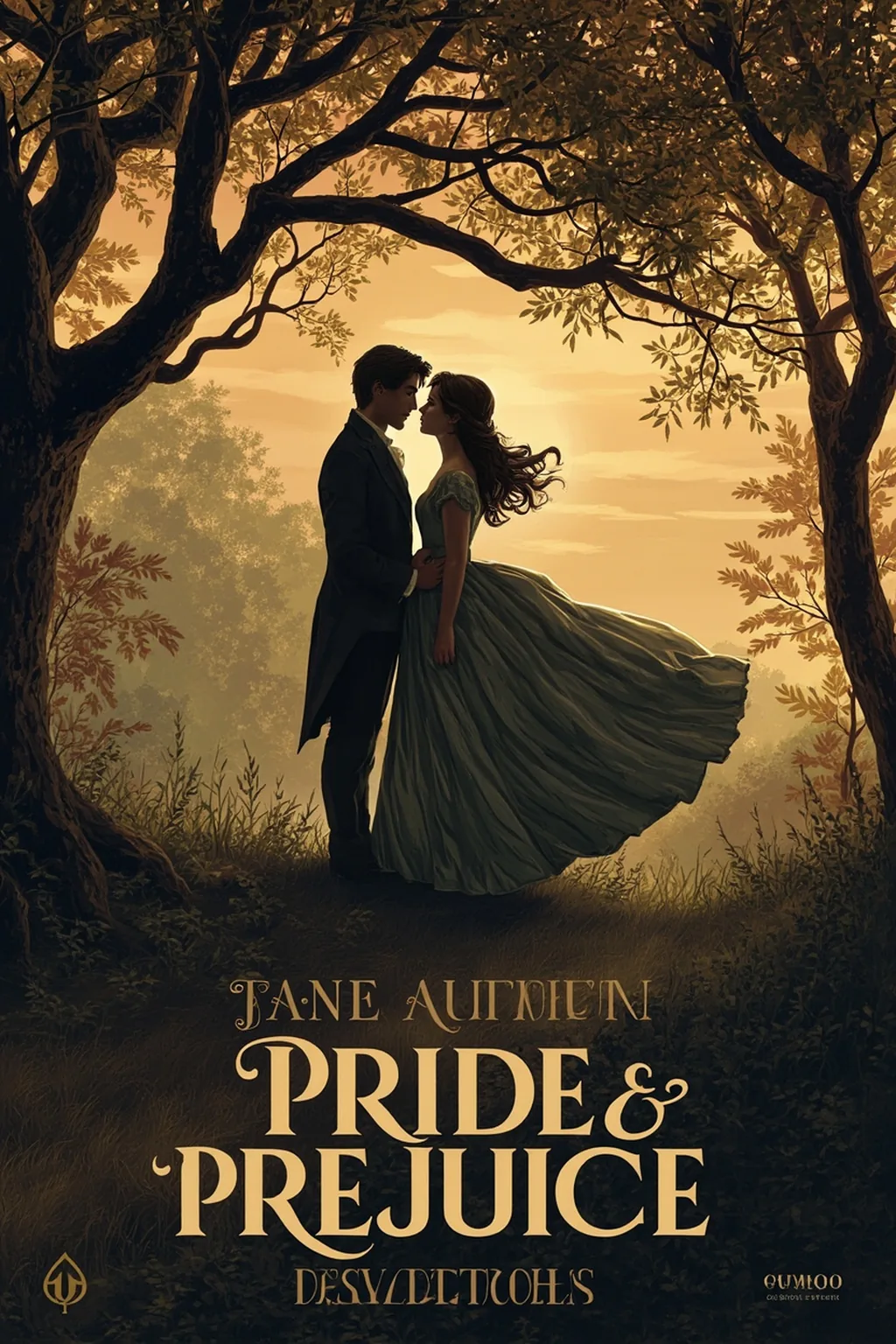
CHAPTER XLII.
Had Elizabeth’s opinion of conjugal felicity been drawn from her own family, she could not have formed a pleasing picture. Her father, captivated by youth and beauty, had married a woman whose weak understanding had early ended all real affection; respect, esteem, and confidence had vanished for ever.
When she had rejoiced over Wickham’s departure, she found little other cause for satisfaction in the loss of the regiment; at home she had a mother and sister whose constant repinings threw a real gloom over the domestic circle. Her tour to the Lakes was now the object of her happiest thoughts.
But a letter from Mrs. Gardiner changed all. Mr. Gardiner would be prevented by business from setting out till a fortnight later in July, and must be in London again within a month—too short for their original plan. They must give up the Lakes and substitute a more contracted tour, going no farther than Derbyshire. That county had much to see; to Mrs. Gardiner it had peculiar attraction, for the town where she had formerly passed some years was probably as great an object as Matlock, Chatsworth, Dovedale, or the Peak.
Elizabeth was excessively disappointed, but it was her business to be satisfied. With the mention of Derbyshire came many connected ideas; it was impossible to see the word without thinking of Pemberley and its owner. “But surely,” said she, “I may enter his county with impunity, and rob it of a few petrified spars, without his perceiving me.”
Four weeks passed before the Gardiners arrived at Longbourn. They stayed one night, then set off next morning with Elizabeth. Their steps bent toward Lambton, the scene of Mrs. Gardiner’s former residence; within five miles of Lambton Elizabeth learned that Pemberley was situated—not on their direct road, nor more than a mile or two from it. Mrs. Gardiner expressed a wish to see the place. Elizabeth felt she had no business at Pemberley. At night she asked the chambermaid whether it were a fine place, the name of its proprietor, and whether the family were down for the summer. A most welcome negative followed; her alarms removed, she felt a great deal of curiosity to see the house herself. To Pemberley, therefore, they were to go.
CHAPTER XLIII.
Elizabeth watched for the first appearance of Pemberley Woods with perturbation; when they turned in at the lodge her spirits were in a high flutter. The park was very large, with great variety of ground; her mind was too full for conversation. Gradually ascending for half a mile, they reached a considerable eminence where the wood ceased and the eye was caught by Pemberley House on the opposite side of the valley—a large, handsome stone building standing well on rising ground, backed by high woody hills. Elizabeth was delighted; she had never seen a place where nature had done more, or natural beauty been so little counteracted by awkward taste.
“And of this place,” thought she, “I might have been mistress!” But recollecting herself—that could never be, for her uncle and aunt would have been lost to her—she saved herself from regret.
Her aunt called her to look at a picture: she saw the likeness of Mr. Wickham. The housekeeper said it was the son of her late master’s steward, brought up by him at his own expense; “He is now gone into the army, but I am afraid he has turned out very wild.” Pointing to another miniature—“that is my master, and very like him.” Mrs. Reynolds evidently took great pleasure in talking of her master and his sister: she had never had a cross word from him, and had known him since he was four. “He was always the sweetest-tempered, most generous-hearted boy in the world.” Elizabeth almost stared. “Can this be Mr. Darcy?” thought she.
“In what an amiable light does this place him!” whispered Mrs. Gardiner, “though not quite consistent with his behaviour to our poor friend.” “Perhaps we might be deceived.” “That is not very likely; our authority was too good.”
In the gallery Elizabeth walked in quest of the only face whose features would be known to her; at last it arrested her—a striking resemblance of Mr. Darcy, with such a smile over the face as she remembered to have sometimes seen when he looked at her. She stood several minutes in contemplation.
As they crossed the lawn towards the river, the owner himself suddenly came forward from the road behind to the stables. They were within twenty yards; their eyes instantly met, and the cheeks of each were overspread with the deepest blush. He absolutely started, and for a moment seemed immovable from surprise; but shortly recovering, advanced and spoke to Elizabeth, if not in perfect composure, at least in perfect civility.
Amazed at the alteration of his manner, every sentence increased her embarrassment. He seemed scarcely more at ease; his accent had none of its usual sedateness. Her uncle and aunt joined her and expressed admiration of his figure, but Elizabeth heard not a word. How strange must it appear to him! In what a disgraceful light might it not strike so vain a man!
At length, surprised yet again, she saw Darcy approaching. Mrs. Gardiner stood a little behind; on her pausing, he asked the honour of introducing him to her friends. The introduction was made; as Elizabeth named their relationship, she stole a sly look at him. He sustained it with fortitude, and, far from going away, turned back with them and entered into conversation with Mr. Gardiner.
After a pause he continued: “There is also one other person in the party who more particularly wishes to be known to you. Will you allow me, or do I ask too much, to introduce my sister to your acquaintance during your stay at Lambton?” The surprise was great. Elizabeth immediately felt that whatever desire Miss Darcy might have of being acquainted with her must be the work of her brother; it was satisfactory and gratifying to know that his resentment had not made him think really ill of her.
Her uncle and aunt began their observations. “He is perfectly well-behaved, polite, and unassuming. I was never more surprised than by his behaviour to us. It was more than civil; it was really attentive; there was no necessity for such attention.” “But perhaps he may be a little whimsical in his civilities,” replied her uncle. “Your great men often are.”
Elizabeth felt herself called on to say something in vindication of his behaviour to Wickham, and therefore gave them to understand, in as guarded a manner as she could, that by what she had heard from his relations in Kent his actions were capable of a very different construction, and that his character was by no means so faulty, nor Wickham’s so amiable, as they had been considered in Hertfordshire.
The day’s occurrences were too full of interest to leave her much attention for new friends; she could do nothing but think, and think with wonder, of Mr. Darcy’s civility, and, above all, of his wishing her to be acquainted with his sister.
The original text of this work is in the public domain. This page focuses on a guided summary article, reading notes, selected quotes, and visual learning materials for educational purposes.