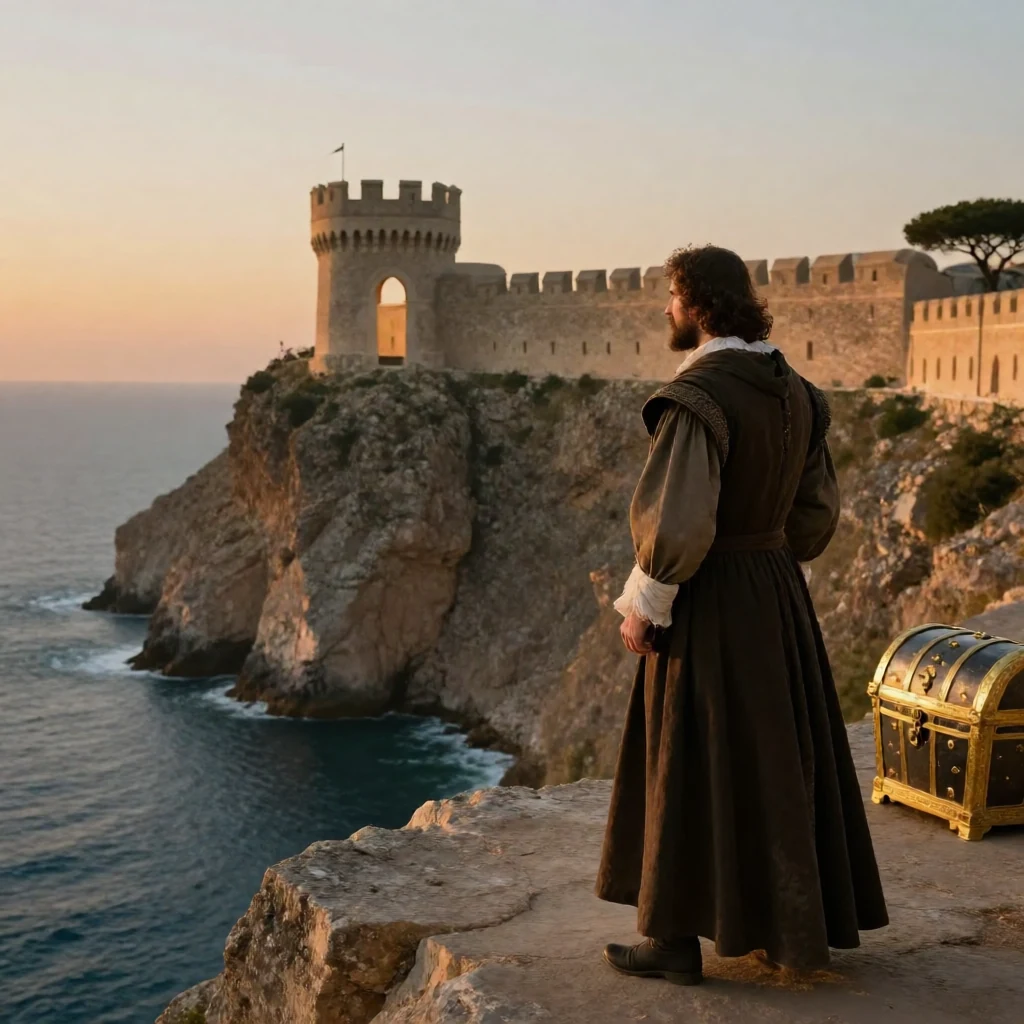
General Quesnel Assassination Inquiry and Villefort’s Royal Favor
The king presses for details on General Quesnel’s death; the police minister confirms it was an assassination, not suicide, as Quesnel was killed after leaving a Bonapartist club. A suspect matching the description of the man who lured Quesnel to his death— a 50- to 52-year-old dark man in a blue buttoned frock-coat with a Legion of Honor rosette—was tracked but lost in the Rue de la Jussienne. Villefort, who orchestrated Quesnel’s murder to cover up his plot against Edmond Dantès, is deeply shaken by the inquiry but conceals his terror to avoid having his motives exposed. The king rewards Villefort for his service, gifting him an officer’s cross of the Legion of Honor, promising future royal favor, and suggesting he may be of great strategic use in Marseilles. The police minister, whose career is effectively ruined, congratulates Villefort on his sudden good fortune as they leave the palace.
Villefort’s Return to His Hotel and Reunion with His Father
Villefort travels to the Hotel de Madrid in the Rue de Tournon, orders horses to be ready in two hours for his departure to Marseilles, and sits down to breakfast. A stranger arrives requesting an audience with him; his valet describes the visitor as a 50-year-old dark man matching the suspect in the Quesnel case. The man enters, revealed to be Villefort’s estranged Bonapartist father, M. Noirtier, who teases Villefort for keeping him waiting in the anteroom and addresses him by his childhood nickname, Gérard. Villefort, pale and shaken, orders his servant Germain to leave them alone.
Chapter 12. Father and Son
This chapter, titled “Father and Son,” centers on a tense, high-stakes conversation between royalist deputy procureur Gérard de Villefort and his Bonapartist father Noirtier, set against the immediate backdrop of Napoleon’s unexpected return from exile on Elba and the Bourbon monarchy’s fragile grip on power in France.
Noirtier’s Arrival, Room Security, and Initial Greeting
Noirtier arrives at Villefort’s Paris home, first taking great care to close and bolt both the antechamber and bedroom doors to avoid being overheard by servants or passersby. He teases Villefort for his unenthusiastic greeting upon arrival, then listens as Villefort explains he has returned to Paris specifically to warn his father of an active royalist police investigation targeting Bonapartist agitators, including Noirtier himself.
Discussion of the Rue Saint-Jacques Club, General Quesnel’s Death, and the Elba Letter
Villefort first reveals he is aware of the Bonapartist club located at 53 Rue Saint-Jacques, where royalist General Quesnel was lured under false pretenses and found dead in the Seine the day after his visit—a killing the king has officially labeled murder. In turn, Noirtier confirms he knows of Napoleon’s landing at Cannes, and Villefort admits he discovered a letter addressed to Noirtier from Elba outlining the full planned invasion in the pocketbook of the messenger carrying it; he burned the letter entirely to prevent it from falling into royalist hands and leading to his father’s arrest and execution.
Noirtier’s Insights on Napoleon’s Return and Advice to Villefort
Noirtier dismisses Villefort’s fears of arrest, citing his decades of experience evading revolutionary persecution during the Reign of Terror. He pushes back on Villefort’s claim that the police have a reliable physical description of the man who lured General Quesnel to the club, and lays out his precise, accurate predictions for Napoleon’s rapid march toward Paris, correcting Villefort’s false assumption that loyal royalist cities like Grenoble and Lyons will block the emperor’s advance. He also reveals his Bonapartist intelligence network is far more effective than the royalist police, noting he learned of Villefort’s secret, unannounced trip to Paris within half an hour of him crossing the city barrier.
Noirtier’s Disguise, Departure, and Villefort’s Aftermath
When Villefort shares the detailed physical description the police have of the man who lured Quesnel—dark hair and complexion, blue frock-coat, Legion of Honor rosette, wide-brimmed hat—Noirtier immediately alters his appearance to evade capture: he shaves off his black whiskers, swaps his blue frock-coat and black cravat for a brown coat and colored neckerchief belonging to Villefort, and exchanges his cane for one of Villefort’s narrow-brimmed hats and a small bamboo switch, rendering himself unrecognizable to the police waiting nearby. He gives Villefort strict orders to keep his visit and their conversation completely secret, return to Marseilles at night via his home’s back entrance, and remain quiet, submissive, and inoffensive, promising that if the political tides shift again in the Bonapartists’ favor, Villefort’s obedience will secure his own career and status. After Noirtier departs, a shaken Villefort destroys all traces of his father’s visit, then travels back to Marseilles, learning along the way that Napoleon has already entered Grenoble.
The original text of this work is in the public domain. This page offers a compressed quick-read summary for educational purposes.