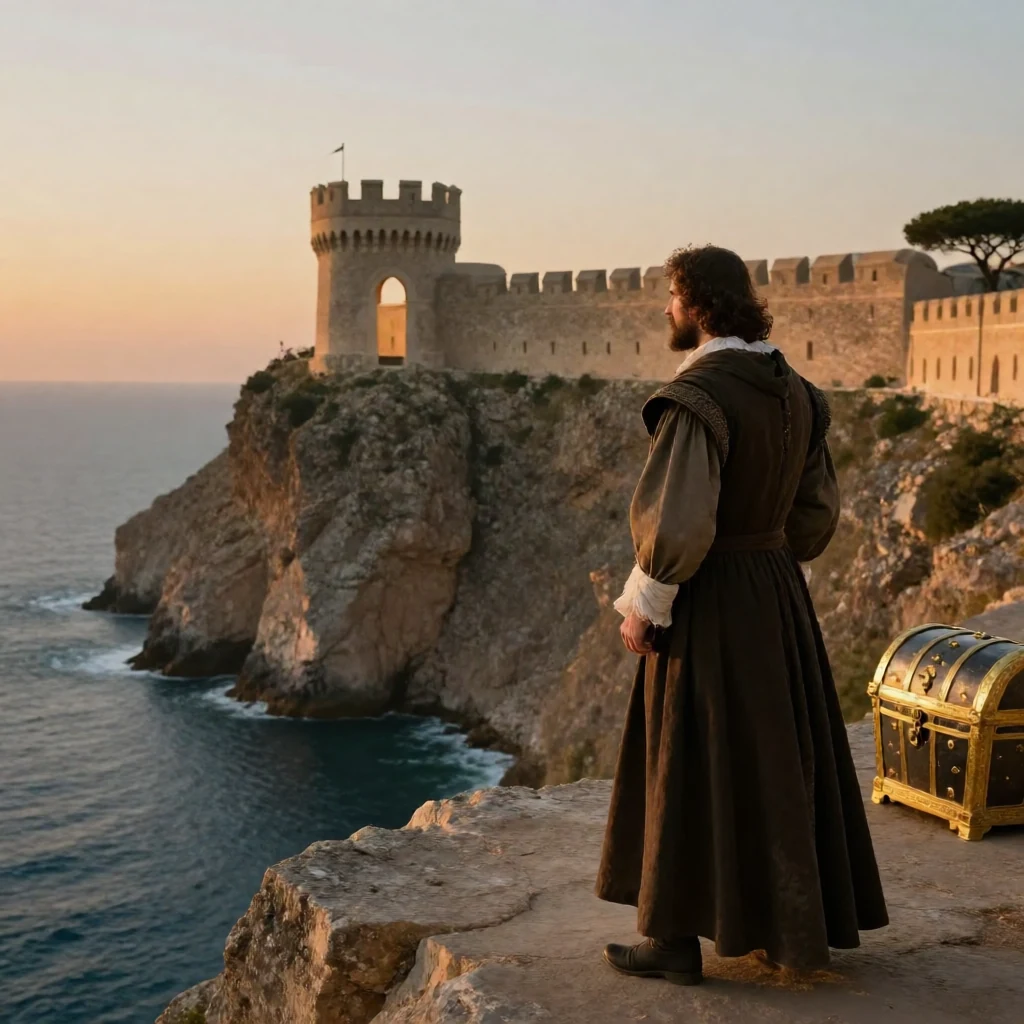
Bertuccio Overhears the Caderousses Discuss the Dantès Diamond
Climbing over the garden-hedge and slipping through the olive and wild fig trees, Bertuccio hid in a shed used for smuggling, separated from the inn only by a partition with peepholes. Caderousse entered with a stranger—evidently a Parisian jeweller at the Beaucaire fair—and announced that the priest had not deceived them: the diamond was real. The jeweller offered 50,000 francs but wished to hear from Caderousse’s wife, pale and feverish Carconte, the story of the diamond’s miraculous acquisition. Carconte explained that her husband had been a great friend of a sailor named Edmond Dantès in 1814 or 1815, whom Caderousse had forgotten but who, at his death, had bequeathed this diamond to him.
CHAPITRE 44. The Vendetta
Chapter 44, “The Vendetta,” unfolds through the retrospective narration of Bertuccio to Monte Cristo, recounting events at Caderousse and La Carconte’s inn during a Beaucaire fair. A jeweller named Joannes comes to purchase a large diamond allegedly left to the couple by the deceased Edmond Dantès through the Abbé Busoni. After lengthy negotiation, the stone is sold for 45,000 francs. As a violent thunderstorm breaks, the jeweller departs, but the couple’s whispered plotting—hinting at murder and robbery along the road—gives way to terror when the jeweller unexpectedly returns. The chapter closes with the ominous image of La Carconte double-locking the door behind the unsuspecting guest, foreshadowing the violent “vendetta” to come.
Diamond Origin Inquiry
Diamond Origin Inquiry The jeweller Joannes interrogates Caderousse and La Carconte about the provenance of the diamond. They repeat the story that Edmond Dantès received it from a wealthy Englishman he befriended and cared for in prison, and that the Abbé Busoni delivered it to them after Dantès’s death. The jeweller murmurs that although the tale seemed improbable, it may be true—their disagreement now centers only on the price.
Diamond Price Negotiation
Diamond Price Negotiation Caderousse claims they had agreed on his asking price, but the jeweller reveals he offered 40,000 francs. La Carconte indignantly protests, insisting the abbé said the stone was worth 50,000 francs without its setting. When the jeweller requests the abbé’s name and learns he is the Abbé Busoni, an Italian from near Mantua, he asks to inspect the diamond again, suspecting a first viewing may have led to an error in valuation. Caderousse produces a small black shagreen case, and at the sight of the hazel-nut-sized stone, La Carconte’s eyes glitter with cupidity.
Jeweller Appraises the Diamond
Jeweller Appraises the Diamond After Monte Cristo asks Bertuccio whether he believed Caderousse’s story, the steward continues his account. The jeweller Joannes removes the diamond from its setting using steel pliers and weighs it on small copper scales. He offers 45,000 francs but no more, noting he brought exactly that sum. When Caderousse insists on the full 50,000, Joannes reconsiders and points out a flaw in the stone, then resets it in the ring.
Diamond Sale Finalized
Diamond Sale Finalized Caderousse threatens to find another buyer, but the jeweller warns him that no one else will accept their unlikely story, and the law might seize the diamond. Caderousse and his wife exchange eager glances and ultimately accept 45,000 francs. La Carconte demands a gold chain and Caderousse a pair of silver buckles, and Joannes obliges from samples he carries, though the trinkets are worth only about five louis and fifteen francs respectively. Joannes counts out 15,000 francs in gold and 30,000 in banknotes, remarking that 45,000 francs equals 2,500 livres of annual income.
Couple Counts Proceeds, Plots Robbery
Couple Counts Proceeds, Plots Robbery As evening falls and a storm gathers, La Carconte asks Caderousse to light the lamp. The three of them—jeweller, innkeeper, and wife—remain oblivious to the thunder, absorbed by the demon of gain. Caderousse counts the gold and notes, passes them to his wife for recounting, while Joannes admires how the diamond sparkles in the lamplight. The money is stowed in a greasy old pocket-book and a bag containing only two or three silver crowns—the couple’s prior fortune. Caderousse invites the jeweller to supper, but Joannes declines, citing the late hour and his worried wife in Beaucaire, and reveals his address in Paris for any future contact with the Abbé Busoni.
The original text of this work is in the public domain. This page focuses on a guided summary article, reading notes, selected quotes, and visual learning materials for educational purposes.