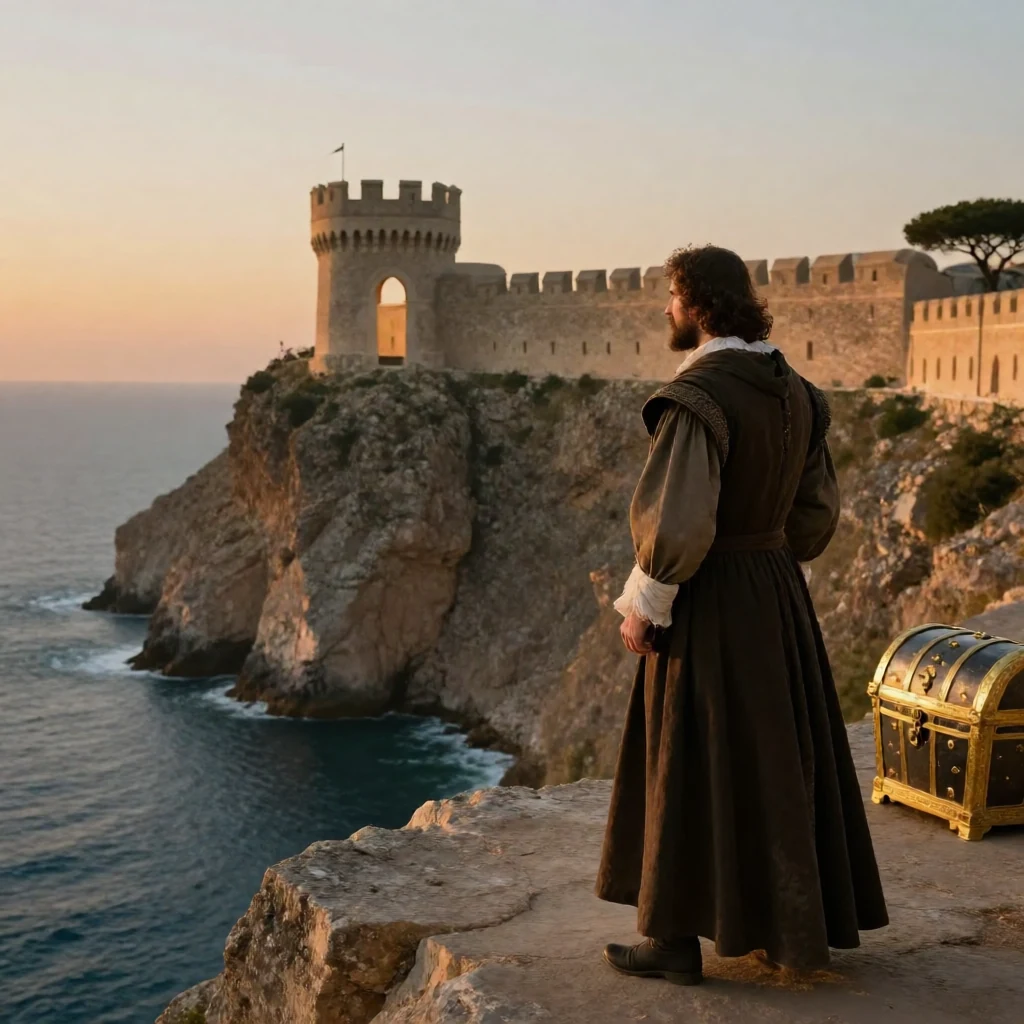
Noirtier Stipulates Charity Bequest If Marriage Proceeds
When the notary asks if Noirtier disinherits Valentine because she has contracted an engagement contrary to his wishes, the old man confirms this understanding—he intends the marriage as the reason for her exclusion. The notary verifies that but for this marriage, Valentine would have been his heir. Villefort declares his intention for Valentine to marry Franz d’Épinay regardless, and she sinks weeping into a chair. The notary then asks how Noirtier wishes to dispose of his fortune if Valentine proceeds with the marriage, and the old man indicates he will devote it to charitable purposes. When the notary notes the law prevents complete disinheritance of a son, Noirtier confirms he intends to leave only what the law allows him to subtract from Villefort’s inheritance. His eye beams with triumph when Villefort declares he knows his father will never alter his mind and claims he cannot plead against the poor.
Will Is Finalized, Witnessed, and Sealed
Despite Villefort’s declaration that he will act according to his conscience, the chapter closes with his departure from the room alongside his wife, leaving his paralyzed father at liberty to proceed as he wishes. The same day the will is completed, witnesses are brought in, the document is approved by Noirtier through his eye signals, and it is sealed in the presence of all assembled. The final testament is given in charge to M. Deschamps, the family notary, ensuring the distribution of Noirtier’s 900,000 francs to charitable purposes rather than to any member of the Villefort family.
CHAPITRE 60. The Telegraph
Upon returning home, M. and Madame de Villefort find the Count of Monte Cristo waiting for them in the drawing room, and the count quickly perceives that Villefort is troubled despite his attempts to mask his feelings. Villefort explains that his father, the paralytic M. Noirtier, is in the process of disinheriting their daughter Valentine by 900,000 francs as punishment for her intended marriage to the young Baron Franz d’Épinay, the son of a man whom Noirtier detests from the political intrigues of an earlier era. Encouraged by the count, who feigns only polite interest while listening intently to the family dispute, Villefort resolves to proceed with the marriage regardless, and the conversation then turns to an upcoming visit to the count’s country house in Auteuil—the very house once owned by M. de Saint-Méran, a fact that visibly agitates the procureur. Before departing, Monte Cristo explains that he is off to observe a nearby telegraph at length, launching into a lengthy meditation on the semaphore’s mechanical arms and the humble operator hired to manipulate them for a modest salary. Chapter 60. The Telegraph In this chapter, Monte Cristo announces his intention to visit a telegraph station during a conversation with Villefort, who inquires about the Count’s destination and his choice of telegraph. Monte Cristo explains that he prefers a rural telegraph to the official ones, declines an introduction to the minister, and receives directions for the route. Upon leaving, he encounters two notaries at the door who have just completed the act disinheriting Valentine.
CHAPITRE 60. The Telegraph
Upon returning home, M. and Madame de Villefort find the Count of Monte Cristo waiting for them in the drawing room, and the count quickly perceives that Villefort is troubled despite his attempts to mask his feelings. Villefort explains that his father, the paralytic M. Noirtier, is in the process of disinheriting their daughter Valentine by 900,000 francs as punishment for her intended marriage to the young Baron Franz d’Épinay, the son of a man whom Noirtier detests from the political intrigues of an earlier era. Encouraged by the count, who feigns only polite interest while listening intently to the family dispute, Villefort resolves to proceed with the marriage regardless, and the conversation then turns to an upcoming visit to the count’s country house in Auteuil—the very house once owned by M. de Saint-Méran, a fact that visibly agitates the procureur. Before departing, Monte Cristo explains that he is off to observe a nearby telegraph at length, launching into a lengthy meditation on the semaphore’s mechanical arms and the humble operator hired to manipulate them for a modest salary.
The original text of this work is in the public domain. This page focuses on a guided summary article, reading notes, selected quotes, and visual learning materials for educational purposes.