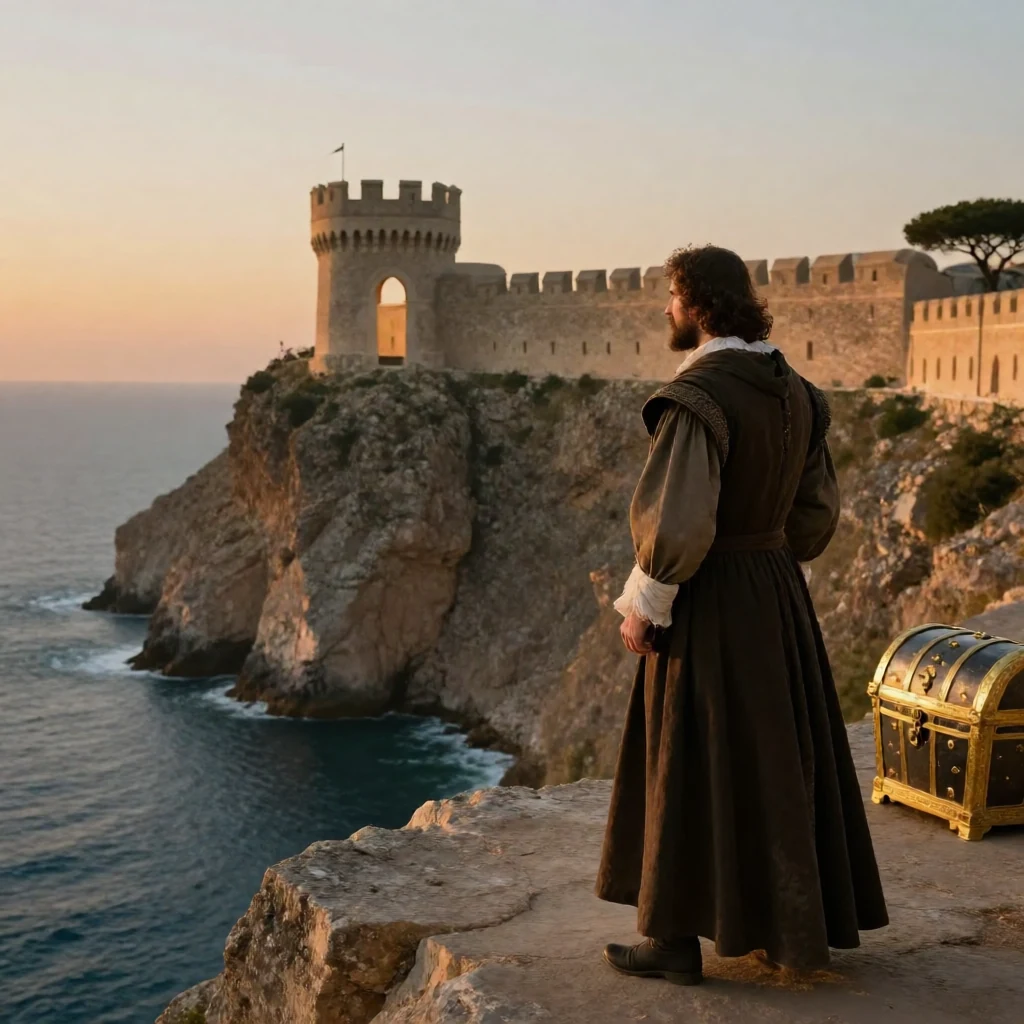
Evening Voyage to Monte Cristo
As evening falls around six o’clock, an opal-colored light bathes the Mediterranean as the heat of day gives way to a gentle breeze carrying the scent of plants and sea. A graceful, swan-like yacht glides swiftly across the calm waters, lit by a setting sun whose rays dance on every wave. At the prow stands a tall, dark-complexioned man with a melancholy expression, gazing ahead at a dark, cone-shaped mass of land rising from the sea.
Identifying Monte Cristo Island
The melancholic traveller asks the captain if the dark, conical landform before them is Monte Cristo. The captain confirms they have reached the island. The traveller repeats the phrase with profound sadness, calling it “the haven,” and falls into reverie. His inner state is betrayed by a sad smile, more revealing than tears would be.
Anchoring and Shore Landing
A flash of light and the sound of firearms from shore serve as a landing signal. The captain offers a loaded carbine, which the traveller raises and fires into the air in response. Within ten minutes the yacht anchors about a hundred fathoms from a small natural harbor. The traveller refuses the comfort of a cushioned seat in the gig and stands with arms crossed, remaining indifferent to the crew’s offer to carry him ashore on their shoulders. He wades through the water to reach dry land about thirty strides away, despite the pilot’s worry that the master will be displeased.
Morrel Meets the Count
On shore in the darkness, a hand rests on the traveller’s shoulder and a familiar voice greets him: “Good-evening, Maximilian; you are punctual, thank you!” It is the Count of Monte Cristo, who welcomes Morrel warmly and notes that he is drenched. Morrel, in an almost joyful accent, presses the Count’s hand with both of his own. The Count notes that the sailors who brought Morrel have already departed without payment or a word, and explains with a smile that he has arranged free access to the island. Morrel observes that the Count is laughing—a marked contrast to his demeanor in Paris.
Discussion of Grief and Consolation
The Count’s brow clouds at the reminder, and he admits he forgot, in his delight at seeing Morrel, that happiness is fleeting. Morrel, seizing the Count’s hands, urges him to laugh and to prove by his indifference that life is endurable to sufferers, saying the Count’s gayety is a charitable act meant to inspire courage. The Count insists he was truly happy, but Morrel replies that if so, the Count has forgotten him. He cites the gladiator’s salute to the emperor: “He who is about to die salutes you.” The Count, surprised, asks if Morrel is still not consoled, and Morrel bitterly demands to know how that could be possible.
Fifth of October Deadline Reference
The Count asks Morrel to honestly examine his own heart—whether he still feels the feverish impatience of grief, the devouring thirst appeased only by the grave, or merely the prostration of fatigue and hope deferred. He suggests that if Morrel’s frozen heart is dead and he puts his trust in God, he is truly consoled. Morrel replies firmly that he has come to die in the arms of a friend, needing someone strong enough to smile at his last moments; his sister Julie would faint with tears, and Emmanuel would try to disarm him.
Entering the Count’s Grotto
The Count mentions the fifth of October as the agreed end of the period of waiting, and Morrel checks his watch, noting that it is now nine o’clock and he has only three hours left to live. The Count consents, and Morrel follows him mechanically. They enter a grotto beneath his notice; Morrel feels a carpet underfoot, a door opens, perfumes envelop him, and a brilliant light dazzles his eyes. The Count draws him in gently, suggesting they spend the final three hours as ancient Romans condemned by Nero would—seated at a table of flowers and perfumes, gliding softly into death. Morrel consents, saying death is always forgetfulness and repose.
The original text of this work is in the public domain. This page focuses on a guided summary article, reading notes, selected quotes, and visual learning materials for educational purposes.