Morrel Awaits Creditor, Prepares for Suicide
After Maximilian leaves, Morrel instructs his distraught clerk Cocles to announce the arrival of the Thomson & French agent when he arrives in 10 minutes. Morrel then waits alone for the 30-minute payment window to close, tormented by his choice between dying to preserve his reputation as an honest man or living as a disgraced bankrupt, and briefly hesitates as he thinks of his daughter Julie before reaching for his pistol again.
Julie Brings Purse with Paid Debt and Her Dowry
Just as Morrel is about to turn the pistol on himself, his daughter Julie bursts into the study, out of breath with joy, holding a red netted silk purse. The purse contains the fully receipted bill for the 287,500 franc debt, plus a large diamond marked as Julie’s dowry, which Morrel recognizes as a purse he once owned. Julie explains she received an anonymous letter that morning directing her to retrieve the purse from a specified address on the fifth floor of a building on the Allées de Meilhan, and that Emmanuel accompanied her on the errand.
Lost Ship Pharaon Spotted Entering Marseilles Harbor
Immediately after Julie presents the life-saving purse, Emmanuel bursts in to announce that the long-believed-lost ship Pharaon, Morrel & Son’s cargo vessel, has been spotted entering Marseilles harbor. Maximilian arrives moments later confirming the sighting, and the entire family rushes to the Canebière to join the large crowd gathering to welcome the ship, which is an exact duplicate of the lost original Pharaon, captained by Gaumard with original crew member Penelon on deck.
Unknown Benefactor Confirms Role, Vows to Punish the Wicked
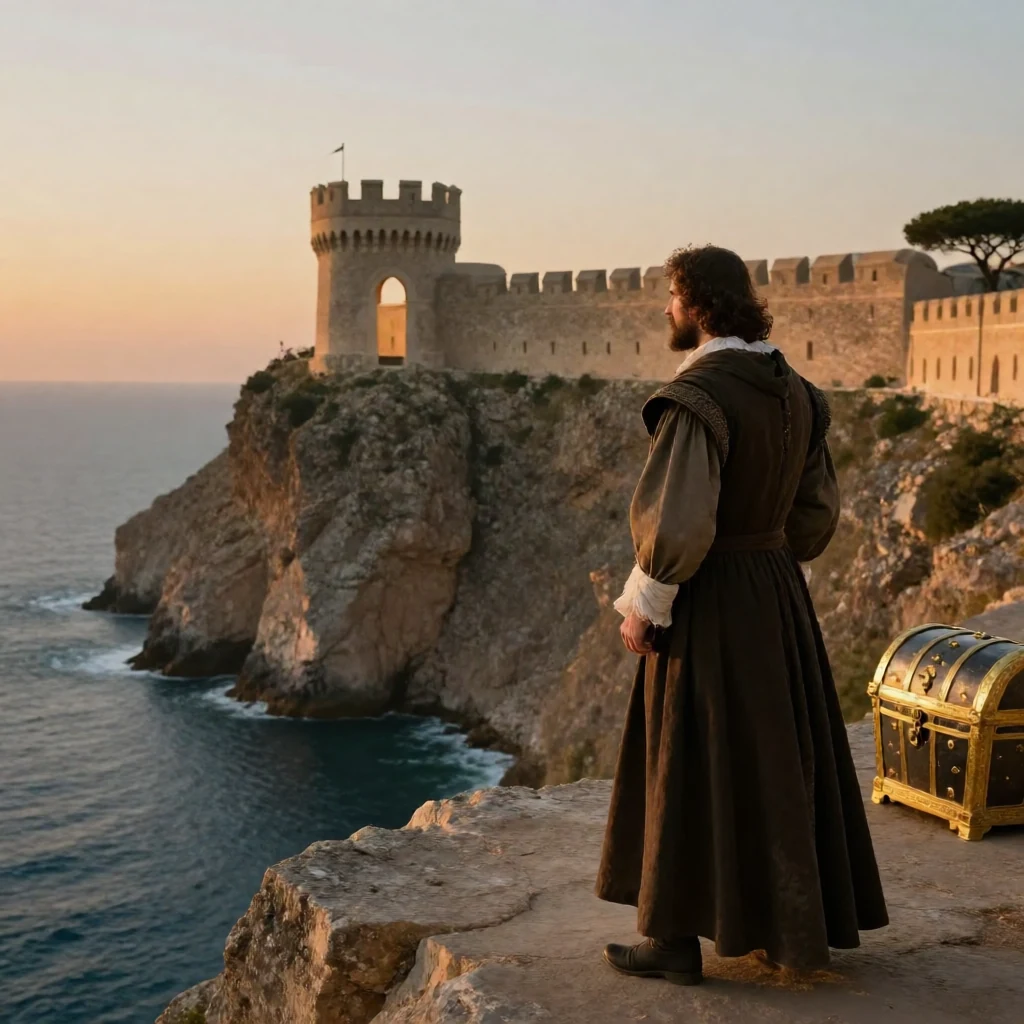
As Morrel and Maximilian embrace in public joy on the pier, an unknown bearded man hiding behind a sentry box watches the scene, expressing quiet satisfaction that his anonymous good deed has saved the noble Morrel family. He slips away unnoticed, boards a launch to a nearby splendidly fitted yacht, and declares that having acted as Heaven’s agent to reward good, he will now take on the power of the god of vengeance to punish the wicked before sailing away.
CHAPITRE 31. Italy: Sinbad the Sailor
Chapter 31, “Italy: Sinbad the Sailor,” follows two young Parisian noblemen—Viscount Albert de Morcerf and Baron Franz d’Épinay—as they arrange lodgings in Rome for the Carnival and embark on a side expedition that takes Franz to the Island of Monte Cristo, where he encounters smugglers, learns of pirate dangers, and comes ashore at night to meet a mixed group of outlaws around a beach fire. In this chapter, Franz, a young Frenchman traveling incognito, lands on a deserted island where he is approached by a mysterious, pale figure known as “Sinbad the Sailor,” who invites him to supper on the condition that he be blindfolded. Franz is led into an opulent subterranean palace carved into the rock, where he finds a chamber lined with crimson and gold brocade and a magnificent marble dining room adorned with antique bas-reliefs, statues, and a splendidly appointed table of silver and Japanese china. Over the lavish meal, the enigmatic host—who is dressed in Tunisian costume and attended by a mute Nubian servant named Ali, whose life he once saved from the Bey of Tunis—speaks of himself as a “king of all creation” who wanders freely and dispenses a silent, personal form of justice, hinting through his pallor, voice, and fleeting ferocity at some profound past suffering beneath his present splendor. Chapter 31 finds Franz dining with the mysterious Sinbad, who deflects Franz’s suggestion that he is a man seeking revenge against society and hints at an eventual incognito trip to Paris, where Franz promises to repay his host’s lavish hospitality. Over a splendid supper, Sinbad introduces Franz to a greenish paste in a silver cup, revealing it to be the purest hashish of Alexandria and tracing its lineage to the Old Man of the Mountain, whose followers were transported to an artificial paradise and thus became obedient assassins; Franz consents to taste it, though he finds the flavor initially unappealing. As the hashish takes effect, Franz is led into a round, richly furred chamber where he smokes a jasmine-tubed chibouque and drinks Turkish coffee before sinking into a luminous, airy vision in which Monte Cristo becomes an oasis, music swells around him, and he is surrounded by statues of Phryne, Cleopatra, and Messalina, whose marble beauty and serpentine embraces yield a dream of passion so overwhelming that he finally surrenders to its spell.
The original text of this work is in the public domain. This page focuses on a guided summary article, reading notes, selected quotes, and visual learning materials for educational purposes.