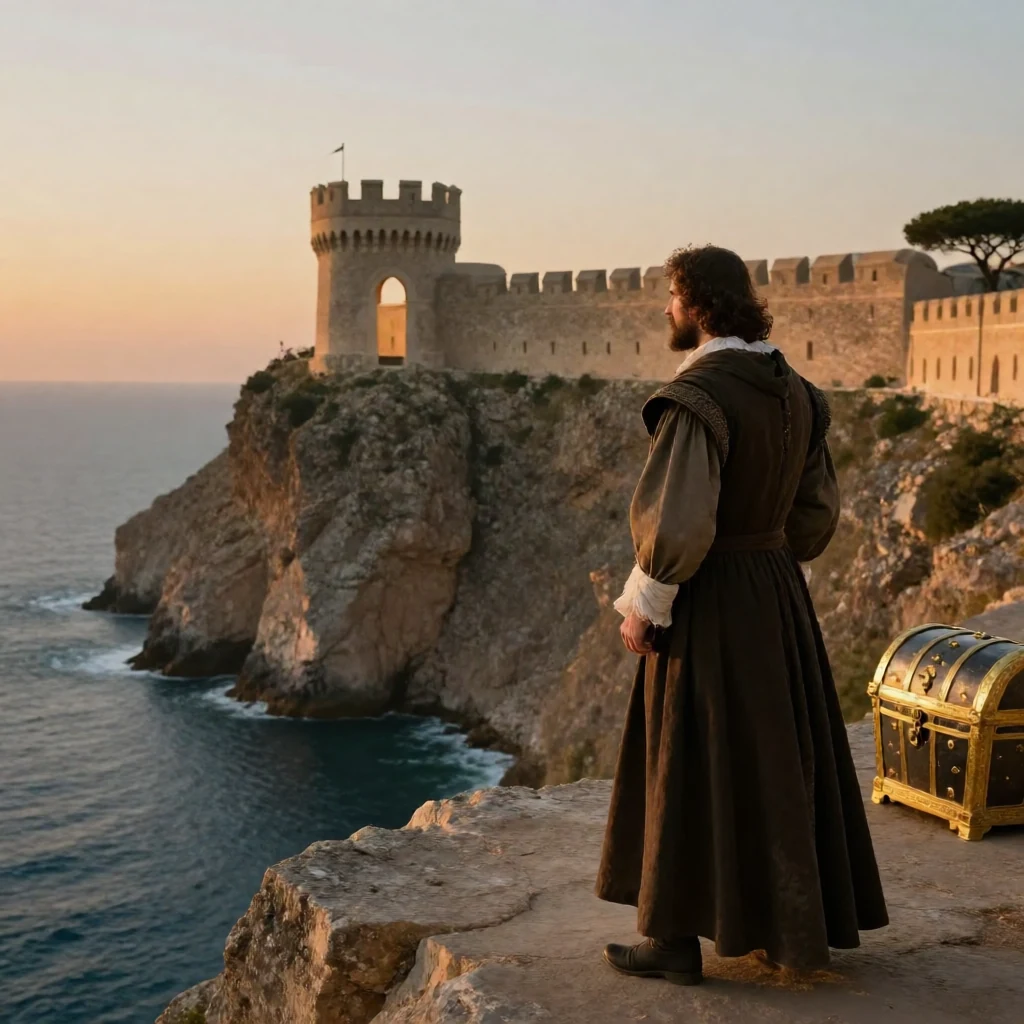
Franz Has Confused Dreams About the Mysterious Figure
Franz spends a restless night beset by confused dreams relating to his two prior encounters with his mysterious tormentor, and by waking speculations about what the following day might bring. He reasons that unless the Count of Monte Cristo possesses the ring of Gyges and can render himself invisible, he cannot possibly escape identification this time.
Franz Inquires About Scheduled Executions
Rising early at eight o’clock while Albert still sleeps, Franz summons his landlord, Signor Pastrini, and asks whether an execution is scheduled for the day. Pastrini explains that the window-viewing opportunities are already taken and notes that one could view the spectacle from Monte Pincio, though that hill is generally claimed by common rabble. Franz requests particulars about the executions—the number, names, and manner of death of those condemned—and Pastrini explains the tavolettas, wooden tablets posted the evening before an execution listing the names, crimes, and modes of punishment so that the faithful may offer prayers for the condemned.
Franz Confirms Execution Details Match Colosseum Information
Pastrini produces a tavoletta from the landing outside Franz’s apartment, and Franz reads that on Wednesday, February 23rd, the first day of Carnival, two men—Andrea Rondolo and Peppino, called Rocca Priori—will be executed in the Piazza del Popolo, the former for murdering a priest and the latter as an accomplice of the bandit Luigi Vampa, by mazzolato and decapitato respectively. Franz recognizes this as precisely the information he overheard in the Colosseum, and concludes that the Transteverin was likely Luigi Vampa himself while the cloaked stranger was the same person he had known as “Sinbad the Sailor,” still pursuing his philanthropic mission in Rome as he had at Porto-Vecchio and Tunis.
Franz and Albert Prepare to Visit the Count
With time advancing, Franz prepares to wake Albert, but his friend enters the room already dressed, having been stirred early by anticipation of the Carnival’s pleasures. Franz asks Pastrini whether they may proceed at once to visit the Count of Monte Cristo, and the landlord assures him the count is an early riser and has been up for two hours, taking full responsibility if the visit proves untimely. Both young men agree they are ready to go and present their best thanks for the count’s courtesy.
Franz and Albert Tour the Count’s Luxurious Apartment
Pastrini leads the friends across the landing to the count’s apartments, and a servant admits them into two luxuriously furnished rooms and an elegantly appointed drawing-room filled with rich Turkey carpets, inviting couches, magnificent paintings, trophies of war, and heavy tapestry curtains. As the servant withdraws to announce them, a brief swell of guzla music escapes through a door, and both young men gaze about in astonishment. Albert marvels that their neighbor must be either a successful stock-jobber or a prince travelling incognito, but Franz cautions him to hush, for the count is approaching.
Franz Recognizes the Count as His Prior Mysterious Acquaintance
The tapestry is drawn aside and the owner of these riches stands before them. Albert rises to greet him, but Franz remains spellbound in his chair, for in the person of the count he recognizes not only the mysterious visitant to the Colosseum and the occupant of the box at the Teatro Argentina, but also his extraordinary former host of Monte Cristo.
CHAPITRE 35. La Mazzolata
Chapter 35, titled “La Mazzolata,” centers on Count Monte Cristo’s visit to the rooms of Albert de Morcerf and Franz d’Épinay at the Hôtel de Londres in Rome. The count arrives to greet the young men, assists them in securing accommodations for Carnival festivities, and engages them in a wide-ranging conversation that moves from polite social exchange to a probing discussion of capital punishment, justice, and vengeance. The chapter culminates in a shared breakfast and a plan to witness an execution at the Piazza del Popolo, with Franz ultimately declining the offer of a window overlooking the scaffold. Chapter 35. La Mazzolata follows the Count, Franz, and Albert as they proceed from Franz’s rooms to the Piazza del Popolo to witness an execution. The chapter confirms the Count’s identity through a prearranged window signal, then unfolds the grim spectacle of a Roman beheading by mace. A last-minute pardon saves one prisoner while inflaming the other, leading to a violent execution before a carnival-minded crowd. The chapter culminates in a chilling moment in which the Count, far from being repulsed, exults in the scene and his view of human nature.
The original text of this work is in the public domain. This page focuses on a guided summary article, reading notes, selected quotes, and visual learning materials for educational purposes.