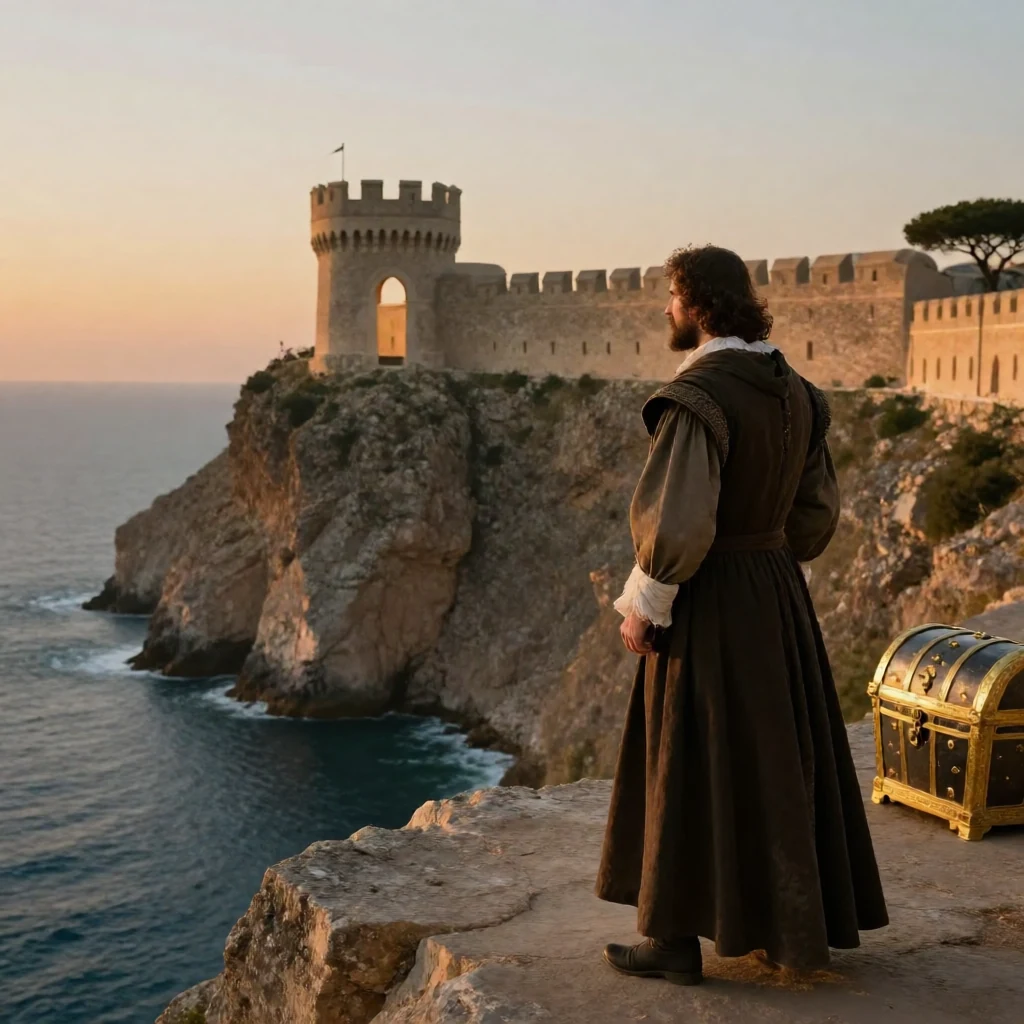
Bertuccio’s Distress on the Drive to Auteuil
As they descend the staircase, Bertuccio signs himself in the Corsican manner—forming the sign of the cross with his thumb and muttering a short prayer. Monte Cristo notices the steward’s extraordinary repugnance for leaving the city walls but is too curious to let Bertuccio avoid this journey. Bertuccio crouches in the carriage corner, examining every house they pass with feverish anxiety. His emotion continues to augment as they enter the village of Auteuil, though he obeys the count’s order to stop at Rue de la Fontaine, No. 28.
Arrival at No. 28 Rue de la Fontaine
The carriage stops at Number 28, situated at the extremity of the village. Night has fallen, giving the surroundings an artificial stage-like appearance. Monte Cristo orders Bertuccio to announce him, and the concierge appears to greet the new master. The footman presents the notary’s order confirming the sale. Monte Cristo assures the concierge he will endeavor not to cause regret for the previous master, and the concierge welcomes him with gratitude after receiving two gold pieces.
Concierge Reveals the House’s Former Owner
When Monte Cristo inquires about the old master, the concierge reveals it was the Marquis of Saint-Méran—a staunch Bourbon follower who had an only daughter that married M. de Villefort, formerly the king’s attorney at Nîmes and Versailles. The concierge mentions the daughter died twenty-one years ago, and the Marquis only visited the house three times afterward. The house did not bring him any income, so he did well to sell it. Upon hearing this information about Villefort, Bertuccio becomes whiter than the wall, nearly fainting against it.
Tour of the Auteuil House Interior
Monte Cristo sends the concierge away with gold pieces and has Bertuccio light the way through the house. They traverse a tolerably large ground floor and a first floor containing a salon, bathroom, and two bedrooms. Near one bedroom, they discover a private winding staircase leading down to the garden. Bertuccio knows this staircase leads to the garden before being told, and his trembling hand holding the light reveals how much it costs him to obey. When they reach the outer door, the steward pauses, unable to proceed further.
Bertuccio’s Terror in the Garden
When they enter the garden under a gloomy moonlit sky, Bertuccio stands paralyzed with horror. His haggard eyes search for traces of some terrible event, and his clenched hands seem to shut out horrible recollections. Monte Cristo insists they visit despite the steward’s protests. Bertuccio cries out that Monte Cristo is standing exactly where “he fell,” and pleads with him to move away from that spot. The Count responds coldly that Bertuccio must be mad and threatens to have him committed to a lunatic asylum. Bertuccio joins his hands, declaring the evil has arrived.
Bertuccio Confesses to a Past Assassination
Bertuccio falls at Monte Cristo’s feet and confesses that his vengeance was accomplished in this house—someone was assassinated here. When the Count points out that this is the house of the Marquis de Saint-Méran, Bertuccio clarifies the assassination was not of him but of another. Bertuccio insists it was fate that led Monte Cristo to purchase this particular house where his crime occurred. The Count descended to the garden by the same staircase the victim used, stopped at the spot where he received the blow, and two paces farther lies the grave where a child had just been buried.
Monte Cristo Confronts Bertuccio’s Secret
Monte Cristo warns Bertuccio that in France, unlike Italy, vendettas are considered in very bad taste—gendarmes occupy themselves with such affairs, judges condemn, and scaffolds avenge. The Count examines Bertuccio coldly, comparing his look to that bent upon an execution in Rome. He mentions that the Abbé Busoni recommended Bertuccio with a letter of praise, but now Monte Cristo will write to the abbé holding him responsible for his protégé’s misconduct. Bertuccio protests his faithful service and declares he has always been an honest man. Monte Cristo observes that a quiet conscience does not cause such paleness and fever in a man’s hands.
The original text of this work is in the public domain. This page focuses on a guided summary article, reading notes, selected quotes, and visual learning materials for educational purposes.