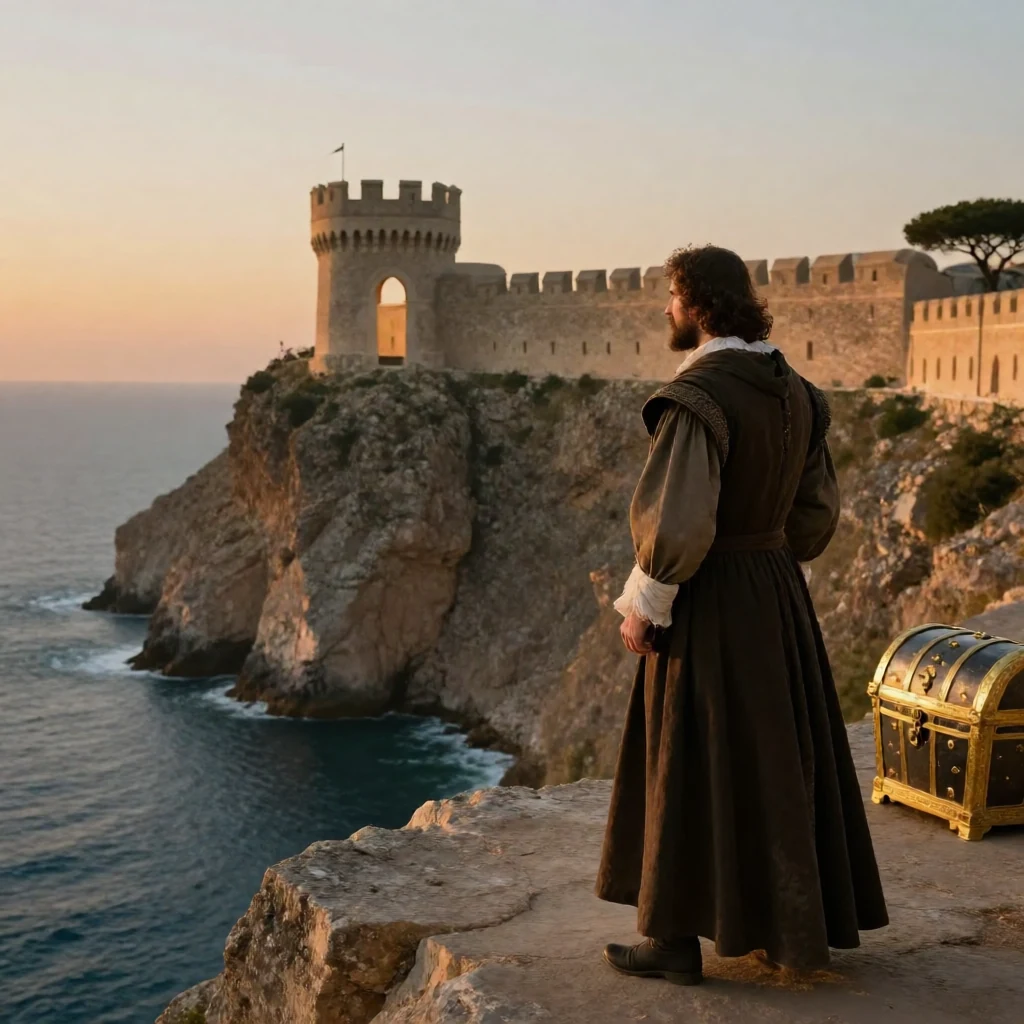
Franz Conducts a Second Grotto Search
Despite the failure of his first attempt, Franz begins a second search of the grotto while Gaetano roasts one of the kids. This extended visit proves equally fruitless. When Franz emerges, the kid is roasted and ready, and he sits where his mysterious host had invited him to supper the previous evening. In the distance, he sees the little yacht like a sea-gull on the waves, continuing toward Corsica—Sinbad’s true destination of Porto-Vecchio becoming clear.
Franz Departs Monte Cristo for Florence
With all hope of detecting the grotto’s secret lost, Franz boards his boat and departs Monte Cristo. As the boat sails, Monte Cristo disappears from view, and with it, all trace of the preceding night—supper, Sinbad, hashish, statues—becomes a dream. He sails through day and night, arriving at Florence to finish his affairs of pleasure before planning to rejoin his companion in Rome.
Franz Arrives in Rome During Carnival
On Saturday evening, Franz arrives in Rome by mail-coach during Carnival season. The streets are thronged with people, and the city buzzes with feverish excitement. Finding no room at the Hôtel de Londres due to hired hackney-coachmen and innkeepers with full houses, Franz sends his card asking for Albert de Morcerf. Signor Pastrini himself greets him, leading him to a two-room apartment with a parlor overlooking the street. The rest of the floor is occupied by a wealthy gentleman believed to be either Sicilian or Maltese.
Franz and Albert Find No Carriages Available
Franz and Albert demand supper and a carriage for the following days. Pastrini serves supper immediately but admits he cannot procure a carriage. Albert proposes putting horses to his own carriage, but Pastrini reveals there are no horses available—all post-horses were hired two weeks prior, with only those absolutely required for posting remaining. Despite Albert’s disbelief and Franz’s resignation, Albert maintains his philosophy that money can solve any problem. He suppers, sleeps soundly, and dreams of racing through Rome during Carnival in a coach with six horses.
The original text of this work is in the public domain. This page focuses on a guided summary article, reading notes, selected quotes, and visual learning materials for educational purposes.