Departure for Danglars
When the clock strikes five, the count strikes thrice upon his gong—one stroke summons Ali, two summon Baptistin, three summon Bertuccio. The steward enters, and the count asks if his horses are ready. Bertuccio confirms they are at the door harnessed to the carriage as desired, and asks if he should accompany him. The count declines: the coachman, Ali, and Baptistin will go. Descending to the door, Monte Cristo beholds his carriage drawn by the very pair of horses he had so much admired in the morning as Danglars’s property. He remarks that they are extremely handsome and praises Bertuccio’s purchase, though reproving him mildly for not having obtained them sooner. Bertuccio replies that there was considerable difficulty in obtaining them and that they have cost an enormous price. The count inquires whether the sum paid makes the animals less beautiful and, receiving an assurance that his satisfaction is all the steward could wish, asks to be driven to the residence of Baron Danglars on the Rue de la Chaussée d’Antin.
Commissioning a Seaside Estate
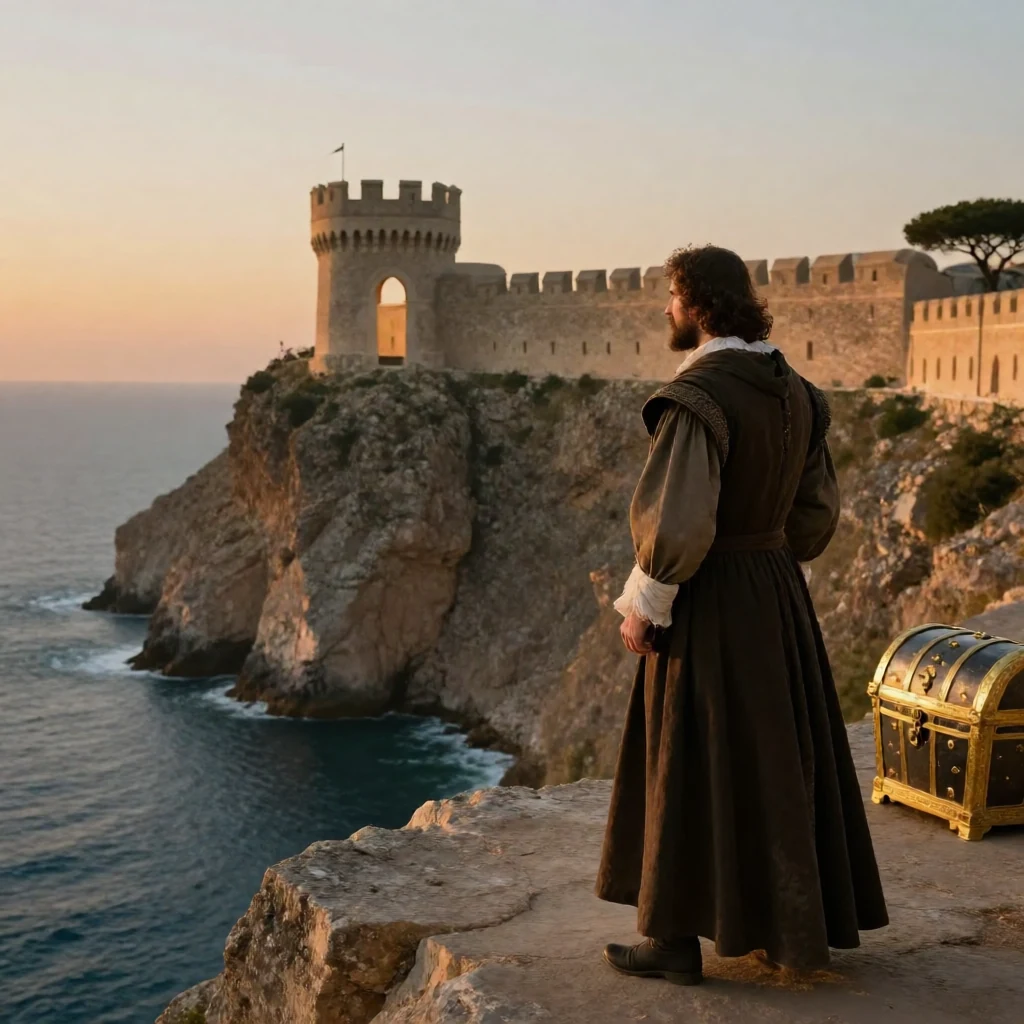
As they stand upon the terrace, from which a flight of stone steps leads to the carriage-drive, the count calls Bertuccio back and commissions him to find an estate by the seaside in Normandy—between Le Havre and Boulogne, for instance. The place must have a small harbor, creek, or bay into which his corvette can enter and remain at anchor, since she draws only fifteen feet. She is to be kept in constant readiness to sail the moment the count gives the signal. The steward should make inquiries, visit any eligible spot, and if it possesses the desired advantages, purchase it at once in his own name. The corvette, the count thinks, must now be on her way to Fécamp.
The original text of this work is in the public domain. This page focuses on a guided summary article, reading notes, selected quotes, and visual learning materials for educational purposes.