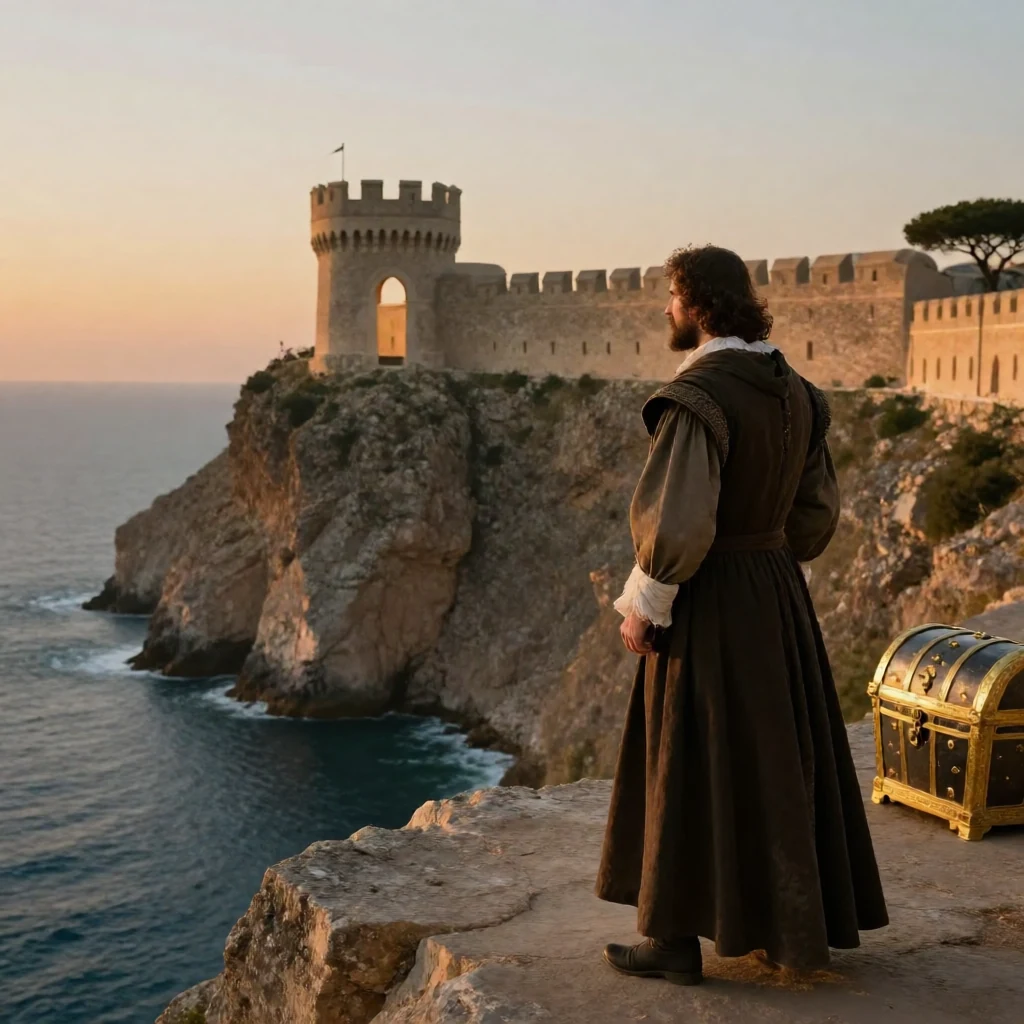
Major and Andrea discuss Abbé Busoni’s letter
The Major reassures Andrea that he can rely on the Count of Monte Cristo’s promises, but insists they must continue to play their parts—the Major as a tender father and Andrea as a dutiful son. Andrea mentions that “they” sent letters to both of them, and the Major produces a letter he received from Abbé Busoni, which Andrea reads aloud. The letter explains that the Major is poor and facing a miserable old age; it instructs him to travel to Paris and demand of the Count of Monte Cristo, at Avenue des Champs-Élysées No. 30, the son he allegedly had with the Marchesa Corsinari, named Andrea Cavalcanti, taken from him at five years old. It encloses an order for 2,400 francs payable in Florence and a draft of 48,000 francs, and specifies arriving on 26 May at seven o’clock in the evening.
Andrea reveals his letter from Lord Wilmore
Andrea reveals that he, too, received a letter of similar intent, though not from Abbé Busoni but from an Englishman calling himself Lord Wilmore, who also goes by “Sinbad the Sailor.” Unlike the Major, Andrea claims to have met this correspondent once, though he refuses to disclose where. He then shows the Major his own letter, which mirrors the Busoni letter: Andrea is told he is poor, offered a name and wealth, instructed to find a post-chaise at the Porte de Gênes, travel through Turin, Chambéry, and Pont-de-Beauvoisin, and arrive at Monte Cristo’s address on 26 May at seven o’clock to claim the Major as his father. The letter encloses a draft for 5,000 livres payable in Nice and a letter of introduction to the Count, with instructions that the Count supply his needs.
The original text of this work is in the public domain. This page focuses on a guided summary article, reading notes, selected quotes, and visual learning materials for educational purposes.