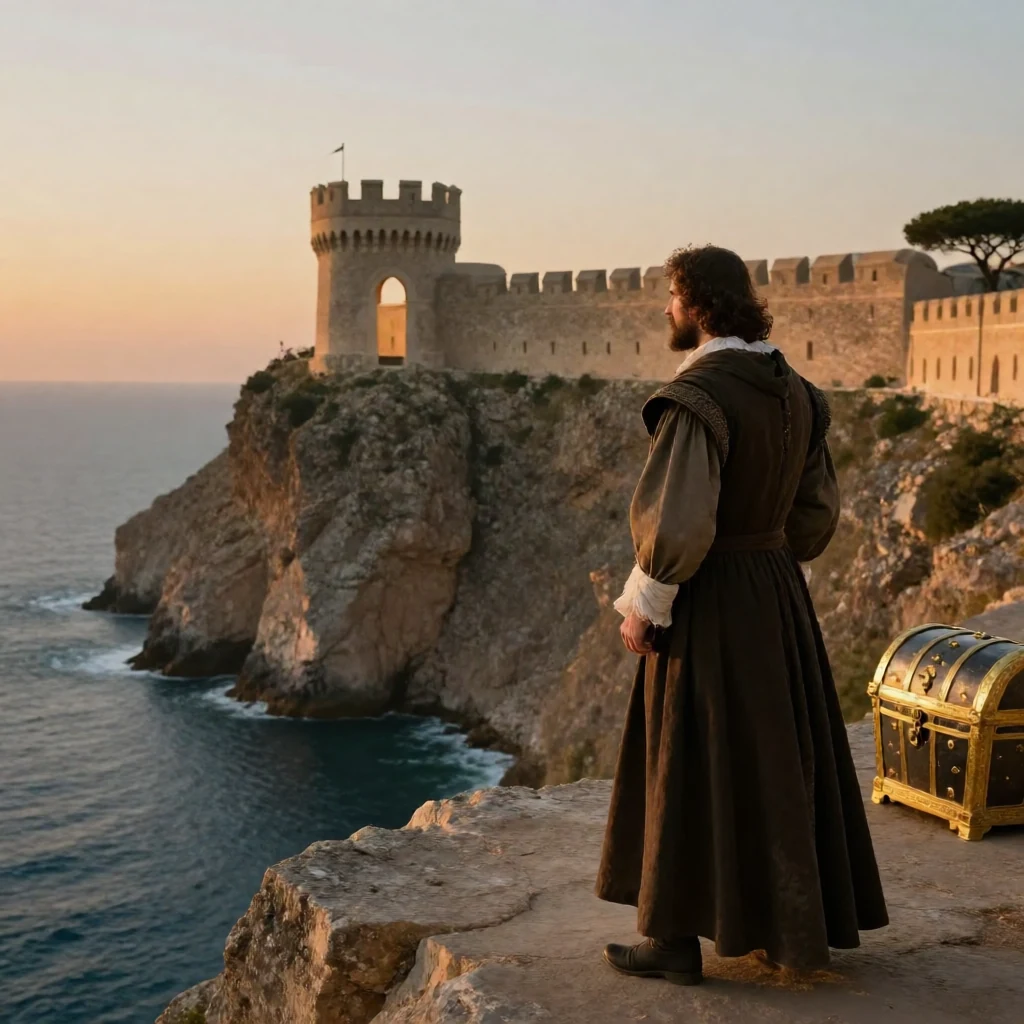
Seeking His Father
The presence of the two victims alarmed him; he could not bear solitude shared only by two corpses. Until then he had been sustained by rage, by his strength of mind, by despair, by the supreme agony which led the Titans to scale the heavens and Ajax to defy the gods. He now arose, his head bowed beneath the weight of grief, and, shaking his damp, dishevelled hair, he who had never felt compassion for anyone determined to seek his father, that he might have someone to whom he could relate his misfortunes—someone by whose side he might weep. He descended the little staircase and entered Noirtier’s room. The old man appeared to be listening attentively and as affectionately as his infirmities would allow to the Abbé Busoni, who looked cold and calm, as usual.
The Unmasking of the Abbé
Villefort, perceiving the abbé, passed his hand across his brow. The past came to him like one of those waves whose wrath foams fiercer than the others. He recollected the call he had made upon him after the dinner at Auteuil, and then the visit the abbé had himself paid to his house on the day of Valentine’s death. “You here, sir!” he exclaimed; “do you, then, never appear but to act as an escort to death?” Busoni turned around, and, perceiving the excitement depicted on the magistrate’s face, the savage lustre of his eyes, he understood that the revelation had been made at the assizes—but beyond this he was ignorant. “I came to pray over the body of your daughter.” “And now why are you here?” “I come to tell you that you have sufficiently repaid your debt, and that from this moment I will pray to God to forgive you, as I do.” “Good heavens!” exclaimed Villefort, stepping back fearfully, “surely that is not the voice of the Abbé Busoni!” “No!” The abbé threw off his wig, shook his head, and his hair, no longer confined, fell in black masses around his manly face. “It is the face of the Count of Monte Cristo!” exclaimed the procureur, with a haggard expression. “You are not exactly right, M. Procureur; you must go farther back.” “That voice, that voice!—where did I first hear it?” “You heard it for the first time at Marseilles, twenty-three years ago, the day of your marriage with Mademoiselle de Saint-Méran. Refer to your papers.” “You are not Busoni?—you are not Monte Cristo? Oh, heavens! you are, then, some secret, implacable, and mortal enemy! I must have wronged you in some way at Marseilles. Oh, woe to me!” “Yes; you are now on the right path,” said the count, crossing his arms over his broad chest; “search—search!”
The original text of this work is in the public domain. This page focuses on a guided summary article, reading notes, selected quotes, and visual learning materials for educational purposes.