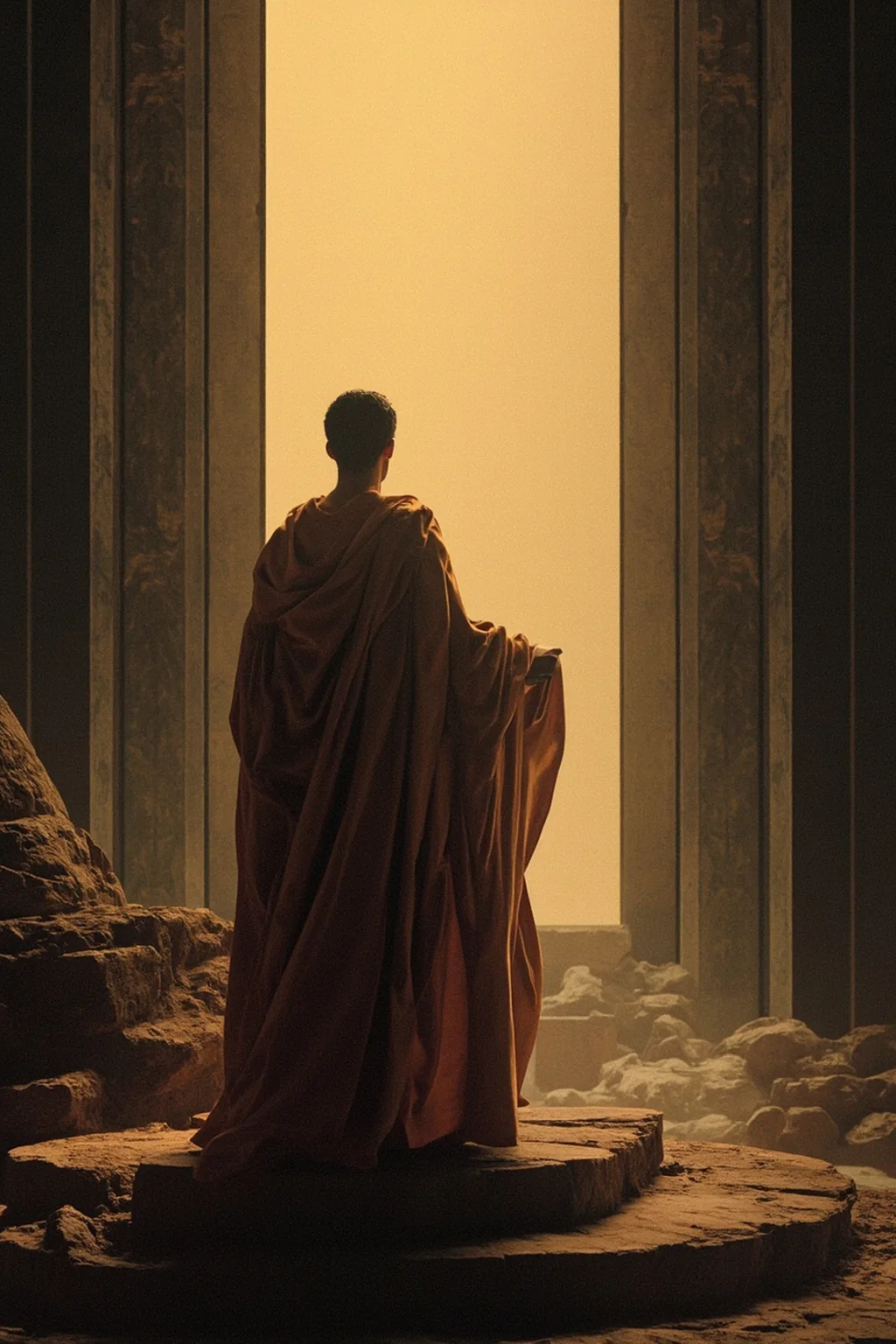
Written during military campaigns at the edges of the empire, the *Meditations* represent a private dialogue between a ruler and his conscience. Marcus Aurelius does not seek to teach a system, but to fortify his own mind against the corruption of power and the fear of death. The work moves from a catalog of gratitude to his teachers to a rigorous metaphysical examination of change, duty, and the rational soul, ultimately concluding that the good life consists in acting justly and accepting fate as a necessary part of the cosmic whole.
Marcus then meditates on the swift succession of death to illustrate the transience of fame and the inevitability of dissolution. He lists a series of deaths—Lucilla, Verus, Antoninus, Faustina, and others—to show that everyone follows the same course into dispersion or translation. He compares the body in its various states—old, sick, or lustful—to the vanity of fame. Both the praiser and the praised will soon be dust, and the earth is but a point in the universe. He argues that life is short and that fame is restricted to a small corner of the earth, making it unworthy of pursuit. He urges the reader to contract their whole life to the measure of a single action, performing what is fitting to the utmost of their power. If an outward impediment arises, he suggests accepting it with equanimity and converting the mind to the new circumstance, thus maintaining a life in harmony with nature.
The focus shifts to the unconquerable nature of the mind and the management of pain. Marcus asserts that pain is not an evil to the body, which is insensible, nor necessarily to the soul, which has the power to preserve its peace and not judge pain as evil. He declares that nothing can hinder the mind or understanding—not fire, iron, tyranny, nor slander. The mind becomes unconquerable when it seeks content in its own inability to be forced. He advises withdrawing opinion from raw perceptions, noting that hearing someone speak ill is a fact, but being hurt is an added opinion. He uses the analogy of a carpenter’s shavings to explain that nature has no “outside” place for waste but transforms everything within itself. He urges the reader to keep the mind free from passions as a chief fortress, for a stronger place of defense does not exist.
The original text of this work is in the public domain. This page focuses on a guided summary article, reading notes, selected quotes, and visual learning materials for educational purposes.