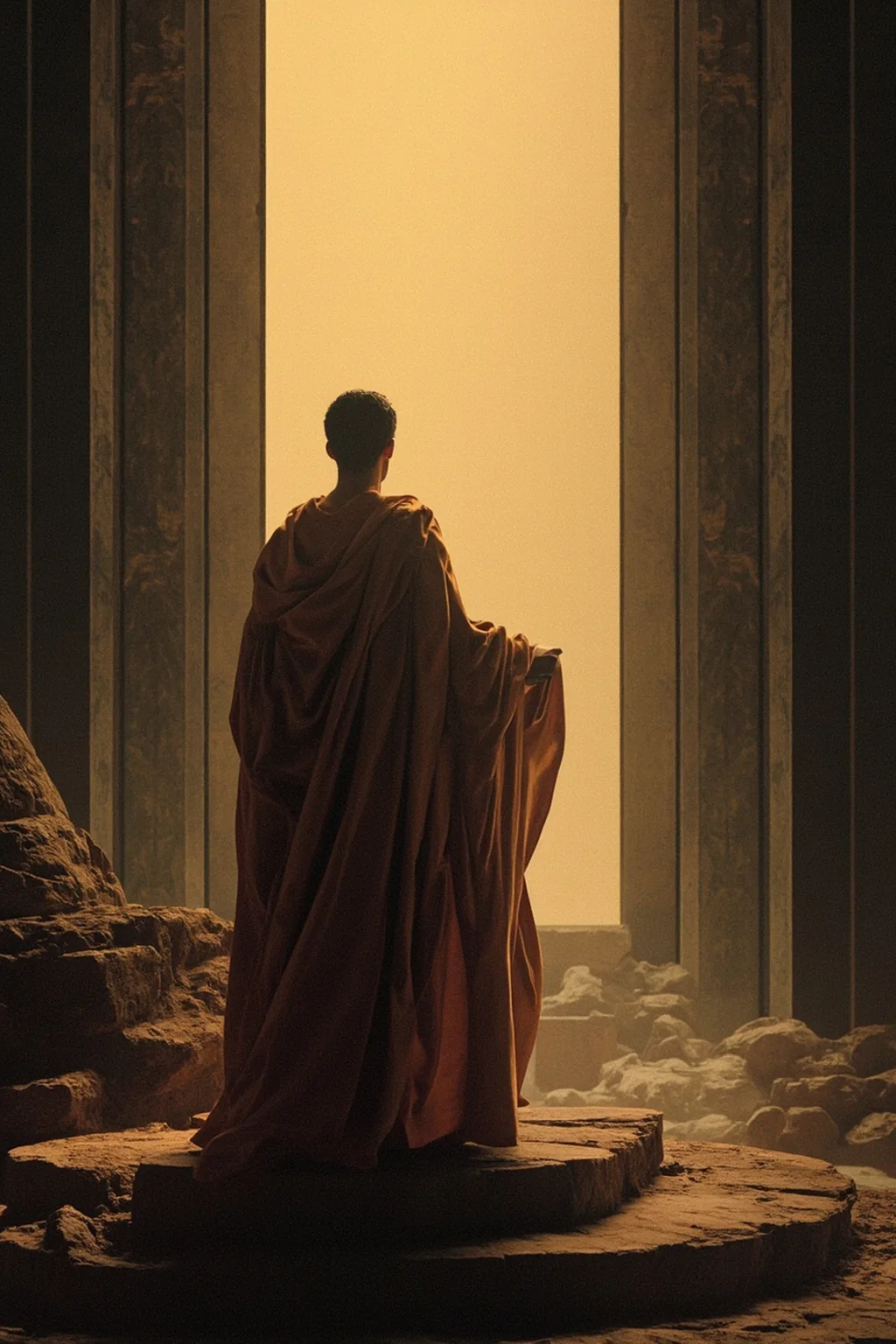
Meditations cover
Stoicism Notable Quotes

Meditations

Passages worth revisiting from classic literature.

Marcus Aurelius, Emperor of Rome 2001 56 min

The Debt of Gratitude and the Ideal Ruler

Quotes

From my brother Severus, to be kind and loving to all them of my house and family; by whom also I came to the knowledge of Thrasea and Helvidius, and Cato, and Dio, and Brutus. He it was also that did put me in the first conceit and desire of an equal commonwealth, administered by justice and equality; and of a kingdom wherein should be regarded nothing more than the good and welfare of the subjects.

Read interpretation

This passage is crucial as it defines Marcus Aurelius’s political ideal. Through his brother Severus, he connects his personal rule to the Stoic opposition figures of the past (Cato, Brutus), establishing a vision of a commonwealth governed solely by justice and the welfare of the people rather than the glory of the ruler.

Quotes

In my father, I observed his meekness; his constancy without wavering in those things, which after a due examination and deliberation, he had determined. How free from all vanity he carried himself in matter of honour and dignity, (as they are esteemed:) his laboriousness and assiduity, his readiness to hear any man, that had aught to say tending to any common good: how generally and impartially he would give every man his due; his skill and knowledge, when rigour or extremity, or when remissness or moderation was in season; how he did abstain from all unchaste love of youths; his moderate condescending to other men’s occasions as an ordinary man, neither absolutely requiring of his friends, that they should wait upon him at his ordinary meals, nor that they should of necessity accompany him in his journeys; and that whensoever any business upon some necessary occasions was to be put off and omitted before it could be ended, he was ever found when he went about it again, the same man that he was before.

Read interpretation

This tribute to Antoninus Pius serves as the practical exemplar of Stoic virtue in governance. It highlights the ideal ruler’s meekness, freedom from vanity, and emotional consistency, illustrating how one can hold absolute power without being corrupted by pride, anger, or the need for flattery.

The Urgency of the Present

Quotes

Remember how long thou hast already put off these things, and how often a certain day and hour as it were, having been set unto thee by the gods, thou hast neglected it. It is high time for thee to understand the true nature both of the world, whereof thou art a part; and of that Lord and Governor of the world, from whom, as a channel from the spring, thou thyself didst flow: and that there is but a certain limit of time appointed unto thee, which if thou shalt not make use of to calm and allay the many distempers of thy soul, it will pass away and thou with it, and never after return.

Read interpretation

This opening statement establishes the urgent tone of the second book, marking the transition from gratitude to active self-discipline. Marcus emphasizes the brevity of life and the necessity of understanding one’s place within the cosmic order before the opportunity for self-improvement is lost forever.

Quotes

Let it be thy earnest and incessant care as a Roman and a man to perform whatsoever it is that thou art about, with true and unfeigned gravity, natural affection, freedom and justice: and as for all other cares, and imaginations, how thou mayest ease thy mind of them. Which thou shalt do; if thou shalt go about every action as thy last action, free from all vanity, all passionate and wilful aberration from reason, and from all hypocrisy, and self-love, and dislike of those things, which by the fates or appointment of God have happened unto thee.

Read interpretation

Here Marcus defines the Stoic discipline of action, urging himself to approach every task as if it were his last. This formulation strips away vanity and fear of the future, focusing entirely on performing the present action with justice, gravity, and acceptance of fate.

Quotes

If thou shouldst live three thousand, or as many as ten thousands of years, yet remember this, that man can part with no life properly, save with that little part of life, which he now lives: and that which he lives, is no other, than that which at every instant he parts with. That then which is longest of duration, and that which is shortest, come both to one effect.

Read interpretation

This quote provides a profound metaphysical analysis of time, asserting that the past and future are unpossessable and therefore irrelevant to the individual. By reducing life to the immediate present, Marcus argues that the duration of a life matters less than the quality of the attention paid to the current moment.

The Aesthetic of Nature and Change

Quotes

This also thou must observe, that whatsoever it is that naturally doth happen to things natural, hath somewhat in itself that is pleasing and delightful: as a great loaf when it is baked, some parts of it cleave as it were, and part asunder, and make the crust of it rugged and uneven, and yet those parts of it, though in some sort it be against the art and intention of baking itself, that they are thus cleft and parted, which should have been and were first made all even and uniform, they become it well nevertheless, and have a certain peculiar property, to stir the appetite.

Read interpretation

Here, Marcus reframes the perception of natural processes, using the metaphor of baking bread to illustrate that apparent imperfections are part of a beautiful, functional order. He suggests that to the profound mind, even decay and irregularity possess a unique aesthetic value because they are inherent to nature.

Quotes

Whatsoever doth happen in the world, is, in the course of nature, as usual and ordinary as a rose in the spring, and fruit in summer. Of the same nature is sickness and death; slander, and lying in wait, and whatsoever else ordinarily doth unto fools use to be occasion either of joy or sorrow.

Read interpretation

By comparing sickness, death, and slander to the natural blooming of roses or fruit in summer, Marcus normalizes the hardships of life. He argues that these events are not evils but necessary parts of the natural sequence.

The Resilience of the Rational Soul

Quotes

That inward mistress part of man if it be in its own true natural temper, is towards all worldly chances and events ever so disposed and affected, that it will easily turn and apply itself to that which may be, and is within its own power to compass… Even as the fire when it prevails upon those things that are in his way; by which things indeed a little fire would have been quenched, but a great fire doth soon turn to its own nature, and so consume whatsoever comes in his way: yea by those very things it is made greater and greater.

Read interpretation

Marcus opens the book by defining the essential resilience of the rational soul. Rather than being broken by obstacles, the ruling reason adapts to them, using the famous analogy of a great fire that consumes the very fuel thrown against it to grow stronger.

Quotes

At what time soever thou wilt, it is in thy power to retire into thyself, and to be at rest, and free from all businesses. A man cannot any whither retire better than to his own soul; he especially who is beforehand provided of such things within, which whensoever he doth withdraw himself to look in, may presently afford unto him perfect ease and tranquillity.

Read interpretation

Here, Marcus argues that true retreat is not a physical location but an internal state of the soul. By withdrawing into one’s own reason and maintaining orderly thoughts, one can find immediate tranquility regardless of external chaos.

Quotes

Thou must be like a promontory of the sea, against which though the waves beat continually, yet it both itself stands, and about it are those swelling waves stilled and quieted.

Read interpretation

This powerful image serves as a model for Stoic stability. Just as a promontory withstands the crashing waves without being moved, the rational mind should remain unmoved by the tumult of external events.

Cosmopolitanism and Social Duty

Quotes

If to understand and to be reasonable be common unto all men, then is that reason, for which we are termed reasonable, common unto all. If reason is general, then is that reason also, which prescribeth what is to be done and what not, common unto all. If that, then law. If law, then are we fellow-citizens. If so, then the world is as it were a city.

Read interpretation

Marcus constructs a logical argument for cosmopolitanism, asserting that because reason and the understanding of justice are shared by all humans, all people are citizens of a single universal city governed by common laws.

Quotes

The form of the Athenians’ prayer did run thus: ‘O rain, rain, good Jupiter, upon all the grounds and fields that belong to the Athenians.’ Either we should not pray at all, or thus absolutely and freely; and not every one for himself in particular alone.

Read interpretation

Marcus invokes the Athenian prayer to illustrate the expansive nature of the rational soul, which must align itself with the common good rather than private interest. It serves as a reminder that the individual is a part of a larger whole and that desires should be directed toward the welfare of the community.

Quotes

As we say commonly, The physician hath prescribed unto this man, riding; unto another, cold baths; unto a third, to go barefoot: so it is alike to say, The nature of the universe hath prescribed unto this man sickness, or blindness, or some loss, or damage or some such thing.

Read interpretation

This section provides a crucial analogy for accepting fate: the universe acts as a physician to the whole. Just as a patient accepts harsh remedies for health, the rational mind must accept personal suffering as a necessary prescription for the health and coherence of the entire cosmos.

The Nature of Evil and the Unconquerable Mind

Quotes

What is wickedness? It is that which many time and often thou hast already seen and known in the world. And so oft as anything doth happen that might otherwise trouble thee, let this memento presently come to thy mind, that it is that which thou hast already often Seen and known. Generally, above and below, thou shalt find but the same things. The very same things whereof ancient stories, middle age stories, and fresh stories are full whereof towns are full, and houses full. There is nothing that is new. All things that are, are both usual and of little continuance.

Read interpretation

Marcus opens the book by grounding the reader in the cyclical nature of history and human behavior. By recognizing that wickedness and chaos are not novel phenomena but recurring patterns throughout time, he argues that we should not be surprised or disturbed by present events.

Quotes

That which is a hindrance of the senses, is an evil to the sensitive nature… And so likewise, whatsoever is a hindrance unto the mind and understanding, must needs be the proper evil of the reasonable nature. Now apply all those things unto thyself… For in those things that properly belong unto the mind, she cannot be hindered by any man. It is not fire, nor iron; nor the power of a tyrant nor the power of a slandering tongue; nor anything else that can penetrate into her.

Read interpretation

This is a definitive statement on the invulnerability of the rational mind. While the body can be constrained by physical force, the mind and understanding cannot be hindered by any external power—neither violence, tyranny, nor slander can penetrate the citadel of the intellect.

Quotes

Remember that thy mind is of that nature as that it becometh altogether unconquerable, when once recollected in herself, she seeks no other content than this, that she cannot be forced: yea though it so fall out, that it be even against reason itself, that it cloth bandy. And therefore let thy chief fort and place of defence be, a mind free from passions.

Read interpretation

Marcus asserts that the mind becomes unconquerable simply by retreating into itself and realizing that it cannot be forced against its will, even by the universe itself. He identifies a mind free from passion as the ultimate impregnable fortress.

The Impiety of Injustice

Quotes

He that is unjust, is also impious. For the nature of the universe, having made all reasonable creatures one for another, to the end that they should do one another good; more or less according to the several persons and occasions but in nowise hurt one another: it is manifest that he that doth transgress against this her will, is guilty of impiety towards the most ancient and venerable of all the deities.

Read interpretation

Marcus establishes the fundamental Stoic argument that injustice is not merely a social failing but a religious transgression. By violating the natural order which binds rational creatures to mutual aid, the unjust man commits impiety against the “common parent” of the universe.

Quotes

He that pursues after pleasures, as that which is truly good and flies from pains, as that which is truly evil: is impious. For such a one must of necessity oftentimes accuse that common nature, as distributing many things both unto the evil, and unto the good, not according to the deserts of either.

Read interpretation

Marcus argues that the pursuit of pleasure and avoidance of pain are acts of rebellion against Providence. By preferring these indifferent states, one implicitly accuses the universe of injustice for distributing goods and evils unequally.

The Vision of the Perfected Soul

Quotes

O my soul, the time I trust will be, when thou shalt be good, simple, single, more open and visible, than that body by which it is enclosed. Thou wilt one day be sensible of their happiness, whose end is love, and their affections dead to all worldly things. Thou shalt one day be full, and in want of no external thing: not seeking pleasure from anything, either living or insensible, that this world can afford; neither… wanting time for the continuation of thy pleasure, nor place and opportunity, nor the favour either of the weather or of men.

Read interpretation

Aurelius opens the book with a visionary address to his own soul, setting the ultimate standard for Stoic self-sufficiency. He describes a state of perfect contentment where the individual requires nothing from the external world—no pleasure, time, or human approval—to be complete.

Quotes

The natural properties, and privileges of a reasonable soul are: That she seeth herself; that she can order, and compose herself: that she makes herself as she will herself: that she reaps her own fruits whatsoever, whereas plants, trees, unreasonable creatures, what fruit soever (be it either fruit properly, or analogically only) they bear, they bear them unto others, and not to themselves.

Read interpretation

Aurelius opens the book by distinguishing the rational soul from lesser forms of life. This quote establishes the soul’s autonomy and self-sufficiency, highlighting that unlike plants or animals which exist for the benefit of others or external ends, the rational soul acts for its own perfection and possesses the unique capacity for self-reflection and self-direction.

The Final Resolution: Acceptance of Mortality

Quotes

Whatsoever thou doest hereafter aspire unto, thou mayest even now enjoy and possess, if thou doest not envy thyself thine own happiness. And that will be, if thou shalt forget all that is past, and for the future, refer thyself wholly to the Divine Providence, and shalt bend and apply all thy present thoughts and intentions to holiness and righteousness.

Read interpretation

This opening passage establishes the central theme of the final book: the immediate availability of happiness through a shift in perspective. Marcus argues that by letting go of the past and the future, and by aligning oneself entirely with the present moment and Divine Providence, one can possess happiness instantly rather than aspiring to it in the future.

Quotes

Either fate, (and that either an absolute necessity, and unavoidable decree; or a placable and flexible Providence) or all is a mere casual confusion, void of all order and government. If an absolute and unavoidable necessity, why doest thou resist? If a placable and exorable Providence, make thyself worthy of the divine help and assistance. If all be a mere confusion without any moderator or governor, then hast thou reason to congratulate thyself; that in such a general flood of confusion thou thyself hast obtained a reasonable faculty, whereby thou mayest govern thine own life and actions.

Read interpretation

This is a decisive logical formulation regarding the nature of the universe. Marcus presents three hypotheses regarding fate: absolute necessity, benevolent providence, or chaos. He argues that in any of these cases, the rational person has no cause for distress—either resistance is futile, one should seek divine aid, or one should rejoice in possessing reason to govern oneself amidst chaos.

Quotes

Herein doth consist happiness of life, for a man to know thoroughly the true nature of everything; what is the matter, and what is the form of it: with all his heart and soul, ever to do that which is just, and to speak the truth. What then remaineth but to enjoy thy life in a course and coherence of good actions, one upon another immediately succeeding, and never interrupted, though for never so little a while?

Read interpretation

The final book concludes with a definition of happiness: understanding the true nature of things and acting justly. Marcus envisions the ideal life as a coherent, uninterrupted succession of good actions. This serves as his ultimate exhortation to live continuously in accordance with reason and virtue until the end.