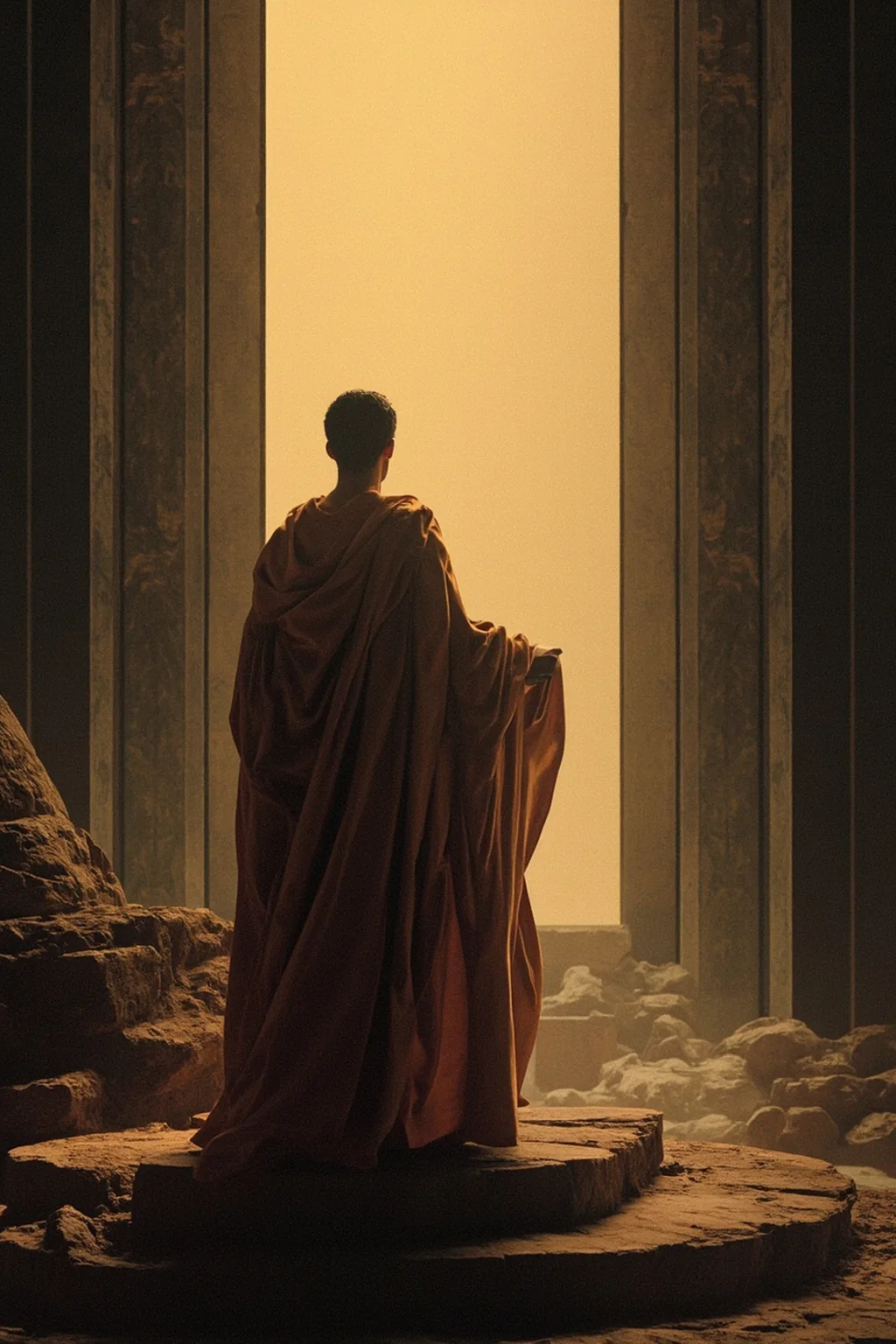
Written during military campaigns at the edges of the empire, the *Meditations* represent a private dialogue between a ruler and his conscience. Marcus Aurelius does not seek to teach a system, but to fortify his own mind against the corruption of power and the fear of death. The work moves from a catalog of gratitude to his teachers to a rigorous metaphysical examination of change, duty, and the rational soul, ultimately concluding that the good life consists in acting justly and accepting fate as a necessary part of the cosmic whole.
He then turns to the acceptance of death, urging a perspective that views dissolution as a natural operation akin to birth, growth, or aging. It is the part of a wise man to wait for death patiently, just as one expects the birth of a child. Marcus suggests that the fear of death can be cured by considering the nature of those one leaves behind. He notes that one is not departing from a community of like-minded men, but rather from a world of differing opinions. The toil of dealing with those who hold contrary beliefs makes death a desirable release, offering an escape from the risk of forgetting oneself in the friction of daily life. He contrasts this with the corruption of the mind, which he deems a far worse plague than any physical distemper, arguing that it is better to die weary of vice than to desire to continue in it.
The text proceeds to explore the natural affinity of rational souls. Marcus observes that just as earthly elements press downward, liquids flow together, and fire tends upward to join, so too do reasonable creatures possess a natural desire for union and society. Even unreasonable animals form flocks and broods, and distant stars maintain a mutual sympathy. However, rational beings are the only creatures who have forgotten this natural affection, often striving to live apart. Despite this scattered tendency, nature ultimately prevails to bring them together, for it is nearly impossible to find a man who can live entirely by himself. Marcus argues that every action must tend toward the perfection of a sociable life. Any action that does not reference the common good is exorbitant, disorderly, and seditious, akin to a citizen dividing himself from the state.
Marcus then addresses the discipline of perception, emphasizing that troubles originate within the mind’s opinions rather than in external events. He advises casting out the fancies that cause distress, noting that the things themselves stand outside without doors, knowing nothing and saying nothing. It is the understanding alone that passes judgment on them, creating the verdict of trouble or harm. He urges the reader to examine the quality of causes stripped of their material accretions and to consider the short duration of their existence. By viewing the perpetual alteration of the universe and the swift succession of generations, one sees that all worldly things are base, filthy, and transient. Whether the world is governed by Providence or by a confusion of atoms, Marcus argues that one can still be well. If governed by Providence, one should submit to its excellent understanding; if by chance, one can use one’s own reason to navigate the circumstances.
The original text of this work is in the public domain. This page focuses on a guided summary article, reading notes, selected quotes, and visual learning materials for educational purposes.