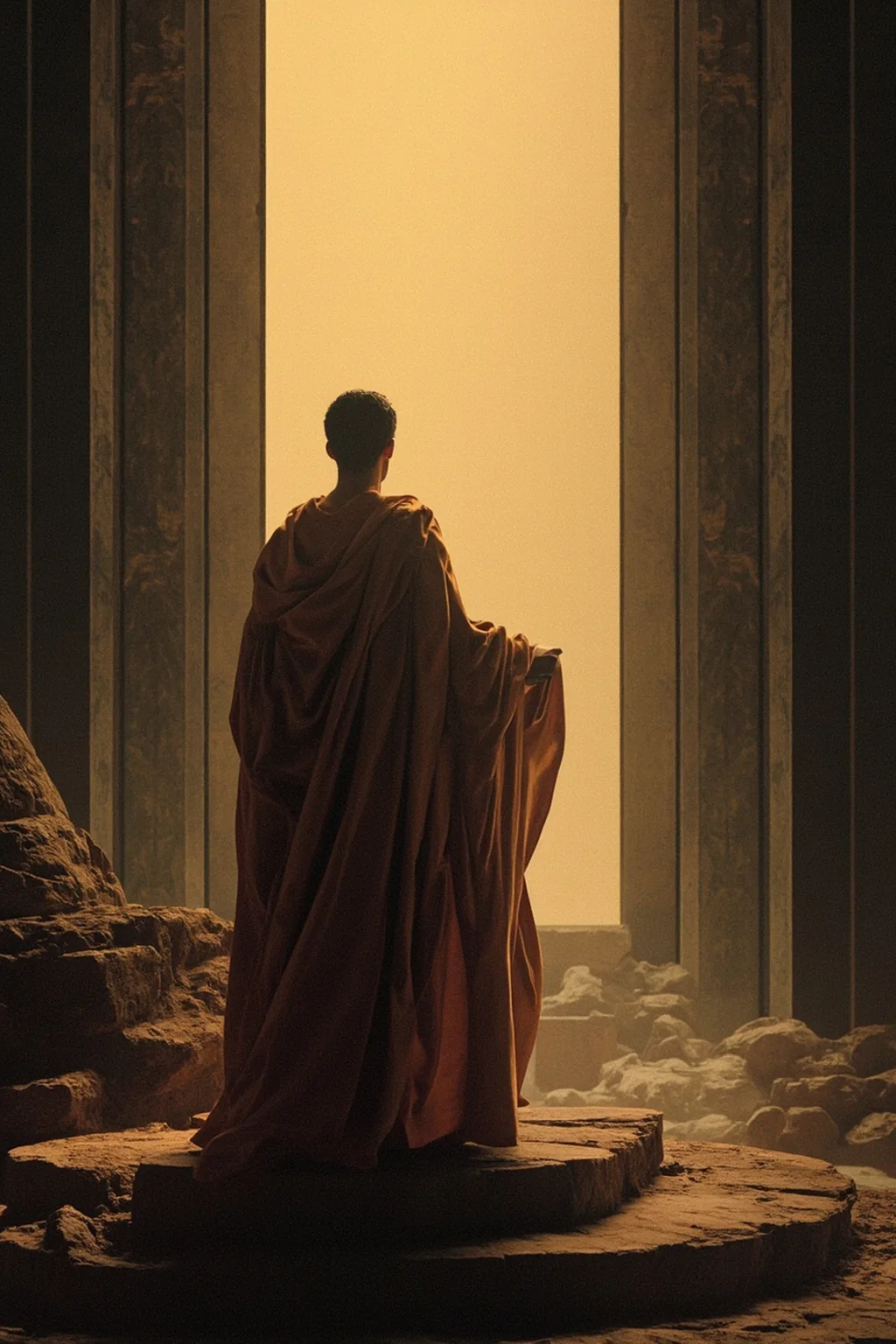
Written during military campaigns at the edges of the empire, the *Meditations* represent a private dialogue between a ruler and his conscience. Marcus Aurelius does not seek to teach a system, but to fortify his own mind against the corruption of power and the fear of death. The work moves from a catalog of gratitude to his teachers to a rigorous metaphysical examination of change, duty, and the rational soul, ultimately concluding that the good life consists in acting justly and accepting fate as a necessary part of the cosmic whole.
In the final movements, Marcus focuses on proper conduct toward others and the nature of prayer. He advises that if one has the power to correct the ignorant, one should teach them; if not, one should bear with them patiently, remembering that the Gods themselves are gracious to such men. He redefines prayer not as asking for external outcomes, such as obtaining pleasures or avoiding pains, but as asking for freedom from the lust for them and the fear of losing them. Citing Epicurus, he urges that in sickness or extremity, one should not abandon philosophy to focus on the body, but strive to keep the mind free from trouble and in possession of its own happiness. When confronted with impudence or vice, Marcus suggests reasoning that such people must exist in the world and that desiring the impossible—a world without them—is foolish. He notes that nature has furnished specific virtues as antidotes to specific vices, such as goodness against unthankfulness. When doing a good turn, one should consider the action itself as the full reward, just as eyes or feet do not demand payment for functioning. A man who does good according to his nature requires no further compensation, for he has simply done what he was made to do.
In the tenth book of his Meditations, Marcus Aurelius turns his gaze inward to examine the soul’s capacity for perfection and its relationship to the vast, deterministic machinery of the cosmos. He opens with an aspirational address to his own soul, envisioning a future state of self-sufficiency where the spirit becomes simpler and more open than the body that encloses it. He describes a condition of complete contentment, where the soul requires no external validation—no pleasure, no time, no human favor—to feel full. In this perfected state, the individual trusts implicitly in the providence of the Gods, viewing the future with the same confidence as the present, understanding that all events contribute to the maintenance of the universal whole. The ultimate goal is a disposition so well-ordered that one neither complains of the divine nor of men, and undertakes no action worthy of condemnation.
From this vision of internal harmony, Aurelius moves to a practical method for testing actions against the hierarchy of nature. He advises the reader to first consider if an action is required by nature in general. If it does not harm one’s existence as a living creature, it may be permissible. Next, one must examine if the action suits a living creature, and finally, if it suits a rational creature. Since reason is inherently sociable, any action that is antisocial or contrary to the community must be rejected. This tripartite test ensures that one’s behavior remains in strict alignment with one’s true constitution.
The original text of this work is in the public domain. This page focuses on a guided summary article, reading notes, selected quotes, and visual learning materials for educational purposes.