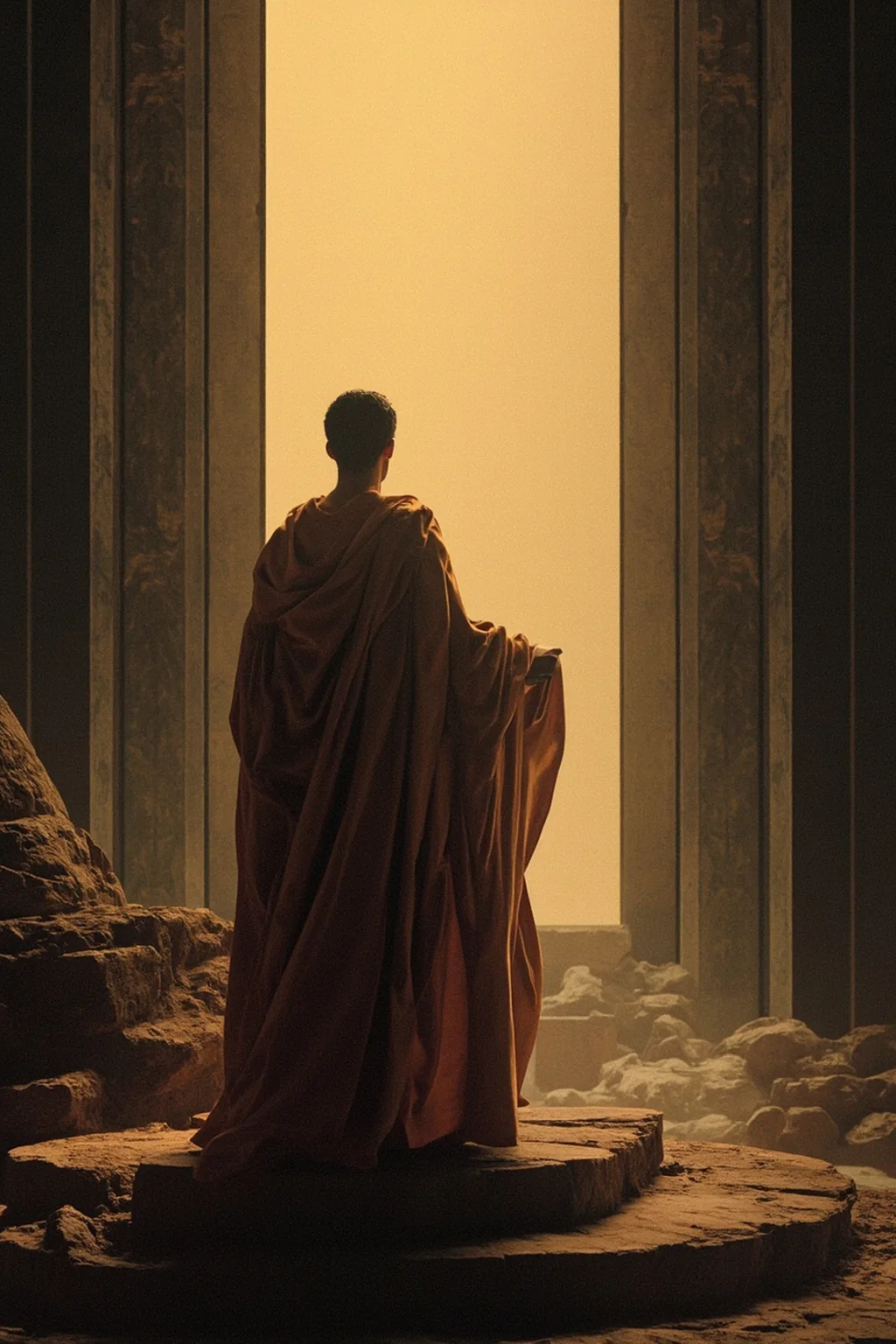
Written during military campaigns at the edges of the empire, the *Meditations* represent a private dialogue between a ruler and his conscience. Marcus Aurelius does not seek to teach a system, but to fortify his own mind against the corruption of power and the fear of death. The work moves from a catalog of gratitude to his teachers to a rigorous metaphysical examination of change, duty, and the rational soul, ultimately concluding that the good life consists in acting justly and accepting fate as a necessary part of the cosmic whole.
Next, he addresses a theological objection regarding the soul: if the Gods are good and just, why are good men never restored to life after death? Marcus counters this by asserting that if it were otherwise, the Gods would have ordered it so. Since the nature of the universe is good, we must trust that the current order is fit and just. He reasons that this (if it be so indeed) would never have been ordered by the Gods had it been fit otherwise. Certainly, it was possible; had it been more just and according to nature, the nature of the universe would easily have borne it. But because it is not so, one must be confident that it was not fit it should be so. He notes that in arguing thus, one is freely arguing and contesting with God, which one would not dare to do if the Gods were not both just and good. If they are just and good, it could not be that in the creation of the world they either unjustly or unreasonably overlooked anything.
Marcus then offers a series of meditations on death and the nature of the universe, designed to strip away the fear of mortality. He proposes three hypotheses regarding fate: it is either absolute necessity, placable providence, or mere confusion. If it is absolute necessity, resistance is useless; if it is placable providence, one should make oneself worthy of the divine help; if it is mere confusion without any moderator or governor, then one has reason to congratulate oneself that in such a general flood of confusion, one possesses a rational faculty whereby one may govern one’s own life and actions. Even if the body or life is carried away by the flood, the mind and understanding cannot be. Should the light of a candle be bright until it is put out, so too should truth, righteousness, and temperance shine in the individual while they have any being.
He reflects on the conceit that another has sinned, urging a reasoned response. One should ask what one knows whether this is a sin indeed, and if it is, realize that the sinner has already condemned himself for it, which is like a man tearing his own face—an object of compassion rather than anger. Furthermore, he who would not have a vicious man to sin is like one who would not have moisture in the fig, nor children to cry, nor a horse to neigh; it is against the nature of the habit. If one has the power and eloquence to remedy it, one should do so.
The original text of this work is in the public domain. This page focuses on a guided summary article, reading notes, selected quotes, and visual learning materials for educational purposes.