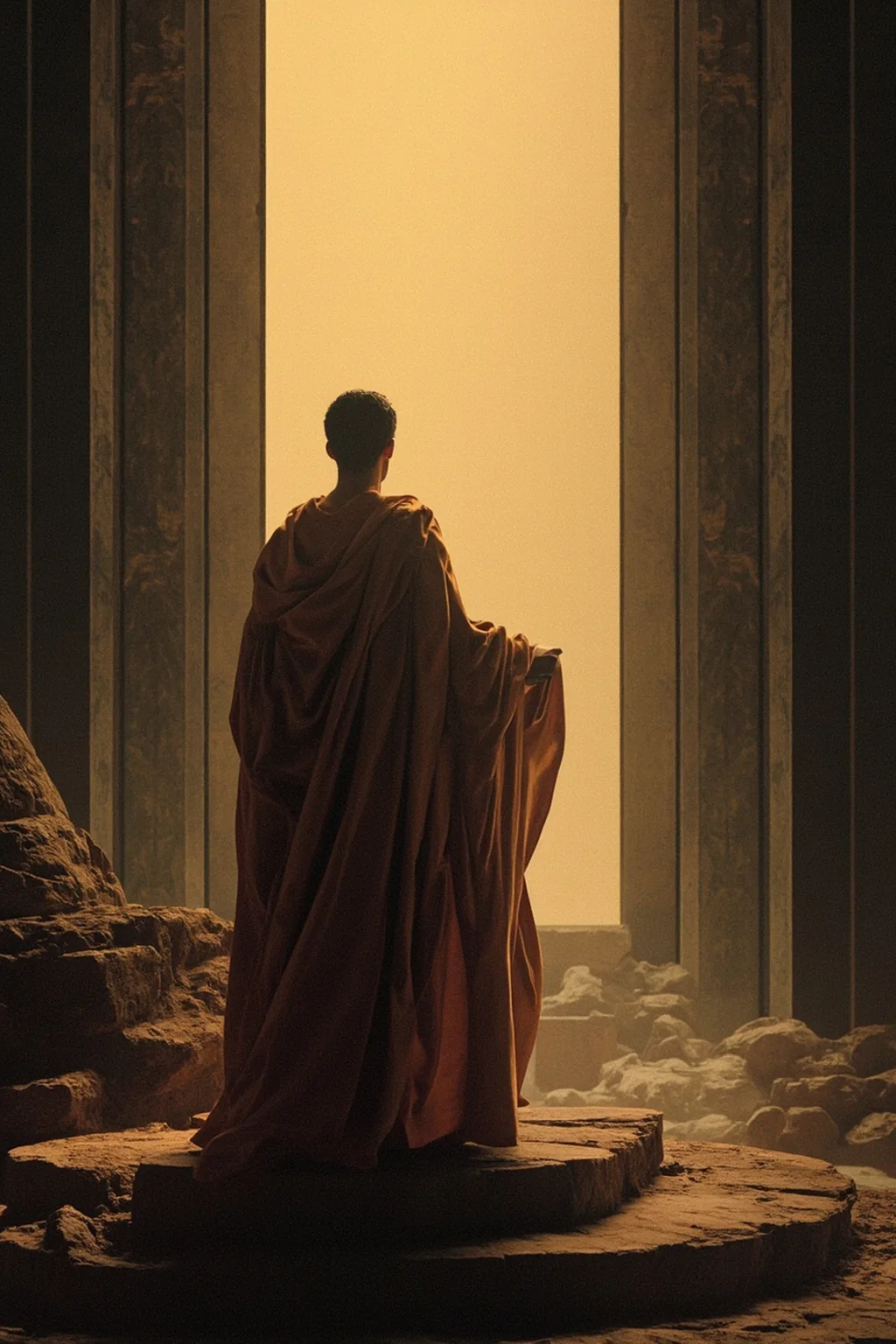
THE SIXTH BOOK
Marcus Aurelius opens by affirming that the matter composing the universe is pliable and tractable, while the rational essence governing it harbors no cause to do evil. This rational principle neither contains nor produces anything harmful, and all events unfold according to its will. The emperor then counsels inner steadiness: whether frozen or warm, sleeping or awake, praised or criticized, dying or acting, the philosopher maintains equanimity, since death itself is simply one duty among life’s actions.
A central teaching is to penetrate appearances and grasp the true worth of things. Marcus recommends vividly imagining foods as the carcasses of fish, birds, and hogs; wine as grape juice; purple robes as sheep’s wool dyed with shellfish blood; and sexual intercourse as a convulsion involving a base entrail. Such mental exercises strip away the jugglery of outward pomp and expose the vileness hidden beneath impressive surfaces. The truly admirable person honors a reasonable soul as such, not wealth, slaves, or craftsmanship for its own sake.
Marcus repeatedly stresses impermanence. All substances hasten to change—some resolving into the whole by exhalation, others scattering into atoms. Our lives, like a sparrow glimpsed and gone, are mere exhalations of blood or breaths of air. He urges the reader to imagine the swift deaths of orators, philosophers, kings, generals, and mathematicians—Heraclitus, Pythagoras, Socrates, Archimedes—reminding us that nothing lasting remains except righteous and loving conduct toward others.
A sustained theme is the distinction between what is and is not within our power. The body cannot itself differentiate between impressions; the mind concerns itself only with present operations. If we treat as good or evil things beyond our will, we shall blame the gods and hate our fellow men. By restricting judgment to our own actions, we eliminate occasion for murmuring against providence or enmity with others. Death is defined as cessation from sense-impressions, passions, mental errors, and bodily servitude.
Philosophy is depicted as a natural mother to whom one constantly returns for comfort, the court being only a stepmother. Marcus exhorts the reader to recall the virtues of companions: the industry of one, the modesty of another, the liberality of a third. He also enjoins imitation of Antoninus Pius—his constancy, equability, sanctity, freedom from vainglory, patient examination, modest lifestyle, and religion without superstition.
Concerning fate and providence, Marcus argues that even those who murmur and resist cooperate with the world’s administration; the whole makes use of whatever materials are available. He holds it impious to believe the gods have not deliberated about human affairs, yet even if they have not, each person retains the power to deliberate. What is expedient for any part is expedient for the whole; Asia, Europe, the sea, and Mount Athos are but corners or drops within a vast eternity.
The book closes with practical maxims: do not conceive impossible things; when reproved, gladly retract toward truth; decline antagonistic encounters as at the palestra without hatred; let honey seem bitter to the jaundice-stricken and a ball seem fine to children, for error forces transgression as powerfully as bile or poison; nothing can happen contrary to the common good; seek to please only oneself through right action. Worship the gods and procure the welfare of men, for this life is short.
THE SEVENTH BOOK
Marcus Aurelius opens by defining wickedness as something already witnessed countless times. The events that disturb us—public spectacles, conflicts, scurrying ants, terrified mice—are not new. Ancient, middle, and modern histories repeat the same patterns: pomp and vanity, disputes, fleeting creatures drawn by wires and nerves. Standing amid this, the philosopher must remain steadfast, judging each person’s worth by what they value rather than by external commotion.
The thread connecting these passages is the sovereignty of reason over perception. Marcus insists that philosophical resolutions remain alive as long as we keep refreshing the representations on which they depend. Whatever happens externally, we can frame it rightly or wrongly; the choice is ours. Even desires for what the gods might grant after death—such as reliving one’s life—can be obtained now by simply seeing the world again with attention.
A second major theme is acceptance of natural order. Words and deeds must be examined individually for their meaning and proper relation. If reason suffices, we act; if not, we either delegate or seek help without shame. The soldier scaling walls does not refuse aid because he cannot climb alone. Future things need not trouble us, because all things are knit together by a sacred bond, forming one cosmos under one God, one substance, one common reason that binds all rational creatures. To resist this order is to resist what is most natural.
This extends to the dissolution of bodies and the recycling of matter. Material substance returns to the whole; formal nature returns to the common reason; fame is swallowed by the age of the world. For rational creatures, action according to nature is automatically action according to reason. “Straight of itself, not made straight” captures the ideal: virtue as inherent rather than imposed. Marcus distinguishes being a μέλος (member) of the rational body from being merely a μέρος (part); true philanthropy flows from understanding, not from seeing charity as merely convenient.
External accidents cannot harm us unless we judge them evil. Like an emerald maintaining its color regardless of what is said or done, we must be constant for our own nature’s sake, not for others’. The understanding, if it does not disturb itself through false opinion, needs nothing else and cannot be troubled. Happiness is identified as a “good daemon”—a guiding spirit—while false opinion is expelled like a troublesome intruder that no longer deceives.
Change is not to be feared; everything that exists owes its being to change, just as baths require fuel to be transformed and food to be digested. Death is simply change on the same principle. Chrysippus, Socrates, Epictetus—all long since absorbed by time. Practical advice follows: focus on doing nothing contrary to human constitution; love those who transgress, recognizing they act from ignorance and will soon perish; examine others’ assumptions before judging them; wipe off opinion; circumscribe the present moment; love mankind and obey God.
Drawing on Plato and Antisthenes, Marcus describes true magnanimity as viewing life from above—observing flocks, armies, marriages, divorces, courts, festivals—seeing how contrary things conspire into cosmic harmony. He likens life to a wrestler’s stance rather than a dancer’s: ready for what falls, not preparing for performance. The Stoic sage spends each day as if it were his last, neither heated nor cold, free of dissimulation. Even amid wild beasts tearing at the body, the mind retains tranquility by judging events according to their true nature and finding in every present object fit material for reason and charity.
The original text of this work is in the public domain. This page offers a compressed quick-read summary for educational purposes.