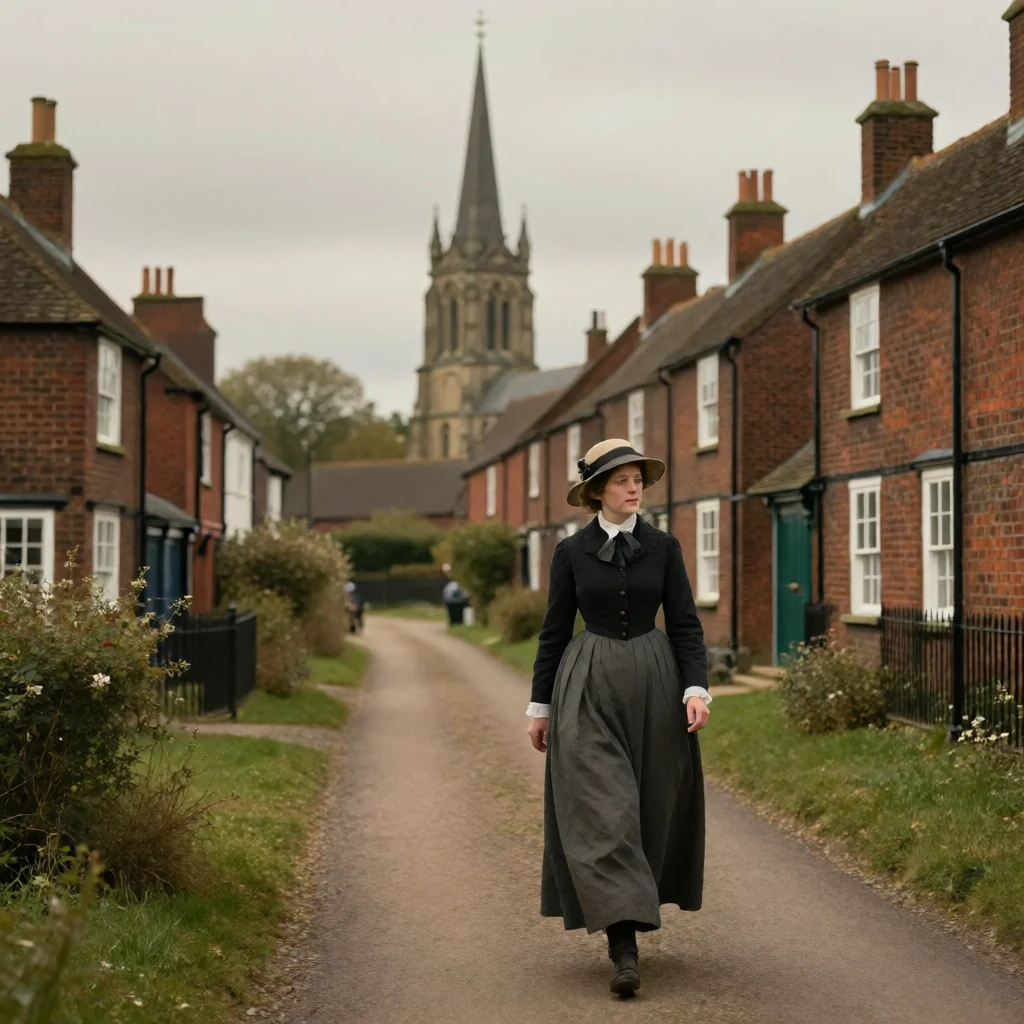
Dorothea’s Conflicted Longings En Route
As she passes Will, Dorothea is pierced by a pang of regret at leaving him behind, and fights the urge to look back. She is torn between persistent longings: she wishes she had understood Will’s feelings earlier so they could have found happiness in mutual thought despite being parted, and wishes she could give him money to ease his struggles in the world. Yet these wishes are countered by the overwhelming weight of societal opinion and the barrier her late husband placed between them, leaving her certain she could never defy these constraints to pursue a closer relationship with Will.
Will’s Bitter Resignation as Dorothea Passes Him
As Dorothea’s carriage grows smaller in the distance, Will is consumed by bitter resignation. His sensitive mood is easily wounded by the sight of her driving past in comfort while he plods along as a struggling man seeking a foothold in a world that offers him little, making his decision to leave feel like a cruel necessity rather than a principled choice. With no assurance that Dorothea loves him, he feels he bears all the pain of their parting alone, with no comfort to sustain his resolve.
Will Departs Middlemarch After Staying with the Lydgates
Will spends his final evening in Middlemarch with the Lydgates, and departs the town the following day.
BOOK VII.
Book VII presents a chapter devoted to examining two distinct temptations, a thematic structure that promises to explore contrasting trials or moral challenges faced within the narrative. The title “TWO TEMPTATIONS” indicates the chapter will systematically address these challenges, likely revealing their distinct natures and the ways in which they test the characters involved.
Two Temptations
The section presents two distinct temptations that serve as trials or challenges within the narrative framework. These temptations likely test the characters’ virtue, resolve, or moral standing, providing a structure for examining human weakness and the difficulty of maintaining principles under pressure. The title itself signals the thematic importance of temptation as a central concern of this portion of the text.
CHAPTER LXIII.
This chapter continues the narrative of Middlemarch society’s observation of Lydgate, depicting the gossip about his financial circumstances, Farebrother’s growing concern, and the significant New Year’s party at the Vincy household where crucial character dynamics are revealed.
Gossip About Lydgate’s Practice and Expenses
At Mr. Toller’s Christmas dinner party, medical men and local gentlemen discuss Lydgate with varying degrees of respect and skepticism. Mr. Toller questions whether Lydgate justifies the attention he receives, and Mr. Harry Toller observes that Lydgate has been “living at a great rate for a young beginner,” wondering if his northern relations are financing his lifestyle. Dr. Minchin diplomatically notes that Lydgate has sent “the cream of Peacock’s patients” to both Toller and Wrench, essentially feeding his rivals’ practices. Mr. Chichely reveals that old Mr. Vincy had reservations about the marriage to Rosamond, hinting at family disapproval of the match. Mr. Toller’s final sarcastic remark—“I shouldn’t think Lydgate ever looked to practice for a living”—suggests that the medical community suspects Lydgate has resources or expectations beyond what his practice generates.
Mr. Farebrother’s Concern for Lydgate
Mr. Farebrother has heard persistent hints that Lydgate’s expenses exceed what his practice can reasonably support, though he hopes there may be resources or expectations that justify such spending. Driven by concern, the Vicar visits Lydgate specifically to offer friendship and conversation. He finds Lydgate changed: instead of his usual easy silence or abrupt energy when speaking, Lydgate displays an agitated restlessness. He talks extensively about biological theories, but lacks the focused, methodical quality that previously characterized his scientific discussions. When they move to the drawing room and Rosamond plays music, Lydgate sinks into silence with strange light in his eyes. Farebrother suspects possible illness—opiate use, neuralgia, or medical worries—but does not consider that his marriage might be failing. He believes, like others, that Rosamond is merely amiable and docile, though he finds her uninteresting.
The original text of this work is in the public domain. This page focuses on a guided summary article, reading notes, selected quotes, and visual learning materials for educational purposes.