BOOK IV.
THREE LOVE PROBLEMS.
CHAPTER XXXIV.
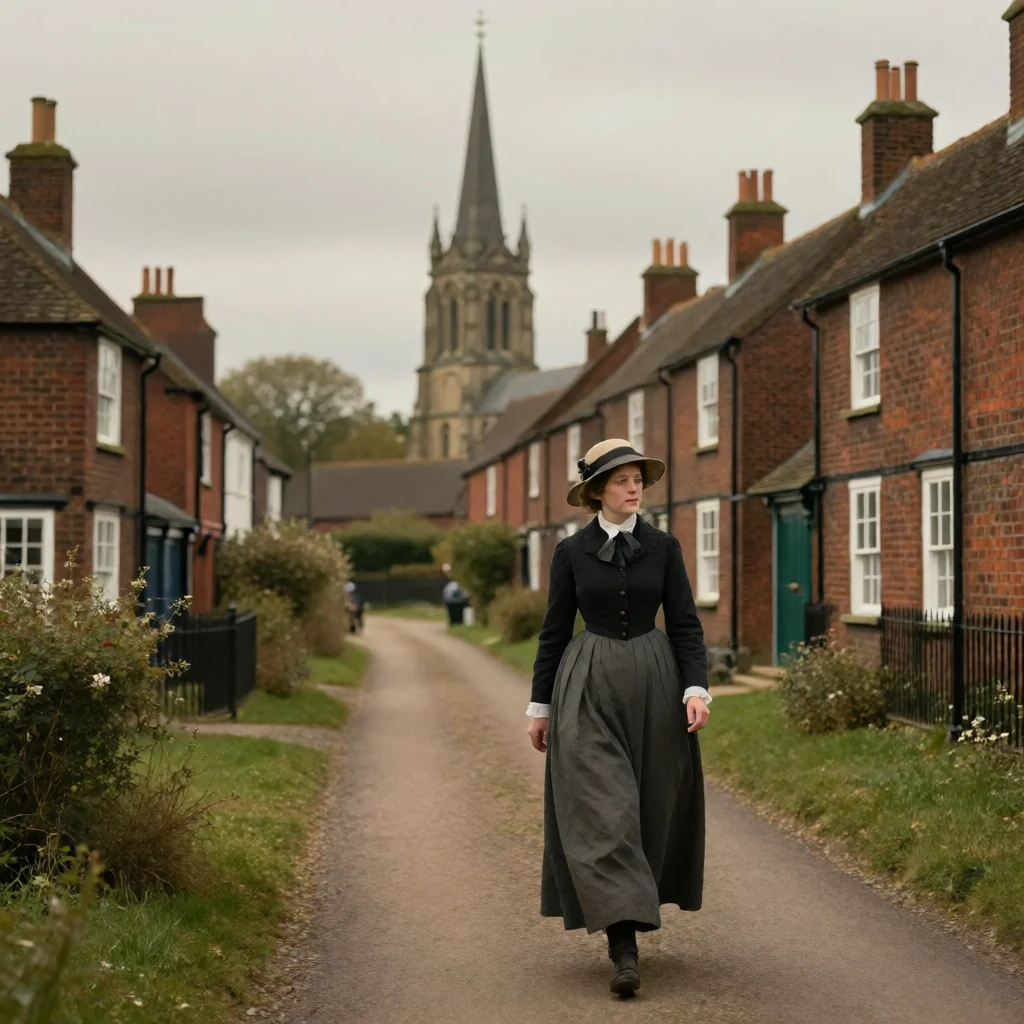
It was on a morning of May that Peter Featherstone was buried. In the prosaic neighborhood of Middlemarch, May was not always warm and sunny, and a chill wind was blowing the blossoms from the surrounding gardens on to the green mounds of Lowick churchyard. The news had spread that it was to be a “big burying”; the old gentleman had left written directions about everything and meant to have a funeral “beyond his betters.” Three mourning-coaches were filled according to the written orders of the deceased. There were pall-bearers on horseback, with the richest scarves and hatbands. Mr. Cadwallader met the procession, also according to the request of Peter Featherstone, who had a contempt for curates and an objection to a parson stuck up above his head preaching to him.
This distinction conferred on the Rector of Tipton and Freshitt was the reason why Mrs. Cadwallader made one of the group that watched from an upper window of the manor. She was not fond of visiting that house, but she liked, as she said, to see collections of strange animals such as there would be at this funeral.
“Quite right to feel obliged to me,” said Mrs. Cadwallader to Dorothea. “Your rich Lowick farmers are as curious as any buffaloes or bisons.”
“How piteous!” said Dorothea, watching the procession. “This funeral seems to me the most dismal thing I ever saw. It is a blot on the morning. I cannot bear to think that any one should die and leave no love behind.”
Then her husband entered and seated himself a little in the background. She saw Mr. Brooke arrive, announcing his own news: Will Ladislaw was come, and was his guest at the Grange. Dorothea felt a shock of alarm: every one noticed her sudden paleness as she looked up immediately at her uncle, while Mr. Casaubon looked at her.
“He came with me, you know; he is my guest—puts up with me at the Grange,” said Mr. Brooke, in his easiest tone. “And we have brought the picture at the top of the carriage. I knew you would be pleased with the surprise, Casaubon. There you are to the very life—as Aquinas, you know.”
Mr. Casaubon bowed with cold politeness, mastering his irritation. Dorothea felt that every word of her uncle’s was about as pleasant as a grain of sand in the eye to Mr. Casaubon. It would be altogether unfitting now to explain that she had not wished her uncle to invite Will Ladislaw.
“A very pretty sprig,” said Mrs. Cadwallader, dryly, after Celia pointed out Will. “What is your nephew to be, Mr. Casaubon?”
“Pardon me, he is not my nephew. He is my cousin.”
CHAPTER XXXV.
The same sort of temptation befell the Christian Carnivora who formed Peter Featherstone’s funeral procession; most of them having their minds bent on a limited store which each would have liked to get the most of. Solomon found time to reflect that Jonah was undeserving, and Jonah to abuse Solomon as greedy; Jane held that Martha’s children ought not to expect so much as the young Waules; and Martha was sorry to think that Jane was so “having.”
But in the morning all the ordinary currents of conjecture were disturbed by the presence of a strange mourner who had plashed among them as if from the moon. This was the stranger described by Mrs. Cadwallader as frog-faced: a man perhaps about two or three and thirty, whose prominent eyes, thin-lipped downward-curved mouth, and hair sleekly brushed away from a forehead that sank suddenly above the ridge of the eyebrows, certainly gave his face a batrachian unchangeableness of expression. This was Mr. Rigg.
The lawyer, Mr. Standish, had come to Stone Court believing that he knew thoroughly well who would be pleased and who disappointed before the day was over. The will he expected to read was the last of three which he had drawn up for Mr. Featherstone. But he found a subsequent instrument, and a codicil to that.
The small bequests came first, and even the recollection that there was another will could not quell the rising disgust and indignation. One likes to be done well by in every tense, past, present, and future. Here was Peter capable of leaving only two hundred apiece to his own brothers and sisters, and only a hundred apiece to his own nephews and nieces: the Garths were not mentioned, but Mrs. Vincy and Rosamond were each to have a hundred. Mr. Trumbull was to have the gold-headed cane and fifty pounds.
Then came the residue. Ten thousand pounds in specified investments were declared to be bequeathed to Fred Vincy. There was still a residue of personal property as well as the land, but the whole was left to one person, and that person was—Joshua Rigg, who was also sole executor, and who was to take thenceforth the name of Featherstone.
There was a rustling which seemed like a shudder running round the room. Every one stared afresh at Mr. Rigg, who apparently experienced no surprise. But there was a second will. The second will revoked everything except the legacies to the low persons before mentioned, and the bequest of all the land lying in Lowick parish with all the stock and household furniture, to Joshua Rigg. The residue of the property was to be devoted to the erection and endowment of almshouses for old men, to be called Featherstone’s Alms-Houses, he wishing—so the document declared—to please God Almighty. Nobody present had a farthing; but Mr. Trumbull had the gold-headed cane.
Mr. Vincy was the first to speak, with loud indignation. “The most unaccountable will I ever heard! I should say this last will was void.” But Mr. Standish replied that everything was quite regular. “Anybody might have had more reason for wondering if the will had been what you might expect from an open-minded straightforward man. For my part, I wish there was no such thing as a will,” said Caleb Garth. Fred, whom he no longer moved to laughter, thought him the lowest monster he had ever seen. But Fred was feeling rather sick.
In the hall, Mary met Fred. He had that withered sort of paleness which will sometimes come on young faces, and his hand was very cold when she shook it. “Good-by,” she said, with affectionate sadness. “Be brave, Fred. I do believe you are better without the money. What was the good of it to Mr. Featherstone?” “What is a fellow to do? I must go into the Church now,” said Fred, pettishly. “What shall you do now, Mary?” “Take another situation, of course, as soon as I can get one. Good-by.”
The original text of this work is in the public domain. This page focuses on a guided summary article, reading notes, selected quotes, and visual learning materials for educational purposes.