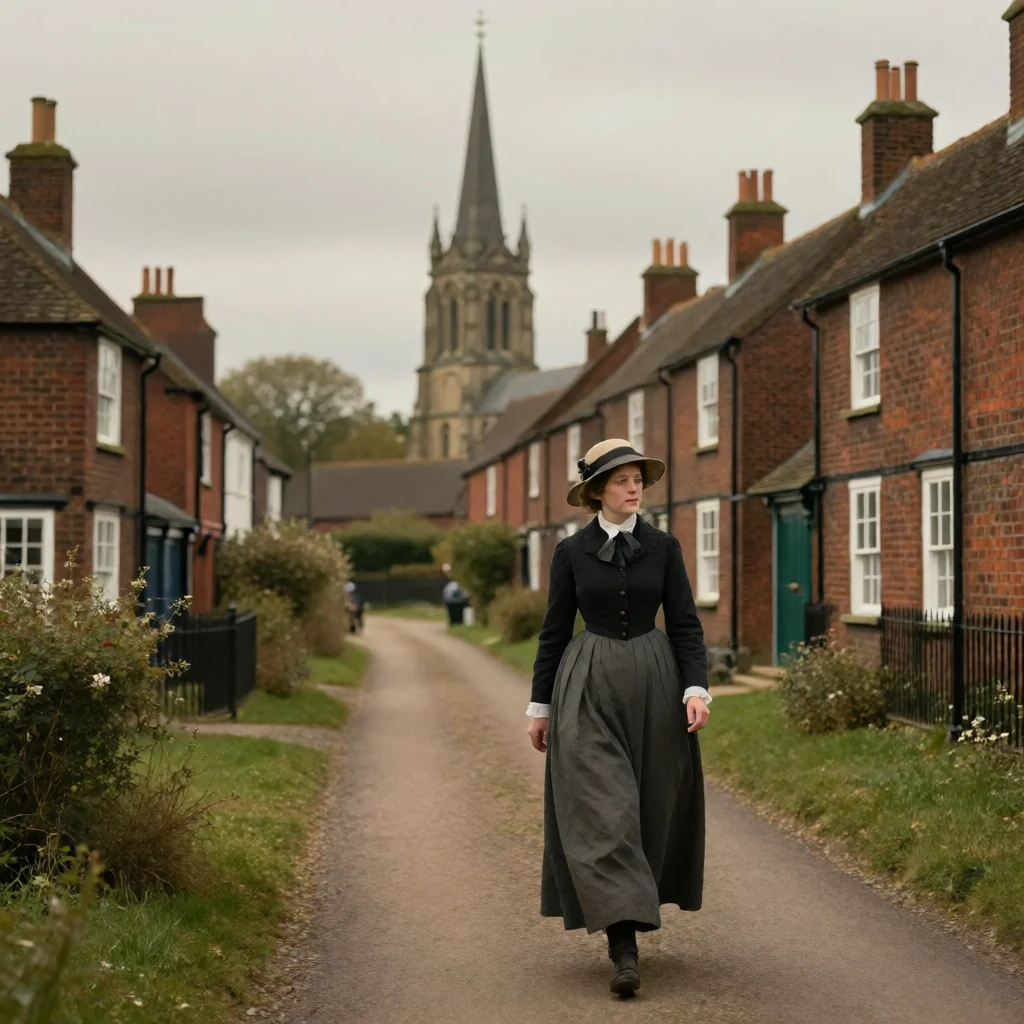
The gray day has turned to a light drizzling rain. Raffles, looking as incongruous amid the moist rural quiet as a baboon escaped from a menagerie, makes his way to the highroad. He is overtaken by the stage-coach, which carries him to Brassing; there he takes the new-made railway, observing to his fellow-passengers that he considers it pretty well seasoned now it had done for Huskisson. And in his pocket, snugged against the brandy-flask, lies Bulstrode’s letter—a bit of ink and paper which may yet, by curious little links of effect, become the opening of a catastrophe.
CHAPTER XLII.
Mr. Casaubon had never put any question to Lydgate about the true nature of his illness — not to his doctor, not even to his wife. To be pitied was intolerable to his pride; to confess alarm an indignity he could not bear. And yet lately the question had begun to press upon him with a savage urgency, for his mind had fastened on something worse than any illness — the suspicion that his young wife, Dorothea, was no longer the adoring disciple who had married him, but a woman grown critical, and that his young cousin Will Ladislaw, with his flippant air and his perpetual nearness to her, was somehow at the centre of the change. So one bright afternoon in autumn, with the limes dropping their leaves upon the yew-trees in long silence, Casaubon paced the gravel walk and waited for Lydgate. He framed his request in the formal measured language of a man who would rather die than show fear. Lydgate, struck by the bent scholar before him — “poor fellow,” he thought, “some men with his years are like lions” — answered with the plain honesty Casaubon’s dignity deserved. He was suffering from fatty degeneration of the heart, a disease only lately understood since Laennec and the stethoscope. Death from it was often sudden; it might also be the slow companion of many more years. Casaubon asked whether Dorothea knew; on learning that she did in part, he waved his hand and wished to be alone. Dorothea, meeting him on his return, took his arm in silence; he kept his hands behind his back and let her pliant arm cling against his rigid one. They entered the house; he shut himself in the library. In her boudoir Dorothea sank into a chair and felt, for the first time in her marriage, a rebellious anger: “What have I done — what am I — that he should treat me so? He wishes he had never married me.” She heard herself, and was checked into stillness. By evening, the anger had ebbed into a mournful lucidity; she stole to the staircase to wait for him with a light. He came up, haggard, and said with gentle surprise, “Dorothea! Were you waiting for me?” She put her hand into his; they went along the corridor together, the quarrel unspoken and unhealed, but for the moment laid to rest.
BOOK V.
THE DEAD HAND.
CHAPTER XLIII.
Two days later Dorothea drove to Lydgate’s house under cover of a small errand of charity, hoping to learn her husband’s true state. Lydgate was out. Mrs. Lydgate would see her. Through an open window she had heard a man’s voice singing, a piano answering him in roulades; the music broke off as she entered. In the drawing-room she faced a contrast fit for the stage: herself in a thin white woollen pelisse that always seemed to smell of sweet hedges, and Rosamond Lydgate, tall and pale-blond, in a pale-blue dress so perfectly cut that no dressmaker could have viewed it without emotion. Will Ladislaw stood in the background, hat in hand. Will offered to fetch Lydgate; Dorothea coloured, and with a sudden sense that any further intercourse with Will was a deception toward her husband, said she would drive to the Hospital herself. She took his offered arm in silence, was handed into the carriage, and drove away. Will, left behind with Rosamond, felt the mortification keenly — his chances of meeting Dorothea were rare, and here one had come only to set him at a distance. He asked, a little sulkily, whether he might come again and finish “Lungi dal caro bene.” Rosamond dimpled and said, “Is Mrs. Casaubon very clever? She looks as if she were.” When Lydgate came home she took his coat-collar in both her small ringed hands and reported that Will seemed to adore Mrs. Casaubon. Lydgate pinched her ears and said, “Poor devil!” Mrs. Casaubon had wanted merely to ask about her husband’s health, but Lydgate thought she would give two hundred a year to the New Hospital.
The original text of this work is in the public domain. This page focuses on a guided summary article, reading notes, selected quotes, and visual learning materials for educational purposes.