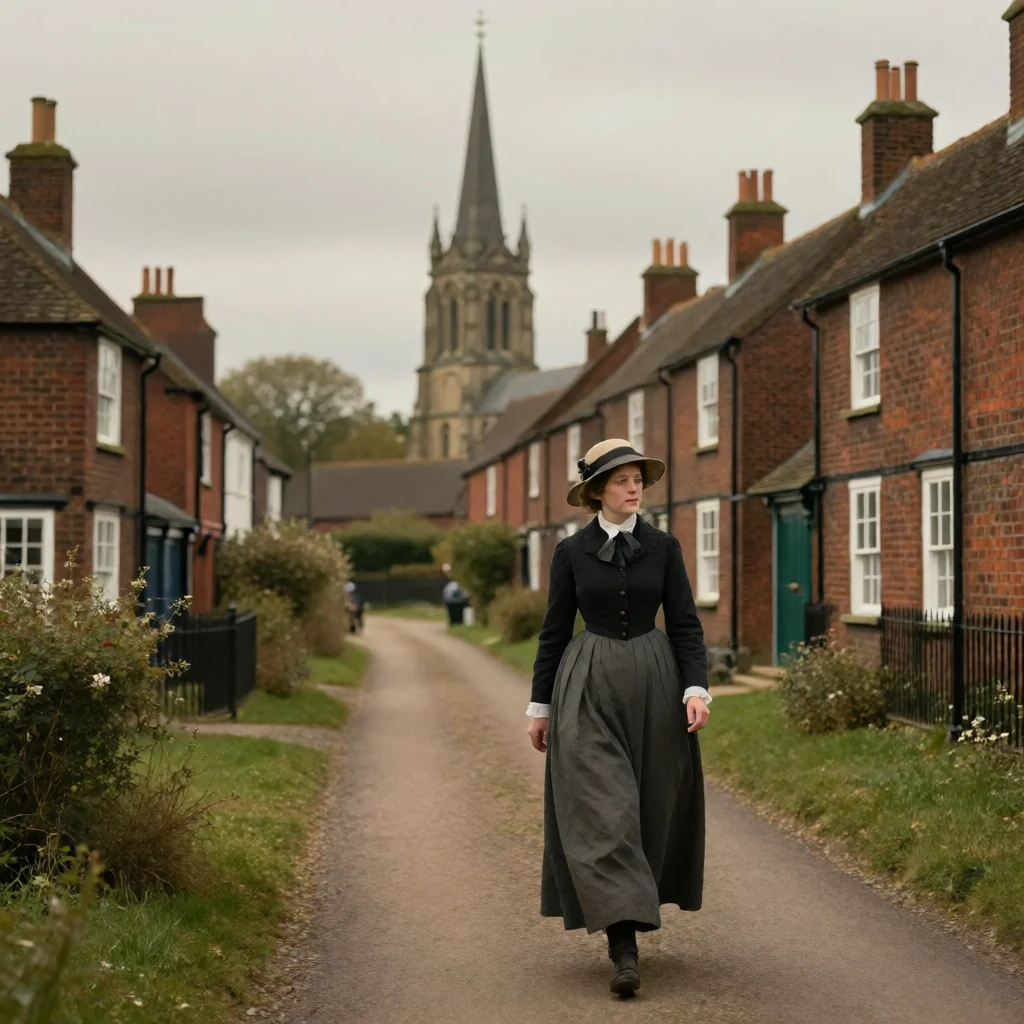
Lydgate produced Dover’s account, marked to show how the debt could be reduced by thirty pounds if certain articles were returned. He had not marked any of the jewellery. “It is useless for me to look, Tertius. You will return what you please,” Rosamond said, not turning her eyes on the paper. Lydgate drew it back. Then Rosamond went out, returning with the leather box containing the amethysts and other boxes. “This is all the jewellery you ever gave me. You can return what you like of it, and of the plate also.” She announced she should go to papa’s. “And when shall you come back again?” said Lydgate. “In the evening. Of course I shall not mention the subject to mamma.” Lydgate said, “Since you are my wife, there is no hindering your share in my disgraces—if there were disgraces.” Rosamond, after a moment, said, “Very well, I will stay at home.” But Lydgate could not help looking forward with dread to the inevitable future discussions about expenditure.
CHAPTER LIX.
News is often dispersed as thoughtlessly and effectively as pollen which the bees carry off when they are buzzing in search of their particular nectar. This fine comparison has reference to Fred Vincy, who on that evening at Lowick Parsonage heard a discussion among the ladies on the news their old servant had got from Tantripp concerning Mr. Casaubon’s strange mention of Mr. Ladislaw in a codicil to his will made not long before his death.
Fred knew little and cared less about Ladislaw and the Casaubons, but one day calling on Rosamond at his mother’s request, he mentioned what he had heard. Now Lydgate, like Mr. Farebrother, knew a great deal more than he told, and he imagined there was a passionate attachment on both sides. He did not trust Rosamond’s reticence towards Will. When she repeated Fred’s news, he said, “Take care you don’t drop the faintest hint to Ladislaw, Rosy.”
But the next time Will came when Lydgate was away, Rosamond spoke archly about his not going to London. “I know all about it. I have a confidential little bird.” “Great God! what do you mean?” said Will, flushing over face and ears. “Don’t joke; tell me what you mean.” “You don’t really know?” said Rosamond. “No!” he returned, impatiently. “Don’t know that Mr. Casaubon has left it in his will that if Mrs. Casaubon marries you she is to forfeit all her property?” “How do you know that it is true?” said Will, eagerly. “My brother Fred heard it from the Farebrothers.”
Will started up from his chair and reached his hat. “Pray don’t say any more about it,” he said, in a hoarse undertone extremely unlike his usual light voice. “It is a foul insult to her and to me.” Then he sat down absently, looking before him, but seeing nothing. “I expect to hear of the marriage,” said Rosamond, playfully. “Never! You will never hear of the marriage!” Will rose, put out his hand to Rosamond, and went away. When he was gone, Rosamond walked to the other end of the room, leaning against a chiffonniere, looking out of the window wearily. She was oppressed by ennui, thinking of the family at Quallingham, who did not write to her.
CHAPTER LX.
A few days afterward, there was an occasion causing some excitement in Middlemarch: the public was to have the advantage of buying, under the distinguished auspices of Mr. Borthrop Trumbull, the furniture, books, and pictures belonging to Edwin Larcher, Esq., who had made a great success in the carrying business. A large sale was regarded as a kind of festival in those times. Mr. Borthrop Trumbull, mounted with desk and hammer, his acquaintance with the history of art enabling him to point out that the hall furniture comprised a piece of carving by a contemporary of Gibbons, was in his element.
Mrs. Bulstrode had particularly wished to have a certain picture—a “Supper at Emmaus,” attributed in the catalogue to Guido. Mr. Bulstrode had called at the office of the “Pioneer” to beg of Mr. Ladislaw as a great favor that he would use his remarkable knowledge of pictures on her behalf. Will replied that he had reasons for deferring his departure and would be happy to go to the sale.
Will was in a defiant mood, his consciousness deeply stung with the thought that the people who looked at him probably knew a fact tantamount to an accusation against him. He stood in a conspicuous place not far from the auctioneer, with a fore-finger in each side-pocket and his head thrown backward. When the “Supper at Emmaus” was brought forward, the auctioneer turned it toward him. “Five pounds,” said Will. Trumbull burst out in remonstrance. The bidding was brisk, and Will, remembering that Mrs. Bulstrode had a strong wish for the picture, continued to share in it. It was knocked down to him at ten guineas, and he pushed his way toward the bow-window and went out.
He chose to go under the marquee to get a glass of water, being hot and thirsty. Before the woman in attendance was well gone, he was annoyed to see entering the florid stranger who had stared at him. Mr. Raffles moved a step or two till he was in front of Will, and said with full-mouthed haste, “Excuse me, Mr. Ladislaw—was your mother’s name Sarah Dunkirk?” Will, starting to his feet, moved backward a step, frowning. “Yes, sir, it was. And what is that to you?” Raffles, who never hesitated to thrust himself on unwilling observation, said he had known Sarah when she was a girl, and that Will was the very image of his father. “Parents alive, Mr. Ladislaw?” “No!” thundered Will. Raffles, who had lifted his hat, turned himself round with a swing of his leg and walked away.
Later in the evening, however, Raffles overtook him in the street and walked by his side. He told Will he had travelled for Sarah’s family in a gentlemanly way at a high salary, and that they hadn’t minded her running away at first—godly folks, very godly. “What do you say, Mr. Ladislaw?—shall we turn in and have a glass?” “No, I must say good evening,” said Will, dashing up a passage which led into Lowick Gate, and almost running to get out of Raffles’s reach.
He walked a long while on the Lowick road away from the town, glad of the starlit darkness when it came. He felt as if he had had dirt cast on him amidst shouts of scorn. There was this to confirm the fellow’s statement—that his mother never would tell him the reason why she had run away from her family. Well! what was he, Will Ladislaw, the worse, supposing the truth about that family to be the ugliest? His mother had braved hardship in order to separate herself from it. But if Dorothea’s friends had known this story, they would have had a fine color to give their suspicions a welcome ground. However, let them suspect what they pleased, they would find themselves in the wrong.
The original text of this work is in the public domain. This page focuses on a guided summary article, reading notes, selected quotes, and visual learning materials for educational purposes.