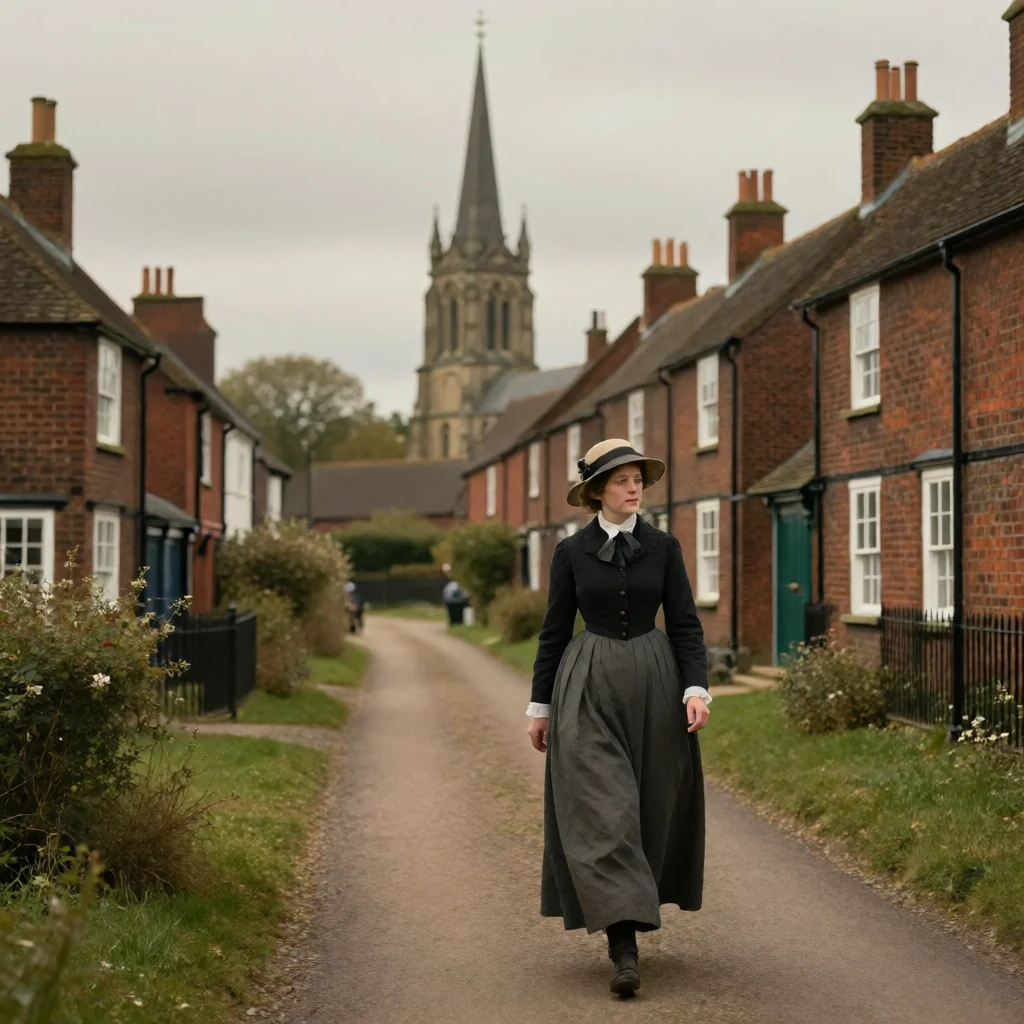
CHAPTER LXII.
Will Ladislaw’s mind was now wholly bent on seeing Dorothea again, and forthwith quitting Middlemarch. The morning after his scene with Bulstrode he wrote a brief letter to her, asking permission to call once more at Lowick. He felt the awkwardness of asking for more last words, but on the whole it was more satisfactory to take the directest means of seeing her than to use any device which might give an air of chance to a meeting.
Dorothea on that morning was not at home. She had driven first to Freshitt to carry the news of her uncle’s return, meaning to go on to the Grange. There, Sir James, anxious to learn Ladislaw’s movements and to forestall any further meetings, had sent for Mrs. Cadwallader and instructed her to drop a hint about Will’s lingering in the neighborhood. When Dorothea met them on the gravel, the rector’s wife spread the palms of her hands outward and remarked that the brilliant young Ladislaw was making a sad dark-blue scandal by warbling continually with Mr. Lydgate’s wife, who was as pretty as pretty could be. Dorothea flushed, her lip trembled, and she said with indignant energy: “I will not hear any evil spoken of Mr. Ladislaw; he has already suffered too much injustice.” She drove away between the berried hedgerows, the tears rolling down her cheeks, a remembrance thrusting itself upon her of the day she had found Will with Mrs. Lydgate. “He said he would never do anything that I disapproved,” she thought, “I wish I could have told him that I disapproved of that.”
At the Grange, the housekeeper told her that Mr. Ladislaw was in the library, looking for something. Dorothea’s heart seemed to turn over, but she asked Mrs. Kell to go in first and tell him that she was there. When she entered, consciousness was overflowed by something that suppressed utterance. She moved automatically towards her uncle’s chair, and Will drew it out a little for her. “Pray sit down,” she said. “I am very glad you were here.”
Will told her he was going away immediately, and could not go without speaking to her once more. He had been grossly insulted in her eyes and in the eyes of others; there had been a mean implication against his character. “Under no circumstances would I have lowered myself by giving men the chance of saying that I sought money under the pretext of seeking something else. There was no need of other safeguard against me, the safeguard of wealth was enough.” He rose and went to the window. Dorothea, hurt, moved to her old place in that window and said, “Do you suppose that I ever disbelieved in you?” When Will saw her there he gave a start and moved backward out of the window without meeting her glance.
They were wasting these last moments in wretched silence. Will at last said, “There are certain things which a man can only go through once in his life. What I care more for than I can ever care for anything else is absolutely forbidden to me, forbidden, even if it were within my reach, by my own pride and honor, by everything I respect myself for.” Dorothea stood silent, her eyes cast down dreamily, while images crowded upon her which left the sickening certainty that Will was referring to Mrs. Lydgate.
When the footman came to say the horses were ready, Will said he must go, the day after to-morrow he would leave Middlemarch. “You have acted in every way rightly,” Dorothea said, in a low tone, feeling a pressure at her heart. She put out her hand, and Will took it for an instant. Their eyes met, but there was discontent in his, and in hers only sadness. He turned away and took his portfolio. “I have never done you injustice. Please remember me,” said Dorothea, repressing a rising sob. “Why should you say that?” said Will, with irritation. “As if I were not in danger of forgetting everything else.” He had really a movement of anger against her at that moment, and went away without pause.
Dorothea sank into the chair, and for a few moments sat like a statue. Joy came first, in spite of the threatening train behind it, joy in the impression that it was really herself whom Will loved and was renouncing, that there was really no other love less permissible, more blameworthy, which honor was hurrying him away from. They were parted all the same, but Dorothea drew a deep breath and felt her strength return. She could think of him unrestrainedly. At that moment the parting was easy to bear.
After a turn of the road, there he was with the portfolio under his arm; but the next moment she was passing him while he raised his hat, and she felt a pang at being seated there in a sort of exaltation, leaving him behind. That evening Will spent with the Lydgates; the next evening he was gone.
The original text of this work is in the public domain. This page focuses on a guided summary article, reading notes, selected quotes, and visual learning materials for educational purposes.