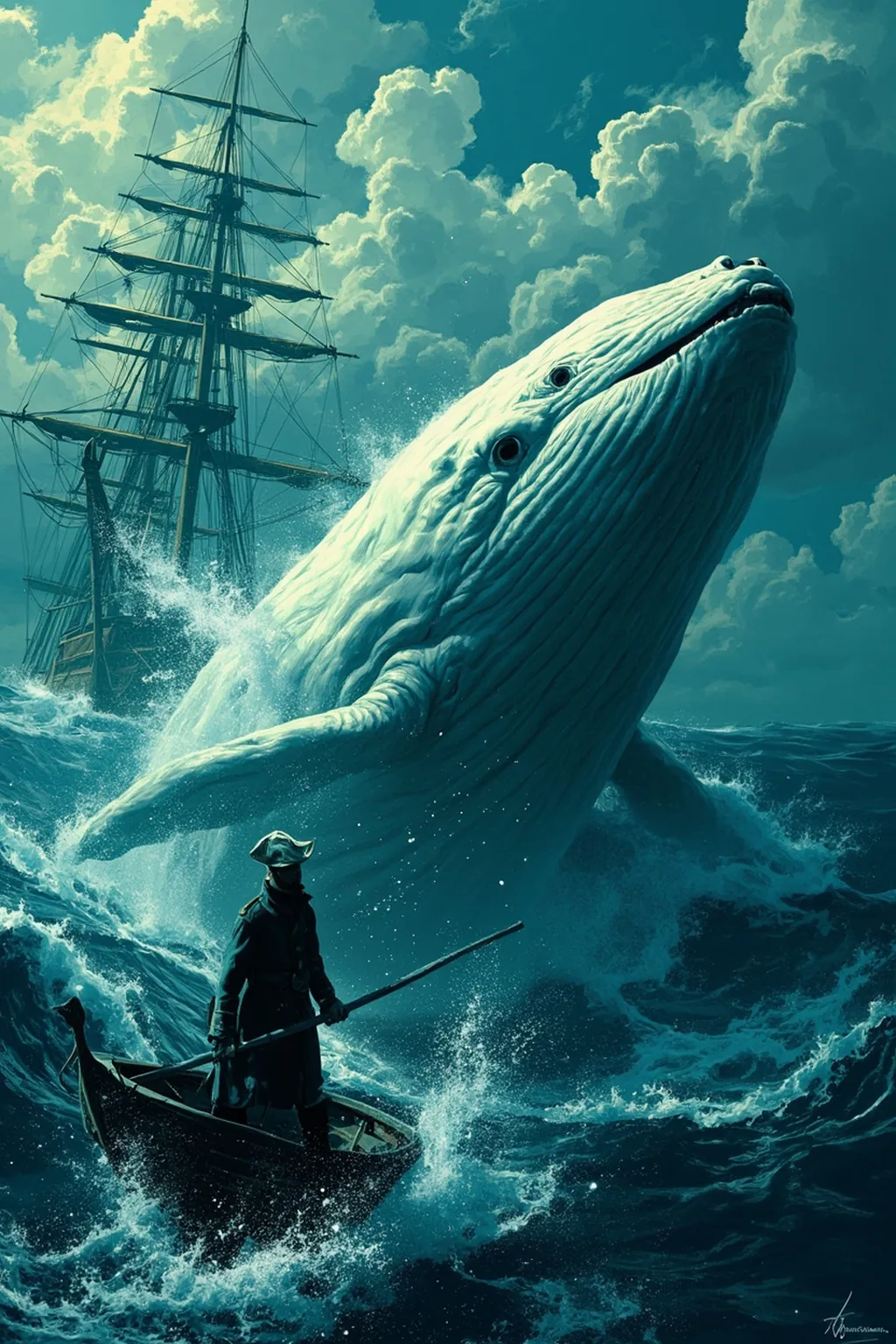
The Jungfrau’s Futile Pursuit
Shortly after the carcass sinks, the Pequod’s mastheads spot the Jungfrau lowering her boats to chase a Fin-Back, a fast, uncapturable whale whose spout is often misidentified as a sperm whale’s by unskilled crews. The Jungfrau and her boats sail full speed after the Fin-Back, disappearing to leeward in their futile pursuit.
CHAPTER 82. The Honor and Glory of Whaling.
This chapter celebrates whaling as an honorable profession with ancient roots. The narrator reflects on the “great honorableness and antiquity” of the calling, finding distinction in belonging to a fraternity that includes great demigods, heroes, and prophets.
The Honor and Antiquity of Whaling
The narrator describes how his deeper research into whaling reveals its noble heritage. He finds himself “transported with the reflection” that he belongs, though “subordinately,” to this distinguished profession. The chapter emphasizes that whaling is not merely a commercial enterprise but a sacred calling with mythological significance.
Perseus: The First Whaleman
Perseus, described as “a son of Jupiter,” is identified as the first whaleman. His adventure with Andromeda demonstrates that the first whale attacked by the brotherhood was not killed for “sordid intent” but was a knightly endeavor to rescue the distressed. The whale monster was slain “at the very first dart,” an accomplishment rarely achieved even by modern harpooneers. In Joppa (now Jaffa), a great whale skeleton was preserved and believed to be the very bones of Perseus’s monster, later carried to Rome in triumph. Notably, Jonah set sail from the same port of Joppa.
St. George and the Whale Dragon
The famous story of St. George and the Dragon is presented as akin to Perseus’s adventure. The narrator argues the dragon was actually a whale, noting that “in many old chronicles whales and dragons are strangely jumbled together.” Ezekiel’s phrase “thou art as a lion of the waters, and as a dragon of the sea” is cited as evidence, with some Bible versions using the word “whale” directly. The narrator contends that killing a snake lacks the glory of confronting “the great monster of the deep.” St. George becomes a tutelary guardian of England, and Nantucket whalemen consider themselves entitled to enrollment in the Order of St. George.
Hercules as an Involuntary Whaleman
The narrator admits uncertainty about including Hercules, who according to Greek mythology was swallowed and thrown up by a whale. The question remains whether this strictly qualifies as being a whaleman, since Hercules never actually harpooned the fish. He is claimed as “a sort of involuntary whaleman,” since “the whale caught him, if he did not the whale.” The chapter acknowledges contradictory authorities who suggest the Hercules story derived from the older Hebrew story of Jonah.
Jonah the Prophet Whaleman
Jonah is included among the roll of whalemen. The text notes that the Greek story of Hercules and the whale is considered to derive from the “still more ancient Hebrew story of Jonah and the whale,” though the relationship may be bidirectional. Both stories share striking similarities, and Jonah earns his place among the brotherhood of whalemen alongside the demigod Hercules.
Vishnoo the Divine Whaleman
The chapter presents the most ancient founder of the whaling fraternity through an oriental story from the Shaster. Vishnoo, one of three persons in the Hindu godhead, became incarnate in a whale to rescue sacred Vedas that had sunk to the bottom of the waters. By this first of his ten earthly incarnations, Vishnoo “forever set apart and sanctified the whale.” The narrator argues Vishnoo qualifies as a whaleman by the same logic that a man who rides a horse is called a horseman.
The Illustrious Roll of Whalemen
The chapter concludes by presenting the complete membership roll: Perseus, St. George, Hercules, Jonah, and Vishnoo. The narrator poses rhetorical challenges to any other club that might claim such distinguished company. This enumeration establishes whaling’s divine and heroic origins, connecting the Nantucket whalemen to the most venerable figures of mythology and scripture.
The original text of this work is in the public domain. This page focuses on a guided summary article, reading notes, selected quotes, and visual learning materials for educational purposes.