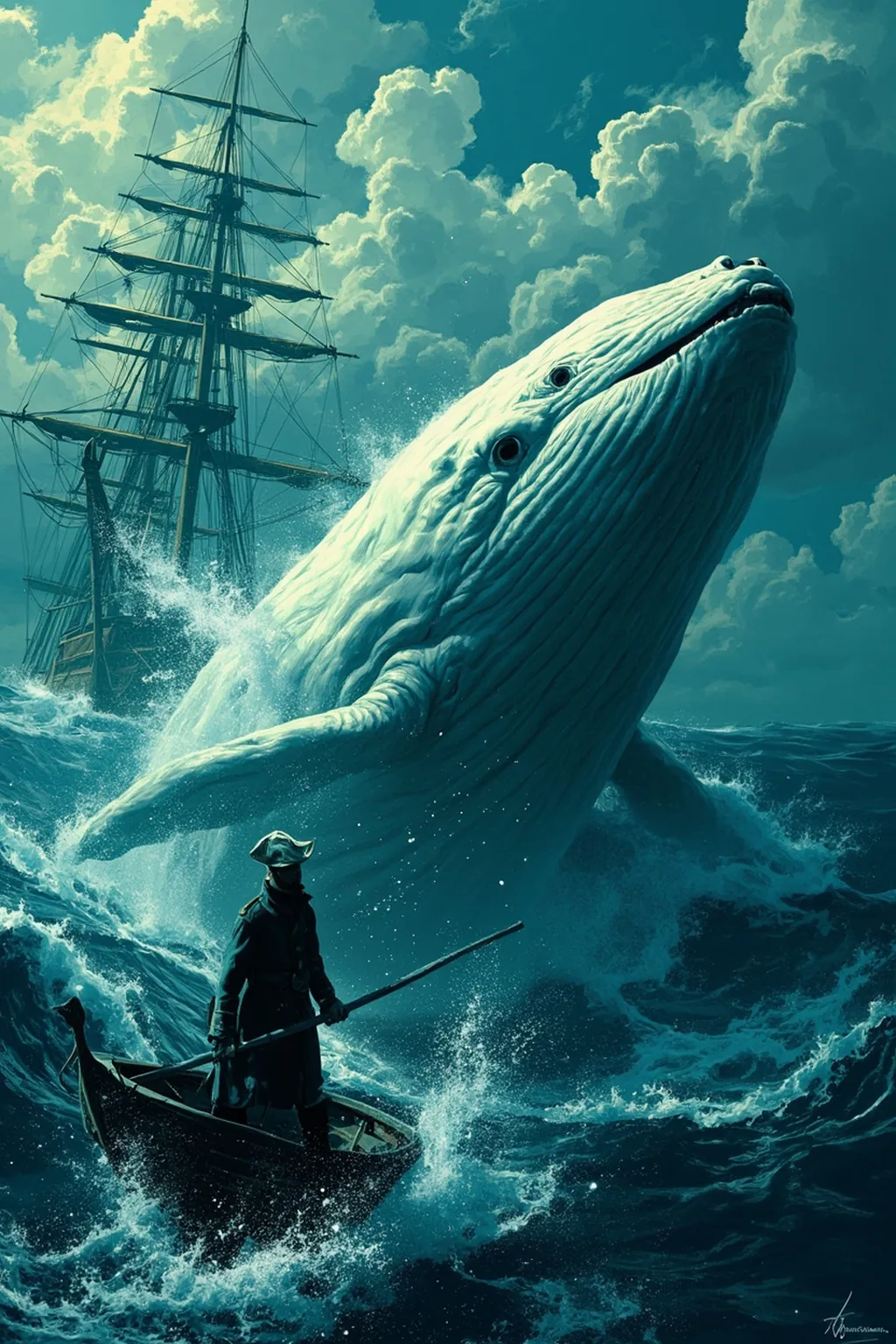
Chapter 5: CHAPTER 1. Loomings.
Call me Ishmael. Some years ago—never mind how long precisely—having little or no money in my purse, and nothing particular to interest me on shore, I thought I would sail about a little and see the watery part of the world.
Whenever I find myself growing grim about the mouth; whenever it is a damp, drizzly November in my soul; whenever I find myself involuntarily pausing before coffin warehouses, and bringing up the rear of every funeral I meet; and especially whenever my hypos get such an upper hand of me, that it requires a strong moral principle to prevent me from deliberately stepping into the street, and methodically knocking people’s hats off—then, I account it high time to get to sea as soon as I can.
Read interpretation
Ishmael vividly catalogs the symptoms of his deep depression and restlessness. The metaphorical “damp, drizzly November in my soul” captures the internal malaise that drives men to the sea as a cure.
With a philosophical flourish Cato throws himself upon his sword; I quietly take to the ship.
Read interpretation
Contrasting the dramatic suicide of the Roman statesman Cato with his own quiet departure, Ishmael frames the voyage as a stoic alternative to self-destruction. It highlights the survival instinct inherent in his escape.
Posted like silent sentinels all around the town, stand thousands upon thousands of mortal men fixed in ocean reveries.
Read interpretation
This powerful image describes the magnetic pull of the water on urban dwellers. It suggests a universal, subconscious desire for the sublime that transcends the mundane routines of city life.
And still deeper the meaning of that story of Narcissus, who because he could not grasp the tormenting, mild image he saw in the fountain, plunged into it and was drowned. But that same image, we ourselves see in all rivers and oceans. It is the image of the ungraspable phantom of life; and this is the key to it all.
Read interpretation
Ishmael reinterprets the myth of Narcissus to explain the human obsession with water. The “ungraspable phantom of life” seen in the waves represents the elusive meaning of existence that men chase but can never fully capture.
What of it, if some old hunks of a sea-captain orders me to get a broom and sweep down the decks? What does that indignity amount to, weighed, I mean, in the scales of the New Testament? Who ain’t a slave?
Read interpretation
Here, Ishmael reconciles his pride with the drudgery of manual labor by invoking a universal servitude. He argues that since all men are servants in some metaphysical sense, taking orders from a captain is no indignity.
Chief among these motives was the overwhelming idea of the great whale himself. Such a portentous and mysterious monster roused all my curiosity.
Read interpretation
The narrative shifts from general philosophy to the specific impetus for this journey. The whale is introduced not merely as prey, but as a cosmic entity that commands the narrator’s total attention.
I am tormented with an everlasting itch for things remote. I love to sail forbidden seas, and land on barbarous coasts.
Read interpretation
Ishmael confesses to a psychological drive toward the dangerous and the unknown. This “itch” explains his willingness to risk the perils of whaling over the safety of conventional life.
…mid most of them all, one grand hooded phantom, like a snow hill in the air.
Read interpretation
The chapter concludes with a haunting, majestic image of the White Whale. It foreshadows the central conflict of the novel, presenting Moby Dick as a spectral, overwhelming presence in Ishmael’s soul.
Chapter 6: CHAPTER 2. The Carpet-Bag.
For my mind was made up to sail in no other than a Nantucket craft, because there was a fine, boisterous something about everything connected with that famous old island, which amazingly pleased me.
Read interpretation
Ishmael reveals a romantic stubbornness regarding his point of departure. He rejects the practicality of New Bedford for the historical prestige and wild character of Nantucket, establishing his preference for the “original” over the merely convenient.
With anxious grapnels I had sounded my pocket, and only brought up a few pieces of silver,—So, wherever you go, Ishmael, said I to myself, as I stood in the middle of a dreary street shouldering my bag… wherever in your wisdom you may conclude to lodge for the night, my dear Ishmael, be sure to inquire the price, and don’t be too particular.
Read interpretation
The nautical metaphor of “anxious grapnels” emphasizes his desperation as he checks his empty pockets. This moment of self-address highlights his isolation and the immediate, grinding poverty that dictates his movements through the dark city.
It seemed the great Black Parliament sitting in Tophet. A hundred black faces turned round in their rows to peer; and beyond, a black Angel of Doom was beating a book in a pulpit.
Read interpretation
Mistaking a raucous black church for an inn, Ishmael offers a hallucinatory description of the scene. The imagery of Tophet—a biblical vale of hellfire—underscores his disorientation and the terrifying, unexpected nature of his mistake.
Coffin?—Spouter?—Rather ominous in that particular connexion, thought I.
Read interpretation
Ishmael’s reaction to the inn’s sign and landlord’s name foreshadows the mortality theme of the novel. His acceptance of these bad omens due to his poverty shows how necessity overrides superstition.
“In judging of that tempestuous wind called Euroclydon,” says an old writer—of whose works I possess the only copy extant—“it maketh a marvellous difference, whether thou lookest out at it from a glass window where the frost is all on the outside, or whether thou observest it from that sashless window, where the frost is on both sides, and of which the wight Death is the only glazier.”
Read interpretation
Ishmael quotes a metaphysical writer to distinguish between the comfort of the rich and the exposure of the poor. The image of Death as the only glazier for a windowless frame is a grim memento mori, emphasizing the vulnerability of those without shelter.
The universe is finished; the copestone is on, and the chips were carted off a million years ago.
Read interpretation
This fatalistic statement reflects Ishmael’s sense of helplessness against the elements. He accepts that the world is a completed, indifferent structure where no improvements or repairs can be made to ease his suffering.
Now, that Lazarus should lie stranded there on the curbstone before the door of Dives, this is more wonderful than that an iceberg should be moored to one of the Moluccas.
Read interpretation
Invoking the biblical parable, Ishmael contrasts the freezing beggar at the door with the rich man inside. He argues that the proximity of such extreme suffering and indifference is a greater anomaly than any natural wonder.
Chapter 7: CHAPTER 3. The Spouter-Inn.
In fact, the artist’s design seemed this: a final theory of my own, partly based upon the aggregated opinions of many aged persons with whom I conversed upon the subject. The picture represents a Cape-Horner in a great hurricane; the half-foundered ship weltering there with its three dismantled masts alone visible; and an exasperated whale, purposing to spring clean over the craft, is in the enormous act of impaling himself upon the three mast-heads.
Read interpretation
Ishmael decodes the chaotic, smoky painting in the entryway, revealing a scene of catastrophic violence. This image of a whale committing suicide by impalement serves as a grim omen of the destructive power and fury inherent in the natural world he is about to enter.
Within are shabby shelves, ranged round with old decanters, bottles, flasks; and in those jaws of swift destruction, like another cursed Jonah (by which name indeed they called him), bustles a little withered old man, who, for their money, dearly sells the sailors deliriums and death.
Read interpretation
The bar, constructed from a whale’s jaw, becomes a symbolic maw where the landlord sells poison to sailors. Likening the landlord to Jonah inside the whale adds a layer of biblical irony to the setting where men gather before facing the perils of the sea.
“Can’t sell his head?—What sort of a bamboozingly story is this you are telling me?” getting into a towering rage. “Do you pretend to say, landlord, that this harpooneer is actually engaged this blessed Saturday night, or rather Sunday morning, in peddling his head around this town?”
Read interpretation
Ishmael’s rising panic and confusion regarding the landlord’s cryptic joke about the harpooneer selling his head highlights the narrator’s vivid imagination and anxiety. This macabre misunderstanding builds suspense before the stranger’s arrival.
There was no hair on his head—none to speak of at least—nothing but a small scalp-knot twisted up on his forehead. His bald purplish head now looked for all the world like a mildewed skull. Had not the stranger stood between me and the door, I would have bolted out of it quicker than ever I bolted a dinner.
Read interpretation
The physical description of Queequeg dehumanizes him, comparing his bald, tattooed head to a mildewed skull. Ishmael’s instinct to flee underscores the deep-seated prejudice and terror he feels toward the “savage” before understanding him.
First he takes about a double handful of shavings out of his grego pocket, and places them carefully before the idol; then laying a bit of ship biscuit on top and applying the flame from the lamp, he kindled the shavings into a sacrificial blaze.
Read interpretation
Queequeg’s pagan ritual, offering a burnt biscuit to his ebony idol, fascinates and horrifies Ishmael. This moment establishes the otherness of the harpooneer, marking him as a heathen in Ishmael’s Christian eyes.
Taking up his tomahawk from the table, he examined the head of it for an instant, and then holding it to the light, with his mouth at the handle, he puffed out great clouds of tobacco smoke. The next moment the light was extinguished, and this wild cannibal, tomahawk between his teeth, sprang into bed with me.
Read interpretation
The tension peaks as the lights go out and the armed stranger leaps into bed. The image of the tomahawk between his teeth transforms the bed into a place of primal danger, provoking Ishmael’s scream for help.
“Don’t be afraid now,” said he, grinning again, “Queequeg here wouldn’t harm a hair of your head.”
Read interpretation
The landlord’s casual reassurance immediately defuses the life-threatening situation. It marks the turning point where the terrifying “monster” is revealed to be a harmless man, shifting the chapter’s tone from horror to comedy.
Better sleep with a sober cannibal than a drunken Christian.
Read interpretation
In a moment of profound epiphany, Ishmael discards his prejudice and embraces Queequeg as a bedfellow. This famous line encapsulates the novel’s theme of looking beyond superficial differences to find common humanity.
Chapter 8: CHAPTER 4. The Counterpane.
Upon waking next morning about daylight, I found Queequeg’s arm thrown over me in the most loving and affectionate manner. You had almost thought I had been his wife. The counterpane was of patchwork, full of odd little parti-coloured squares and triangles; and this arm of his tattooed all over with an interminable Cretan labyrinth of a figure, no two parts of which were of one precise shade—owing I suppose to his keeping his arm at sea unmethodically in sun and shade, his shirt sleeves irregularly rolled up at various times—this same arm of his, I say, looked for all the world like a strip of that same patchwork quilt.
Read interpretation
This opening establishes the chapter’s central motif of confusing intimacy and visual blending. The comparison of Queequeg’s tattooed arm to the patchwork quilt dissolves the boundary between the “savage” and the domestic, setting the stage for Ishmael’s disorientation upon waking.
Instantly I felt a shock running through all my frame; nothing was to be seen, and nothing was to be heard; but a supernatural hand seemed placed in mine. My arm hung over the counterpane, and the nameless, unimaginable, silent form or phantom, to which the hand belonged, seemed closely seated by my bed-side. For what seemed ages piled on ages, I lay there, frozen with the most awful fears, not daring to drag away my hand; yet ever thinking that if I could but stir it one single inch, the horrid spell would be broken.
Read interpretation
Ishmael’s recollection of childhood terror serves as a psychological mirror to his current situation. This passage highlights the primal fear of the unknown and the paralysis of the imagination, which he must overcome to accept the reality of the “cannibal” in his bed.
Throwing aside the counterpane, there lay the tomahawk sleeping by the savage’s side, as if it were a hatchet-faced baby. A pretty pickle, truly, thought I; abed here in a strange house in the broad day, with a cannibal and a tomahawk!
Read interpretation
The discovery of the weapon shifts the tone from supernatural dread to physical danger and dark comedy. Describing the deadly tomahawk as a “hatchet-faced baby” juxtaposes the lethal with the infantile, underscoring the absurdity of Ishmael’s predicament.
But Queequeg, do you see, was a creature in the transition stage—neither caterpillar nor butterfly. He was just enough civilized to show off his outlandishness in the strangest possible manners. His education was not yet completed. He was an undergraduate.
Read interpretation
This observation captures the novel’s complex theme of cultural relativism and the “savage-civilized” continuum. Ishmael frames Queequeg’s bizarre behavior—crawling under the bed to put on his boots—not as mere savagery, but as a unique, hybrid state of becoming.
I was watching to see where he kept his razor, when lo and behold, he takes the harpoon from the bed corner, slips out the long wooden stock, unsheathes the head, whets it a little on his boot, and striding up to the bit of mirror against the wall, begins a vigorous scraping, or rather harpooning of his cheeks.
Read interpretation
The image of Queequeg shaving with the sharpened head of his harpoon is one of the most iconic illustrations of his character in the book. It fuses the violence of the hunt with the rituals of grooming, symbolizing the seamless integration of his profession and his daily life.
Chapter 9: CHAPTER 5. Breakfast.
However, a good laugh is a mighty good thing, and rather too scarce a good thing; the more’s the pity. So, if any one man, in his own proper person, afford stuff for a good joke to anybody, let him not be backward, but let him cheerfully allow himself to spend and be spent in that way. And the man that has anything bountifully laughable about him, be sure there is more in that man than you perhaps think for.
Read interpretation
Ishmael offers a philosophical justification for his resilience and good humor after being tricked into sharing a bed with a “savage.” This sentiment establishes his capacity for adaptability and his willingness to find value in discomfort, a trait essential for his upcoming voyage.
But who could show a cheek like Queequeg? which, barred with various tints, seemed like the Andes’ western slope, to show forth in one array, contrasting climates, zone by zone.
Read interpretation
Melville employs grand geographical imagery to describe Queequeg’s tattooed face, elevating the harpooner from a mere curiosity to a landscape of vast complexity. The comparison to the Andes suggests that Queequeg contains multitudes and worlds within his person, defying simple categorization.
They say that men who have seen the world, thereby become quite at ease in manner, quite self-possessed in company. Not always, though: Ledyard, the great New England traveller, and Mungo Park, the Scotch one; of all men, they possessed the least assurance in the parlor.
Read interpretation
This observation deconstructs the romantic assumption that extensive travel breeds social sophistication. By citing famous explorers who were awkward in domestic settings, Ishmael prepares the reader for the paradoxical behavior of the whalemen, who are fearless on the ocean but timid at a breakfast table.
Yes, here were a set of sea-dogs, many of whom without the slightest bashfulness had boarded great whales on the high seas—entire strangers to them—and duelled them dead without winking; and yet, here they sat at a social breakfast table—all of the same calling, all of kindred tastes—looking round as sheepishly at each other as though they had never been out of sight of some sheepfold among the Green Mountains. A curious sight; these bashful bears, these timid warrior whalemen!
Read interpretation
The chapter captures the ironic contrast between the violent professional lives of the sailors and their shy, landlocked demeanor. The image of “bashful bears” highlights the specific, narrow context in which these men are kings, rendering them helpless and embarrassed in the mundane rituals of civilization.
But as for Queequeg—why, Queequeg sat there among them—at the head of the table, too, it so chanced; as cool as an icicle. To be sure I cannot say much for his breeding. His greatest admirer could not have cordially justified his bringing his harpoon into breakfast with him, and using it there without ceremony; reaching over the table with it, to the imminent jeopardy of many heads, and grappling the beefsteaks towards him. But that was certainly very coolly done by him, and every one knows that in most people’s estimation, to do anything coolly is to do it genteelly.
Read interpretation
Queequeg’s absolute composure and his use of a weapon as cutlery distinguish him from the awkward crew. This act of “coolness” asserts his dominance and comfort in his own skin, regardless of social norms, while the physical danger of the harpoon adds a layer of wild unpredictability to the breakfast scene.
Chapter 10: CHAPTER 6. The Street.
Ah, poor Hay-Seed! how bitterly will burst those straps in the first howling gale, when thou art driven, straps, buttons, and all, down the throat of the tempest.
Read interpretation
This sarcastic prediction highlights the naivety of the rural “greenhorns” who flock to the whaling life. Ishmael exposes the futility of their attempts to fashion themselves as romantic heroes through consumer goods, foreshadowing the brutal indifference of the sea that will strip away such superficialities.
Go and gaze upon the iron emblematical harpoons round yonder lofty mansion, and your question will be answered. Yes; all these brave houses and flowery gardens came from the Atlantic, Pacific, and Indian oceans. One and all, they were harpooned and dragged up hither from the bottom of the sea.
Read interpretation
Melville draws a direct, visceral line between the opulence of the town and the violence of the hunt. The image of houses and gardens being “harpooned and dragged up” from the ocean depths reveals that the civilization on shore is literally built upon the body of the whale.
In New Bedford, fathers, they say, give whales for dowers to their daughters, and portion off their nieces with a few porpoises a-piece. You must go to New Bedford to see a brilliant wedding; for, they say, they have reservoirs of oil in every house, and every night recklessly burn their lengths in spermaceti candles.
Read interpretation
This hyperbolic description of the local economy illustrates the sheer magnitude of wealth generated by the whale fishery. By treating whales as currency and burning expensive oil casually, the text conveys a sense of abundance that borders on the fantastical, rooted in the exploitation of nature.
And the women of New Bedford, they bloom like their own red roses. But roses only bloom in summer; whereas the fine carnation of their cheeks is perennial as sunlight in the seventh heavens. Elsewhere match that bloom of theirs, ye cannot, save in Salem, where they tell me the young girls breathe such musk, their sailor sweethearts smell them miles off shore, as though they were drawing nigh the odorous Moluccas instead of the Puritanic sands.
Read interpretation
The chapter concludes with a lush, sensual comparison of the women to the natural world, linking their beauty to the exotic allure of the Spice Islands. This passage romanticizes the port as a place where the domestic and the foreign, the Puritan and the sensual, intoxicatingly merge.
Chapter 11: CHAPTER 7. The Chapel.
Each silent worshipper seemed purposely sitting apart from the other, as if each silent grief were insular and incommunicable.
Read interpretation
This opening description establishes the bleak, isolating atmosphere of the chapel. By portraying the congregation as “silent islands,” Melville emphasizes the solitary nature of grief and the unique, unshared burdens carried by those who wait for sailors who may never return.
What bitter blanks in those black-bordered marbles which cover no ashes! What despair in those immovable inscriptions! What deadly voids and unbidden infidelities in the lines that seem to gnaw upon all Faith, and refuse resurrections to the beings who have placelessly perished without a grave.
Read interpretation
Ishmael reflects on the specific horror of maritime death: the lack of a body to bury. The “bitter blanks” of cenotaphs—memorials for the missing—create a crisis of faith, suggesting that those lost at sea are denied the physical resurrection and closure afforded to those buried under “green grass.”
But Faith, like a jackal, feeds among the tombs, and even from these dead doubts she gathers her most vital hope.
Read interpretation
In a striking metaphor, Ishmael suggests that faith is not destroyed by the presence of death and doubt, but rather sustained by them. Like a scavenger that thrives in a graveyard, faith finds its most vital sustenance in the very despair that threatens to overwhelm the spirit.
Methinks that what they call my shadow here on earth is my true substance. Methinks that in looking at things spiritual, we are too much like oysters observing the sun through the water, and thinking that thick water the thinnest of air. Methinks my body is but the lees of my better being. In fact take my body who will, take it I say, it is not me.
Read interpretation
Facing the high probability of death on his impending voyage, Ishmael undergoes a philosophical reversal. He dismisses the physical body as mere dregs—the “lees”—and asserts the invulnerability of his soul, finding comfort in the distinction between his mortal shadow and his immortal substance.
Chapter 12: CHAPTER 8. The Pulpit.
At the time I now write of, Father Mapple was in the hardy winter of a healthy old age; that sort of old age which seems merging into a second flowering youth, for among all the fissures of his wrinkles, there shone certain mild gleams of a newly developing bloom—the spring verdure peeping forth even beneath February’s snow.
Read interpretation
This description introduces Father Mapple not as a decaying elder, but as a figure of robust spiritual vitality. The imagery of “spring verdure” beneath “February’s snow” suggests that his advanced age and the hardships of his past life have cultivated, rather than diminished, his inner strength.
Halting for an instant at the foot of the ladder, and with both hands grasping the ornamental knobs of the man-ropes, Father Mapple cast a look upwards, and then with a truly sailor-like but still reverential dexterity, hand over hand, mounted the steps as if ascending the main-top of his vessel.
Read interpretation
Mapple’s ascent blends his two identities: the seasoned sailor and the holy preacher. By climbing the rope ladder with the dexterity of a crewman scaling a mast, he physically enacts his transition from the profane world of the sea to the sacred space of the ministry.
I was not prepared to see Father Mapple after gaining the height, slowly turn round, and stooping over the pulpit, deliberately drag up the ladder step by step, till the whole was deposited within, leaving him impregnable in his little Quebec.
Read interpretation
The physical act of hauling up the ladder serves as a powerful symbol of the preacher’s isolation. By cutting off his only means of descent, Mapple renders himself “impregnable,” signifying the solitary, fortified nature of his communion with God before he addresses the congregation.
Can it be, then, that by that act of physical isolation, he signifies his spiritual withdrawal for the time, from all outward worldly ties and connexions? Yes, for replenished with the meat and wine of the word, to the faithful man of God, this pulpit, I see, is a self-containing stronghold—a lofty Ehrenbreitstein, with a perennial well of water within the walls.
Read interpretation
Ishmael interprets the architecture of the pulpit as a metaphor for spiritual self-sufficiency. The pulpit becomes a fortress or stronghold, a place where the preacher is entirely separated from worldly distractions to draw sustenance from the “meat and wine of the word.”
What could be more full of meaning?—for the pulpit is ever this earth’s foremost part; all the rest comes in its rear; the pulpit leads the world. From thence it is the storm of God’s quick wrath is first descried, and the bow must bear the earliest brunt.
Read interpretation
Ishmael elevates the pulpit to the most critical position in human existence—the “prow” of the world. Just as a ship’s bow takes the first impact of a storm, the pulpit leads society and bears the brunt of divine wrath, serving as the vanguard for moral and spiritual direction.
Chapter 13: CHAPTER 9. The Sermon.
He paused a little; then kneeling in the pulpit’s bows, folded his large brown hands across his chest, uplifted his closed eyes, and offered a prayer so deeply devout that he seemed kneeling and praying at the bottom of the sea.
Read interpretation
This opening image establishes the submerged, aquatic spirituality of Father Mapple. By praying in a manner that suggests the bottom of the ocean, he physically and mentally aligns himself with the maritime environment of his congregation and the biblical depths he is about to explore.
“Oh! so my conscience hangs in me!” he groans, “straight upwards, so it burns; but the chambers of my soul are all in crookedness!”
Read interpretation
Mapple uses the nautical imagery of the swinging lamp to describe the internal state of the guilty Jonah. The “false, lying levels” of the ship reflect the crookedness of a sinner’s soul, contrasting with the upright, burning alignment of a true conscience.
And here, shipmates, is true and faithful repentance; not clamorous for pardon, but grateful for punishment.
Read interpretation
This is the theological crux of the sermon, redefining repentance not as a demand for mercy, but as an acceptance of justice. Mapple argues that Jonah’s silence and submission to his fate represent a higher form of piety than begging for escape.
“Shipmates, God has laid but one hand upon you; both his hands press upon me. I have read ye by what murky light may be mine the lesson that Jonah teaches to all sinners; and therefore to ye, and still more to me, for I am a greater sinner than ye.”
Read interpretation
Mapple distinguishes the burden of the preacher from that of the congregation. He claims a “greater sin” and a heavier divine pressure, emphasizing the terrifying responsibility of the “pilot-prophet” who must speak unwelcome truths to a wicked world.
“Woe to him who seeks to please rather than to appal! Woe to him whose good name is more to him than goodness! Woe to him who, in this world, courts not dishonor! Woe to him who would not be true, even though to be false were salvation!”
Read interpretation
The preacher pronounces a series of “woes” that condemn the comfort-seeking hypocrite. This passage serves as a warning against the temptation to dilute the truth for social acceptance, framing the loss of reputation as a necessary consequence of spiritual integrity.
“Delight is to him, whom all the waves of the billows of the seas of the boisterous mob can never shake from this sure Keel of the Ages. And eternal delight… will be his, who coming to lay him down, can say with his final breath—O Father!—chiefly known to me by Thy rod—mortal or immortal, here I die. I have striven to be Thine, more than to be this world’s, or mine own.”
Read interpretation
The sermon concludes with a triumphant vision of martyrdom and steadfastness. Mapple finds “inward delight” in the idea of being unshakable as a ship’s keel, valuing obedience to God over life itself and finding peace in the “rod” of divine discipline.
Chapter 14: CHAPTER 10. A Bosom Friend.
Savage though he was, and hideously marred about the face—at least to my taste—his countenance yet had a something in it which was by no means disagreeable. You cannot hide the soul. Through all his unearthly tattooings, I thought I saw the traces of a simple honest heart; and in his large, deep eyes, fiery black and bold, there seemed tokens of a spirit that would dare a thousand devils.
Read interpretation
Ishmael looks past the terrifying exterior of the harpooner to perceive an inner nobility and honesty. This moment establishes the foundation of their bond, suggesting that spiritual worth transcends physical appearance or cultural origin.
At first they are overawing; their calm self-collectedness of simplicity seems a Socratic wisdom. He made no advances whatever; appeared to have no desire to enlarge the circle of his acquaintances. All this struck me as mighty singular; yet, upon second thoughts, there was something almost sublime in it.
Read interpretation
Ishmael interprets Queequeg’s stoic isolation not as savagery, but as a form of philosophical self-sufficiency. This re-evaluation marks a shift in Ishmael’s perspective, moving from fear to a profound respect for the “savage’s” serene independence.
I felt a melting in me. No more my splintered heart and maddened hand were turned against the wolfish world. This soothing savage had redeemed it. There he sat, his very indifference speaking a nature in which there lurked no civilized hypocrisies and bland deceits.
Read interpretation
Overcoming his initial alienation, Ishmael experiences a emotional thaw and rejects the cynicism he held toward “civilized” society. He finds a refreshing authenticity in Queequeg’s lack of pretense, deciding to embrace this pagan friendship over hollow Christian courtesy.
He seemed to take to me quite as naturally and unbiddenly as I to him; and when our smoke was over, he pressed his forehead against mine, clasped me round the waist, and said that henceforth we were married; meaning, in his country’s phrase, that we were bosom friends; he would gladly die for me, if need should be.
Read interpretation
The shared smoke acts as a social sacrament that cements their kinship, leading to Queequeg’s declaration of symbolic “marriage.” This ritualistic binding transforms them from strangers into intimate companions with a pledge of mutual loyalty.
But what is worship?—to do the will of God—that is worship. And what is the will of God?—to do to my fellow man what I would have my fellow man to do to me—that is the will of God. Now, Queequeg is my fellow man. And what do I wish that this Queequeg would do to me? Why, unite with me in my particular Presbyterian form of worship. Consequently, I must then unite with him in his; ergo, I must turn idolator.
Read interpretation
Ishmael rationalizes joining Queequeg’s idolatry through a universalist interpretation of Christian ethics. By prioritizing the Golden Rule over dogmatic ritual, he reconciles his conscience with their friendship, choosing human connection over theological rigidity.
How it is I know not; but there is no place like a bed for confidential disclosures between friends. Man and wife, they say, there open the very bottom of their souls to each other; and some old couples often lie and chat over old times till nearly morning. Thus, then, in our hearts’ honeymoon, lay I and Queequeg—a cosy, loving pair.
Read interpretation
The chapter concludes with the pair in bed, likening their intimacy to that of a honeymooning couple. This final image solidifies the “marriage” of bosom friends, emphasizing the deep, domestic, and spiritual union that has formed between the narrator and the harpooner.
Chapter 15: CHAPTER 11. Nightgown.
The more so, I say, because truly to enjoy bodily warmth, some small part of you must be cold, for there is no quality in this world that is not what it is merely by contrast. Nothing exists for itself.
Read interpretation
Ishmael articulates a central philosophy of the novel: that existence is defined by relativity and contrast rather than intrinsic absolutes. This physical sensation of the cold nose enhancing the warmth of the bed serves as a metaphor for the necessity of opposition to define experience.
Then there you lie like the one warm spark in the heart of an arctic crystal.
Read interpretation
This vivid image captures the fragility and preciousness of the bond forming between the two men. It emphasizes their isolation within the vast, indifferent universe, highlighting the intimacy of their shared warmth against the surrounding cold.
Because no man can ever feel his own identity aright except his eyes be closed; as if darkness were indeed the proper element of our essences, though light be more congenial to our clayey part.
Read interpretation
Ishmael explores the introspective nature of the self, suggesting that true identity is internal and obscured by the external world. The act of closing one’s eyes becomes a retreat into the essential self, contrasting the “clayey” physical body with the spiritual essence.
For now I liked nothing better than to have Queequeg smoking by me, even in bed, because he seemed to be full of such serene household joy then. I was only alive to the condensed confidential comfortableness of sharing a pipe and a blanket with a real friend.
Read interpretation
This passage marks the complete dissolution of Ishmael’s earlier prejudices, replaced by a profound domestic comfort. The “condensed confidential” nature of their shared smoke signifies a deepening of trust and the normalization of their unconventional intimacy.
Chapter 16: CHAPTER 12. Biographical.
Queequeg was a native of Rokovoko, an island far away to the West and South. It is not down in any map; true places never are.
Read interpretation
This famous opening line establishes the mythical quality of Queequeg’s origins, suggesting that authenticity and truth exist beyond the mapped, known world. It elevates the harpooner from a mere curiosity to a figure from a “true place” that defies empirical categorization.
But like Czar Peter content to toil in the shipyards of foreign cities, Queequeg disdained no seeming ignominy, if thereby he might happily gain the power of enlightening his untutored countrymen.
Read interpretation
Queequeg’s willingness to work as a common sailor despite his royal blood is compared to the great Czar Peter the Great. This highlights his noble humility and his original, benevolent motivation for leaving home—to gain knowledge that would uplift his people, rather than for mere adventure.
But, alas! the practices of whalemen soon convinced him that even Christians could be both miserable and wicked; infinitely more so, than all his father’s heathens. Thought he, it’s a wicked world in all meridians; I’ll die a pagan.
Read interpretation
This moment marks Queequeg’s profound disillusionment with “Christendom,” shattering his idealistic view of the civilized world. It serves as a biting social critique from Melville, asserting that moral corruption is universal and that the “savage” may possess more integrity than the supposed Christians.
He answered no, not yet; and added that he was fearful Christianity, or rather Christians, had unfitted him for ascending the pure and undefiled throne of thirty pagan Kings before him.
Read interpretation
Queequeg reveals that exposure to Western society has contaminated him in a way that makes him unfit for his own royal lineage. This underscores the theme of cultural corruption, suggesting that the “civilizing” influence has actually marred the purity of his essential nature.
He at once resolved to accompany me to that island, ship aboard the same vessel, get into the same watch, the same boat, the same mess with me, in short to share my every hap; with both my hands in his, boldly dip into the Potluck of both worlds.
Read interpretation
This declaration cements the pact between Ishmael and Queequeg, binding their fates together completely. The imagery of sharing every “hap” and dipping into the “Potluck of both worlds” signifies a union that bridges Ishmael’s Christian civilization and Queequeg’s pagan savagery.
Chapter 17: CHAPTER 13. Wheelbarrow.
“Shifting the barrow from my hand to his, he told me a funny story about the first wheelbarrow he had ever seen. It was in Sag Harbor. The owners of his ship, it seems, had lent him one, in which to carry his heavy chest to his boarding house. Not to seem ignorant about the thing—though in truth he was entirely so, concerning the precise way in which to manage the barrow—Queequeg puts his chest upon it; lashes it fast; and then shoulders the barrow and marches up the wharf.”
Read interpretation
This anecdote highlights the cultural disconnect and Queequeg’s dignity in the face of foreign technology. Rather than pushing the wheelbarrow, he shoulders it like a porter, illustrating his “savage” practicality and the humor found in cross-cultural misunderstandings.
“Now a certain grand merchant ship once touched at Rokovoko, and its commander—from all accounts, a very stately punctilious gentleman, at least for a sea captain—this commander was invited to the wedding feast of Queequeg’s sister… Seeing himself placed next the Priest, and noting the ceremony, and thinking himself—being Captain of a ship—as having plain precedence over a mere island King, especially in the King’s own house—the Captain coolly proceeds to wash his hands in the punchbowl;—taking it I suppose for a huge finger-glass.”
Read interpretation
Queequeg’s tale of the Captain washing his hands in the sacred wedding punchbowl serves as a satirical inversion of “civilized” manners. It exposes the arrogance of colonial rank, where a ship Captain presumes precedence over a King and unwittingly commits a sacrilege through his own ignorance.
“How I snuffed that Tartar air!—how I spurned that turnpike earth!—that common highway all over dented with the marks of slavish heels and hoofs; and turned me to admire the magnanimity of the sea which will permit no records.”
Read interpretation
Ishmael expresses a profound sense of liberation as the schooner departs. He contrasts the restrictive, “slavish” nature of land-based society with the “magnanimity” of the sea, a place that wipes away history and offers a clean slate for the soul.
“Kill-e,” cried Queequeg, twisting his tattooed face into an unearthly expression of disdain, “ah! him bevy small-e fish-e; Queequeg no kill-e so small-e fish-e; Queequeg kill-e big whale!”
Read interpretation
Queequeg dismisses the Captain’s reprimand regarding the greenhorn with a logic based on his own hierarchy of worth. His broken English emphasizes his perspective: he is a hunter of leviathans, not a murderer of inconsequential men, rendering the Captain’s threat absurd.
“In the midst of this consternation, Queequeg dropped deftly to his knees, and crawling under the path of the boom, whipped hold of a rope, secured one end to the bulwarks, and then flinging the other like a lasso, caught it round the boom as it swept over his head, and at the next jerk, the spar was that way trapped, and all was safe.”
Read interpretation
This moment marks the climax of the chapter, showcasing Queequeg’s heroic physical prowess and calmness under pressure. While the crew panics, the “savage” demonstrates superior seamanship and courage, securing the deadly boom with a singular, daring feat.
“He only asked for water—fresh water—something to wipe the brine off; that done, he put on dry clothes, lighted his pipe, and leaning against the bulwarks, and mildly eyeing those around him, seemed to be saying to himself—“It’s a mutual, joint-stock world, in all meridians. We cannibals must help these Christians.””
Read interpretation
Following the rescue, Queequeg’s casual demeanor and the internal monologue attributed to him encapsulate the novel’s theme of universal brotherhood. The quote dissolves the barrier between “civilized” and “savage,” suggesting that in the shared peril of the sea, all men are stockholders in the same fate.
Chapter 18: CHAPTER 14. Nantucket.
“Nantucket! Take out your map and look at it. See what a real corner of the world it occupies; how it stands there, away off shore, more lonely than the Eddystone lighthouse. Look at it—a mere hillock, and elbow of sand; all beach, without a background.”
Read interpretation
Ishmael establishes the stark, isolated geography of Nantucket, emphasizing its vulnerability and separation from the mainland. This physical isolation serves as the foundation for the unique culture of its inhabitants, who are surrounded by the ocean on all sides.
“Look now at the wondrous traditional story of how this island was settled by the red-men. Thus goes the legend. In olden times an eagle swooped down upon the New England coast, and carried off an infant Indian in his talons. With loud lament the parents saw their child borne out of sight over the wide waters. They resolved to follow in the same direction. Setting out in their canoes, after a perilous passage they discovered the island, and there they found an empty ivory casket,—the poor little Indian’s skeleton.”
Read interpretation
The mythical origin story of the island, involving a stolen infant and a skeleton found in an ivory casket, imbues Nantucket with a sense of ancient, melancholic destiny. It foreshadows the perilous relationship between the islanders and the sea, where the ocean is both a discoverer and a tomb.
“And thus have these naked Nantucketers, these sea hermits, issuing from their ant-hill in the sea, overrun and conquered the watery world like so many Alexanders; parcelling out among them the Atlantic, Pacific, and Indian oceans, as the three pirate powers did Poland. Let America add Mexico to Texas, and pile Cuba upon Canada; let the English overswarm all India, and hang out their blazing banner from the sun; two thirds of this terraqueous globe are the Nantucketer’s.”
Read interpretation
Ishmael elevates the Nantucketers to the status of emperors of the globe, claiming their dominion over the sea surpasses all terrestrial empires. This hyperbolic declaration asserts that the true conquest of the world is not on land, but upon the “two thirds” of the planet covered by water.
“The Nantucketer, he alone resides and riots on the sea; he alone, in Bible language, goes down to it in ships; to and fro ploughing it as his own special plantation. There is his home; there lies his business, which a Noah’s flood would not interrupt, though it overwhelmed all the millions in China.”
Read interpretation
This quote defines the existential state of the whaleman, distinguishing him from all other sailors who merely traverse the surface. For the Nantucketer, the sea is not a highway but a home and a plantation, a place of residence and labor that is more permanent to him than the land itself.
“He lives on the sea, as prairie cocks in the prairie; he hides among the waves, he climbs them as chamois hunters climb the Alps. For years he knows not the land; so that when he comes to it at last, it smells like another world, more strangely than the moon would to an Earthsman.”
Read interpretation
The simile of the prairie cock and the chamois hunter illustrates the Nantucketer’s adaptation to a marine environment, making the fluid waves as natural to him as solid earth. The alienation from the land is so complete that returning to shore feels like visiting an extraterrestrial landscape.
Chapter 19: CHAPTER 15. Chowder.
Two enormous wooden pots painted black, and suspended by asses’ ears, swung from the cross-trees of an old top-mast, planted in front of an old doorway. The horns of the cross-trees were sawed off on the other side, so that this old top-mast looked not a little like a gallows. Perhaps I was over sensitive to such impressions at the time, but I could not help staring at this gallows with a vague misgiving. A sort of crick was in my neck as I gazed up to the two remaining horns; yes, two of them, one for Queequeg, and one for me. It’s ominous, thinks I. A Coffin my Innkeeper upon landing in my first whaling port; tombstones staring at me in the whalemen’s chapel; and here a gallows! and a pair of prodigious black pots too! Are these last throwing out oblique hints touching Tophet?
Read interpretation
The arrival at the Try Pots immediately unsettles Ishmael, as the inn’s sign—a mast resembling a gallows—triggers a superstitious dread. He connects the imagery to previous encounters with death, fearing that these black pots are oblique hints of hell awaiting them.
Oh, sweet friends! hearken to me. It was made of small juicy clams, scarcely bigger than hazel nuts, mixed with pounded ship biscuit, and salted pork cut up into little flakes; the whole enriched with butter, and plentifully seasoned with pepper and salt.
Read interpretation
This sensory interlude breaks the tension with a lavish, appetizing description of the clam chowder. The detailed recipe serves as a warm, physical grounding after the ominous gallows, celebrating the sustenance that awaits the travelers.
Fishiest of all fishy places was the Try Pots, which well deserved its name; for the pots there were always boiling chowders. Chowder for breakfast, and chowder for dinner, and chowder for supper, till you began to look for fish-bones coming through your clothes. The area before the house was paved with clam-shells. Mrs. Hussey wore a polished necklace of codfish vertebra; and Hosea Hussey had his account books bound in superior old shark-skin. There was a fishy flavor to the milk, too, which I could not at all account for, till one morning happening to take a stroll along the beach among some fishermen’s boats, I saw Hosea’s brindled cow feeding on fish remnants, and marching along the sand with each foot in a cod’s decapitated head, looking very slip-shod, I assure ye.
Read interpretation
The atmosphere at the inn grows grotesquely surreal as Ishmael describes the total saturation of the place by the sea. The image of the cow marching with cod’s heads on its feet underscores the inescapable, fishy nature of Nantucket life.
“Because it’s dangerous,” says she. “Ever since young Stiggs coming from that unfort’nt v’y’ge of his, when he was gone four years and a half, with only three barrels of ile, was found dead in my first floor back, with his harpoon in his side; ever since then I allow no boarders to take sich dangerous weepons in their rooms at night.”
Read interpretation
The domestic comfort of the inn is pierced by Mrs. Hussey’s grim anecdote about young Stiggs. Her refusal to let Queequeg keep his harpoon brings the violence of the whaling profession into the bedroom, reminding them that the tools of their trade are also instruments of death.
Chapter 20: CHAPTER 16. The Ship.
Queequeg now gave me to understand, that he had been diligently consulting Yojo—the name of his black little god—and Yojo had told him two or three times over, and strongly insisted upon it everyway, that instead of our going together among the whaling-fleet in harbor, and in concert selecting our craft; instead of this, I say, Yojo earnestly enjoined that the selection of the ship should rest wholly with me, inasmuch as Yojo purposed befriending us; and, in order to do so, had already pitched upon a vessel, which, if left to myself, I, Ishmael, should infallibly light upon, for all the world as though it had turned out by chance; and in that vessel I must immediately ship myself, for the present irrespective of Queequeg.
Read interpretation
This passage establishes the whimsical yet fateful mechanism by which Ishmael and Queequeg are separated for the ship selection. By deferring to the idol Yojo, Melville blends the pagan with the practical, setting up a “chance” encounter that feels predestined. It highlights the trust Ishmael places in Queequeg’s spirituality and sets the stage for Ishmael to choose the Pequod alone.
She was apparelled like any barbaric Ethiopian emperor, his neck heavy with pendants of polished ivory. She was a thing of trophies. A cannibal of a craft, tricking herself forth in the chased bones of her enemies. All round, her unpanelled, open bulwarks were garnished like one continuous jaw, with the long sharp teeth of the sperm whale, inserted there for pins, to fasten her old hempen thews and tendons to.
Read interpretation
The description of the Pequod transforms the ship into a living, predatory entity. By adorning the vessel with the bones and teeth of its prey, Melville creates a grotesque image of a “cannibal” craft, foreshadowing the violent and consuming nature of the voyage ahead. The ship is not just a means of transport but a monument to slaughter.
“Thou knowest best,” was the sepulchral reply, “the seven hundred and seventy-seventh wouldn’t be too much, would it?—‘where moth and rust do corrupt, but lay—’”
Read interpretation
Captain Bildad uses scripture to justify his stinginess, attempting to cloak his greed in piety by quoting Matthew 6:19 regarding earthly treasures. The pun on the word “lay”—referring both to the sailor’s share of the profit and to laying up treasures—exposes the hypocrisy of using religious language to exploit labor. It underscores the harsh economic reality of the whaling industry.
“He’s a grand, ungodly, god-like man, Captain Ahab; doesn’t speak much; but, when he does speak, then you may well listen. Mark ye, be forewarned; Ahab’s above the common; Ahab’s been in colleges, as well as ’mong the cannibals; been used to deeper wonders than the waves; fixed his fiery lance in mightier, stranger foes than whales. His lance! aye, the keenest and the surest that out of all our isle!”
Read interpretation
Peleg’s introduction of the unseen Captain Ahab is laden with grandiose and contradictory praise, elevating Ahab to a mythic status before he even appears. The description of Ahab as “ungodly, god-like” hints at his blasphemous ambition and intellectual depth, while the mention of “mightier, stranger foes” suggests that his true battle is not merely with whales but with existential forces.
As I walked away, I was full of thoughtfulness; what had been incidentally revealed to me of Captain Ahab, filled me with a certain wild vagueness of painfulness concerning him. And somehow, at the time, I felt a sympathy and a sorrow for him, but for I don’t know what, unless it was the cruel loss of his leg. And yet I also felt a strange awe of him; but that sort of awe, which I cannot at all describe, was not exactly awe; I do not know what it was.
Read interpretation
Ishmael’s reaction to the descriptions of Ahab captures the novel’s central tension between attraction and repulsion. He feels an inexplicable mixture of sympathy, sorrow, and awe for a man he has not yet met, sensing the profound “painfulness” and charisma that radiate from the captain. This emotional premonition signals that Ahab is a force of nature rather than a typical seaman.
Chapter 21: CHAPTER 17. The Ramadan.
I say, we good Presbyterian Christians should be charitable in these things, and not fancy ourselves so vastly superior to other mortals, pagans and what not, because of their half-crazy conceits on these subjects. There was Queequeg, now, certainly entertaining the most absurd notions about Yojo and his Ramadan;—but what of that? Queequeg thought he knew what he was about, I suppose; he seemed to be content; and there let him rest. All our arguing with him would not avail; let him be, I say: and Heaven have mercy on us all—Presbyterians and Pagans alike—for we are all somehow dreadfully cracked about the head, and sadly need mending.
Read interpretation
Ishmael articulates a philosophy of radical religious tolerance, acknowledging that all humans, regardless of creed, possess a fundamental “crackedness” or irrationality. This quote establishes the chapter’s initial tone of bemused respect for Queequeg’s rituals before the situation escalates into panic.
With a prodigious noise the door flew open, and the knob slamming against the wall, sent the plaster to the ceiling; and there, good heavens! there sat Queequeg, altogether cool and self-collected; right in the middle of the room; squatting on his hams, and holding Yojo on top of his head. He looked neither one way nor the other way, but sat like a carved image with scarce a sign of active life.
Read interpretation
The climax of Ishmael’s fear is deflated by the surreal, statue-like image of Queequeg in a trance. This visual captures the “otherness” of Queequeg’s spirituality, contrasting Ishmael’s frantic, Western anxiety with Queequeg’s immobile, stoic devotion.
I then went on, beginning with the rise and progress of the primitive religions, and coming down to the various religions of the present time, during which time I labored to show Queequeg that all these Lents, Ramadans, and prolonged ham-squattings in cold, cheerless rooms were stark nonsense; bad for the health; useless for the soul; opposed, in short, to the obvious laws of Hygiene and common sense.
Read interpretation
Ishmael shifts from observer to lecturer, attempting to apply Western logic and “hygiene” to Queequeg’s spiritual practices. This quote highlights the cultural divide, as Ishmael arrogantly tries to rationalize away his friend’s faith as physically detrimental.
In one word, Queequeg, said I, rather digressively; hell is an idea first born on an undigested apple-dumpling; and since then perpetuated through the hereditary dyspepsias nurtured by Ramadans.
Read interpretation
Ishmael delivers his central, humorous thesis that religious damnation is merely a metaphor for indigestion. It is a classic Melvillean reduction of the metaphysical to the physical, underscoring the novel’s recurring theme of the body’s influence on the spirit.
He said no; only upon one memorable occasion. It was after a great feast given by his father the king, on the gaining of a great battle wherein fifty of the enemy had been killed by about two o’clock in the afternoon, and all cooked and eaten that very evening.
Read interpretation
Queequeg’s rebuttal to Ishmael’s lecture is a deadpan anecdote about cannibalism causing his only bout of stomach trouble. The quote subverts Ishmael’s medical authority with a horrific, casual detail that emphasizes the vast, unbridgeable gulf between their respective worldviews.
Chapter 22: CHAPTER 18. His Mark.
“I mean,” he replied, “he must show his papers.” “Yes,” said Captain Bildad in his hollow voice, sticking his head from behind Peleg’s, out of the wigwam. “He must show that he’s converted. Son of darkness,” he added, turning to Queequeg, “art thou at present in communion with any Christian church?”
Read interpretation
The owners of the Pequod block Queequeg’s entry, demanding bureaucratic and religious proof of his humanity. This confrontation highlights the systemic prejudice and “civilized” hypocrisy that Ishmael must navigate to secure his friend’s place on the ship.
Finding myself thus hard pushed, I replied. “I mean, sir, the same ancient Catholic Church to which you and I, and Captain Peleg there, and Queequeg here, and all of us, and every mother’s son and soul of us belong; the great and everlasting First Congregation of this whole worshipping world; we all belong to that; only some of us cherish some queer crotchets no ways touching the grand belief; in that we all join hands.”
Read interpretation
Pressed for a specific denomination, Ishmael improvises a brilliant theological defense, claiming a universal, ancient brotherhood that encompasses all of humanity. This argument momentarily disarms the captains and serves as one of Ishmael’s most explicit statements on spiritual unity.
“Cap’ain, you see him small drop tar on water dere? You see him? well, spose him one whale eye, well, den!” and taking sharp aim at it, he darted the iron right over old Bildad’s broad brim, clean across the ship’s decks, and struck the glistening tar spot out of sight.
Read interpretation
Queequeg bypasses the need for religious credentials with a display of primal, lethal skill. By striking a speck of tar from across the deck, he proves his value to the ship in the only currency that truly matters to the whalers: proficiency with the iron.
But at this question, Queequeg, who had twice or thrice before taken part in similar ceremonies, looked no ways abashed; but taking the offered pen, copied upon the paper, in the proper place, an exact counterpart of a queer round figure which was tattooed upon his arm; so that through Captain Peleg’s obstinate mistake touching his appellative, it stood something like this:— Quohog. his X mark.
Read interpretation
Queequeg signs the ship’s articles not with a name, but by replicating the tattoo on his arm. This act blends his pagan identity with the legal contract of the voyage, marking him as “Quohog” and sealing his commitment with his flesh.
“Avast there, avast there, Bildad, avast now spoiling our harpooneer,” cried Peleg. “Pious harpooneers never make good voyagers—it takes the shark out of ’em; no harpooneer is worth a straw who aint pretty sharkish.”
Read interpretation
Captain Peleg interrupts Bildad’s evangelizing to assert that too much religion ruins a whaler’s aggression. This quote encapsulates the harsh pragmatism of the whaling industry, where survival depends on a “sharkish” nature rather than Christian meekness.
Chapter 23: CHAPTER 19. The Prophet.
“Shipmates, have ye shipped in that ship?”
Read interpretation
This abrupt interrogation marks the inciting incident of the chapter, where the mysterious stranger Elijah intercepts Ishmael and Queequeg immediately after they have committed themselves to the voyage. The question serves as a gateway to the ominous foreshadowing that follows, disrupting the ordinary business of signing articles with a sense of immediate, supernatural scrutiny.
“A soul’s a sort of a fifth wheel to a wagon.”
Read interpretation
Elijah’s cynical remark about souls introduces a tone of spiritual desolation and nihilism that hangs over the Pequod. It suggests that the men who board this ship are embarking on a journey where the human soul is superfluous, reinforcing the idea that this is not a standard commercial venture but a doomed, fated undertaking.
“Look ye; when Captain Ahab is all right, then this left arm of mine will be all right; not before.”
Read interpretation
This cryptic statement links the stranger’s physical deformity directly to Captain Ahab’s condition. It implies that Ahab is permanently damaged—physically, mentally, or spiritually—and that no recovery is possible. The quote solidifies the image of Ahab not merely as a man with a missing leg, but as a broken force who has infected those around him with his own affliction.
“But nothing about that thing that happened to him off Cape Horn, long ago, when he lay like dead for three days and nights; nothing about that deadly skrimmage with the Spaniard afore the altar in Santa?—heard nothing about that, eh? Nothing about the silver calabash he spat into? And nothing about his losing his leg last voyage, according to the prophecy.”
Read interpretation
Here Elijah unleashes a torrent of specific, violent imagery associated with Ahab’s past—death-like trances, religious sacrilege, and prophecy. The accumulation of these dark details transforms Ahab from a mere captain into a mythical, almost demonic figure whose history is steeped in blasphemy and violence, deeply unsettling Ishmael with the weight of the unknown.
“Well, well, what’s signed, is signed; and what’s to be, will be; and then again, perhaps it won’t be, after all. Anyhow, it’s all fixed and arranged a’ready; and some sailors or other must go with him, I suppose; as well these as any other men, God pity ’em!”
Read interpretation
Elijah’s resignation here captures the theme of fatalism that runs through the novel. By stating that the signing of the articles has sealed an immutable fate, he strips Ishmael and Queequeg of their agency, suggesting that they are now expendable pawns in a predestined tragedy that requires “some sailors or other” as sacrifices.
“Elijah.”
Read interpretation
The revelation of the stranger’s biblical name serves as a final, heavy symbolic marker. Identifying himself as the prophet who foretold the coming of a messiah (or in this context, a monomaniacal destroyer), he cements his role as a harbinger of doom. The name resonates with Ishmael, planting a seed of dread that he cannot entirely shake off, despite his later skepticism.
This circumstance, coupled with his ambiguous, half-hinting, half-revealing, shrouded sort of talk, now begat in me all kinds of vague wonderments and half-apprehensions, and all connected with the Pequod; and Captain Ahab; and the leg he had lost; and the Cape Horn fit; and the silver calabash; and what Captain Peleg had said of him, when I left the ship the day previous; and the prediction of the squaw Tistig; and the voyage we had bound ourselves to sail; and a hundred other shadowy things.
Read interpretation
Ishmael’s internal monologue reveals the cumulative psychological effect of the encounter. The fragmented list of “shadowy things”—prophecies, scars, and past warnings—swirls together in his mind, creating a pervasive atmosphere of paranoia and inevitable doom that overshadows the voyage before it has even begun.
Chapter 24: CHAPTER 20. All Astir.
Every one knows what a multitude of things—beds, sauce-pans, knives and forks, shovels and tongs, napkins, nut-crackers, and what not, are indispensable to the business of housekeeping. Just so with whaling, which necessitates a three-years’ housekeeping upon the wide ocean, far from all grocers, costermongers, doctors, bakers, and bankers.
Read interpretation
Melville expands the scope of the voyage by equating the domestic minutiae of a household with the logistical enormity of a whaling ship. This comparison underscores the isolation of the journey; the Pequod must be a self-sustaining world, carrying every necessity of life for three years because it will be entirely severed from the support of civilization.
Hence, the spare boats, spare spars, and spare lines and harpoons, and spare everythings, almost, but a spare Captain and duplicate ship.
Read interpretation
This wry observation highlights the singular vulnerability of the command structure. While the ship is overloaded with redundant material equipment to ensure survival against physical dangers, there is no redundancy for the human leadership. It subtly emphasizes the absolute, irreplaceable nature of Captain Ahab’s role, foreshadowing the peril of placing the entire mission in the hands of one man.
But it was startling to see this excellent hearted Quakeress coming on board, as she did the last day, with a long oil-ladle in one hand, and a still longer whaling lance in the other.
Read interpretation
The image of Aunt Charity, a figure of domestic benevolence, wielding instruments of violence and industry, captures the duality of the Pequod. It is a vessel that is simultaneously a home and a machine of death, where the comforts of housekeeping are inextricably linked to the brutal business of the hunt.
If I had been downright honest with myself, I would have seen very plainly in my heart that I did but half fancy being committed this way to so long a voyage, without once laying my eyes on the man who was to be the absolute dictator of it, so soon as the ship sailed out upon the open sea.
Read interpretation
Ishmael admits to a deep, suppressed anxiety about entrusting his life to a captain he has never seen. The phrase “absolute dictator” foreshadows the autocratic rule Ahab will exercise, and Ishmael’s willingness to ignore his own misgivings illustrates the psychological compulsion driving him toward the voyage despite the warning signs.
But when a man suspects any wrong, it sometimes happens that if he be already involved in the matter, he insensibly strives to cover up his suspicions even from himself.
Read interpretation
This psychological insight explains Ishmael’s passivity in the face of mounting dread. Having already signed the articles and committed to the voyage, he subconsciously suppresses his fear to avoid the cognitive dissonance of backing out, illustrating how fate is often sealed not by external forces, but by internal self-deception.
Chapter 25: CHAPTER 21. Going Aboard.
“Avast!” cried a voice, whose owner at the same time coming close behind us, laid a hand upon both our shoulders, and then insinuating himself between us, stood stooping forward a little, in the uncertain twilight, strangely peering from Queequeg to me. It was Elijah.
Read interpretation
This sudden interception establishes the chapter’s atmosphere of unease and mystery. Elijah’s physical intrusion between the two friends and his penetrating gaze in the “uncertain twilight” signal that the voyage ahead is shadowed by unseen dangers and secrets.
“Did ye see anything looking like men going towards that ship a while ago?”
Read interpretation
Elijah’s cryptic question introduces the first major plot point of the voyage: the presence of shadowy, unauthorized figures boarding the ship. It plants a seed of paranoia regarding the crew’s composition and suggests that Ahab’s influence is already gathering unseen forces.
“Oh! I was going to warn ye against—but never mind, never mind—it’s all one, all in the family too;—sharp frost this morning, ain’t it? Good-bye to ye. Shan’t see ye again very soon, I guess; unless it’s before the Grand Jury.”
Read interpretation
The prophet’s fractured speech hints at a dark legal or moral judgment hanging over the ship. By mentioning the “Grand Jury” and then retracting a specific warning, Elijah implies that the Pequod is not merely a whaling vessel but a vehicle for a transgression that may eventually face divine or earthly judgment.
“The Captain came aboard last night.”
Read interpretation
This simple revelation from the sleeping rigger confirms that Ahab is already on the ship, contrary to the expectation of meeting him later. It marks the Captain’s invisible presence as an immediate, looming reality rather than a distant figurehead, heightening the tension before the ship even sails.
Meanwhile Captain Ahab remained invisibly enshrined within his cabin.
Read interpretation
The chapter concludes with this potent image of the hidden captain. Ahab is described as “enshrined,” suggesting a idolatrous or sepulchral isolation, setting the stage for his dramatic emergence and establishing the central conflict between the visible crew and the invisible, driving will of their commander.
Chapter 26: CHAPTER 22. Merry Christmas.
“Now, Mr. Starbuck, are you sure everything is right? Captain Ahab is all ready—just spoke to him—nothing more to be got from shore, eh? Well, call all hands, then. Muster ’em aft here—blast ’em!”
Read interpretation
This quote captures the chaotic and rough authority of the part-owners as they prepare to launch the ship. Peleg’s mixture of operational verification and profane shouting sets a tone of urgency and disorder, contrasting sharply with the solemnity of the impending voyage.
“Man the capstan! Blood and thunder!—jump!”
Read interpretation
Peleg’s violent command illustrates the physical coercion driving the ship’s departure. The visceral language emphasizes the harsh reality of seafaring life, where the crew is forced into action by the sheer force of the owners’ tempers.
I almost thought he would sink the ship before the anchor could be got up; involuntarily I paused on my handspike, and told Queequeg to do the same, thinking of the perils we both ran, in starting on the voyage with such a devil for a pilot. I was comforting myself, however, with the thought that in pious Bildad might be found some salvation, spite of his seven hundred and seventy-seventh lay; when I felt a sudden sharp poke in my rear, and turning round, was horrified at the apparition of Captain Peleg in the act of withdrawing his leg from my immediate vicinity. That was my first kick.
Read interpretation
Ishmael’s hesitation and subsequent physical punishment highlight the vulnerability of the sailors and the capriciousness of those in command. The moment serves as a harsh initiation into the discipline of the Pequod, where philosophical reflection is abruptly cut short by violence.
“Sweet fields beyond the swelling flood, Stand dressed in living green. So to the Jews old Canaan stood, While Jordan rolled between.”
Read interpretation
Bildad’s psalm singing amidst the freezing, chaotic departure creates a jarring juxtaposition of piety and peril. The hymn offers a momentary, illusory comfort of a “pleasant haven” that contrasts with the icy, dangerous reality of the Atlantic.
“God bless ye, and have ye in His holy keeping, men,” murmured old Bildad, almost incoherently. “I hope ye’ll have fine weather now, so that Captain Ahab may soon be moving among ye—a pleasant sun is all he needs, and ye’ll have plenty of them in the tropic voyage ye go. Be careful in the hunt, ye mates. Don’t stave the boats needlessly, ye harpooneers; good white cedar plank is raised full three per cent. within the year. Don’t forget your prayers, either. Mr. Starbuck, mind that cooper don’t waste the spare staves. Oh! the sail-needles are in the green locker! Don’t whale it too much a’ Lord’s days, men; but don’t miss a fair chance either, that’s rejecting Heaven’s good gifts. Have an eye to the molasses tierce, Mr. Stubb; it was a little leaky, I thought. If ye touch at the islands, Mr. Flask, beware of fornication. Good-bye, good-bye! Don’t keep that cheese too long down in the hold, Mr. Starbuck; it’ll spoil. Be careful with the butter—twenty cents the pound it was, and mind ye, if—”
Read interpretation
Bildad’s frantic, rambling farewell blends spiritual blessings with mundane concerns about provisions and profit. This stream of consciousness underscores the Quaker owners’ unique mix of domestic anxiety, religious sentiment, and commercial investment as they release the ship into the unknown.
Ship and boat diverged; the cold, damp night breeze blew between; a screaming gull flew overhead; the two hulls wildly rolled; we gave three heavy-hearted cheers, and blindly plunged like fate into the lone Atlantic.
Read interpretation
The final separation from the pilot boat marks the point of no return. The imagery of the “heavy-hearted cheers” and the ship plunging “like fate” into the ocean encapsulates the isolation and the deterministic force of the voyage that is now fully underway.
Chapter 27: CHAPTER 23. The Lee Shore.
The land seemed scorching to his feet. Wonderfullest things are ever the unmentionable; deep memories yield no epitaphs; this six-inch chapter is the stoneless grave of Bulkington.
Read interpretation
Ishmael elevates the obscure mariner Bulkington to a mythic status, acknowledging that the most profound human experiences often go unrecorded. By calling this brief chapter a “stoneless grave,” he emphasizes the anonymity and sacrifice inherent in a life dedicated to the sea.
But in that gale, the port, the land, is that ship’s direst jeopardy; she must fly all hospitality; one touch of land, though it but graze the keel, would make her shudder through and through.
Read interpretation
This passage inverts the traditional symbolism of land as sanctuary and sea as danger. For Ishmael, the “lee shore” represents a seductive but destructive safety that threatens the ship’s integrity, forcing the vessel to choose perilous freedom over comfortable stagnation.
But as in landlessness alone resides highest truth, shoreless, indefinite as God—so, better is it to perish in that howling infinite, than be ingloriously dashed upon the lee, even if that were safety!
Read interpretation
Ishmael equates the “landlessness” of the open ocean with the divine nature of God—an infinite, undefined state of being. He argues that a glorious death in the infinite is superior to a safe but craven existence on the solid ground.
Up from the spray of thy ocean-perishing—straight up, leaps thy apotheosis!
Read interpretation
The chapter concludes with a powerful image of transcendence, where Bulkington’s death by drowning is transformed into an “apotheosis” or elevation to godhood. This final beatification cements the theme that spiritual truth is found only in the terrifying, boundless deep.
Chapter 28: CHAPTER 24. The Advocate.
For what are the comprehensible terrors of man compared with the interlinked terrors and wonders of God!
Read interpretation
Ishmael elevates the whaler’s profession above the military by contrasting the mundane dangers of human warfare with the sublime, metaphysical terror of encountering the whale. This argument serves to reframe the “butchering” trade as a confrontation with the divine.
I freely assert, that the cosmopolite philosopher cannot, for his life, point out one single peaceful influence, which within the last sixty years has operated more potentially upon the whole broad world, taken in one aggregate, than the high and mighty business of whaling.
Read interpretation
Here, Ishmael makes a grand historical claim, positioning the whaling industry not merely as a commercial venture but as the primary engine of global exploration and geopolitical change in the modern era.
If American and European men-of-war now peacefully ride in once savage harbors, let them fire salutes to the honor and glory of the whale-ship, which originally showed them the way, and first interpreted between them and the savages.
Read interpretation
This passage demands respect for the anonymous whalemen who acted as pioneers and diplomats, arguing that their dangerous, unheralded explorations paved the way for celebrated naval heroes and civilization itself.
The whale no famous author, and whaling no famous chronicler? Who wrote the first account of our Leviathan? Who but mighty Job!
Read interpretation
Ishmael defends the literary and spiritual pedigree of whaling by invoking biblical authority, aligning the modern hunter with the prophet Job to sanctify the pursuit against accusations of lowliness.
And for me, if, by any possibility, there be any as yet undiscovered prime thing in me… then here I prospectively ascribe all the honor and the glory to whaling; for a whale-ship was my Yale College and my Harvard.
Read interpretation
The chapter concludes with a personal testament of education and identity, where Ishmael rejects traditional institutions in favor of the whale-ship as the true source of his intellectual and moral formation.
Chapter 29: CHAPTER 25. Postscript.
In behalf of the dignity of whaling, I would fain advance naught but substantiated facts. But after embattling his facts, an advocate who should wholly suppress a not unreasonable surmise, which might tell eloquently upon his cause—such an advocate, would he not be blameworthy?
Read interpretation
Ishmael justifies his speculative leap into royal ceremony, framing his defense of whaling as a rhetorical duty where even a reasonable surmise must be voiced to support the dignity of the profession.
In truth, a mature man who uses hair-oil, unless medicinally, that man has probably got a quoggy spot in him somewhere. As a general rule, he can’t amount to much in his totality.
Read interpretation
He contrasts the sacred anointing of monarchs with the social stigma of common men using hair oil, injecting a biting, humorous judgment that such vanity indicates a fundamental deficiency in character.
What then can it possibly be, but sperm oil in its unmanufactured, unpolluted state, the sweetest of all oils?
Read interpretation
Through a process of elimination, Ishmael deduces that the only substance pure and sweet enough for the consecration of royalty is the unrefined oil of the whale, elevating the trade to a divine necessity.
Think of that, ye loyal Britons! we whalemen supply your kings and queens with coronation stuff!
Read interpretation
The chapter culminates in a triumphant, ironic claim to national prestige, asserting that the rough whaling industry is the hidden, indispensable provider of the sacred oil legitimizing the British crown.
Chapter 30: CHAPTER 26. Knights and Squires.
He was a long, earnest man, and though born on an icy coast, seemed well adapted to endure hot latitudes, his flesh being hard as twice-baked biscuit. Transported to the Indies, his live blood would not spoil like bottled ale.
Read interpretation
Ishmael introduces Starbuck with a vivid metaphor of durability, comparing the mate’s constitution to preserved rations that can withstand any climate, establishing him as a man of condensed, essential vitality.
“I will have no man in my boat,” said Starbuck, “who is not afraid of a whale.” By this, he seemed to mean, not only that the most reliable and useful courage was that which arises from the fair estimation of the encountered peril, but that an utterly fearless man is a far more dangerous comrade than a coward.
Read interpretation
Starbuck articulates a philosophy of courage rooted in caution, arguing that a healthy respect for the whale’s power is a necessary safety mechanism, distinguishing prudence from recklessness.
What doom was his own father’s? Where, in the bottomless deeps, could he find the torn limbs of his brother?
Read interpretation
The source of Starbuck’s caution is revealed to be a deep, personal trauma; the ocean has already claimed his family, haunting him with the specific, violent reality of loss that tempers his daring.
Yet it was that sort of bravery chiefly, visible in some intrepid men, which, while generally abiding firm in the conflict with seas, or winds, or whales, or any of the ordinary irrational horrors of the world, yet cannot withstand those more terrific, because more spiritual terrors, which sometimes menace you from the concentrating brow of an enraged and mighty man.
Read interpretation
Ishmael delivers a crucial psychological forecast, suggesting that Starbuck’s physical courage will fail him when confronted by the overwhelming, spiritual force of a superior will, foreshadowing his inevitable conflict with Ahab.
That immaculate manliness we feel within ourselves, so far within us, that it remains intact though all the outer character seem gone; bleeds with keenest anguish at the undraped spectacle of a valor-ruined man.
Read interpretation
The narrator elevates the tragedy of Starbuck’s potential collapse to a universal level, asserting that the sight of a noble man losing his courage strikes a painful chord in the shared soul of humanity.
Thou shalt see it shining in the arm that wields a pick or drives a spike; that democratic dignity which, on all hands, radiates without end from God; Himself! The great God absolute! The centre and circumference of all democracy! His omnipresence, our divine equality!
Read interpretation
In a passionate digression, Ishmael redefines dignity not as a royal trait but as a divine, democratic spark found in the labor of the lowest workers, connecting the toil of the sailor to the omnipresence of God.
Chapter 31: CHAPTER 27. Knights and Squires.
Good-humored, easy, and careless, he presided over his whale-boat as if the most deadly encounter were but a dinner, and his crew all invited guests.
Read interpretation
This quote perfectly encapsulates the essence of Stubb, the second mate, whose defining characteristic is a nonchalant indifference to mortal danger. It establishes his unique psychological makeup, where the life-or-death struggle of whaling is treated with the casual air of a social gathering, highlighting his role as the “happy-go-lucky” counterpoint to the intense Starbuck.
For, when Stubb dressed, instead of first putting his legs into his trowsers, he put his pipe into his mouth.
Read interpretation
Ishmael attributes Stubb’s impious fearlessness and constant good humor to his perpetual smoking. This vivid image of prioritizing the pipe over trousers illustrates the depth of Stubb’s dependency on tobacco as a “disinfectant” against the world’s miseries, suggesting that his philosophy is one of managed sedation rather than courage.
So utterly lost was he to all sense of reverence for the many marvels of their majestic bulk and mystic ways; and so dead to anything like an apprehension of any possible danger from encountering them; that in his poor opinion, the wondrous whale was but a species of magnified mouse, or at least water-rat…
Read interpretation
Flask, the third mate, is introduced here as the antithesis of the whale’s mystic grandeur. By reducing the leviathan to a “magnified mouse,” Melville underscores Flask’s pugnacious ignorance and lack of awe, characterizing him as a man who seeks only to eradicate a nuisance rather than engage with a sublime force of nature.
And since in this famous fishery, each mate or headsman, like a Gothic Knight of old, is always accompanied by his boat-steerer or harpooneer… it is therefore but meet, that in this place we set down who the Pequod’s harpooneers were, and to what headsman each of them belonged.
Read interpretation
This passage establishes the structural metaphor of the chapter, explicitly framing the hierarchy of the Pequod as a medieval romance. The “Gothic Knight” and squire dynamic provides the organizing principle for the crew, elevating the rough whaling enterprise into a chivalric order of battle.
To look at the tawny brawn of his lithe snaky limbs, you would almost have credited the superstitions of some of the earlier Puritans, and half-believed this wild Indian to be a son of the Prince of the Powers of the Air.
Read interpretation
Tashtego, the Native American harpooneer, is described with a blend of admiration and supernatural dread. This quote emphasizes his “unvitiated” warrior heritage and almost demonic grace, setting him apart as a figure of primal power who has traded his bow for the harpoon.
Curious to tell, this imperial negro, Ahasuerus Daggoo, was the Squire of little Flask, who looked like a chess-man beside him.
Read interpretation
The introduction of Daggoo highlights the visual and thematic contrasts of the crew. Described as a “gigantic, coal-black negro-savage” with a “lion-like tread,” his pairing with the diminutive Flask creates a striking image of the “knight and squire” dynamic, subverting expectations of size and authority.
They were nearly all Islanders in the Pequod, Isolatoes too, I call such, not acknowledging the common continent of men, but each Isolato living on a separate continent of his own.
Read interpretation
Ishmael reflects on the composition of the crew, coining the term “Isolatoes” to describe the men from distant corners of the globe. This quote underscores the theme of isolation and the strange federation of disparate souls united only by the ship’s keel, emphasizing the alienation inherent in the whaling life.
Black Little Pip—he never did—oh, no! he went before. Poor Alabama boy! On the grim Pequod’s forecastle, ye shall ere long see him, beating his tambourine; prelusive of the eternal time, when sent for, to the great quarter-deck on high, he was bid strike in with angels, and beat his tambourine in glory; called a coward here, hailed a hero there!
Read interpretation
The chapter concludes with a haunting foreshadowing of Little Pip, the cabin boy. By mentioning that he “went before” and describing his future tambourine-beating in glory, Ishmael hints at Pip’s tragic fate and eventual madness, injecting a note of melancholy and premonition into the crew roster.
Chapter 32: CHAPTER 28. Ahab.
Reality outran apprehension; Captain Ahab stood upon his quarter-deck.
Read interpretation
This moment marks the climax of the chapter’s tension, where the unseen, rumored commander finally manifests physically. It signifies the transition from anxious speculation to the overwhelming reality of Ahab’s presence.
He looked like a man cut away from the stake, when the fire has overrunningly wasted all the limbs without consuming them, or taking away one particle from their compacted aged robustness.
Read interpretation
Melville uses a harrowing simile to describe Ahab’s physical appearance, likening him to a victim of burning who has been scarred but not destroyed. This image establishes Ahab as a figure who has endured a catastrophic, consuming event that has left him permanently marked yet unyieldingly solid.
Threading its way out from among his grey hairs, and continuing right down one side of his tawny scorched face and neck, till it disappeared in his clothing, you saw a slender rod-like mark, livid… It resembled that perpendicular seam sometimes made in the straight, lofty trunk of a great tree, when the upper lightning tearingly darts down it…
Read interpretation
The description of the scar serves as a vital symbol of Ahab’s past encounter with the whale, comparing the mark to a lightning strike on a tree. It suggests a divine or elemental violence that has branded him, setting him apart from ordinary humanity.
There was an infinity of firmest fortitude, a determinate, unsurrenderable wilfulness, in the fixed and fearless, forward dedication of that glance.
Read interpretation
This quote captures the essence of Ahab’s character as a force of nature rather than a typical man. His silence and fixed gaze demonstrate a terrifying, unshakeable resolve that intimidates his officers before he has even spoken.
And not only that, but moody stricken Ahab stood before them with a crucifixion in his face; in all the nameless regal overbearing dignity of some mighty woe.
Read interpretation
Ahab is elevated to a tragic, almost Christ-like figure of suffering, bearing a “crucifixion” of woe that commands a fearful reverence. The imagery suggests that his burden is monumental and regal, isolating him from the crew through the sheer magnitude of his pain.
Chapter 33: CHAPTER 29. Enter Ahab; to Him, Stubb.
“It feels like going down into one’s tomb,”—he would mutter to himself—“for an old captain like me to be descending this narrow scuttle, to go to my grave-dug berth.”
Read interpretation
This quote establishes the heavy, funereal atmosphere that surrounds Ahab’s insomnia. It reveals his internal perception of the ship not as a vessel of life, but as a place of entombment, foreshadowing the death drive that will eventually consume the entire crew.
“Am I a cannon-ball, Stubb,” said Ahab, “that thou wouldst wad me that fashion? But go thy ways; I had forgot. Below to thy nightly grave; where such as ye sleep between shrouds, to use ye to the filling one at last.—Down, dog, and kennel!”
Read interpretation
Ahab’s explosive reaction to Stubb’s mild suggestion reveals his volatile pride and the terrifying authority he holds. The metaphor of the cannon-ball and the command to retreat to a “nightly grave” display his ability to instantly turn a mundane interaction into a life-or-death power struggle.
“Then be called ten times a donkey, and a mule, and an ass, and begone, or I’ll clear the world of thee!”
Read interpretation
The escalation of Ahab’s insults highlights his overwhelming, almost god-like wrath. The threat to “clear the world” of Stubb underscores the monomaniacal force Ahab possesses, reducing his subordinates to mere annoyances that could be blotted out of existence.
“I was never served so before without giving a hard blow for it,” muttered Stubb, as he found himself descending the cabin-scuttle. “It’s very queer. Stop, Stubb; somehow, now, I don’t well know whether to go back and strike him, or—what’s that?—down here on my knees and pray for him?”
Read interpretation
Stubb’s confusion here marks a pivotal psychological moment where the usual hierarchy of the whaling ship breaks down. His oscillation between violence and prayer in response to Ahab’s “queerness” signals that the captain is no longer just a commander, but a source of spiritual dread that defies normal logic.
Chapter 34: CHAPTER 30. The Pipe.
In old Norse times, the thrones of the sea-loving Danish kings were fabricated, saith tradition, of the tusks of the narwhale. How could one look at Ahab then, seated on that tripod of bones, without bethinking him of the royalty it symbolized? For a Khan of the plank, and a king of the sea, and a great lord of Leviathans was Ahab.
Read interpretation
This passage establishes Ahab’s self-perception and his dominion over the ship, likening him to ancient monarchs. By seating himself upon the ivory stool, he transforms the deck into a throne room, reinforcing his singular, autocratic authority over the crew and the hunt.
“How now,” he soliloquized at last, withdrawing the tube, “this smoking no longer soothes. Oh, my pipe! hard must it go with me if thy charm be gone! Here have I been unconsciously toiling, not pleasuring—aye, and ignorantly smoking to windward all the while; to windward, and with such nervous whiffs, as if, like the dying whale, my final jets were the strongest and fullest of trouble. What business have I with this pipe? This thing that is meant for sereneness, to send up mild white vapors among mild white hairs, not among torn iron-grey locks like mine. I’ll smoke no more—”
Read interpretation
Ahab realizes that the customary comforts of life are no longer accessible to him. He perceives the act of smoking not as a relief, but as a labor mirroring his internal torment, and rejects the pipe because it is a symbol of the peace he can no longer attain.
He tossed the still lighted pipe into the sea. The fire hissed in the waves; the same instant the ship shot by the bubble the sinking pipe made. With slouched hat, Ahab lurchingly paced the planks.
Read interpretation
The violent rejection of the pipe marks a definitive turning point where Ahab casts aside all pretense of calm or humanity. As the ship rushes past the vanishing bubble, he is left pacing the deck with a “lurching” gait, physically stripped of serenity and entirely consumed by his obsession.
Chapter 35: CHAPTER 31. Queen Mab.
“In old England the greatest lords think it great glory to be slapped by a queen, and made garter-knights of; but, be your boast, Stubb, that ye were kicked by old Ahab, and made a wise man of. Remember what I say; be kicked by him; account his kicks honors; and on no account kick back; for you can’t help yourself, wise Stubb.”
Read interpretation
This passage captures the surreal, twisted logic of Stubb’s dream, where a humpbacked merman reinterprets Ahab’s physical aggression as a form of royal accolade. It highlights the novel’s recurring theme of Ahab’s perceived god-like or kingly status, elevating his abuse to an honor that the common sailor is helpless to reject.
“If ye see a white one, split your lungs for him!”
Read interpretation
Ahab’s sudden command pierces the dreamlike confusion of the chapter with a sharp, violent specificity. This shout marks the transition from the subconscious, absurd rationalization of Stubb’s dream to the terrifying reality of Ahab’s monomaniacal focus on the White Whale.
Chapter 36: CHAPTER 32. Cetology.
“But the time has at last come for a new proclamation. This is Charing Cross; hear ye! good people all,—the Greenland whale is deposed,—the great sperm whale now reigneth!”
Read interpretation
Ishmael dramatically shifts the scientific and poetic hierarchy of the ocean, dethroning the Greenland whale to establish the Sperm Whale as the true monarch. This proclamation is central to the book’s obsession with the White Whale, elevating Ahab’s quarry above all other natural wonders.
“Far above all other hunted whales, his is an unwritten life.”
Read interpretation
This quote underscores the mystery and magnitude of the sperm whale, emphasizing that existing literature fails to capture its true nature. It sets the stage for the narrative itself, suggesting that the story to follow is an attempt to write that unwritten life through experience and action.
“To grope down into the bottom of the sea after them; to have one’s hands among the unspeakable foundations, ribs, and very pelvis of the world; this is a fearful thing.”
Read interpretation
Ishmael acknowledges the terrifying, almost blasphemous ambition of trying to classify and understand such ancient, massive creatures. The imagery of touching the “pelvis of the world” gives the task a cosmic, architectural weight that borders on the sacrilegious.
“Be it known that, waiving all argument, he takes the good old fashioned ground that the whale is a fish, and calls upon holy Jonah to back him.”
Read interpretation
In a humorous rejection of modern taxonomy (specifically Linnaeus), Ishmael asserts a traditional definition based on biblical authority rather than scientific anatomy. This choice highlights his preference for myth, legend, and the sailor’s practical experience over rigid academic classification.
“To be short, then, a whale is a spouting fish with a horizontal tail.”
Read interpretation
Ishmael provides his own concise, functional definition of the whale, stripping away the complexity of anatomy to focus on the most visible and distinct characteristics. This pragmatic definition serves as the foundation for the elaborate taxonomic system he is about to construct.
Chapter 37: BOOK I. (_Folio_), CHAPTER I. (_Sperm Whale_).—This whale, among the
He is, without doubt, the largest inhabitant of the globe; the most formidable of all whales to encounter; the most majestic in aspect; and lastly, by far the most valuable in commerce; he being the only creature from which that valuable substance, spermaceti, is obtained.
Read interpretation
Ishmael establishes the Sperm Whale not merely as an animal, but as the supreme inhabitant of the earth, combining terrifying power with an overwhelming majesty that commands both fear and commercial greed.
In those times, also, spermaceti was exceedingly scarce, not being used for light, but only as an ointment and medicament. It was only to be had from the druggists as you nowadays buy an ounce of rhubarb.
Read interpretation
Before the era of industrial whaling, the whale’s essence was a rare and sacred medicine, dispensed by apothecaries with the same caution as potent drugs, far removed from its future status as a common fuel.
And so the appellation must at last have come to be bestowed upon the whale from which this spermaceti was really derived.
Read interpretation
The chapter concludes by tracing the linguistic accident that named the beast, revealing how the commercial value of the oil eclipsed the creature itself, leaving the whale permanently branded by the commodity harvested from its body.
Chapter 38: BOOK I. (_Folio_), CHAPTER II. (_Right Whale_).—In one respect this is
In one respect this is the most venerable of the leviathans, being the one first regularly hunted by man. It yields the article commonly known as whalebone or baleen; and the oil specially known as “whale oil,” an inferior article in commerce.
Read interpretation
Ishmael establishes the historical and commercial precedence of the Right Whale, identifying it as the first species to be systematically hunted by man, while simultaneously diminishing its value compared to the Sperm Whale.
Among the fishermen, he is indiscriminately designated by all the following titles: The Whale; the Greenland Whale; the Black Whale; the Great Whale; the True Whale; the Right Whale. There is a deal of obscurity concerning the identity of the species thus multitudinously baptised.
Read interpretation
This passage highlights the confusion and lack of precise nomenclature surrounding the creature, suggesting that the multitude of names creates a fog of identity rather than clarifying it.
It is by endless subdivisions based upon the most inconclusive differences, that some departments of natural history become so repellingly intricate.
Read interpretation
Ishmael critiques the pedantry of naturalists who create artificial complexity through trivial distinctions, rejecting the attempt to separate the American Right Whale from the English Greenland Whale.
Chapter 39: BOOK I. (_Folio_), CHAPTER III. (_Fin-Back_).—Under this head I reckon
On that Ahaz-dial the shadow often goes back. The Fin-Back is not gregarious. He seems a whale-hater, as some men are man-haters. Very shy; always going solitary; unexpectedly rising to the surface in the remotest and most sullen waters; his straight and single lofty jet rising like a tall misanthropic spear upon a barren plain; gifted with such wondrous power and velocity in swimming, as to defy all present pursuit from man; this leviathan seems the banished and unconquerable Cain of his race, bearing for his mark that style upon his back. From having the baleen in his mouth, the Fin-Back is sometimes included with the right whale, among a theoretic species denominated Whalebone whales, that is, whales with baleen.
Read interpretation
Ishmael elevates the Fin-Back from a biological specimen to a mythic outcast, comparing its solitary nature and distinctive dorsal fin to the biblical Cain. The image of the whale as a “misanthropic spear” and a “banished Cain” underscores the theme of isolation and the unknowable, defiant nature of the leviathan.
On this rock every one of the whale-naturalists has split.
Read interpretation
This concise, forceful sentence summarizes the failure of scientific taxonomy to categorize whales based on external features like baleen or fins. It serves as a humorous yet sharp critique of human attempts to impose rigid order on the chaotic and fluid natural world.
What then remains? nothing but to take hold of the whales bodily, in their entire liberal volume, and boldly sort them that way. And this is the Bibliographical system here adopted; and it is the only one that can possibly succeed, for it alone is practicable.
Read interpretation
Ishmael justifies his unique classification system by rejecting anatomical complexity in favor of sheer size. This pragmatic, almost physical approach to defining the whales reflects the novel’s broader engagement with the overwhelming, incomprehensible vastness of the whale itself.
Chapter 40: BOOK I. (_Folio_) CHAPTER IV. (_Hump Back_).—This whale is often seen
He has a great pack on him like a peddler; or you might call him the Elephant and Castle whale.
Read interpretation
This quote captures the whimsical visual imagery that defines the Hump Back whale, likening its massive physical form to a peddler’s burden or a castle, emphasizing the novel’s focus on the distinct, almost caricature-like silhouettes of different leviathans.
He is the most gamesome and light-hearted of all the whales, making more gay foam and white water generally than any other of them.
Read interpretation
Melville personifies the whale here, contrasting its physical bulk with a surprisingly playful nature, suggesting that even the largest monsters of the deep possess a capacity for joy and liveliness.
Chapter 41: BOOK I. (_Folio_), CHAPTER V. (_Razor Back_).—Of this whale little is
Of a retiring nature, he eludes both hunters and philosophers. Though no coward, he has never yet shown any part of him but his back, which rises in a long sharp ridge.
Read interpretation
This passage introduces the Razor Back as a symbol of elusive mystery, emphasizing the creature’s ability to evade both physical pursuit and intellectual classification. The imagery of the “long sharp ridge” suggests a formidable, impenetrable nature that refuses to be fully known or conquered.
Chapter 42: BOOK I. (_Folio_), CHAPTER VI. (_Sulphur Bottom_).—Another retiring
He is never chased; he would run away with rope-walks of line. Prodigies are told of him. Adieu, Sulphur Bottom! I can say nothing more that is true of ye, nor can the oldest Nantucketer.
Read interpretation
This quote marks the conclusion of the Folio classification by acknowledging the limits of human knowledge regarding the Sulphur Bottom. Ishmael admits that despite legends of this immense creature, it is too fast and elusive to be studied, emphasizing the theme of the unknowable depths of the natural world.
Thus ends BOOK I. (Folio), and now begins BOOK II. (Octavo).
Read interpretation
This line serves as a pivotal structural transition in the cetology section, shifting the focus from the largest whales to those of middling magnitude. It underscores Ishmael’s meticulous, if eccentric, approach to categorizing the marine life he is obsessed with.
Because, while the whales of this order, though smaller than those of the former order, nevertheless retain a proportionate likeness to them in figure, yet the bookbinder’s Quarto volume in its dimensioned form does not preserve the shape of the Folio volume, but the Octavo volume does.
Read interpretation
Here, Ishmael provides his characteristically idiosyncratic logic for naming the classification groups based on book formats rather than just biological traits. It highlights his tendency to view the world through the lens of literature and physical form, preserving the “shape” of the whale in the dimensions of the book.
Chapter 43: BOOK II. (_Octavo_), CHAPTER I. (_Grampus_).—Though this fish, whose
He is of moderate octavo size, varying from fifteen to twenty-five feet in length, and of corresponding dimensions round the waist. He swims in herds; he is never regularly hunted, though his oil is considerable in quantity, and pretty good for light.
Read interpretation
This passage grounds the abstract classification of “Octavo” in visceral physical reality, defining the Grampus by its specific dimensions and its social nature. The contrast between its gregarious existence and the fact that it is “never regularly hunted” underscores the arbitrary economics of the whale fishery, where value is dictated solely by the market’s appetite for the Sperm Whale.
Chapter 44: BOOK II. (_Octavo_), CHAPTER II. (_Black Fish_).—I give the popular
So, call him the Hyena Whale, if you please. His voracity is well known, and from the circumstance that the inner angles of his lips are curved upwards, he carries an everlasting Mephistophelean grin on his face.
Read interpretation
Ishmael rejects the vague common name “Black Fish” in favor of “Hyena Whale,” a rechristening that emphasizes the creature’s sinister nature. The description of the “everlasting Mephistophelean grin” caused by its upward-curving lips imbues the animal with a distinct, malevolent personality, transforming a biological trait into a character flaw.
When not more profitably employed, the sperm whale hunters sometimes capture the Hyena whale, to keep up the supply of cheap oil for domestic employment—as some frugal housekeepers, in the absence of company, and quite alone by themselves, burn unsavory tallow instead of odorous wax.
Read interpretation
This quote highlights the economic pragmatism of the whaling industry, where the majestic hunt for sperm whales gives way to the mundane capture of lesser creatures. The simile comparing the hunters to “frugal housekeepers” burning “unsavory tallow” underscores the gap between the romantic ideal of the sea and the often gritty, cost-cutting reality of survival.
Chapter 45: BOOK II. (_Octavo_), CHAPTER III. (_Narwhale_), that is, _Nostril
Strictly speaking, this horn is but a lengthened tusk, growing out from the jaw in a line a little depressed from the horizontal. But it is only found on the sinister side, which has an ill effect, giving its owner something analogous to the aspect of a clumsy left-handed man.
Read interpretation
Ishmael focuses on the anatomical oddity of the narwhale, noting that the tusk grows only from the left—or “sinister”—side. This observation characterizes the creature as unbalanced or clumsy, adding a layer of personality to the biological description.
What precise purpose this ivory horn or lance answers, it would be hard to say. It does not seem to be used like the blade of the sword-fish and bill-fish; though some sailors tell me that the Narwhale employs it for a rake in turning over the bottom of the sea for food. Charley Coffin said it was used for an ice-piercer; for the Narwhale, rising to the surface of the Polar Sea, and finding it sheeted with ice, thrusts his horn up, and so breaks through.
Read interpretation
The function of the narwhale’s tusk remains a subject of speculation and sailor lore. Ishmael presents conflicting theories regarding whether the horn is used to rake the sea floor or pierce through ice, highlighting the mystery surrounding the creature’s natural habits.
My own opinion is, that however this one-sided horn may really be used by the Narwhale—however that may be—it would certainly be very convenient to him for a folder in reading pamphlets.
Read interpretation
Ishmael interjects his characteristic dry wit, suggesting a mundane and human use for the formidable tusk. This humorous aside contrasts sharply with the dangerous environment the narwhale inhabits, showcasing Ishmael’s tendency to find the absurd in the sublime.
From certain cloistered old authors I have gathered that this same sea-unicorn’s horn was in ancient days regarded as the great antidote against poison, and as such, preparations of it brought immense prices. It was also distilled to a volatile salts for fainting ladies, the same way that the horns of the male deer are manufactured into hartshorn.
Read interpretation
The narrative shifts from biological speculation to historical superstition, revealing the value once placed on the narwhale’s tusk as a cure for poison and a restorative for fainting women. This establishes the creature’s mythical status as a “sea-unicorn” in the human imagination.
Black Letter tells me that Sir Martin Frobisher on his return from that voyage, when Queen Bess did gallantly wave her jewelled hand to him from a window of Greenwich Palace, as his bold ship sailed down the Thames; “when Sir Martin returned from that voyage,” saith Black Letter, “on bended knees he presented to her highness a prodigious long horn of the Narwhale, which for a long period after hung in the castle at Windsor.”
Read interpretation
Ishmael recounts a specific historical anecdote involving Sir Martin Frobisher and Queen Elizabeth I. The presentation of the “prodigious long horn” to the Queen underscores the object’s status as a royal treasure and a wonder of the New World.
The Narwhale has a very picturesque, leopard-like look, being of a milk-white ground colour, dotted with round and oblong spots of black.
Read interpretation
The chapter concludes with a vivid visual description of the narwhale’s appearance. Comparing the whale to a leopard due to its spotted, milk-white coat emphasizes the creature’s beauty and distinctiveness within the “picturesque” polar landscape.
Chapter 46: BOOK II. (_Octavo_), CHAPTER IV. (_Killer_).—Of this whale little is
He is very savage—a sort of Feegee fish. He sometimes takes the great Folio whales by the lip, and hangs there like a leech, till the mighty brute is worried to death.
Read interpretation
This quote vividly establishes the Killer whale not merely as a predator, but as a distinctively terrorizing force capable of tormenting the largest creatures in the ocean. The imagery of hanging like a leech until the victim is worried to death emphasizes a cruel, parasitic ferocity that elevates the Killer above common beasts.
Exception might be taken to the name bestowed upon this whale, on the ground of its indistinctness. For we are all killers, on land and on sea; Bonapartes and Sharks included.
Read interpretation
Ishmael expands the classification from biological taxonomy to a moral philosophy, questioning the specific title of “Killer.” By equating human conquerors like Napoleon with sharks, he suggests that the instinct to destroy is a universal trait shared by all living things, rendering the whale’s name ironically redundant.
Chapter 47: BOOK II. (_Octavo_), CHAPTER V. (_Thrasher_).—This gentleman is famous
This gentleman is famous for his tail, which he uses for a ferule in thrashing his foes. He mounts the Folio whale’s back, and as he swims, he works his passage by flogging him; as some schoolmasters get along in the world by a similar process. Still less is known of the Thrasher than of the Killer. Both are outlaws, even in the lawless seas.
Read interpretation
Melville continues his cetological classification with a vivid, almost violent image of the Thrasher. By comparing the whale’s tail to a schoolmaster’s ferule used to beat the larger Folio whale, he injects a note of sadism and chaos into the natural order, reinforcing the theme of the sea as a place where even the mightiest creatures are subject to brutal, unexpected attacks.
To those who have not chanced specially to study the subject, it may possibly seem strange, that fishes not commonly exceeding four or five feet should be marshalled among WHALES—a word, which, in the popular sense, always conveys an idea of hugeness. But the creatures set down above as Duodecimoes are infallibly whales, by the terms of my definition of what a whale is—i.e. a spouting fish, with a horizontal tail.
Read interpretation
Ishmael defends his taxonomic rigor against common sense, asserting that small porpoises are whales based on his specific structural definition rather than popular notions of size. This insistence on precise, technical definitions over general impressions highlights Ishmael’s analytical, obsessive character and serves as a metaphor for the book’s broader project of dissecting the world’s complexities.
Chapter 48: BOOK III. (_Duodecimo_), CHAPTER 1. (_Huzza Porpoise_).—This is the
I call him thus, because he always swims in hilarious shoals, which upon the broad sea keep tossing themselves to heaven like caps in a Fourth-of-July crowd.
Read interpretation
Ishmael christens the common porpoise the “Huzza Porpoise” to capture its jubilant, crowd-like behavior. The vivid image of the shoals tossing themselves like caps in a crowd establishes the creature as a symbol of high spirits, contrasting the often ominous nature of the sea with a moment of pure, gamesome joy.
If you yourself can withstand three cheers at beholding these vivacious fish, then heaven help ye; the spirit of godly gamesomeness is not in ye.
Read interpretation
Here, Ishmael elevates the porpoise from a mere animal to a spiritual test for the sailor. The ability to cheer for these lively fish becomes a measure of one’s inner vitality and moral capacity for joy, suggesting that a hardened soul cannot appreciate the sea’s lighter wonders.
But the next time you have a chance, watch him; and you will then see the great Sperm whale himself in miniature.
Read interpretation
Despite its small size and playful nature, Ishmael reveals a biological link between the porpoise and the terrifying Sperm whale. This observation serves as a reminder that the ocean’s hierarchy is connected, and that the miniature spout of the porpoise echoes the grandeur of the leviathan.
Chapter 49: BOOK III. (_Duodecimo_), CHAPTER II. (_Algerine Porpoise_).—A pirate.
Very savage. He is only found, I think, in the Pacific. He is somewhat larger than the Huzza Porpoise, but much of the same general make. Provoke him, and he will buckle to a shark. I have lowered for him many times, but never yet saw him captured.
Read interpretation
This brief description characterizes the Algerine Porpoise as a distinctively aggressive and elusive creature, likened to a pirate for its ferocity and ability to contend with sharks. Ishmael’s admission of never capturing one, despite numerous attempts, adds a layer of mystery and untamable wildness to the animal.
Chapter 50: BOOK III. (_Duodecimo_), CHAPTER III. (_Mealy-mouthed Porpoise_).—The
But his mealy-mouth spoils all. Though his entire back down to his side fins is of a deep sable, yet a boundary line, distinct as the mark in a ship’s hull, called the “bright waist,” that line streaks him from stem to stern, with two separate colours, black above and white below. The white comprises part of his head, and the whole of his mouth, which makes him look as if he had just escaped from a felonious visit to a meal-bag. A most mean and mealy aspect!
Read interpretation
Ishmael concludes his biological classification with a characteristically vivid and humorous description of the Mealy-mouthed Porpoise. By comparing the whale’s distinct coloration to a thief escaping from a meal-bag, he blends scientific observation with a roguish, almost criminal anthropomorphism that typifies his narrative voice.
But there are a rabble of uncertain, fugitive, half-fabulous whales, which, as an American whaleman, I know by reputation, but not personally. I shall enumerate them by their fore-castle appellations; for possibly such a list may be valuable to future investigators, who may complete what I have here but begun.
Read interpretation
Here Ishmael acknowledges the limits of his own knowledge and the vastness of the natural world. By listing “half-fabulous” whales known only by sailor folklore, he invites future scientists to verify and complete his work, bridging the gap between maritime myth and empirical classification.
Finally: It was stated at the outset, that this system would not be here, and at once, perfected. You cannot but plainly see that I have kept my word. But I now leave my cetological System standing thus unfinished, even as the great Cathedral of Cologne was left, with the crane still standing upon the top of the uncompleted tower. For small erections may be finished by their first architects; grand ones, true ones, ever leave the copestone to posterity.
Read interpretation
Ishmael offers a philosophical justification for the incompleteness of his work, comparing it to the unfinished Cologne Cathedral. This quote elevates the book from a simple whaling manual to a metaphysical treatise, suggesting that true grandeur requires the passage of time and the contributions of future generations to be fully realized.
Chapter 51: CHAPTER 33. The Specksnyder.
Literally this word means Fat-Cutter; usage, however, in time made it equivalent to Chief Harpooneer. In those days, the captain’s authority was restricted to the navigation and general management of the vessel; while over the whale-hunting department and all its concerns, the Specksnyder or Chief Harpooneer reigned supreme.
Read interpretation
This passage establishes the historical precedent for the harpooneer’s unique authority, contrasting the modern captain’s total control with the ancient division of power where the “Fat-Cutter” ruled the hunt. It grounds the novel’s social hierarchy in a specific, vanished maritime tradition.
Indeed, many are the Nantucket ships in which you will see the skipper parading his quarter-deck with an elated grandeur not surpassed in any military navy; nay, extorting almost as much outward homage as if he wore the imperial purple, and not the shabbiest of pilot-cloth.
Read interpretation
Melville satirizes the pompousness of whaling captains who, despite their humble attire and profession, strut with the arrogance of emperors. This observation sets the stage for Ahab, who rejects such shallow vanity for a far more terrifying and substantive form of power.
That certain sultanism of his brain, which had otherwise in a good degree remained unmanifested; through those forms that same sultanism became incarnate in an irresistible dictatorship.
Read interpretation
This is the chapter’s crucial turning point, revealing that Ahab’s strict adherence to naval etiquette is not respect for tradition, but a calculated strategy. He uses the “forms” of the quarter-deck to legitimize and mask his internal tyranny, transforming custom into a weapon of absolute control.
For be a man’s intellectual superiority what it will, it can never assume the practical, available supremacy over other men, without the aid of some sort of external arts and entrenchments, always, in themselves, more or less paltry and base.
Read interpretation
Ishmael delivers a cynical philosophical maxim here: true intellect requires “paltry” external symbols—like crowns, titles, or rigid rank—to exert power over the masses. It explains why Ahab, despite his monomaniacal genius, must play the role of the Captain to command the ship.
Oh, Ahab! what shall be grand in thee, it must needs be plucked at from the skies, and dived for in the deep, and featured in the unbodied air!
Read interpretation
The chapter concludes with a poetic definition of Ahab’s nature. Unlike earthly kings who rely on visible robes and crowns, Ahab’s grandeur is elemental and metaphysical, drawn from the cosmos and the abyss rather than human society.
Chapter 52: CHAPTER 34. The Cabin-Table.
Over his ivory-inlaid table, Ahab presided like a mute, maned sea-lion on the white coral beach, surrounded by his warlike but still deferential cubs. In his own proper turn, each officer waited to be served. They were as little children before Ahab; and yet, in Ahab, there seemed not to lurk the smallest social arrogance.
Read interpretation
This passage captures the suffocating atmosphere of the officers’ mess, where Ahab’s silent presence transforms a meal into a ritual of silent terror. The imagery of the “mute, maned sea-lion” emphasizes his predatory nature and absolute authority, while the mates are reduced to fearful children waiting for permission to eat.
For, like the Coronation banquet at Frankfort, where the German Emperor profoundly dines with the seven Imperial Electors, so these cabin meals were somehow solemn meals, eaten in awful silence; and yet at table old Ahab forbade not conversation; only he himself was dumb.
Read interpretation
Melville elevates the mundane act of eating to a historical and political allegory, comparing the cabin table to the court of an Emperor. The “awful silence” underscores the psychological pressure Ahab exerts; he does not need to speak to command the room, his mere presence stifles all sound.
Therefore it was that Flask once admitted in private, that ever since he had arisen to the dignity of an officer, from that moment he had never known what it was to be otherwise than hungry, more or less. For what he ate did not so much relieve his hunger, as keep it immortal in him.
Read interpretation
Flask’s perpetual hunger serves as a grim counterpoint to the solemnity of the captain’s table. It highlights the rigid, dehumanizing hierarchy of the ship where the lowest officer is systematically starved by protocol, reducing his existence to a state of “immortal” discomfort.
In strange contrast to the hardly tolerable constraint and nameless invisible domineerings of the captain’s table, was the entire care-free license and ease, the almost frantic democracy of those inferior fellows the harpooneers.
Read interpretation
The narrative pivot from the officers’ silence to the harpooneers’ chaos highlights the bizarre social stratification aboard the Pequod. While the officers are paralyzed by etiquette, the harpooneers engage in a “frantic democracy,” devouring their food with a terrifying freedom that contrasts sharply with the muted tyranny above.
And once Daggoo, seized with a sudden humor, assisted Dough-Boy’s memory by snatching him up bodily, and thrusting his head into a great empty wooden trencher, while Tashtego, knife in hand, began laying out the circle preliminary to scalping him.
Read interpretation
This violent, slapstick moment illustrates the physical danger the steward faces daily. It underscores the perceived savagery of the harpooneers and the genuine terror Dough-Boy feels, turning the act of serving dinner into a life-threatening encounter with “cannibals.”
Though nominally included in the census of Christendom, he was still an alien to it. He lived in the world, as the last of the Grisly Bears lived in settled Missouri. And as when Spring and Summer had departed, that wild Logan of the woods, burying himself in the hollow of a tree, lived out the winter there, sucking his own paws; so, in his inclement, howling old age, Ahab’s soul, shut up in the caved trunk of his body, there fed upon the sullen paws of its gloom!
Read interpretation
The chapter concludes with a powerful metaphor for Ahab’s profound isolation. He is not just a captain but a “Grisly Bear,” an alien force feeding on his own gloom. This image of self-consumption and hibernation in the “caved trunk of his body” cements his status as a monomaniacal figure removed from all human companionship.
Chapter 53: CHAPTER 35. The Mast-Head.
There you stand, lost in the infinite series of the sea, with nothing ruffled but the waves. The tranced ship indolently rolls; the drowsy trade winds blow; everything resolves you into languor. For the most part, in this tropic whaling life, a sublime uneventfulness invests you; you hear no news; read no gazettes; extras with startling accounts of commonplaces never delude you into unnecessary excitements; you hear of no domestic afflictions; bankrupt securities; fall of stocks; are never troubled with the thought of what you shall have for dinner—for all your meals for three years and more are snugly stowed in casks, and your bill of fare is immutable.
Read interpretation
This passage captures the seductive, dreamlike isolation of the mast-head watch. Ishmael contrasts the chaotic, news-driven life of land with the sublime, uneventful stasis of the tropic sea, where the sailor is removed from all domestic anxieties and financial worries, existing in a state of suspended animation.
Let me make a clean breast of it here, and frankly admit that I kept but sorry guard. With the problem of the universe revolving in me, how could I—being left completely to myself at such a thought-engendering altitude—how could I but lightly hold my obligations to observe all whale-ships’ standing orders, “Keep your weather eye open, and sing out every time.”
Read interpretation
Ishmael confesses his dereliction of duty, admitting that the philosophical grandeur of the view distracts him from the practical task of spotting whales. It highlights the tension between the physical demands of whaling and the intellectual wanderlust of the dreamy sailor.
And let me in this place movingly admonish you, ye ship-owners of Nantucket! Beware of enlisting in your vigilant fisheries any lad with lean brow and hollow eye; given to unseasonable meditativeness; and who offers to ship with the Phædon instead of Bowditch in his head. Beware of such an one, I say; your whales must be seen before they can be killed; and this sunken-eyed young Platonist will tow you ten wakes round the world, and never make you one pint of sperm the richer.
Read interpretation
Ishmael humorously warns ship-owners against hiring “Platonics”—young men prone to deep philosophical thought—who are useless for the practical business of hunting whales. It serves as a critique of using the whaling industry as an asylum for romantic, melancholic youth seeking escape from the world.
Perhaps they were; or perhaps there might have been shoals of them in the far horizon; but lulled into such an opium-like listlessness of vacant, unconscious reverie is this absent-minded youth by the blending cadence of waves with thoughts, that at last he loses his identity; takes the mystic ocean at his feet for the visible image of that deep, blue, bottomless soul, pervading mankind and nature; and every strange, half-seen, gliding, beautiful thing that eludes him; every dimly-discovered, uprising fin of some undiscernible form, seems to him the embodiment of those elusive thoughts that only people the soul by continually flitting through it.
Read interpretation
This quote describes the dangerous psychological state induced by the mast-head, where the boundary between the observer and the infinite sea dissolves. The sailor falls into a trance-like state, losing his identity and mistaking the physical ocean for the metaphysical soul of the universe.
In this enchanted mood, thy spirit ebbs away to whence it came; becomes diffused through time and space; like Cranmer’s sprinkled Pantheistic ashes, forming at last a part of every shore the round globe over.
Read interpretation
Ishmael expands on the pantheistic peril of the watch, where the individual spirit completely disperses into the elements. The reference to Cranmer’s ashes suggests a total dissolution of the self into the greater whole, a sublime but terrifying loss of individuality.
There is no life in thee, now, except that rocking life imparted by a gently rolling ship; by her, borrowed from the sea; by the sea, from the inscrutable tides of God. But while this sleep, this dream is on ye, move your foot or hand an inch; slip your hold at all; and your identity comes back in horror. Over Descartian vortices you hover. And perhaps, at mid-day, in the fairest weather, with one half-throttled shriek you drop through that transparent air into the summer sea, no more to rise for ever.
Read interpretation
The chapter concludes with a horrific image of the sudden return to reality. The philosophical dream is fragile; a single slip or movement brings the sailor crashing back to his mortal body and the physical danger of his perch, potentially plunging him to his death in the “summer sea.”
Chapter 54: CHAPTER 36. The Quarter-Deck.
“All visible objects, man, are but as pasteboard masks. But in each event—in the living act, the undoubted deed—there, some unknown but still reasoning thing puts forth the mouldings of its features from behind the unreasoning mask. If man will strike, strike through the mask! How can the prisoner reach outside except by thrusting through the wall? To me, the white whale is that wall, shoved near to me. Sometimes I think there’s naught beyond. But ’tis enough. He tasks me; he heaps me; I see in him outrageous strength, with an inscrutable malice sinewing it. That inscrutable thing is chiefly what I hate; and be the white whale agent, or be the white whale principal, I will wreak that hate upon him. Talk not to me of blasphemy, man; I’d strike the sun if it insulted me.”
Read interpretation
This is the philosophical core of Ahab’s monomania. He rejects the rational view of the whale as a mere animal, arguing instead that Moby Dick is a “pasteboard mask” concealing a malicious, intelligent force. By declaring he would “strike the sun” if it insulted him, Ahab elevates his personal vendetta to a cosmic, metaphysical struggle against the very nature of reality.
“Aye, aye! and I’ll chase him round Good Hope, and round the Horn, and round the Norway Maelstrom, and round perdition’s flames before I give him up. And this is what ye have shipped for, men! to chase that white whale on both sides of land, and over all sides of earth, till he spouts black blood and rolls fin out.”
Read interpretation
Ahab dramatically shifts the purpose of the entire voyage from commercial whaling to his personal revenge. His vow to chase the whale “round perdition’s flames” signals to the crew that this is no ordinary hunt, but a demonic pursuit that defies geographical limits and rational caution.
“Whosoever of ye raises me a white-headed whale with a wrinkled brow and a crooked jaw; whosoever of ye raises me that white whale, he shall have this gold ounce, my boys!”
Read interpretation
By nailing the gold doubloon to the mast, Ahab creates a tangible, idolatrous focus for the crew’s energy. This act transforms the abstract concept of his obsession into a physical challenge and a financial temptation, effectively bribing the men into complicity with his madness.
“Now, three to three, ye stand. Commend the murderous chalices! Bestow them, ye who are now made parties to this indissoluble league. Ha! Starbuck! but the deed is done! Yon ratifying sun now waits to sit upon it. Drink, ye harpooneers! drink and swear, ye men that man the deathful whaleboat’s bow—Death to Moby Dick! God hunt us all, if we do not hunt Moby Dick to his death!”
Read interpretation
The chapter concludes with a blasphemous pagan ritual that binds the crew to Ahab’s fate. Filling the harpoon sockets with grog and toasting “Death to Moby Dick,” Ahab forces a blood oath that overrides the men’s individual agency, sealing their doom in an “indissoluble league” of vengeance.
Chapter 55: CHAPTER 37. Sunset.
I leave a white and turbid wake; pale waters, paler cheeks, where’er I sail. The envious billows sidelong swell to whelm my track; let them; but first I pass.
Read interpretation
Ahab acknowledges the destructive nature of his existence, visualizing his path as a blight upon the sea. He accepts that the world may rush in to erase his tracks, but insists on moving forward before that can happen, establishing his isolation and the inevitability of his passage.
Is, then, the crown too heavy that I wear? this Iron Crown of Lombardy. Yet is it bright with many a gem; I the wearer, see not its far flashings; but darkly feel that I wear that, that dazzlingly confounds. ’Tis iron—that I know—not gold. ’Tis split, too—that I feel; the jagged edge galls me so, my brain seems to beat against the solid metal; aye, steel skull, mine; the sort that needs no helmet in the most brain-battering fight!
Read interpretation
This powerful metaphor describes the burden of his obsession as an “Iron Crown”—heavy, unyielding, and painful. The split nature of the crown mirrors his fractured psyche, while the “steel skull” imagery suggests his mind has been hardened and armored by his suffering, rendering him impervious to reason but tormented by the pressure.
Gifted with the high perception, I lack the low, enjoying power; damned, most subtly and most malignantly! damned in the midst of Paradise!
Read interpretation
Ahab laments the curse of his intellect, recognizing that his heightened awareness strips him of the ability to simply enjoy the beauty of the world. He perceives himself as exiled from happiness even while surrounded by the natural splendor of the sunset, a figure of tragic damnation in a setting of peace.
’Twas not so hard a task. I thought to find one stubborn, at the least; but my one cogged circle fits into all their various wheels, and they revolve. Or, if you will, like so many ant-hills of powder, they all stand before me; and I their match.
Read interpretation
Reflecting on his manipulation of the crew, Ahab marvels at how easily he integrated his singular obsession into the diverse lives of the men. He compares himself to a necessary cog or a match that ignites gunpowder, acknowledging that he must expend himself to drive them toward his own destructive ends.
The prophecy was that I should be dismembered; and—Aye! I lost this leg. I now prophesy that I will dismember my dismemberer. Now, then, be the prophet and the fulfiller one. That’s more than ye, ye great gods, ever were.
Read interpretation
Ahab embraces the cycle of violence foretold by Fedallah, transforming from a victim of the whale into its would-be executioner. By declaring himself both prophet and fulfiller, he elevates his vengeance above divine will, challenging the gods themselves with his active, blasphemous pursuit of retribution.
Swerve me? The path to my fixed purpose is laid with iron rails, whereon my soul is grooved to run. Over unsounded gorges, through the rifled hearts of mountains, under torrents’ beds, unerringly I rush! Naught’s an obstacle, naught’s an angle to the iron way!
Read interpretation
The chapter concludes with one of literature’s most definitive statements of monomania. Ahab asserts that his will is mechanically fixed, like a train on iron rails, rendering him incapable of deviation or mercy regardless of the terrain or consequences.
Chapter 56: CHAPTER 38. Dusk.
My soul is more than matched; she’s overmanned; and by a madman! Insufferable sting, that sanity should ground arms on such a field! But he drilled deep down, and blasted all my reason out of me! I think I see his impious end; but feel that I must help him to it. Will I, nill I, the ineffable thing has tied me to him; tows me with a cable I have no knife to cut.
Read interpretation
Starbuck articulates the core tragedy of his existence: his rational mind and moral compass have been overpowered by Ahab’s monomania. The metaphor of being tethered by a cable he cannot sever highlights his inescapable complicity in the captain’s doom, despite his ability to foresee the disaster.
Oh! I plainly see my miserable office,—to obey, rebelling; and worse yet, to hate with touch of pity! For in his eyes I read some lurid woe would shrivel me up, had I it. Yet is there hope. Time and tide flow wide. The hated whale has the round watery world to swim in, as the small gold-fish has its glassy globe. His heaven-insulting purpose, God may wedge aside.
Read interpretation
This passage captures the agonizing duality of Starbuck’s duty, forcing him to obey a man he willfully hates yet pities. He clings to a fragile hope that divine intervention might thwart Ahab’s blasphemous quest, contrasting the vastness of the ocean with the captain’s contained, obsessive fury.
Foremost through the sparkling sea shoots on the gay, embattled, bantering bow, but only to drag dark Ahab after it, where he broods within his sternward cabin, builded over the dead water of the wake, and further on, hunted by its wolfish gurglings.
Read interpretation
Starbuck envisions the ship itself as a grotesque metaphor for the voyage: a beautiful, energetic facade dragging a brooding evil in its wake. The image of the “wolfish gurglings” hunting the cabin underscores the latent horror and inevitable destruction he senses lurking beneath the surface of their journey.
Oh, life! ’tis in an hour like this, with soul beat down and held to knowledge,—as wild, untutored things are forced to feed—Oh, life! ’tis now that I do feel the latent horror in thee! but ’tis not me! that horror’s out of me! and with the soft feeling of the human in me, yet will I try to fight ye, ye grim, phantom futures!
Read interpretation
In a moment of despair, Starbuck confronts the existential dread of the voyage. He acknowledges the “latent horror” inherent in life and their mission, but resolves to summon his remaining humanity to fight against the grim fate that awaits them.
Chapter 57: CHAPTER 39. First Night-Watch.
Ha! ha! ha! ha! hem! clear my throat!—I’ve been thinking over it ever since, and that ha, ha’s the final consequence. Why so? Because a laugh’s the wisest, easiest answer to all that’s queer; and come what will, one comfort’s always left—that unfailing comfort is, it’s all predestinated.
Read interpretation
Stubb articulates his personal philosophy of fatalism here, choosing laughter as the only rational response to the “queerness” of Ahab’s madness and the unknown dangers of the voyage. This quote establishes the thematic contrast between Stubb’s carefree acceptance of destiny and the heavy, agonizing determinism that drives Captain Ahab.
I heard not all his talk with Starbuck; but to my poor eye Starbuck then looked something as I the other evening felt. Be sure the old Mogul has fixed him, too. I twigged it, knew it; had had the gift, might readily have prophesied it—for when I clapped my eye upon his skull I saw it.
Read interpretation
Stubb demonstrates his sharp, if cynical, intuition by recognizing that Starbuck has already been psychologically ensnared by Ahab’s monomania. The reference to seeing the fate in Starbuck’s skull suggests a physical manifestation of the doom that hangs over the crew, reinforcing the inevitability of their shared dark future.
Here’s a carcase. I know not all that may be coming, but be it what it will, I’ll go to it laughing.
Read interpretation
This line encapsulates Stubb’s bravado and his method of coping with the existential threat of the hunt. By reducing the complex and terrifying situation to a mere “carcase” and resolving to meet it with humor, he attempts to strip the horror of its power, highlighting the absurdity of life and death at sea.
We’ll drink to-night with hearts as light, To love, as gay and fleeting As bubbles that swim, on the beaker’s brim, And break on the lips while meeting.
Read interpretation
Stubb sings this fragment of a song to distract himself from the oppressive atmosphere, juxtaposing the light, fleeting nature of love and joy against the heavy, permanent fate awaiting them. It serves as a momentary, fragile escape from the looming shadow of the Pequod’s mission.
Aye, aye, sir—(Aside) he’s my superior, he has his too, if I’m not mistaken.
Read interpretation
The sudden interruption by Starbuck breaks Stubb’s revelry, forcing a return to the rigid hierarchy of the ship. Stubb’s aside reveals a moment of empathy and realization that even his superior, Starbuck, is burdened by his own “too”—likely the crushing weight of his conscience and fear regarding Ahab’s quest.
Chapter 58: CHAPTER 40. Midnight, Forecastle.
Farewell and adieu to you, Spanish ladies! Farewell and adieu to you, ladies of Spain! Our captain’s commanded.
Read interpretation
This opening chorus establishes the deceptive lightness of the forecastle at midnight. The song of sentimental leave-taking contrasts sharply with the harsh reality of the sailors’ lives and the impending violence of the squall, setting a rhythm of revelry that is about to be broken.
By Brahma! boys, it’ll be douse sail soon. The sky-born, high-tide Ganges turned to wind! Thou showest thy black brow, Seeva!
Read interpretation
The Lascar sailor’s invocation of Hindu gods marks the turning point where the atmosphere shifts from leisure to danger. The personification of the wind as the goddess Seeva and the darkening sky signal that the elements are about to overwhelm the human carousal.
DAGGOO (springing). Swallow thine, mannikin! White skin, white liver! SPANISH SAILOR (meeting him). Knife thee heartily! big frame, small spirit!
Read interpretation
This explosive exchange encapsulates the sudden eruption of racial and personal tension among the crew. The brawl between the African harpooneer and the Spanish sailor cuts through the camaraderie of the dance, revealing the volatile undercurrents that exist just beneath the surface of the ship’s hierarchy.
MATE’S VOICE FROM THE QUARTER-DECK. Hands by the halyards! in top-gallant sails! Stand by to reef topsails!
Read interpretation
The mate’s command shatters the chaos of the human conflict, instantly reasserting the discipline required for survival. The shift from a “row” to reefing sails highlights the fragility of social order when faced with the overwhelming, indifferent power of a squall.
Oh, thou big white God aloft there somewhere in yon darkness, have mercy on this small black boy down here; preserve him from all men that have no bowels to feel fear!
Read interpretation
Pip’s terrified prayer beneath the windlass connects the physical terror of the “white squall” with the metaphysical terror of the White Whale. His plea to the “big white God” reveals a profound sense of vulnerability and foreshadows the spiritual and psychological trials that lie ahead for the crew.
Chapter 59: CHAPTER 41. Moby Dick.
I, Ishmael, was one of that crew; my shouts had gone up with the rest; my oath had been welded with theirs; and stronger I shouted, and more did I hammer and clinch my oath, because of the dread in my soul. A wild, mystical, sympathetical feeling was in me; Ahab’s quenchless feud seemed mine.
Read interpretation
Ishmael acknowledges his own psychological entrapment in Ahab’s quest. This moment is crucial because it shifts the narrative from an objective account of the captain to a subjective, shared complicity; the narrator is no longer just a witness but an active participant bound by a “mystical” sympathy to the monomania.
For not only are whalemen as a body unexempt from that ignorance and superstitiousness hereditary to all sailors; but of all sailors, they are by all odds the most directly brought into contact with whatever is appallingly astonishing in the sea; face to face they not only eye its greatest marvels, but, hand to jaw, give battle to them.
Read interpretation
Melville explores the origins of the whale’s mythos, explaining how isolation and the sheer terror of the hunt breed superstition. The phrase “hand to jaw” captures the visceral, physical nature of confronting a leviathan, justifying how a mere animal transforms into a supernatural agent in the minds of men.
That captain was Ahab. And then it was, that suddenly sweeping his sickle-shaped lower jaw beneath him, Moby Dick had reaped away Ahab’s leg, as a mower a blade of grass in the field.
Read interpretation
The specific, violent imagery of the injury that birthed the obsession. By comparing the whale’s jaw to a sickle and Ahab to a blade of grass, Melville emphasizes the terrifying ease with which the whale dismantled a man, cementing the personal nature of the feud.
He piled upon the whale’s white hump the sum of all the general rage and hate felt by his whole race from Adam down; and then, as if his chest had been a mortar, he burst his hot heart’s shell upon it.
Read interpretation
Ahab transforms the whale from a beast into a universal symbol of malice. This passage illustrates the psychological transference occurring within Ahab, where his personal pain is expanded into a cosmic, theological struggle against all evil.
Human madness is oftentimes a cunning and most feline thing. When you think it fled, it may have but become transfigured into some still subtler form. Ahab’s full lunacy subsided not, but deepeningly contracted; like the unabated Hudson, when that noble Northman flows narrowly, but unfathomably through the Highland gorge.
Read interpretation
This describes the evolution of Ahab’s insanity from a temporary fit into a focused, permanent monomania. The simile of the river contracting into a deep, narrow gorge suggests that his madness has not disappeared but has become denser and more powerful, directing all his intellect toward a single destructive end.
Now, in his heart, Ahab had some glimpse of this, namely: all my means are sane, my motive and my object mad.
Read interpretation
Ahab’s terrifying self-awareness. He is not delusional in the sense of being unaware of reality; rather, he rationally calculates the means to achieve an insane goal, making him a far more dangerous antagonist than a simple lunatic.
Such a crew, so officered, seemed specially picked and packed by some infernal fatality to help him to a monomaniac revenge.
Read interpretation
Ishmael reflects on the eerie composition of the Pequod’s crew. He suggests a darker, predestined force at work that has assembled exactly the right mix of moral weakness and indifference to enable Ahab’s suicide mission, implicating the entire ship in the captain’s doom.
Chapter 60: CHAPTER 42. The Whiteness of the Whale.
It was the whiteness of the whale that above all things appalled me. But how can I hope to explain myself here; and yet, in some dim, random way, explain myself I must, else all these chapters might be naught.
Read interpretation
Ishmael identifies the specific quality of Moby Dick that inspires his deepest dread: not the whale’s size or ferocity, but its color. This declaration sets the philosophical stage for the chapter, moving the analysis from physical danger to metaphysical terror.
Yet for all these accumulated associations, with whatever is sweet, and honorable, and sublime, there yet lurks an elusive something in the innermost idea of this hue, which strikes more of panic to the soul than that redness which affrights in blood.
Read interpretation
After listing the many positive associations of whiteness—purity, royalty, divinity—Ishmael pivots to the core paradox. He argues that whiteness, when stripped of its benign contexts, possesses a unique capacity to induce panic that exceeds even the visceral fear of blood.
Witness the white bear of the poles, and the white shark of the tropics; what but their smooth, flaky whiteness makes them the transcendent horrors they are? That ghastly whiteness it is which imparts such an abhorrent mildness, even more loathsome than terrific, to the dumb gloating of their aspect.
Read interpretation
Ishmael uses natural examples to illustrate his theory. He suggests that the “ghastly whiteness” of the polar bear and the white shark creates a specific type of loathsome terror, an “abhorrent mildness” that is more unsettling than simple aggression.
I cannot tell, can only hint, the things that darted through me then. But at last I awoke; and turning, asked a sailor what bird was this. A goney, he replied. Goney! never had heard that name before; is it conceivable that this glorious thing is utterly unknown to men ashore!
Read interpretation
Recalling an encounter with a white albatross, Ishmael describes a spiritual experience where the bird’s whiteness seemed to connect him to divine secrets. The passage emphasizes the isolating and overwhelming nature of this “pale dread” found in nature.
Or is it, that as in essence whiteness is not so much a colour as the visible absence of colour; and at the same time the concrete of all colours; is it for these reasons that there is such a dumb blankness, full of meaning, in a wide landscape of snows—a colourless, all-colour of atheism from which we shrink?
Read interpretation
Ishmael reaches the philosophical climax of the chapter, defining whiteness as a “visible absence of color” and a “colorless all-color of atheism.” He posits that this void-like quality represents the blankness of the universe and the annihilation of meaning, which causes the soul to shrink away.
And when we proceed further, and consider that the mystical cosmetic which produces every one of her hues, the great principle of light, for ever remains white or colorless in itself, and if operating without medium upon matter, would touch all objects, even tulips and roses, with its own blank tinge—pondering all this, the palsied universe lies before us a leper…
Read interpretation
Expanding on the metaphor of light, Ishmael suggests that the source of all color is inherently blank. He concludes that nature is essentially a “charnel-house” masked by beauty, and that without this mask, the universe is revealed as a palsied leper, stripped of all comforting illusions.
And of all these things the Albino whale was the symbol. Wonder ye then at the fiery hunt?
Read interpretation
The final sentence binds the abstract philosophy back to the narrative. Ishmael declares that the White Whale is the ultimate symbol of this cosmic void and “demonism,” providing a terrifying justification for Ahab’s obsessive and “fiery” quest.
Chapter 61: CHAPTER 43. Hark!
“HIST! Did you hear that noise, Cabaco?”
Read interpretation
This sudden whisper breaks the profound, ritualistic silence of the mid-watch, introducing an immediate sense of mystery and unease aboard the ship. It signals a disruption in the ordinary routine, suggesting that something unseen and potentially ominous is lurking just beneath the surface of the crew’s disciplined labor.
It was the middle-watch: a fair moonlight; the seamen were standing in a cordon, extending from one of the fresh-water butts in the waist, to the scuttle-butt near the taffrail. In this manner, they passed the buckets to fill the scuttle-butt. Standing, for the most part, on the hallowed precincts of the quarter-deck, they were careful not to speak or rustle their feet. From hand to hand, the buckets went in the deepest silence, only broken by the occasional flap of a sail, and the steady hum of the unceasingly advancing keel.
Read interpretation
Melville establishes a hushed, almost sacred atmosphere, emphasizing the “hallowed precincts” and the “deepest silence” of the night. This heavy stillness amplifies the tension, making the ship feel like a suspended world where any sound becomes a portent, setting the stage for the supernatural dread that follows.
“There again—there it is!—it sounds like two or three sleepers turning over, now!”
Read interpretation
Archy’s insistence that he hears sleepers in the after-hold transforms a mundane noise into a ghostly presence. The specific detail of “sleepers turning over” implies a hidden, living stowaway, feeding the crew’s paranoia and hinting at secrets Captain Ahab may be keeping from them.
“Caramba! have done, shipmate, will ye? It’s the three soaked biscuits ye eat for supper turning over inside of ye—nothing else. Look to the bucket!”
Read interpretation
Cabaco’s dismissal of the eerie sounds as mere indigestion provides a rational, earthy counterpoint to Archy’s fear. This interaction highlights the divide between superstitious suspicion and skeptical skepticism, while the command to focus on the work underscores the relentless, mechanical demands of life aboard a whaler.
“Hark ye, Cabaco, there is somebody down in the after-hold that has not yet been seen on deck; and I suspect our old Mogul knows something of it too. I heard Stubb tell Flask, one morning watch, that there was something of that sort in the wind.”
Read interpretation
Archy directly connects the mysterious noises to Captain Ahab (“our old Mogul”), suggesting a conspiracy. This quote ties the chapter’s suspense back to the central tension of the novel—the secret machinations of Ahab and the foreboding sense that the ship is sailing toward a fate known only to its commander.
Chapter 62: CHAPTER 44. The Chart.
While thus employed, the heavy pewter lamp suspended in chains over his head, continually rocked with the motion of the ship, and for ever threw shifting gleams and shadows of lines upon his wrinkled brow, till it almost seemed that while he himself was marking out lines and courses on the wrinkled charts, some invisible pencil was also tracing lines and courses upon the deeply marked chart of his forehead.
Read interpretation
This passage creates a powerful visual metaphor linking Ahab’s physical study of the sea charts to the mental and spiritual mapping occurring within his own mind. The shifting lamp light suggests the instability of his sanity, while the “invisible pencil” implies that his obsession is etching a permanent, destructive path into his very being.
So assured, indeed, is the fact concerning the periodicalness of the sperm whale’s resorting to given waters, that many hunters believe that, could he be closely observed and studied throughout the world; were the logs for one voyage of the entire whale fleet carefully collated, then the migrations of the sperm whale would be found to correspond in invariability to those of the herring-shoals or the flights of swallows.
Read interpretation
Melville elevates Ahab’s quest from a simple hunt to a scientific and almost cosmic certainty. By comparing the whale’s migration to the predictable patterns of swallows and herring, the text underscores Ahab’s conviction that Moby Dick is not a random monster but a fixture of the natural order that can be calculated, tracked, and ultimately destroyed.
That particular set time and place were conjoined in the one technical phrase—the Season-on-the-Line. For there and then, for several consecutive years, Moby Dick had been periodically descried, lingering in those waters for awhile, as the sun, in its annual round, loiters for a predicted interval in any one sign of the Zodiac.
Read interpretation
The introduction of the term “Season-on-the-Line” marks a specific, fated intersection of time and space. Comparing the whale’s appearance to the sun moving through the Zodiac adds a mythological weight to Ahab’s pursuit, suggesting that the encounter is governed by celestial mechanics rather than chance.
Ah, God! what trances of torments does that man endure who is consumed with one unachieved revengeful desire. He sleeps with clenched hands; and wakes with his own bloody nails in his palms.
Read interpretation
This quote captures the visceral physical toll of Ahab’s monomania. The image of waking with bloody nails from his own clenched hands illustrates how his internal rage manifests as self-inflicted torture, blurring the line between his sleeping dreams and his waking reality.
Therefore, the tormented spirit that glared out of bodily eyes, when what seemed Ahab rushed from his room, was for the time but a vacated thing, a formless somnambulistic being, a ray of living light, to be sure, but without an object to colour, and therefore a blankness in itself. God help thee, old man, thy thoughts have created a creature in thee; and he whose intense thinking thus makes him a Prometheus; a vulture feeds upon that heart for ever; that vulture the very creature he creates.
Read interpretation
The chapter culminates in a terrifying realization: Ahab’s obsession has become an autonomous entity. By comparing him to Prometheus, whose liver is eternally eaten by a vulture, Melville suggests that Ahab’s intellect has birthed a demon that now feeds upon him, separating his soul from his body and leaving a hollow shell driven only by the will to hunt.
Chapter 63: CHAPTER 45. The Affidavit.
First: I have personally known three instances where a whale, after receiving a harpoon, has effected a complete escape; and, after an interval (in one instance of three years), has been again struck by the same hand, and slain; when the two irons, both marked by the same private cypher, have been taken from the body.
Read interpretation
Ishmael begins his legal defense of the whale’s individuality by citing specific, verifiable instances of recognizing the same whale years apart. This establishes that whales are not interchangeable brutes but distinct individuals with identities and histories, a crucial concept for understanding Ahab’s personal vendetta.
For God’s sake, be economical with your lamps and candles! not a gallon you burn, but at least one drop of man’s blood was spilled for it.
Read interpretation
Here Ishmael exposes the hidden cost of the whaling industry to the ignorant landsman. He argues that the public is unaware of the true perils of the fishery because deaths at sea often go unreported, linking the luxury of light directly to human sacrifice.
Every fact seemed to warrant me in concluding that it was anything but chance which directed his operations; he made two several attacks upon the ship, at a short interval between them, both of which, according to their direction, were calculated to do us the most injury… His aspect was most horrible, and such as indicated resentment and fury.
Read interpretation
This testimony from Owen Chace, first mate of the Essex, provides the core evidence for the whale’s capacity for intelligent malice. It transforms the whale from a dumb beast into a calculating adversary capable of revenge, validating the central premise of the novel.
The dark ocean and swelling waters were nothing; the fears of being swallowed up by some dreadful tempest, or dashed upon hidden rocks, with all the other ordinary subjects of fearful contemplation, seemed scarcely entitled to a moment’s thought; the dismal looking wreck, and the horrid aspect and revenge of the whale, wholly engrossed my reflections, until day again made its appearance.
Read interpretation
Chace’s reflection in the open boat emphasizes the psychological dominance of the whale over the natural elements. The horror of the whale’s attack eclipses even the primal fear of the sea itself, illustrating the unique trauma inflicted by Moby Dick’s kind.
Very good; but there is more coming. Some weeks after, the Commodore set sail in this impregnable craft for Valparaiso. But he was stopped on the way by a portly sperm whale, that begged a few moments’ confidential business with him. That business consisted in fetching the Commodore’s craft such a thwack, that with all his pumps going he made straight for the nearest port to heave down and repair.
Read interpretation
Ishmael uses a mix of irony and awe to describe the physical power of the whale, capable of halting a naval sloop-of-war. This anecdote serves to bolster the argument that the sperm whale possesses strength enough to destroy the mightiest man-made vessels.
In the Propontis, as far as I can learn, none of that peculiar substance called brit is to be found, the aliment of the right whale. But I have every reason to believe that the food of the sperm whale—squid or cuttle-fish—lurks at the bottom of that sea… according to all human reasoning, Procopius’s sea-monster, that for half a century stove the ships of a Roman Emperor, must in all probability have been a sperm whale.
Read interpretation
The chapter concludes by linking the current threat to ancient history, identifying a “sea-monster” from the time of Justinian as a sperm whale. This historical corroboration suggests that the whale’s destructive nature is an ancient and enduring truth, not merely a superstition of the present age.
Chapter 64: CHAPTER 46. Surmises.
Though, consumed with the hot fire of his purpose, Ahab in all his thoughts and actions ever had in view the ultimate capture of Moby Dick; though he seemed ready to sacrifice all mortal interests to that one passion; nevertheless it may have been that he was by nature and long habituation far too wedded to a fiery whaleman’s ways, altogether to abandon the collateral prosecution of the voyage.
Read interpretation
This opening establishes the central tension of the chapter: Ahab’s overwhelming monomania is at odds with the practical necessities of running a whaling ship. It highlights that despite his obsession, he cannot fully abandon the “collateral prosecution” of the voyage, setting the stage for his strategic manipulation of the crew.
He knew, for example, that however magnetic his ascendency in some respects was over Starbuck, yet that ascendency did not cover the complete spiritual man any more than mere corporeal superiority involves intellectual mastership; for to the purely spiritual, the intellectual but stand in a sort of corporeal relation. Starbuck’s body and Starbuck’s coerced will were Ahab’s, so long as Ahab kept his magnet at Starbuck’s brain; still he knew that for all this the chief mate, in his soul, abhorred his captain’s quest, and could he, would joyfully disintegrate himself from it, or even frustrate it.
Read interpretation
Ahab recognizes the limits of his authority over Starbuck, acknowledging that while he can command the mate’s body and coerced will, Starbuck’s soul remains independent and hostile to the quest. This psychological insight reveals Ahab’s awareness of the potential for mutiny rooted in moral objection rather than just greed or fear.
Not only that, but the subtle insanity of Ahab respecting Moby Dick was noways more significantly manifested than in his superlative sense and shrewdness in foreseeing that, for the present, the hunt should in some way be stripped of that strange imaginative impiousness which naturally invested it; that the full terror of the voyage must be kept withdrawn into the obscure background (for few men’s courage is proof against protracted meditation unrelieved by action); that when they stood their long night watches, his officers and men must have some nearer things to think of than Moby Dick.
Read interpretation
Here, Melville articulates Ahab’s cunning strategy of psychological management. Ahab understands that the “full terror” of his obsessive quest would paralyze the crew if constantly exposed to it, so he deliberately distracts them with ordinary tasks to keep them from succumbing to fear or rebellion during the long, idle hours at sea.
The permanent constitutional condition of the manufactured man, thought Ahab, is sordidness. Granting that the White Whale fully incites the hearts of this my savage crew, and playing round their savageness even breeds a certain generous knight-errantism in them, still, while for the love of it they give chase to Moby Dick, they must also have food for their more common, daily appetites. … I will not strip these men, thought Ahab, of all hopes of cash—aye, cash. They may scorn cash now; but let some months go by, and no perspective promise of it to them, and then this same quiescent cash all at once mutinying in them, this same cash would soon cashier Ahab.
Read interpretation
Ahab delivers a cynical but pragmatic assessment of human nature, realizing that the crew’s “sordid” need for profit is the only force strong enough to counterbalance the danger of his own monomania. He concedes that he must allow them the prospect of financial gain to prevent them from eventually turning on him.
Having impulsively, it is probable, and perhaps somewhat prematurely revealed the prime but private purpose of the Pequod’s voyage, Ahab was now entirely conscious that, in so doing, he had indirectly laid himself open to the unanswerable charge of usurpation; and with perfect impunity, both moral and legal, his crew if so disposed, and to that end competent, could refuse all further obedience to him, and even violently wrest from him the command.
Read interpretation
This passage exposes Ahab’s political vulnerability. By revealing his private, obsessive quest too early, he has technically violated his contract and given the crew the legal and moral right to depose him. This realization drives his subsequent need to perform the duties of a standard whaling captain to legitimize his command.
For all these reasons then, and others perhaps too analytic to be verbally developed here, Ahab plainly saw that he must still in a good degree continue true to the natural, nominal purpose of the Pequod’s voyage; observe all customary usages; and not only that, but force himself to evince all his well known passionate interest in the general pursuit of his profession.
Read interpretation
The chapter concludes with Ahab’s resolution: he must maintain a convincing pretense of normalcy. To protect his authority and secure his ultimate revenge, he is forced to simulate the behavior of a conventional whaling captain, masking his true intentions behind a facade of professional routine.
Chapter 65: CHAPTER 47. The Mat-Maker.
This warp seemed necessity; and here, thought I, with my own hand I ply my own shuttle and weave my own destiny into these unalterable threads. Meantime, Queequeg’s impulsive, indifferent sword, sometimes hitting the woof slantingly, or crookedly, or strongly, or weakly, as the case might be; and by this difference in the concluding blow producing a corresponding contrast in the final aspect of the completed fabric; this savage’s sword, thought I, which thus finally shapes and fashions both warp and woof; this easy, indifferent sword must be chance—aye, chance, free will, and necessity—nowise incompatible—all interweavingly working together.
Read interpretation
This passage is the philosophical core of the chapter, transforming the physical act of weaving a mat into a complex meditation on the nature of destiny. Ishmael perceives the loom as Time itself, the fixed threads as Necessity, his own hand as Free Will, and Queequeg’s erratic sword strokes as Chance, illustrating how these forces combine to create the fabric of life.
Thus we were weaving and weaving away when I started at a sound so strange, long drawn, and musically wild and unearthly, that the ball of free will dropped from my hand, and I stood gazing up at the clouds whence that voice dropped like a wing.
Read interpretation
The metaphor of the “loom of time” is violently shattered by the cry from the mast-head. The image of the “ball of free will” dropping from Ishmael’s hand signifies the immediate suspension of philosophical contemplation in the face of urgent, external reality—the hunt has begun.
But at this critical instant a sudden exclamation was heard that took every eye from the whale. With a start all glared at dark Ahab, who was surrounded by five dusky phantoms that seemed fresh formed out of air.
Read interpretation
The chapter concludes with a sudden, supernatural shift in focus. Just as the crew prepares for the hunt, attention is diverted to Ahab and the mysterious appearance of his shadowy crew, introducing a new layer of unease and foreshadowing the secret, darker purpose of the voyage.
Chapter 66: CHAPTER 48. The First Lowering.
The phantoms, for so they then seemed, were flitting on the other side of the deck, and, with a noiseless celerity, were casting loose the tackles and bands of the boat which swung there. This boat had always been deemed one of the spare boats, though technically called the captain’s, on account of its hanging from the starboard quarter. The figure that now stood by its bows was tall and swart, with one white tooth evilly protruding from its steel-like lips. A rumpled Chinese jacket of black cotton funereally invested him, with wide black trowsers of the same dark stuff. But strangely crowning this ebonness was a glistening white plaited turban, the living hair braided and coiled round and round upon his head.
Read interpretation
The sudden appearance of Fedallah and his crew transforms the ship’s deck into a stage for the supernatural. Their funereal attire and “tiger-yellow” complexions mark them not merely as stowaways, but as the physical embodiment of Ahab’s secret and unholy quest, introducing a harrowing visual omen before the hunt has even begun.
“Pull, pull, my fine hearts-alive; pull, my children; pull, my little ones,” drawlingly and soothingly sighed Stubb to his crew, some of whom still showed signs of uneasiness. “Why don’t you break your backbones, my boys? What is it you stare at? Those chaps in yonder boat? Tut! They are only five more hands come to help us—never mind from where—the more the merrier. Pull, then, do pull; never mind the brimstone—devils are good fellows enough.”
Read interpretation
Stubb’s reaction to the demonic stowaways highlights the crew’s mixture of superstition and fatalism. By jokingly dismissing the “devils” as merely extra hands, Stubb maintains morale and discipline, yet his words inadvertently acknowledge the dark pact that seems to be driving the voyage forward.
Hardly had they pulled out from under the ship’s lee, when a fourth keel, coming from the windward side, pulled round under the stern, and showed the five strangers rowing Ahab, who, standing erect in the stern, loudly hailed Starbuck, Stubb, and Flask, to spread themselves widely, so as to cover a large expanse of water. But with all their eyes again riveted upon the swart Fedallah and his crew, the inmates of the other boats obeyed not the command.
Read interpretation
The revelation of Ahab steering his own secret boat shifts the command dynamic of the ship. The other crews are so paralyzed by the sight of the “swart Fedallah and his crew” that they momentarily ignore Ahab’s orders, illustrating the disruptive and hypnotic power Ahab’s private vengeance holds over the collective whaling operation.
Those tiger yellow creatures of his seemed all steel and whalebone; like five trip-hammers they rose and fell with regular strokes of strength, which periodically started the boat along the water like a horizontal burst boiler out of a Mississippi steamer.
Read interpretation
Melville uses a powerful industrial simile to describe the superhuman rowing of Ahab’s crew. Comparing them to “trip-hammers” and a “burst boiler” emphasizes the mechanical, relentless, and explosive force of Ahab’s monomania, propelling them faster and harder than the natural strength of the other boats.
A short rushing sound leaped out of the boat; it was the darted iron of Queequeg. Then all in one welded commotion came an invisible push from astern, while forward the boat seemed striking on a ledge; the sail collapsed and exploded; a gush of scalding vapor shot up near by; something rolled and tumbled like an earthquake beneath us. The whole crew were half suffocated as they were tossed helter-skelter into the white curdling cream of the squall. Squall, whale, and harpoon had all blended together; and the whale, merely grazed by the iron, escaped.
Read interpretation
This chaotic paragraph mimics the violent confusion of the hunt failing. The convergence of the harpoon strike, the whale’s counterattack, and the sudden natural violence of the squall creates a moment of total disorientation, where the boundaries between the hunter, the prey, and the elements dissolve into a single “welded commotion.”
So, cutting the lashing of the waterproof match keg, after many failures Starbuck contrived to ignite the lamp in the lantern; then stretching it on a waif pole, handed it to Queequeg as the standard-bearer of this forlorn hope. There, then, he sat, holding up that imbecile candle in the heart of that almighty forlornness. There, then, he sat, the sign and symbol of a man holding up hope in the midst of despair.
Read interpretation
In the aftermath of the wreck, Starbuck’s act of lighting a lantern becomes a desperate assertion of order against chaos. By handing the light to Queequeg, the “standard-bearer of this forlorn hope,” Starbuck creates a poignant symbol of resilience, where a single “imbecile candle” is held up against the “almighty forlornness” of the sea.
Floating on the waves we saw the abandoned boat, as for one instant it tossed and gaped beneath the ship’s bows like a chip at the base of a cataract; and then the vast hull rolled over it, and it was seen no more till it came up weltering astern. Again we swam for it, were dashed against it by the seas, and were at last taken up and safely landed on board.
Read interpretation
The rescue scene provides a terrifying perspective on the ship’s power. Viewing the Pequod from the water, reduced to a “vast hull” that nearly crushes them, emphasizes the vulnerability of the individual sailors in the face of the immense, indifferent forces of both nature and the whaling industry they serve.
Chapter 67: CHAPTER 49. The Hyena.
There are certain queer times and occasions in this strange mixed affair we call life when a man takes this whole universe for a vast practical joke, though the wit thereof he but dimly discerns, and more than suspects that the joke is at nobody’s expense but his own. However, nothing dispirits, and nothing seems worth while disputing. He bolts down all events, all creeds, and beliefs, and persuasions, all hard things visible and invisible, never mind how knobby; as an ostrich of potent digestion gobbles down bullets and gun flints. And as for small difficulties and worryings, prospects of sudden disaster, peril of life and limb; all these, and death itself, seem to him only sly, good-natured hits, and jolly punches in the side bestowed by the unseen and unaccountable old joker.
Read interpretation
This passage establishes the chapter’s central metaphor of the “Hyena”—a nihilistic, desperate philosophy born of extreme danger. Ishmael describes a psychological state where the fear of death is neutralized by viewing existence as a cosmic joke, allowing him to swallow the horrors of the voyage without flinching.
“Mr. Stubb,” said I, turning to that worthy, who, buttoned up in his oil-jacket, was now calmly smoking his pipe in the rain; “Mr. Stubb, I think I have heard you say that of all whalemen you ever met, our chief mate, Mr. Starbuck, is by far the most careful and prudent. I suppose then, that going plump on a flying whale with your sail set in a foggy squall is the height of a whaleman’s discretion?”
Read interpretation
Ishmael’s sarcastic interrogation of Stubb highlights the absurdity and inherent danger of whaling. By contrasting Starbuck’s famed prudence with the reckless reality of their recent near-death experience, he underscores the insanity of their trade and the randomness of survival.
Here then, from three impartial witnesses, I had a deliberate statement of the entire case. Considering, therefore, that squalls and capsizings in the water and consequent bivouacks on the deep, were matters of common occurrence in this kind of life; considering that at the superlatively critical instant of going on to the whale I must resign my life into the hands of him who steered the boat—oftentimes a fellow who at that very moment is in his impetuousness upon the point of scuttling the craft with his own frantic stampings; considering that the particular disaster to our own particular boat was chiefly to be imputed to Starbuck’s driving on to his whale almost in the teeth of a squall, and considering that Starbuck, notwithstanding, was famous for his great heedfulness in the fishery; considering that I belonged to this uncommonly prudent Starbuck’s boat; and finally considering in what a devil’s chase I was implicated, touching the White Whale: taking all things together, I say, I thought I might as well go below and make a rough draft of my will.
Read interpretation
This long, cumulative sentence acts as a pivot point for the chapter, moving Ishmael from observation to action. The repetitive use of “considering” builds a logical argument that the voyage is suicidal, leading inevitably to the practical, fatalistic decision to draft his will immediately.
It may seem strange that of all men sailors should be tinkering at their last wills and testaments, but there are no people in the world more fond of that diversion. This was the fourth time in my nautical life that I had done the same thing. After the ceremony was concluded upon the present occasion, I felt all the easier; a stone was rolled away from my heart. Besides, all the days I should now live would be as good as the days that Lazarus lived after his resurrection; a supplementary clean gain of so many months or weeks as the case might be. I survived myself; my death and burial were locked up in my chest. I looked round me tranquilly and contentedly, like a quiet ghost with a clean conscience sitting inside the bars of a snug family vault.
Read interpretation
The completion of the will brings Ishmael a paradoxical peace. By symbolically dying and locking his “burial” in his chest, he adopts the identity of a ghost or resurrected man, rendering him immune to future fear. This “resurrection” grants him a fearless, detached perspective for the remainder of the hunt.
Chapter 68: CHAPTER 50. Ahab’s Boat and Crew. Fedallah.
“Who would have thought it, Flask!” cried Stubb; “if I had but one leg you would not catch me in a boat, unless maybe to stop the plug-hole with my timber toe. Oh! he’s a wonderful old man!”
Read interpretation
Stubb’s incredulous remark highlights the physical absurdity and danger of a maimed captain leading a whaleboat. It underscores the crew’s skepticism regarding Ahab’s fitness for the hunt, contrasting his disability with the lethal demands of the chase.
So Tamerlane’s soldiers often argued with tears in their eyes, whether that invaluable life of his ought to be carried into the thickest of the fight.
Read interpretation
The narrative elevates Ahab’s decision to hunt from a mere breach of protocol to a historical and strategic dilemma. By comparing Ahab to Tamerlane, Melville frames the captain’s obsession as a matter of regal, almost tyrannical, risk-taking that defies the logic of self-preservation.
As a general thing, the joint-owners of the Pequod must have plainly thought not.
Read interpretation
This blunt statement confirms the illegitimacy of Ahab’s actions within the commercial framework of the voyage. It establishes that his secret preparations are a mutinous act against the owners’ interests, driven solely by personal vengeance.
…when it was observed how often he stood up in that boat with his solitary knee fixed in the semi-circular depression in the cleat, and with the carpenter’s chisel gouged out a little here and straightened it a little there…
Read interpretation
The detailed imagery of Ahab physically modifying the boat to accommodate his ivory leg reveals his terrifying determination. It transforms the vessel into an extension of his body, emphasizing the singular, unnatural bond between the man, his prosthesis, and his quest.
But be all this as it may, certain it is that while the subordinate phantoms soon found their place among the crew, though still as it were somehow distinct from them, yet that hair-turbaned Fedallah remained a muffled mystery to the last.
Read interpretation
Fedallah is introduced not merely as a foreign sailor, but as a permanent, unsettling enigma. This quote marks the integration of the “phantom crew” into the ship’s hierarchy while isolating Fedallah as a figure of ominous, unexplained authority linked directly to Ahab’s fate.
He was such a creature as civilized, domestic people in the temperate zone only see in their dreams, and that but dimly; but the like of whom now and then glide among the unchanging Asiatic communities…
Read interpretation
Melville describes Fedallah as something ancient and preternatural, a relic of a primal, ghostly world. This characterization suggests that Fedallah operates outside the bounds of normal humanity, hinting at a demonic or fateful influence that guides Ahab toward his doom.
Chapter 69: CHAPTER 51. The Spirit-Spout.
“There she blows!” Had the trump of judgment blown, they could not have quivered more; yet still they felt no terror; rather pleasure. For though it was a most unwonted hour, yet so impressive was the cry, and so deliriously exciting, that almost every soul on board instinctively desired a lowering.
Read interpretation
This quote captures the hypnotic and supernatural power of the “Spirit-Spout.” The sight of the silvery jet in the moonlight transforms the crew’s usual fear of night hunting into a delirious, almost religious desire to give chase, setting the tone for the phantom pursuit.
“And had you watched Ahab’s face that night, you would have thought that in him also two different things were warring. While his one live leg made lively echoes along the deck, every stroke of his dead limb sounded like a coffin-tap. On life and death this old man walked.”
Read interpretation
Melville uses Ahab’s physical movement to embody his internal state. The contrast between the lively echo of his living leg and the coffin-tap of his ivory leg underscores that Ahab is a man straddling the boundary between the living and the dead, driven by a fatal obsession.
“Mysteriously jetted into the clear moonlight, or as if it were treacherously beckoning us on and on, in order that the monster might turn round upon us, and rend us at last in the remotest and most savage seas.”
Read interpretation
The spout acts as a malevolent siren song. This passage highlights the crew’s growing superstition and the sense that they are being lured into a trap by Moby Dick, turning the pursuit into a journey toward inevitable doom.
“Cape of Good Hope, do they call ye? Rather Cape Tormentoso, as called of yore; for long allured by the perfidious silences that before had attended us, we found ourselves launched into this tormented sea, where guilty beings transformed into those fowls and these fish, seemed condemned to swim on everlastingly without any haven in store…”
Read interpretation
Renaming the Cape of Good Hope to its old title, “Cape Tormentoso,” marks a shift from the serene, deceptive weather to a violent, purgatorial storm. The landscape becomes a reflection of the crew’s damnation, filled with seabirds that seem like condemned souls.
“Then Captain and crew become practical fatalists. So, with his ivory leg inserted into its accustomed hole, and with one hand firmly grasping a shroud, Ahab for hours and hours would stand gazing dead to windward, while an occasional squall of sleet or snow would all but congeal his very eyelashes together.”
Read interpretation
Amidst the physical chaos of the gale, Ahab becomes a statue of fatalism. His refusal to seek shelter and his unblinking vigil into the storm illustrate his monomaniacal resolve; he is as unmoving and relentless as the ice forming upon his face.
“Never could Starbuck forget the old man’s aspect, when one night going down into the cabin to mark how the barometer stood, he saw him with closed eyes sitting straight in his floor-screwed chair; the rain and half-melted sleet of the storm from which he had some time before emerged, still slowly dripping from the unremoved hat and coat. On the table beside him lay unrolled one of those charts of tides and currents which have previously been spoken of.”
Read interpretation
This image of Ahab asleep yet obsessed is haunting. Even in rest, he is physically tethered to the storm (dripping water) and his quest (the charts), with his closed eyes fixed on the compass. It reveals that his pursuit of Moby Dick has consumed his subconscious as completely as his waking hours.
Chapter 70: CHAPTER 52. The Albatross.
As if the waves had been fullers, this craft was bleached like the skeleton of a stranded walrus. All down her sides, this spectral appearance was traced with long channels of reddened rust, while all her spars and her rigging were like the thick branches of trees furred over with hoar-frost.
Read interpretation
This vivid description establishes the ghostly, decayed state of the Goney, a ship that resembles a skeleton more than a vessel. The imagery of rust and frost sets a tone of desolation and foreshadows the ominous nature of the encounter.
“Ship ahoy! Have ye seen the White Whale?”
Read interpretation
Ahab’s singular question cuts through the silence of the ocean, revealing his monomaniacal obsession. It is the only thing that matters to him amidst the vastness of the sea, prioritizing his personal vendetta over all other maritime courtesies.
But as the strange captain, leaning over the pallid bulwarks, was in the act of putting his trumpet to his mouth, it somehow fell from his hand into the sea; and the wind now rising amain, he in vain strove to make himself heard without it.
Read interpretation
The accidental loss of the trumpet serves as a symbolic frustration of Ahab’s quest. It is a moment of bad luck that silences his inquiry, suggesting a futility in his attempts to command the elements or his destiny.
“Ahoy there! This is the Pequod, bound round the world! Tell them to address all future letters to the Pacific ocean! and this time three years, if I am not at home, tell them to address them to ——”
Read interpretation
Ahab redirects his mail to the Pacific, effectively announcing that he has no intention of returning home. It is a chilling declaration of his commitment to the voyage and his acceptance of a fate that keeps him perpetually at sea.
At that moment the two wakes were fairly crossed, and instantly, then, in accordance with their singular ways, shoals of small harmless fish, that for some days before had been placidly swimming by our side, darted away with what seemed the shuddering fins, and ranged themselves fore and aft with the stranger’s flanks.
Read interpretation
The sudden flight of the fish to the stranger ship is a superstitious omen that unsettles Ahab. Nature itself seems to recoil from the Pequod and its cursed captain, seeking the company of the homeward-bound vessel instead.
“Swim away from me, do ye?” murmured Ahab, gazing over into the water. There seemed but little in the words, but the tone conveyed more of deep helpless sadness than the insane old man had ever before evinced.
Read interpretation
For a moment, Ahab’s fury cracks to reveal a profound sense of isolation and abandonment. The reaction to the fish highlights his deep-seated despair beneath the veneer of his rage.
Round the world! There is much in that sound to inspire proud feelings; but whereto does all that circumnavigation conduct? Only through numberless perils to the very point whence we started, where those that we left behind secure, were all the time before us.
Read interpretation
The narrator reflects on the irony of circumnavigation, noting that the journey only leads back to the beginning. It serves as a metaphor for Ahab’s quest—a circular, barren chase that offers no real progress or escape.
But in pursuit of those far mysteries we dream of, or in tormented chase of that demon phantom that, some time or other, swims before all human hearts; while chasing such over this round globe, they either lead us on in barren mazes or midway leave us whelmed.
Read interpretation
This philosophical conclusion cements the chapter’s theme of futility. Whether chasing mysteries or the “demon phantom” of the White Whale, the pursuit leads only to confusion or destruction, emphasizing the tragic nature of Ahab’s endeavor.
Chapter 71: CHAPTER 53. The Gam.
“But all this might remain inadequately estimated, were not something said here of the peculiar usages of whaling-vessels when meeting each other in foreign seas, and especially on a common cruising-ground.”
Read interpretation
This quote establishes the premise of the chapter, highlighting the unique social protocols of whalers. It sets the stage for the explanation of the “Gam” by contrasting the isolation of the sea with the specific, almost desperate need for connection among these particular sailors.
“For the long absent ship, the outward-bounder, perhaps, has letters on board; at any rate, she will be sure to let her have some papers of a date a year or two later than the last one on her blurred and thumb-worn files.”
Read interpretation
Melville captures the profound isolation of the whaling life here, where news from home is years old and precious. The “blurred and thumb-worn files” suggest the intense, repeated reading of the only tenuous links to civilization and family that these men possess.
“So, then, we see that of all ships separately sailing the sea, the whalers have most reason to be sociable—and they are. Whereas, some merchant ships crossing each other’s wake in the mid-Atlantic, will oftentimes pass on without so much as a single word of recognition, mutually cutting each other on the high seas, like a brace of dandies in Broadway…”
Read interpretation
The author employs a biting social satire here, contrasting the camaraderie of whalemen with the snobbery of merchant vessels. By likening merchant sailors to “dandies in Broadway,” Melville elevates the rough-hewn whalers as possessing a genuine humanity and brotherhood lacking in more polite society.
“GAM. NOUN—A social meeting of two (or more) Whaleships, generally on a cruising-ground; when, after exchanging hails, they exchange visits by boats’ crews: the two captains remaining, for the time, on board of one ship, and the two chief mates on the other.”
Read interpretation
This is the formal definition of the chapter’s central concept, presented with mock-lexicographical authority. It serves as the structural pivot of the text, moving from the why of sociability to the precise mechanics of how these isolated worlds briefly collide.
“And as for a tiller, the whale-boat never admits of any such effeminacy; and therefore as in gamming a complete boat’s crew must leave the ship, and hence as the boat steerer or harpooneer is of the number, that subordinate is the steersman upon the occasion, and the captain, having no place to sit in, is pulled off to his visit all standing like a pine tree.”
Read interpretation
Melville shifts to a vivid, physical comedy, describing the awkwardness of a captain visiting another ship. The image of the captain standing “like a pine tree” in a rocking boat, denied the comfort of a seat, underscores the rugged, unpolished nature of whaling authority compared to other naval traditions.
Chapter 72: CHAPTER 54. The Town-Ho’s Story.
“He did not love Steelkilt, and Steelkilt knew it.”
Read interpretation
This establishes the foundational conflict of the chapter, highlighting the irrational, personal hatred that fuels the coming tragedy. It underscores the theme of tyranny and resentment that plagues the hierarchical structure of the ship.
“‘Mr. Radney, I will not obey you. Take that hammer away, or look to yourself.’”
Read interpretation
Steelkilt’s defiance marks the irreversible turning point where discipline breaks down into open violence. The quote captures the tension between a man’s dignity and the oppressive demands of authority, setting the stage for the mutiny.
“Immediately the hammer touched the cheek; the next instant the lower jaw of the mate was stove in his head; he fell on the hatch spouting blood like a whale.”
Read interpretation
The sudden, graphic violence of this moment shocks the narrative, transforming a labor dispute into a manslaughter. The simile of the blood spouting like a whale foreshadows the later, more cosmic violence that will befall Radney.
“What I say is this—and mind it well—if you flog me, I murder you!”
Read interpretation
Even while bound and facing execution, Steelkilt exerts a terrifying psychological dominance over the Captain. This whispered threat halts the Captain’s hand, demonstrating that moral authority can be broken by the sheer force of a desperate man’s will.
“He cut it; and the whale was free.”
Read interpretation
This brief, decisive action is the climax of Steelkilt’s revenge. By severing the line, he actively allows Moby Dick to claim Radney, shifting the agency of the murder from his own hands to the monstrous whale, thus fulfilling his vengeance through a “judgment of God.”
“So help me Heaven, and on my honor the story I have told ye, gentlemen, is in substance and its great items, true.”
Read interpretation
Ishmael’s solemn oath to the Spanish gentlemen elevates the story from a mere sea yarn to a verified testament of the White Whale’s malice. It reinforces the reality of Moby Dick as a supernatural force that haunts the narratives of all who sail the seas.
Chapter 73: CHAPTER 55. Of the Monstrous Pictures of Whales.
I shall ere long paint to you as well as one can without canvas, something like the true form of the whale as he actually appears to the eye of the whaleman when in his own absolute body the whale is moored alongside the whale-ship so that he can be fairly stepped upon there. It may be worth while, therefore, previously to advert to those curious imaginary portraits of him which even down to the present day confidently challenge the faith of the landsman. It is time to set the world right in this matter, by proving such pictures of the whale all wrong.
Read interpretation
Ishmael establishes his authority as a truth-teller against a world of artistic falsehood. He promises to reveal the “true form” of the whale, contrasting the direct, dangerous experience of the whaleman with the fanciful delusions that have long satisfied landsmen. This sets the stage for a systematic dismantling of history and art.
But though this sculpture is half man and half whale, so as only to give the tail of the latter, yet that small section of him is all wrong. It looks more like the tapering tail of an anaconda, than the broad palms of the true whale’s majestic flukes.
Read interpretation
Melville critiques ancient religious art with a specific, mocking comparison. By likening the divine Matse Avatar to an anaconda, he dismisses the spiritual authority of the sculpture in favor of biological accuracy, asserting that the “majestic flukes” of reality are far removed from sacred myth.
In a word, Frederick Cuvier’s Sperm Whale is not a Sperm Whale, but a squash. Of course, he never had the benefit of a whaling voyage (such men seldom have), but whence he derived that picture, who can tell?
Read interpretation
The attack moves from ancient artists to modern scientists. Ishmael mocks the pretension of academic naturalists who describe animals they have never seen in their natural habitat, reducing the grandeur of the Sperm Whale to the absurdity of a vegetable.
Most of the scientific drawings have been taken from the stranded fish; and these are about as correct as a drawing of a wrecked ship, with broken back, would correctly represent the noble animal itself in all its undashed pride of hull and spars.
Read interpretation
This is the central structural argument of the chapter: the impossibility of accurate representation. Ishmael explains that a whale out of water is a collapsed ruin, just as a beached ship loses its form. To draw a whale from a stranded carcass is to misunderstand the creature entirely.
For it is one of the more curious things about this Leviathan, that his skeleton gives very little idea of his general shape. In fact, as the great Hunter says, the mere skeleton of the whale bears the same relation to the fully invested and padded animal as the insect does to the chrysalis that so roundingly envelopes it.
Read interpretation
Ishmael strips away even the authority of anatomy. He argues that bone is deceptive because the whale’s true shape is defined by flesh and fat, not the frame beneath. The comparison to a chrysalis emphasizes that the visible skeleton is merely a shell that conceals the living form.
So there is no earthly way of finding out precisely what the whale really looks like. And the only mode in which you can derive even a tolerable idea of his living contour, is by going a whaling yourself; but by so doing, you run no small risk of being eternally stove and sunk by him.
Read interpretation
The chapter concludes with a fatalistic admission. The only way to truly know the whale is to hunt it, an act that carries the penalty of death. This creates a paradox where knowledge is inextricably linked to destruction, rendering the whale permanently unknowable to the safe observer.
Chapter 74: CHAPTER 56. Of the Less Erroneous Pictures of Whales, and the True
In the first engraving a noble Sperm Whale is depicted in full majesty of might, just risen beneath the boat from the profundities of the ocean, and bearing high in the air upon his back the terrific wreck of the stoven planks. The prow of the boat is partially unbroken, and is drawn just balancing upon the monster’s spine; and standing in that prow, for that one single incomputable flash of time, you behold an oarsman, half shrouded by the incensed boiling spout of the whale, and in the act of leaping, as if from a precipice.
Read interpretation
Ishmael offers a vivid, kinetic description of a French engraving by Garnery, praising its ability to capture the catastrophic energy of a whale attack. Unlike the static scientific outlines he previously dismissed, this image conveys the “living and breathing commotion” of the hunt, freezing a split-second of mortal danger where the whale’s power and the boat’s fragility are perfectly balanced.
Thus, the foreground is all raging commotion; but behind, in admirable artistic contrast, is the glassy level of a sea becalmed, the drooping unstarched sails of the powerless ship, and the inert mass of a dead whale, a conquered fortress, with the flag of capture lazily hanging from the whale-pole inserted into his spout-hole.
Read interpretation
Analyzing a second engraving of a Right Whale hunt, Ishmael highlights the dramatic tension between the violent foreground and the peaceful background. This contrast serves as a visual metaphor for the whaling life itself, where moments of chaotic, life-threatening action are juxtaposed against the long, monotonous calms of the sea, and the once-mighty whale is reduced to a “conquered fortress.”
The natural aptitude of the French for seizing the picturesqueness of things seems to be peculiarly evinced in what paintings and engravings they have of their whaling scenes. With not one tenth of England’s experience in the fishery, and not the thousandth part of that of the Americans, they have nevertheless furnished both nations with the only finished sketches at all capable of conveying the real spirit of the whale hunt.
Read interpretation
Ishmael critiques the mechanical accuracy of English and American draughtsmen, arguing that technical experience does not guarantee artistic truth. He elevates the French artists for their instinctual grasp of action and “picturesqueness,” suggesting that the essence of the whale hunt lies not in anatomical precision but in capturing the sublime terror and dynamism of the encounter.
From the ship, the smoke of the torments of the boiling whale is going up like the smoke over a village of smithies; and to windward, a black cloud, rising up with earnest of squalls and rains, seems to quicken the activity of the excited seamen.
Read interpretation
In his analysis of H. Durand’s engravings, Ishmael focuses on the atmospheric intensity of the cutting-in process. The simile comparing the whale’s boiling blubber to a village of smithies underscores the industrial, fiery nature of the slaughter, while the approaching storm cloud mirrors and amplifies the frantic, sweaty labor of the crew on the deck.
Chapter 75: CHAPTER 57. Of Whales in Paint; in Teeth; in Wood; in Sheet-Iron; in
Long exile from Christendom and civilization inevitably restores a man to that condition in which God placed him, i.e. what is called savagery. Your true whale-hunter is as much a savage as an Iroquois. I myself am a savage, owning no allegiance but to the King of the Cannibals; and ready at any moment to rebel against him.
Read interpretation
This passage connects the artistic labor of the sailors to a deeper psychological regression. Ishmael suggests that the isolation of the sea strips away the veneer of civilization, reverting the whaleman to a “savage” state. This reversion is presented not as a degradation, but as a return to a primal, authentic condition that fuels the intricate patience required for their carving.
In bony, ribby regions of the earth, where at the base of high broken cliffs masses of rock lie strewn in fantastic groupings upon the plain, you will often discover images as of the petrified forms of the Leviathan partly merged in grass, which of a windy day breaks against them in a surf of green surges.
Read interpretation
Ishmael expands the search for the whale from man-made artifacts to the natural world itself. Here, the landscape becomes a canvas, with rocky cliffs resembling the petrified bones of the beast. The imagery of the “surf of green surges” breaking against these stone forms blurs the line between the solid earth and the fluid ocean, suggesting the whale’s presence is immanent in the very structure of the planet.
With a frigate’s anchors for my bridle-bitts and fasces of harpoons for spurs, would I could mount that whale and leap the topmost skies, to see whether the fabled heavens with all their countless tents really lie encamped beyond my mortal sight!
Read interpretation
The chapter culminates in a burst of cosmic aspiration, moving from earthly carvings to celestial constellations. Ishmael expresses a desire to ride the whale like a mount to transcend the limits of mortal vision. It is a moment of sublime longing, where the whale becomes the vehicle for a metaphysical journey to verify the existence of the divine or the infinite.
Chapter 76: CHAPTER 58. Brit.
As morning mowers, who side by side slowly and seethingly advance their scythes through the long wet grass of marshy meads; even so these monsters swam, making a strange, grassy, cutting sound; and leaving behind them endless swaths of blue upon the yellow sea.
Read interpretation
This quote captures the majestic, agricultural imagery Melville employs to describe the feeding Right Whales. By comparing the immense leviathans to common laborers mowing a field, he grounds the sublime scene in a familiar, rhythmic action, highlighting the intersection of the industrial and the natural in the whaling industry.
Seen from the mast-heads, especially when they paused and were stationary for a while, their vast black forms looked more like lifeless masses of rock than anything else.
Read interpretation
Here, Ishmael reflects on the deceptive nature of the ocean’s vastness, where living giants appear as inanimate geography. It underscores the theme of the sea as a place where scale and perception are distorted, rendering the animate seemingly inanimate.
For though some old naturalists have maintained that all creatures of the land are of their kind in the sea; and though taking a broad general view of the thing, this may very well be; yet coming to specialties, where, for example, does the ocean furnish any fish that in disposition answers to the sagacious kindness of the dog? The accursed shark alone can in any generic respect be said to bear comparative analogy to him.
Read interpretation
Ishmael challenges the romantic notion of a harmonious natural world, pointing out the absence of familiar virtues like kindness in marine life. This serves to characterize the ocean as an alien, hostile environment devoid of the “sagacious” traits found in domesticated land animals.
Yea, foolish mortals, Noah’s flood is not yet subsided; two thirds of the fair world it yet covers.
Read interpretation
Melville equates the contemporary ocean with the biblical deluge, suggesting that humanity is still navigating a primordial, unfinished catastrophe. It is a stark reminder of the perpetual, ancient danger that the sea represents to mankind.
Like a savage tigress that tossing in the jungle overlays her own cubs, so the sea dashes even the mightiest whales against the rocks, and leaves them there side by side with the split wrecks of ships.
Read interpretation
The sea is personified here as a savage, indifferent mother that destroys her own offspring. This violent imagery reinforces the idea of the ocean as a “fiend” that harbors no loyalty, not even to the immense creatures that dwell within it.
Consider the subtleness of the sea; how its most dreaded creatures glide under water, unapparent for the most part, and treacherously hidden beneath the loveliest tints of azure.
Read interpretation
This quote highlights the terrifying contrast between the ocean’s surface beauty and its hidden dangers. It speaks to the “subtleness” of the threat—death and horror are often masked by the serene and inviting appearance of the deep.
For as this appalling ocean surrounds the verdant land, so in the soul of man there lies one insular Tahiti, full of peace and joy, but encompassed by all the horrors of the half known life.
Read interpretation
The chapter concludes with a profound philosophical analogy, mapping the geography of the earth onto the human psyche. It suggests that the peaceful conscious mind is a fragile island besieged by the terrors of the subconscious and the unknown, warning the reader to venture away from that inner safety at their own peril.
Chapter 77: CHAPTER 59. Squid.
“In the distance, a great white mass lazily rose, and rising higher and higher, and disentangling itself from the azure, at last gleamed before our prow like a snow-slide, new slid from the hills. Thus glistening for a moment, as slowly it subsided, and sank. Then once more arose, and silently gleamed. It seemed; not a whale; and yet is this Moby Dick? thought Daggoo. Again the phantom went down, but on re-appearing once more, with a stiletto-like cry that startled every man from his nod, the negro yelled out—“There! there again! there she breaches! right ahead! The White Whale, the White Whale!””
Read interpretation
The passage captures the high tension of the false alarm, where the serene atmosphere is shattered by Daggoo’s sighting of a mysterious white mass. The imagery of the “snow-slide” and the “stiletto-like cry” transforms the ocean into a stage for a ghostly apparition, priming the crew—and Ahab—for a confrontation with the White Whale, only to subvert their expectations with a different kind of leviathan.
“Almost forgetting for the moment all thoughts of Moby Dick, we now gazed at the most wondrous phenomenon which the secret seas have hitherto revealed to mankind. A vast pulpy mass, furlongs in length and breadth, of a glancing cream-colour, lay floating on the water, innumerable long arms radiating from its centre, and curling and twisting like a nest of anacondas, as if blindly to clutch at any hapless object within reach. No perceptible face or front did it have; no conceivable token of either sensation or instinct; but undulated there on the billows, an unearthly, formless, chance-like apparition of life.”
Read interpretation
Melville shifts from the specific hunt for Moby Dick to the broader, terrifying mystery of the deep sea. The description of the squid as a “vast pulpy mass” with arms like “anacondas” emphasizes the alien, formless nature of ocean life, contrasting the focused, malevolent agency of the White Whale with this blind, instinctless horror.
““Almost rather had I seen Moby Dick and fought him, than to have seen thee, thou white ghost!””
Read interpretation
Starbuck’s reaction highlights a crucial theme of the novel: the psychological preference for a known, tangible evil over an incomprehensible, supernatural void. The “white ghost” of the squid unsettles the pious first mate more than the prospect of battle, suggesting that the unknown depths of the sea hold a terror that rivals even Ahab’s singular obsession.
“They fancy that the monster to which these arms belonged ordinarily clings by them to the bed of the ocean; and that the sperm whale, unlike other species, is supplied with teeth in order to attack and tear it.”
Read interpretation
This quote bridges the gap between the terrifying spectacle and the natural order, proposing a violent symbiosis between the whale and the squid. It reinforces the image of the sperm whale not merely as a passive giant, but as a ferocious combatant of the deep, equipped with teeth specifically to rend the “monster” of the abyss.
Chapter 78: CHAPTER 60. The Line.
All the oarsmen are involved in its perilous contortions; so that to the timid eye of the landsman, they seem as Indian jugglers, with the deadliest snakes sportively festooning their limbs.
Read interpretation
This quote vividly captures the physical reality of the whale-line, transforming the technical arrangement of ropes into a terrifying image of men entwined with deadly serpents. It establishes the immediate, visceral danger inherent in the very structure of the whale-boat.
Yet habit—strange thing! what cannot habit accomplish?—Gayer sallies, more merry mirth, better jokes, and brighter repartees, you never heard over your mahogany, than you will hear over the half-inch white cedar of the whale-boat, when thus hung in hangman’s nooses; and, like the six burghers of Calais before King Edward, the six men composing the crew pull into the jaws of death, with a halter around every neck, as you may say.
Read interpretation
Ishmael here explores the psychological paradox of the whaleman, who jokes and laughs while sitting amidst the instruments of his potential destruction. The reference to the burghers of Calais underscores the grim resignation and courage required to work while effectively wearing a noose.
It is worse; for you cannot sit motionless in the heart of these perils, because the boat is rocking like a cradle, and you are pitched one way and the other, without the slightest warning; and only by a certain self-adjusting buoyancy and simultaneousness of volition and action, can you escape being made a Mazeppa of, and run away with where the all-seeing sun himself could never pierce you out.
Read interpretation
The allusion to Mazeppa—tied to a wild horse—elevates the nautical hazard to a mythic struggle against entrapment. This quote emphasizes the chaotic motion of the hunt and the terrifying possibility of being dragged away into the depths by the line.
All men live enveloped in whale-lines. All are born with halters round their necks; but it is only when caught in the swift, sudden turn of death, that mortals realize the silent, subtle, ever-present perils of life.
Read interpretation
The chapter concludes by expanding the specific mechanics of the whale-line into a universal metaphor for mortality. Ishmael suggests that everyone is unknowingly entangled in fatal bonds, realizing the peril only when the “swift, sudden turn” of death snaps the line taut.
Chapter 79: CHAPTER 61. Stubb Kills a Whale.
“Suddenly bubbles seemed bursting beneath my closed eyes; like vices my hands grasped the shrouds; some invisible, gracious agency preserved me; with a shock I came back to life. And lo! close under our lee, not forty fathoms off, a gigantic Sperm Whale lay rolling in the water like the capsized hull of a frigate, his broad, glossy back, of an Ethiopian hue, glistening in the sun’s rays like a mirror.”
Read interpretation
This passage captures the jarring transition from the hypnotic, trance-like state of the crew to the sudden, violent reality of the hunt. The imagery of the whale as a capsized warship emphasizes its immense power and the danger it represents, shattering the calm of the “enchanted air.”
“Start her, start her, my men! Don’t hurry yourselves; take plenty of time—but start her; start her like thunder-claps, that’s all… Start her like grim death and grinning devils, and raise the buried dead perpendicular out of their graves, boys—that’s all. Start her!”
Read interpretation
Stubb’s contradictory commands—urging patience while demanding a start like “grim death”—highlight the chaotic energy and desperate speed required in the chase. The quote exemplifies the strange mixture of discipline and madness that propels the crew forward as they transform from silent paddlers into a screaming, rowing machine.
“It was like holding an enemy’s sharp two-edged sword by the blade, and that enemy all the time striving to wrest it out of your clutch.”
Read interpretation
Melville describes the physical peril of the whale-line with visceral intensity. As the rope burns through Stubb’s hands, the comparison to holding a sword by the blade illustrates the agonizing tension between the hunter and the hunted, where the connection to the prey becomes a source of torture.
“The red tide now poured from all sides of the monster like brooks down a hill. His tormented body rolled not in brine but in blood, which bubbled and seethed for furlongs behind in their wake. The slanting sun playing upon this crimson pond in the sea, sent back its reflection into every face, so that they all glowed to each other like red men.”
Read interpretation
This graphic depiction of the slaughter transforms the sea into a “crimson pond,” bathing the hunters in the gore of their victim. The reflection of blood on the crew’s faces suggests a primal, shared savagery, marking them as participants in a violent, almost demonic ritual.
“But that gold watch he sought was the innermost life of the fish. And now it is struck; for, starting from his trance into that unspeakable thing called his ‘flurry,’ the monster horribly wallowed in his blood, overwrapped himself in impenetrable, mad, boiling spray, so that the imperilled craft, instantly dropping astern, had much ado blindly to struggle out from that phrensied twilight into the clear air of the day.”
Read interpretation
The “flurry” represents the whale’s final, convulsive death throes, a moment of supreme danger where the boat is nearly swamped by the dying beast’s fury. The metaphor of the “gold watch” deepens the sense of violation, as Stubb reaches into the very core of the whale’s life to extinguish it.
““Yes; both pipes smoked out!” and withdrawing his own from his mouth, Stubb scattered the dead ashes over the water; and, for a moment, stood thoughtfully eyeing the vast corpse he had made.”
Read interpretation
Stubb’s laconic remark equates the extinguishing of his pipe with the death of the whale, a characteristically flippant dismissal of the monumental violence just enacted. Scattering the ashes over the water serves as a final, ironic burial rite for the leviathan he has just slain.
Chapter 80: CHAPTER 62. The Dart.
But however prolonged and exhausting the chase, the harpooneer is expected to pull his oar meanwhile to the uttermost; indeed, he is expected to set an example of superhuman activity to the rest, not only by incredible rowing, but by repeated loud and intrepid exclamations; and what it is to keep shouting at the top of one’s compass, while all the other muscles are strained and half started—what that is none know but those who have tried it.
Read interpretation
Ishmael exposes the brutal physical contradiction inherent in the standard whaling practice, where the harpooneer is tasked with the most exhausting rowing and shouting immediately before being required to perform the delicate, strength-intensive act of striking the whale.
No wonder, taking the whole fleet of whalemen in a body, that out of fifty fair chances for a dart, not five are successful; no wonder that so many hapless harpooneers are madly cursed and disrated; no wonder that some of them actually burst their blood-vessels in the boat; no wonder that some sperm whalemen are absent four years with four barrels; no wonder that to many ship owners, whaling is but a losing concern; for it is the harpooneer that makes the voyage, and if you take the breath out of his body how can you expect to find it there when most wanted!
Read interpretation
This passage serves as a biting critique of the industry’s inefficiency, linking the high rate of failure and physical ruin among harpooneers directly to the foolish requirement that they exhaust themselves before the critical moment of the strike.
Again, if the dart be successful, then at the second critical instant, that is, when the whale starts to run, the boatheader and harpooneer likewise start to running fore and aft, to the imminent jeopardy of themselves and every one else. It is then they change places; and the headsman, the chief officer of the little craft, takes his proper station in the bows of the boat.
Read interpretation
Ishmael highlights the chaotic and dangerous transition period immediately following a successful strike, where the frantic swapping of positions between the rowing harpooneer and the boatheader endangers the entire crew just as the whale begins its flight.
Now, I care not who maintains the contrary, but all this is both foolish and unnecessary. The headsman should stay in the bows from first to last; he should both dart the harpoon and the lance, and no rowing whatever should be expected of him, except under circumstances obvious to any fisherman. I know that this would sometimes involve a slight loss of speed in the chase; but long experience in various whalemen of more than one nation has convinced me that in the vast majority of failures in the fishery, it has not by any means been so much the speed of the whale as the before described exhaustion of the harpooneer that has caused them.
Read interpretation
Asserting his authority as a seasoned narrator, Ishmael proposes a radical reform to whaling tactics, arguing that preserving the harpooneer’s energy for the kill is strategically superior to the marginal gain in speed achieved by working him to the point of uselessness.
To insure the greatest efficiency in the dart, the harpooneers of this world must start to their feet from out of idleness, and not from out of toil.
Read interpretation
The chapter concludes with a pithy, paradoxical maxim that encapsulates Ishmael’s philosophy: the deadliest strikes come not from those worn down by labor, but from those who strike from a state of rest.
Chapter 81: CHAPTER 63. The Crotch.
It is a notched stick of a peculiar form, some two feet in length, which is perpendicularly inserted into the starboard gunwale near the bow, for the purpose of furnishing a rest for the wooden extremity of the harpoon, whose other naked, barbed end slopingly projects from the prow. Thereby the weapon is instantly at hand to its hurler, who snatches it up as readily as a backwoodsman swings his rifle from the wall.
Read interpretation
Ishmael defines the specific apparatus of the “crotch,” a notched rest that holds the harpoons ready for immediate action. The comparison to a backwoodsman snatching a rifle emphasizes the speed, readiness, and lethal potential required in the hunt.
But these two harpoons, each by its own cord, are both connected with the line; the object being this: to dart them both, if possible, one instantly after the other into the same whale; so that if, in the coming drag, one should draw out, the other may still retain a hold. It is a doubling of the chances.
Read interpretation
The strategic rationale for carrying two irons is explained: redundancy is necessary because the violence of the whale often dislodges the first weapon. This highlights the precariousness of the hunt, where success relies on mechanical backups rather than skill alone.
Nevertheless, as the second iron is already connected with the line, and the line is running, hence that weapon must, at all events, be anticipatingly tossed out of the boat, somehow and somewhere; else the most terrible jeopardy would involve all hands. Tumbled into the water, it accordingly is in such cases; the spare coils of box line (mentioned in a preceding chapter) making this feat, in most instances, prudently practicable. But this critical act is not always unattended with the saddest and most fatal casualties.
Read interpretation
Ishmael describes the frantic mechanics of a failed second strike. If the harpooneer cannot hit the whale again, he must still toss the loaded iron overboard to prevent the line from snapping back and destroying the boat, a maneuver that often leads to death.
Furthermore: you must know that when the second iron is thrown overboard, it thenceforth becomes a dangling, sharp-edged terror, skittishly curvetting about both boat and whale, entangling the lines, or cutting them, and making a prodigious sensation in all directions. Nor, in general, is it possible to secure it again until the whale is fairly captured and a corpse.
Read interpretation
Once in the water, a missed harpoon transforms from a tool into a “dangling, sharp-edged terror.” This passage vividly illustrates the chaotic environment of the whaleboat, where the hunters’ own weapons become lethal, unpredictable hazards that cannot be reclaimed until the prey is dead.
Consider, now, how it must be in the case of four boats all engaging one unusually strong, active, and knowing whale; when owing to these qualities in him, as well as to the thousand concurring accidents of such an audacious enterprise, eight or ten loose second irons may be simultaneously dangling about him.
Read interpretation
Ishmael foreshadows the extreme danger of the multi-boat chase. The image of eight or ten loose irons dancing around a single whale serves as a structural warning, setting the stage for the catastrophic entanglements and confusion that will define the novel’s climactic scenes.
Chapter 82: CHAPTER 64. Stubb’s Supper.
“Though, in overseeing the pursuit of this whale, Captain Ahab had evinced his customary activity, to call it so; yet now that the creature was dead, some vague dissatisfaction, or impatience, or despair, seemed working in him; as if the sight of that dead body reminded him that Moby Dick was yet to be slain; and though a thousand other whales were brought to his ship, all that would not one jot advance his grand, monomaniac object.”
Read interpretation
This passage highlights the singular, consuming nature of Ahab’s obsession. While the crew celebrates a successful kill, Ahab finds no satisfaction in the dead whale because it is not the White Whale. It underscores the futility of the voyage in his eyes, as any success other than the destruction of Moby Dick is meaningless to him.
“If you have never seen that sight, then suspend your decision about the propriety of devil-worship, and the expediency of conciliating the devil.”
Read interpretation
Melville uses the grotesque, hellish imagery of thousands of sharks feasting on the whale carcass to blur the line between the natural world and the demonic. The sheer noise and ferocity of the scene create an atmosphere where the existence of devils seems plausible, adding a layer of supernatural dread to the physical reality of whaling.
“Your woraciousness, fellow-critters, I don’t blame ye so much for; dat is natur, and can’t be helped; but to gobern dat wicked natur, dat is de pint. You is sharks, sartin; but if you gobern de shark in you, why den you be angel; for all angel is not’ing more dan de shark well goberned.”
Read interpretation
Fleece’s sermon to the sharks is a comic but poignant piece of shipboard theology. By telling the sharks that being an angel is simply a matter of governing one’s inner shark, Melville offers a cynical definition of morality: virtue is not the absence of appetite, but the control of it.
“You must go home and be born over again; you don’t know how to cook a whale-steak yet.”
Read interpretation
Stubb’s teasing interrogation of the cook Fleece touches upon the theme of spiritual rebirth. While ostensibly criticizing Fleece’s culinary skills, Stubb’s command to be “born over again” parodies religious conversion, reducing the profound concept of regeneration to a trivial requirement for cooking a steak to Stubb’s liking.
“When dis old brack man dies,” said the negro slowly, changing his whole air and demeanor, “he hisself won’t go nowhere; but some bressed angel will come and fetch him.”
Read interpretation
In the midst of the chaotic, carnivorous feast, Fleece offers a moment of humble, almost childlike faith. His assertion that he cannot go to heaven on his own but must be “fetched” by an angel contrasts sharply with Stubb’s cynical pragmatism, highlighting the simple spirituality of the black cook against the intellectualized atheism or superstition of the white officers.
Chapter 83: CHAPTER 65. The Whale as a Dish.
That mortal man should feed upon the creature that feeds his lamp, and, like Stubb, eat him by his own light, as you may say; this seems so outlandish a thing that one must needs go a little into the history and philosophy of it.
Read interpretation
Ishmael establishes the central paradox of the chapter: the consumption of the whale, the very source of the light that allows civilization to function. This quote sets the stage for an examination of the taboo surrounding whale meat, framing it as a philosophical inquiry rather than a mere culinary description.
The fact is, that among his hunters at least, the whale would by all hands be considered a noble dish, were there not so much of him; but when you come to sit down before a meat-pie nearly one hundred feet long, it takes away your appetite.
Read interpretation
Here, Melville juxtaposes the epic scale of the whale with the mundane limits of human appetite. The image of a “meat-pie nearly one hundred feet long” serves as a humorous yet grotesque illustration of the sheer magnitude of the leviathan, rendering it unappetizing simply through its overwhelming abundance.
Cannibals? who is not a cannibal? I tell you it will be more tolerable for the Fejee that salted down a lean missionary in his cellar against a coming famine; it will be more tolerable for that provident Fejee, I say, in the day of judgment, than for thee, civilized and enlightened gourmand, who nailest geese to the ground and feastest on their bloated livers in thy paté-de-foie-gras.
Read interpretation
This is a biting critique of civilized hypocrisy, where Ishmael argues that the “savage” cannibal is morally superior to the “enlightened” gourmand who force-feeds geese to create delicacies. The passage exposes the arbitrary nature of dietary taboos and condemns the cruelty masked by culinary refinement.
Look at your knife-handle, there, my civilized and enlightened gourmand dining off that roast beef, what is that handle made of?—what but the bones of the brother of the very ox you are eating? And what do you pick your teeth with, after devouring that fat goose? With a feather of the same fowl.
Read interpretation
Melville delivers a final, material blow to the reader’s sense of superiority. By pointing out that the tools of dining—knife handles and toothpicks—are made from the victims of the meal, he underscores the inescapable complicity of civilization in the slaughter of animals, stripping away any pretense of gentility.
Chapter 84: CHAPTER 66. The Shark Massacre.
They viciously snapped, not only at each other’s disembowelments, but like flexible bows, bent round, and bit their own; till those entrails seemed swallowed over and over again by the same mouth, to be oppositely voided by the gaping wound.
Read interpretation
This passage captures the grotesque, surreal horror of the shark massacre. Melville elevates the scene from a mere struggle for food to a vision of primal chaos, where the creatures are so consumed by voracity that they turn upon themselves, consuming their own viscera in an endless, hellish loop.
A sort of generic or Pantheistic vitality seemed to lurk in their very joints and bones, after what might be called the individual life had departed. Killed and hoisted on deck for the sake of his skin, one of these sharks almost took poor Queequeg’s hand off, when he tried to shut down the dead lid of his murderous jaw.
Read interpretation
Here, the narrative shifts from physical violence to metaphysical dread. The shark exhibits a “Pantheistic vitality,” a malevolent life force that persists even after biological death, suggesting a universe where animosity is intrinsic to matter itself and cannot be extinguished by mere destruction.
“Queequeg no care what god made him shark,” said the savage, agonizingly lifting his hand up and down; “wedder Fejee god or Nantucket god; but de god wat made shark must be one dam Ingin.”
Read interpretation
Queequeg’s theological conclusion provides a darkly humorous yet poignant commentary on the problem of evil. Nursing his mangled hand, he dismisses sectarian differences between his native gods and the Christian God, united only in the conviction that any deity responsible for creating such a monster must be fundamentally savage.
Chapter 85: CHAPTER 67. Cutting In.
It was a Saturday night, and such a Sabbath as followed! Ex officio professors of Sabbath breaking are all whalemen. The ivory Pequod was turned into what seemed a shamble; every sailor a butcher. You would have thought we were offering up ten thousand red oxen to the sea gods.
Read interpretation
This opening establishes the chapter’s sacrificial tone, transforming the ship from a vessel of travel into a temple of slaughter. The imagery of the “shamble” and the “ten thousand red oxen” elevates the industrial butchery to the level of a dark, religious ritual.
When instantly, the entire ship careens over on her side; every bolt in her starts like the nail-heads of an old house in frosty weather; she trembles, quivers, and nods her frighted mast-heads to the sky.
Read interpretation
Melville personifies the ship under the immense strain of the blubber hook, capturing the physical tension and danger of the operation. The groaning vessel, trembling like a frightened beast, mirrors the violence being inflicted upon the whale.
Now as the blubber envelopes the whale precisely as the rind does an orange, so is it stripped off from the body precisely as an orange is sometimes stripped by spiralizing it.
Read interpretation
A striking simile that demystifies the massive creature, comparing its complex anatomy to a common fruit. This “spiralizing” motion dictates the rhythm of the entire chapter, reducing the leviathan to a peel being unwound by mechanical force.
…the prodigious blood-dripping mass sways to and fro as if let down from the sky, and every one present must take good heed to dodge it when it swings, else it may box his ears and pitch him headlong overboard.
Read interpretation
The quote highlights the immediate peril the crew faces amidst their work. The “blood-dripping mass” swinging aloft turns the deck into a hazard zone, emphasizing the chaotic and unforgiving nature of life on a whaling ship.
And thus the work proceeds; the two tackles hoisting and lowering simultaneously; both whale and windlass heaving, the heavers singing, the blubber-room gentlemen coiling, the mates scarfing, the ship straining, and all hands swearing occasionally, by way of assuaging the general friction.
Read interpretation
This concluding sentence captures the hypnotic, industrial rhythm of the “cutting in” process. It weaves together the mechanical, the vocal, and the profane into a single, driving motion that defines the crew’s existence at this moment.
Chapter 86: CHAPTER 68. The Blanket.
It is transparent, as I said before; and being laid upon the printed page, I have sometimes pleased myself with fancying it exerted a magnifying influence. At any rate, it is pleasant to read about whales through their own spectacles, as you may say.
Read interpretation
Ishmael engages in a characteristic blend of scientific observation and whimsical fancy, using the transparent membrane of the whale’s skin as a literal lens through which to view the creature. This moment encapsulates his desire to understand the whale not just as a specimen, but from its own perspective.
Like those mystic rocks, too, the mystic-marked whale remains undecipherable.
Read interpretation
Comparing the scars on the whale’s hide to ancient hieroglyphics, Ishmael acknowledges the profound inscrutability of the creature. The whale becomes a living text of history and violence that the naturalist can observe but never fully translate, reinforcing the theme of the whale’s alien majesty.
It is by reason of this cosy blanketing of his body, that the whale is enabled to keep himself comfortable in all weathers, in all seas, times, and tides. What would become of a Greenland whale, say, in those shuddering, icy seas of the North, if unsupplied with his cosy surtout?
Read interpretation
Ishmaelilizes the thick blubber as a “blanket” or “surtout,” highlighting the biological necessity of the whale’s fat layer for survival in the Arctic. This imagery transforms the anatomical into the domestic, emphasizing the creature’s self-sufficiency in the face of lethal cold.
Oh, man! admire and model thyself after the whale! Do thou, too, remain warm among ice. Do thou, too, live in this world without being of it. Be cool at the equator; keep thy blood fluid at the Pole. Like the great dome of St. Peter’s, and like the great whale, retain, O man! in all seasons a temperature of thine own.
Read interpretation
Elevating the whale to a moral exemplar, Ishmael urges humanity to emulate the creature’s independence and internal stability. The whale becomes a symbol of stoic endurance, maintaining its own essential nature regardless of the hostile or changing environment that surrounds it.
Chapter 87: CHAPTER 69. The Funeral.
“Haul in the chains! Let the carcase go astern!”
The vast tackles have now done their duty. The peeled white body of the beheaded whale flashes like a marble sepulchre; though changed in hue, it has not perceptibly lost anything in bulk. It is still colossal. Slowly it floats more and more away, the water round it torn and splashed by the insatiate sharks, and the air above vexed with rapacious flights of screaming fowls, whose beaks are like so many insulting poniards in the whale. The vast white headless phantom floats further and further from the ship, and every rod that it so floats, what seem square roods of sharks and cubic roods of fowls, augment the murderous din. For hours and hours from the almost stationary ship that hideous sight is seen. Beneath the unclouded and mild azure sky, upon the fair face of the pleasant sea, wafted by the joyous breezes, that great mass of death floats on and on, till lost in infinite perspectives.
Read interpretation
This passage establishes the central, grotesque image of the chapter: the stripped, headless whale becoming a “marble sepulchre.” Melville contrasts the serene, beautiful day with the violent frenzy of the sharks and birds, creating a powerful visual of nature’s indifference and the “great mass of death” adrift in the infinite.
There’s a most doleful and most mocking funeral! The sea-vultures all in pious mourning, the air-sharks all punctiliously in black or speckled. In life but few of them would have helped the whale, I ween, if peradventure he had needed it; but upon the banquet of his funeral they most piously do pounce. Oh, horrible vultureism of earth! from which not the mightiest whale is free.
Read interpretation
Ishmael condemns the hypocrisy of the natural world, where scavengers ignore the whale in life but feast upon it with “pious mourning” in death. The quote captures the chapter’s satirical edge, framing the biological reality of the food chain as a “mocking funeral” and “horrible vultureism.”
Nor is this the end. Desecrated as the body is, a vengeful ghost survives and hovers over it to scare. Espied by some timid man-of-war or blundering discovery-vessel from afar, when the distance obscuring the swarming fowls, nevertheless still shows the white mass floating in the sun, and the white spray heaving high against it; straightway the whale’s unharming corpse, with trembling fingers is set down in the log—shoals, rocks, and breakers hereabouts: beware! And for years afterwards, perhaps, ships shun the place; leaping over it as silly sheep leap over a vacuum, because their leader originally leaped there when a stick was held. There’s your law of precedents; there’s your utility of traditions; there’s the story of your obstinate survival of old beliefs never bottomed on the earth, and now not even hovering in the air! There’s orthodoxy!
Read interpretation
Here the narrative shifts from the physical to the metaphysical, describing how the floating carcass creates a phantom danger. Ishmael uses this maritime error to satirize human “orthodoxy” and the blind following of tradition, where sailors shun empty water for years based on a false logbook entry, much like sheep leaping over a non-existent obstacle.
Thus, while in life the great whale’s body may have been a real terror to his foes, in his death his ghost becomes a powerless panic to a world.
Read interpretation
This concise summary highlights the irony of the whale’s existence: in life, it was a physical threat of immense power, but in death, it becomes a “powerless panic” that controls human behavior through superstition and fear rather than force.
Are you a believer in ghosts, my friend? There are other ghosts than the Cock-Lane one, and far deeper men than Doctor Johnson who believe in them.
Read interpretation
The chapter concludes with a direct challenge to the reader’s skepticism. By referencing the “ghost” of the whale—which is physically powerless yet effectively haunts the navigation of ships—Ishmael suggests that belief in the unseen, whether superstitious or traditional, holds a tangible power over the world.
Chapter 88: CHAPTER 70. The Sphynx.
Consider that the whale has nothing that can properly be called a neck; on the contrary, where his head and body seem to join, there, in that very place, is the thickest part of him. Remember, also, that the surgeon must operate from above, some eight or ten feet intervening between him and his subject, and that subject almost hidden in a discoloured, rolling, and oftentimes tumultuous and bursting sea. Bear in mind, too, that under these untoward circumstances he has to cut many feet deep in the flesh; and in that subterraneous manner, without so much as getting one single peep into the ever-contracting gash thus made, he must skilfully steer clear of all adjacent, interdicted parts, and exactly divide the spine at a critical point hard by its insertion into the skull.
Read interpretation
This passage meticulously details the grotesque and perilous nature of whaling, emphasizing the “subterraneous” blindness required to sever the spine of a creature that lacks a neck. It underscores the physical impossibility and sheer audacity of the task, elevating the butchery into a dark, scientific feat.
The Pequod’s whale being decapitated and the body stripped, the head was hoisted against the ship’s side—about half way out of the sea, so that it might yet in great part be buoyed up by its native element. And there with the strained craft steeply leaning over to it, by reason of the enormous downward drag from the lower mast-head, and every yard-arm on that side projecting like a crane over the waves; there, that blood-dripping head hung to the Pequod’s waist like the giant Holofernes’s from the girdle of Judith.
Read interpretation
Melville employs a violent biblical allusion to capture the sheer scale of the trophy. The image of the ship listing under the weight of the “blood-dripping head” likens the Pequod to Judith, emphasizing the destructive power and heavy burden of the leviathan they have slain.
An intense copper calm, like a universal yellow lotus, was more and more unfolding its noiseless measureless leaves upon the sea.
Read interpretation
A moment of profound stillness descends upon the ship, contrasting sharply with the violence of the beheading. This “copper calm” creates a suspended, almost sacred atmosphere, setting the stage for Ahab’s solitary communion with the dead.
It was a black and hooded head; and hanging there in the midst of so intense a calm, it seemed the Sphynx’s in the desert. “Speak, thou vast and venerable head,” muttered Ahab, “which, though ungarnished with a beard, yet here and there lookest hoary with mosses; speak, mighty head, and tell us the secret thing that is in thee. Of all divers, thou hast dived the deepest. That head upon which the upper sun now gleams, has moved amid this world’s foundations. Where unrecorded names and navies rust, and untold hopes and anchors rot; where in her murderous hold this frigate earth is ballasted with bones of millions of the drowned; there, in that awful water-land, there was thy most familiar home.
Read interpretation
Ahab addresses the severed head as the mythical Sphynx, demanding it reveal the secrets of the deep. He personifies the whale as a witness to the world’s sunken tragedies—a repository of lost lovers, murdered men, and ruined navies—seeking a truth that lies beneath the surface of the ocean.
“Sail ho!” cried a triumphant voice from the main-mast-head.
Read interpretation
The lookout’s cry shatters the mystical trance, abruptly returning the narrative from Ahab’s metaphysical interrogation to the practical demands of the voyage.
“Aye? Well, now, that’s cheering,” cried Ahab, suddenly erecting himself, while whole thunder-clouds swept aside from his brow. “That lively cry upon this deadly calm might almost convert a better man.—Where away?”
Read interpretation
Ahab’s reaction is ironically enthusiastic; the “deadly calm” of his obsession is broken by the promise of a new pursuit. He perceives a mystical connection between the arriving breeze and his own internal state, welcoming the external stimulus that shifts his focus.
Chapter 89: CHAPTER 71. The Jeroboam’s Story.
“Think, think of the fevers, yellow and bilious! Beware of the horrible plague!”
Read interpretation
Gabriel, a Shaker turned mad sailor who believes himself to be the Archangel, interrupts the captains to warn of the disease quarantining his ship. His frantic repetition and apocalyptic language establish him as a figure of chaotic superstition who holds the Jeroboam’s crew in a grip of terror.
“Think, think of thy whale-boat, stoven and sunk! Beware of the horrible tail!”
Read interpretation
When Ahab attempts to inquire about the White Whale, Gabriel counters with a prophetic warning of doom. This exchange highlights the thematic conflict between Ahab’s reckless pursuit and the supernatural dread that Moby Dick inspires in others, positioning the whale as an agent of divine judgment.
Next instant, the luckless mate, so full of furious life, was smitten bodily into the air, and making a long arc in his descent, fell into the sea at the distance of about fifty yards. Not a chip of the boat was harmed, nor a hair of any oarsman’s head; but the mate for ever sank.
Read interpretation
Captain Mayhew recounts the death of Chief Mate Macey, who ignored Gabriel’s warnings and hunted the White Whale. The precision of the whale’s retribution—killing only the transgressor while sparing the boat—validates Gabriel’s mad prophecies and elevates Moby Dick to the status of a supernatural avenger.
“Nay, keep it thyself,” cried Gabriel to Ahab; “thou art soon going that way.”
Read interpretation
Upon discovering a letter for the deceased Mr. Macey, Ahab attempts to pass it to Captain Mayhew. Gabriel intercepts the delivery with this chilling curse, directly linking Ahab’s monomaniacal quest to the fate of the dead man and implying that Ahab’s own death is imminent.
He clutched it in an instant, seized the boat-knife, and impaling the letter on it, sent it thus loaded back into the ship. It fell at Ahab’s feet.
Read interpretation
Gabriel rejects the letter with violent theatricality, stabbing it and throwing it back at Ahab. This physical rejection of communication serves as a dramatic break between the rational world of the Pequod and the fanatical, doomed domain of the Jeroboam.
Chapter 90: CHAPTER 72. The Monkey-Rope.
So that for better or for worse, we two, for the time, were wedded; and should poor Queequeg sink to rise no more, then both usage and honor demanded, that instead of cutting the cord, it should drag me down in his wake. So, then, an elongated Siamese ligature united us. Queequeg was my own inseparable twin brother; nor could I any way get rid of the dangerous liabilities which the hempen bond entailed.
Read interpretation
This passage establishes the central metaphor of the chapter, the “monkey-rope,” which physically binds Ishmael to Queequeg. It transforms a simple piece of rigging into a symbol of shared mortality and the inescapable interconnectedness of human fate, where one man’s doom inevitably becomes the other’s.
So strongly and metaphysically did I conceive of my situation then, that while earnestly watching his motions, I seemed distinctly to perceive that my own individuality was now merged in a joint stock company of two; that my free will had received a mortal wound; and that another’s mistake or misfortune might plunge innocent me into unmerited disaster and death.
Read interpretation
Ishmael expands the physical tether into a philosophical realization, recognizing that individual autonomy is an illusion. He perceives that the specific danger of the whale hunt mirrors the universal human condition, where the errors of others—bankers, apothecaries, or friends—can arbitrarily dictate one’s survival.
Well, well, my dear comrade and twin-brother, thought I, as I drew in and then slacked off the rope to every swell of the sea—what matters it, after all? Are you not the precious image of each and all of us men in this whaling world? That unsounded ocean you gasp in, is Life; those sharks, your foes; those spades, your friends; and what between sharks and spades you are in a sad pickle and peril, poor lad.
Read interpretation
Here, Ishmael explicitly maps the elements of the scene onto the human experience, identifying the whale as life, the sharks as enemies, and the spades wielded by his shipmates as friends. It is a poignant summary of existence, acknowledging that man is perpetually caught in a precarious balance between salvation and destruction from all sides.
“Ginger? Do I smell ginger?” suspiciously asked Stubb, coming near. “Yes, this must be ginger,” peering into the as yet untasted cup. Then standing as if incredulous for a while, he calmly walked towards the astonished steward slowly saying, “Ginger? ginger? and will you have the goodness to tell me, Mr. Dough-Boy, where lies the virtue of ginger? Ginger! is ginger the sort of fuel you use, Dough-boy, to kindle a fire in this shivering cannibal?”
Read interpretation
Stubb’s incredulous reaction to the offer of ginger water injects a sharp, practical tension into the chapter. His sarcastic interrogation highlights the clash between the harsh physical demands of whaling life and the misguided, land-based moralities of “Aunt Charity” and the temperance movement, which seek to deny the men the spirits they need to recover.
“It was not me,” cried Dough-Boy, “it was Aunt Charity that brought the ginger on board; and bade me never give the harpooneers any spirits, but only this ginger-jub—so she called it.”
Read interpretation
The steward’s defense reveals the source of the inadequate refreshment: Aunt Charity. This introduces a layer of domestic interference and misguided piety into the masculine world of the forecastle, setting the stage for Stubb’s decisive rejection of her authority in favor of the crew’s immediate needs.
Chapter 91: CHAPTER 73. Stubb and Flask kill a Right Whale; and Then Have a Talk
“Wants with it?” said Flask, coiling some spare line in the boat’s bow, “did you never hear that the ship which but once has a Sperm Whale’s head hoisted on her starboard side, and at the same time a Right Whale’s on the larboard; did you never hear, Stubb, that that ship can never afterwards capsize?”
Read interpretation
This quote captures the specific nautical superstition driving the action of the chapter. Flask reveals the rationale behind the otherwise disdainful hunt for a Right Whale: the belief that balancing the two specific heads on opposite sides of the ship acts as a charm against capsizing. It highlights the blend of practical seamanship and deep-sea mysticism that governs the crew’s actions.
“Sink him! I never look at him at all; but if ever I get a chance of a dark night, and he standing hard by the bulwarks, and no one by; look down there, Flask”—pointing into the sea with a peculiar motion of both hands—“Aye, will I! Flask, I take that Fedallah to be the devil in disguise.”
Read interpretation
Stubb’s intense suspicion and hatred of Fedallah boil over in this declaration. Identifying the Parsee harpooneer as the devil in disguise underscores the unease Fedallah inspires among the crew. Stubb’s violent fantasy of tossing the mysterious figure overboard reveals the underlying tension and fear that surrounds Ahab’s shadowy attendant.
“Do you see that mainmast there?” pointing to the ship; “well, that’s the figure one; now take all the hoops in the Pequod’s hold, and string along in a row with that mast, for oughts, do you see; well, that wouldn’t begin to be Fedallah’s age. Nor all the coopers in creation couldn’t show hoops enough to make oughts enough.”
Read interpretation
Stubb employs hyperbolic imagery to emphasize Fedallah’s unnerving, seemingly ageless nature. By suggesting that the ship’s mast and all the hoops in the hold would not suffice to count the Parsee’s years, Stubb paints Fedallah as a timeless, almost supernatural entity, reinforcing the chapter’s theme of the diabolical or the uncanny aboard the Pequod.
As before, the Pequod steeply leaned over towards the sperm whale’s head, now, by the counterpoise of both heads, she regained her even keel; though sorely strained, you may well believe. So, when on one side you hoist in Locke’s head, you go over that way; but now, on the other side, hoist in Kant’s and you come back again; but in very poor plight.
Read interpretation
The narrator describes the physical restoration of the ship’s equilibrium with a philosophical metaphor. The ship, dangerously listing under the weight of the Sperm Whale’s head, is balanced by the Right Whale. Melville uses this physical counterpoise to comment on intellectual balance—referencing Locke and Kant—suggesting that opposing forces are necessary to maintain stability, even if the result leaves the vessel in a “poor plight.”
Meantime, Fedallah was calmly eyeing the right whale’s head, and ever and anon glancing from the deep wrinkles there to the lines in his own hand. And Ahab chanced so to stand, that the Parsee occupied his shadow; while, if the Parsee’s shadow was there at all it seemed only to blend with, and lengthen Ahab’s.
Read interpretation
This concluding image solidifies the ominous connection between Ahab and Fedallah. As Fedallah examines the new whale head, he stands literally within Ahab’s shadow, blending with it to the point where they seem like a single, extended entity. It visually represents Fedallah as an extension or dark twin of Ahab’s will, silently observing and reinforcing the captain’s monomaniacal quest.
Chapter 92: CHAPTER 74. The Sperm Whale’s Head—Contrasted View.
In a word, the position of the whale’s eyes corresponds to that of a man’s ears; and you may fancy, for yourself, how it would fare with you, did you sideways survey objects through your ears. You would find that you could only command some thirty degrees of vision in advance of the straight side-line of sight; and about thirty more behind it. If your bitterest foe were walking straight towards you, with dagger uplifted in broad day, you would not be able to see him, any more than if he were stealing upon you from behind.
Read interpretation
This passage highlights the bizarre anatomical structure of the whale, emphasizing the creature’s inability to see directly ahead. By comparing the whale’s vision to a human listening through their ears, Melville creates a striking image of perceptual limitation, suggesting that the leviathan moves through the world with a significant blind spot directly in its path.
The whale, therefore, must see one distinct picture on this side, and another distinct picture on that side; while all between must be profound darkness and nothingness to him. Man may, in effect, be said to look out on the world from a sentry-box with two joined sashes for his window. But with the whale, these two sashes are separately inserted, making two distinct windows, but sadly impairing the view.
Read interpretation
Melville expands on the implications of the divided vision, proposing that the whale experiences two separate realities with a void of darkness in the center. This metaphorical separation touches on themes of consciousness and the fragmentation of experience, contrasting the unified human perspective with the disjointed perception of the whale.
Is it not curious, that so vast a being as the whale should see the world through so small an eye, and hear the thunder through an ear which is smaller than a hare’s? But if his eyes were broad as the lens of Herschel’s great telescope; and his ears capacious as the porches of cathedrals; would that make him any longer of sight, or sharper of hearing? Not at all.—Why then do you try to “enlarge” your mind? Subtilize it.
Read interpretation
Here the narrator pivots from anatomical observation to philosophical critique. The minute size of the whale’s sensory organs compared to its immense body serves as a parable for human intellect, suggesting that vastness of mind is not a matter of accumulation but of subtlety and refinement.
But far more terrible is it to behold, when fathoms down in the sea, you see some sulky whale, floating there suspended, with his prodigious jaw, some fifteen feet long, hanging straight down at right-angles with his body, for all the world like a ship’s jib-boom. This whale is not dead; he is only dispirited; out of sorts, perhaps; hypochondriac; and so supine, that the hinges of his jaw have relaxed, leaving him there in that ungainly sort of plight, a reproach to all his tribe, who must, no doubt, imprecate lock-jaws upon him.
Read interpretation
This description of the “dispirited” whale with its jaw hanging loose is one of the novel’s most memorable images of the creature’s vulnerability. By attributing human emotions like hypochondria and despondency to the whale, Melville bridges the gap between the leviathan’s monstrous form and the reader’s own experiences of melancholy.
With a keen cutting-spade, Queequeg lances the gums; then the jaw is lashed down to ringbolts, and a tackle being rigged from aloft, they drag out these teeth, as Michigan oxen drag stumps of old oaks out of wild wood lands. There are generally forty-two teeth in all; in old whales, much worn down, but undecayed; nor filled after our artificial fashion.
Read interpretation
The violent extraction of the whale’s teeth is described with industrial vigor, comparing the harpooneers to oxen clearing land. This underscores the brutal practicality of the whaling industry, where the magnificent anatomy of the whale is reduced to raw materials—ivory and bone—to be harvested and processed.
Chapter 93: CHAPTER 75. The Right Whale’s Head—Contrasted View.
As in general shape the noble Sperm Whale’s head may be compared to a Roman war-chariot (especially in front, where it is so broadly rounded); so, at a broad view, the Right Whale’s head bears a rather inelegant resemblance to a gigantic galliot-toed shoe. Two hundred years ago an old Dutch voyager likened its shape to that of a shoemaker’s last. And in this same last or shoe, that old woman of the nursery tale, with the swarming brood, might very comfortably be lodged, she and all her progeny.
Read interpretation
Melville employs grotesque domestic imagery to distinguish the Right Whale from the noble Sperm Whale. By comparing the massive head to a shoemaker’s last and a nursery rhyme shoe, he strips the creature of majesty, rendering it an object of clumsy, ungainly bulk rather than martial grandeur.
Upon my word were I at Mackinaw, I should take this to be the inside of an Indian wigwam. Good Lord! is this the road that Jonah went? The roof is about twelve feet high, and runs to a pretty sharp angle, as if there were a regular ridge-pole there; while these ribbed, arched, hairy sides, present us with those wondrous, half vertical, scimetar-shaped slats of whalebone, say three hundred on a side, which depending from the upper part of the head or crown bone, form those Venetian blinds which have elsewhere been cursorily mentioned.
Read interpretation
The narrator transforms the anatomical examination into a structural and architectural tour. Likening the whale’s mouth to a wigwam and the baleen to Venetian blinds creates a sense of cavernous, artificial space within the living beast, emphasizing the bizarre, house-like quality of its internal anatomy.
Seeing all these colonnades of bone so methodically ranged about, would you not think you were inside of the great Haarlem organ, and gazing upon its thousand pipes? For a carpet to the organ we have a rug of the softest Turkey—the tongue, which is glued, as it were, to the floor of the mouth.
Read interpretation
Continuing the architectural metaphor, the baleen plates are reimagined as the pipes of a grand organ, turning the whale’s feeding apparatus into a musical instrument. This comparison elevates the biological function of straining water into a complex, almost artistic mechanism, while the tongue serves as a sacrificial, valuable rug.
Can you catch the expression of the Sperm Whale’s there? It is the same he died with, only some of the longer wrinkles in the forehead seem now faded away. I think his broad brow to be full of a prairie-like placidity, born of a speculative indifference as to death. But mark the other head’s expression. See that amazing lower lip, pressed by accident against the vessel’s side, so as firmly to embrace the jaw. Does not this whole head seem to speak of an enormous practical resolution in facing death? This Right Whale I take to have been a Stoic; the Sperm Whale, a Platonian, who might have taken up Spinoza in his latter years.
Read interpretation
The chapter culminates in a philosophical projection onto the severed heads. Melville assigns temperaments to the species: the Sperm Whale possesses a high-minded, abstract indifference to a mortal end, while the Right Whale exhibits a grounded, stubborn resolve. This anthropomorphism bridges the gap between biological anatomy and the human condition of facing mortality.
Chapter 94: CHAPTER 76. The Battering-Ram.
Wherefore, you must now have perceived that the front of the Sperm Whale’s head is a dead, blind wall, without a single organ or tender prominence of any sort whatsoever.
Read interpretation
This passage establishes the terrifying physical reality of the whale’s head as a biological battering-ram. By describing the front as a “dead, blind wall” devoid of sensory organs or vulnerable points, Melville transforms the creature into an instrument of pure, blunt force, setting the stage for the destructive potential he is about to describe.
The severest pointed harpoon, the sharpest lance darted by the strongest human arm, impotently rebounds from it. It is as though the forehead of the Sperm Whale were paved with horses’ hoofs.
Read interpretation
Ishmael uses a striking simile to convey the unnatural toughness of the whale’s hide. The image of a forehead paved with horses’ hoofs emphasizes the futility of human weapons against such a defense, reinforcing the theme of man’s powerlessness in the face of the leviathan’s sheer physical resilience.
It has hypothetically occurred to me, I say, that those mystical lung-celled honeycombs there may possibly have some hitherto unknown and unsuspected connexion with the outer air, so as to be susceptible to atmospheric distension and contraction.
Read interpretation
Here the narrator shifts from anatomical observation to speculative theory, proposing that the whale’s head functions as a pneumatic engine. This hypothesis suggests that the creature’s power is not merely static mass but is augmented by a dynamic, atmospheric force, adding a layer of scientific mystery to its already formidable strength.
For unless you own the whale, you are but a provincial and sentimentalist in Truth. But clear Truth is a thing for salamander giants only to encounter; how small the chances for the provincials then?
Read interpretation
Melville challenges the reader’s capacity to comprehend the “clear Truth” of the whale’s might. By contrasting “provincials” with “salamander giants,” he suggests that only those capable of withstanding intense, elemental realities can truly grasp the nature of such a monster, dismissing ordinary incredulity as sentimental weakness.
Chapter 95: CHAPTER 77. The Great Heidelburgh Tun.
The upper part, known as the Case, may be regarded as the great Heidelburgh Tun of the Sperm Whale. And as that famous great tierce is mystically carved in front, so the whale’s vast plaited forehead forms innumerable strange devices for the emblematical adornment of his wondrous tun. Moreover, as that of Heidelburgh was always replenished with the most excellent of the wines of the Rhenish valleys, so the tun of the whale contains by far the most precious of all his oily vintages; namely, the highly-prized spermaceti, in its absolutely pure, limpid, and odoriferous state.
Read interpretation
This passage establishes the central metaphor of the chapter, comparing the whale’s cranial reservoir to the famous Heidelburgh Tun. It elevates the spermaceti from mere biological oil to a “precious vintage,” highlighting the immense value and purity of the substance the whalers risk their lives to obtain.
Though in life it remains perfectly fluid, yet, upon exposure to the air, after death, it soon begins to concrete; sending forth beautiful crystalline shoots, as when the first thin delicate ice is just forming in water.
Read interpretation
Melville captures the delicate, almost alchemical transformation of the spermaceti. The imagery of “beautiful crystalline shoots” contrasts sharply with the brutal violence of the hunt, emphasizing the unique, fragile beauty hidden within the massive, brutal frame of the leviathan.
I know not with what fine and costly material the Heidelburgh Tun was coated within, but in superlative richness that coating could not possibly have compared with the silken pearl-coloured membrane, like the lining of a fine pelisse, forming the inner surface of the Sperm Whale’s case.
Read interpretation
Here the narrator marvels at the internal anatomy of the whale, likening the organic membrane to luxury human textiles. This description serves to romanticize the creature, portraying the inside of the monster as a space of refined beauty and richness.
As in decapitating the whale, the operator’s instrument is brought close to the spot where an entrance is subsequently forced into the spermaceti magazine; he has, therefore, to be uncommonly heedful, lest a careless, untimely stroke should invade the sanctuary and wastefully let out its invaluable contents.
Read interpretation
The tension shifts from anatomical admiration to the high-stakes peril of the extraction process. The “sanctuary” of the spermaceti magazine must be breached with surgical precision; a single mistake can ruin the profit of the hunt, symbolizing the fine line between success and disaster in the whaling trade.
Chapter 96: CHAPTER 78. Cistern and Buckets.
Nimble as a cat, Tashtego mounts aloft; and without altering his erect posture, runs straight out upon the overhanging mainyard-arm, to the part where it exactly projects over the hoisted Tun. He has carried with him a light tackle called a whip, consisting of only two parts, travelling through a single-sheaved block. Securing this block, so that it hangs down from the yard-arm, he swings one end of the rope, till it is caught and firmly held by a hand on deck. Then, hand-over-hand, down the other part, the Indian drops through the air, till dexterously he lands on the summit of the head.
Read interpretation
This passage establishes the precarious nature of the whaling operation, highlighting the physical agility and daring required of the harpooneers. The imagery of Tashtego running along the yard-arm and dropping onto the suspended whale head sets the stage for the disaster that follows, emphasizing the height and danger involved in extracting the spermaceti.
…on a sudden, as the eightieth or ninetieth bucket came suckingly up—my God! poor Tashtego—like the twin reciprocating bucket in a veritable well, dropped head-foremost down into this great Tun of Heidelburgh, and with a horrible oily gurgling, went clean out of sight!
Read interpretation
The sudden, catastrophic fall of Tashtego marks the chapter’s turning point from routine labor to life-threatening emergency. The comparison to a “veritable well” and the “horrible oily gurgling” create a visceral sense of the trap closing, as the sailor vanishes into the dark, oily depths of the whale’s head.
Almost in the same instant, with a thunder-boom, the enormous mass dropped into the sea, like Niagara’s Table-Rock into the whirlpool; the suddenly relieved hull rolled away from it, to far down her glittering copper; and all caught their breath, as half swinging—now over the sailors’ heads, and now over the water—Daggoo, through a thick mist of spray, was dimly beheld clinging to the pendulous tackles, while poor, buried-alive Tashtego was sinking utterly down to the bottom of the sea!
Read interpretation
The detachment of the massive whale head escalates the accident into a nightmare scenario. Melville’s simile comparing the falling head to Niagara’s Table-Rock underscores the sheer weight and violence of the event, while the image of Tashtego sinking “buried-alive” adds a claustrophobic horror to the spectacle.
“Ha! ha!” cried Daggoo, all at once, from his now quiet, swinging perch overhead; and looking further off from the side, we saw an arm thrust upright from the blue waves; a sight strange to see, as an arm thrust forth from the grass over a grave.
Read interpretation
This moment captures the eerie suspense of the rescue, where the arm rising from the ocean evokes the macabre image of a grave. It serves as a crucial visual confirmation that Queequeg’s desperate dive has connected with the sinking Tashtego, shifting the narrative tone from despair to hope.
Now, had Tashtego perished in that head, it had been a very precious perishing; smothered in the very whitest and daintiest of fragrant spermaceti; coffined, hearsed, and tombed in the secret inner chamber and sanctum sanctorum of the whale.
Read interpretation
Melville reflects on the irony of a “sweet” death within the whale, contrasting the horror of drowning with a poetic meditation on being entombed in the purest substance of the leviathan. This philosophical musing recontextualizes the near-death experience, blending the grotesque with the sublime to conclude the chapter.
Chapter 97: CHAPTER 79. The Prairie.
To scan the lines of his face, or feel the bumps on the head of this Leviathan; this is a thing which no Physiognomist or Phrenologist has as yet undertaken. Such an enterprise would seem almost as hopeful as for Lavater to have scrutinized the wrinkles on the Rock of Gibraltar, or for Gall to have mounted a ladder and manipulated the Dome of the Pantheon. Still, in that famous work of his, Lavater not only treats of the various faces of men, but also attentively studies the faces of horses, birds, serpents, and fish; and dwells in detail upon the modifications of expression discernible therein. Nor have Gall and his disciple Spurzheim failed to throw out some hints touching the phrenological characteristics of other beings than man. Therefore, though I am but ill qualified for a pioneer, in the application of these two semi-sciences to the whale, I will do my endeavor. I try all things; I achieve what I can.
Read interpretation
Ishmael acknowledges the immense difficulty of applying human sciences like physiognomy and phrenology to the whale, comparing the task to reading the wrinkles of the Rock of Gibraltar. Despite feeling unqualified, he resolves to attempt a reading of the Leviathan’s features, establishing the chapter’s theme of striving to understand the unknowable.
Physiognomically regarded, the Sperm Whale is an anomalous creature. He has no proper nose. And since the nose is the central and most conspicuous of the features; and since it perhaps most modifies and finally controls their combined expression; hence it would seem that its entire absence, as an external appendage, must very largely affect the countenance of the whale. For as in landscape gardening, a spire, cupola, monument, or tower of some sort, is deemed almost indispensable to the completion of the scene; so no face can be physiognomically in keeping without the elevated open-work belfry of the nose. Dash the nose from Phidias’s marble Jove, and what a sorry remainder! Nevertheless, Leviathan is of so mighty a magnitude, all his proportions are so stately, that the same deficiency which in the sculptured Jove were hideous, in him is no blemish at all. Nay, it is an added grandeur. A nose to the whale would have been impertinent.
Read interpretation
The whale is described as physiognomically anomalous due to its lack of a nose. Ishmael argues that while a missing nose would be a blemish on human sculpture, the whale’s sheer magnitude transforms this absence into an added grandeur, removing any potential for indignity and reinforcing its alien perfection.
In some particulars, perhaps the most imposing physiognomical view to be had of the Sperm Whale, is that of the full front of his head. This aspect is sublime.
Read interpretation
Ishmael presents the full front view of the whale’s head as the most imposing and sublime perspective, setting the stage for a detailed description of its overwhelming, god-like presence.
In thought, a fine human brow is like the East when troubled with the morning. In the repose of the pasture, the curled brow of the bull has a touch of the grand in it. Pushing heavy cannon up mountain defiles, the elephant’s brow is majestic. Human or animal, the mystical brow is as that great golden seal affixed by the German emperors to their decrees. It signifies—“God: done this day by my hand.” But in most creatures, nay in man himself, very often the brow is but a mere strip of alpine land lying along the snow line. Few are the foreheads which like Shakespeare’s or Melancthon’s rise so high, and descend so low, that the eyes themselves seem clear, eternal, tideless mountain lakes; and all above them in the forehead’s wrinkles, you seem to track the antlered thoughts descending there to drink, as the Highland hunters track the snow prints of the deer. But in the great Sperm Whale, this high and mighty god-like dignity inherent in the brow is so immensely amplified, that gazing on it, in that full front view, you feel the Deity and the dread powers more forcibly than in beholding any other object in living nature. For you see no one point precisely; not one distinct feature is revealed; no nose, eyes, ears, or mouth; no face; he has none, proper; nothing but that one broad firmament of a forehead, pleated with riddles; dumbly lowering with the doom of boats, and ships, and men. Nor, in profile, does this wondrous brow diminish; though that way viewed its grandeur does not domineer upon you so. In profile, you plainly perceive that horizontal, semi-crescentic depression in the forehead’s middle, which, in man, is Lavater’s mark of genius.
Read interpretation
The vast, pleated forehead of the whale lacks distinct features like eyes or a mouth, creating a sense of overwhelming, god-like dignity and doom that surpasses human or animal expressions of genius. Ishmael perceives this blank brow as a “firmament” that conveys the presence of the Deity more forcibly than any other living object.
But how? Genius in the Sperm Whale? Has the Sperm Whale ever written a book, spoken a speech? No, his great genius is declared in his doing nothing particular to prove it. It is moreover declared in his pyramidical silence. And this reminds me that had the great Sperm Whale been known to the young Orient World, he would have been deified by their child-magian thoughts. They deified the crocodile of the Nile, because the crocodile is tongueless; and the Sperm Whale has no tongue, or at least it is so exceedingly small, as to be incapable of protrusion. If hereafter any highly cultured, poetical nation shall lure back to their birth-right, the merry May-day gods of old; and livingly enthrone them again in the now egotistical sky; in the now unhaunted hill; then be sure, exalted to Jove’s high seat, the great Sperm Whale shall lord it.
Read interpretation
The whale’s genius is defined not by action but by its “pyramidical silence” and lack of a tongue. Ishmael suggests that ancient cultures would have deified such a creature, placing it higher than tongueless gods like the crocodile, perhaps even exalting it to the seat of Jove.
Champollion deciphered the wrinkled granite hieroglyphics. But there is no Champollion to decipher the Egypt of every man’s and every being’s face. Physiognomy, like every other human science, is but a passing fable. If then, Sir William Jones, who read in thirty languages, could not read the simplest peasant’s face in its profounder and more subtle meanings, how may unlettered Ishmael hope to read the awful Chaldee of the Sperm Whale’s brow? I but put that brow before you. Read it if you can.
Read interpretation
Ishmael admits that the whale’s brow is an unreadable hieroglyphic, lacking a Champollion to decipher it. He places the “awful Chaldee” of the whale’s face beyond the reach of even the most learned scholars, leaving it as a terrifying, unreadable text that defies human interpretation.
Chapter 98: CHAPTER 80. The Nut.
If the Sperm Whale be physiognomically a Sphinx, to the phrenologist his brain seems that geometrical circle which it is impossible to square.
Read interpretation
Ishmael opens the chapter by establishing the whale as an enigma that defies human scientific classification. By comparing the whale’s brain to a geometrical impossibility, he sets the reader up for a deconstruction of phrenology and the realization that human intellect cannot fully capture the nature of this leviathan.
The brain is at least twenty feet from his apparent forehead in life; it is hidden away behind its vast outworks, like the innermost citadel within the amplified fortifications of Quebec.
Read interpretation
This vivid imagery highlights the massive disconnect between the whale’s external appearance and its internal reality. The brain is buried deep within the skull, protected by layers of bone and spermaceti, suggesting that the whale’s true intelligence or essence is inaccessible and heavily guarded.
It is plain, then, that phrenologically the head of this Leviathan, in the creature’s living intact state, is an entire delusion. As for his true brain, you can then see no indications of it, nor feel any. The whale, like all things that are mighty, wears a false brow to the common world.
Read interpretation
Ishmael dismisses the pseudoscience of phrenology when applied to the whale, noting that the creature presents a deceptive face to the world. This “false brow” implies that surface-level readings of character are often flawed, especially when dealing with forces of great magnitude.
And by those negations, considered along with the affirmative fact of his prodigious bulk and power, you can best form to yourself the truest, though not the most exhilarating conception of what the most exalted potency is.
Read interpretation
When viewing the stripped skull, Ishmael notes the absence of “self-esteem” and “veneration” bumps. He interprets this lack of human vanity not as a deficiency, but as the mark of a terrifying, inhuman power that requires no self-validation.
I rejoice in my spine, as in the firm audacious staff of that flag which I fling half out to the world.
Read interpretation
Ishmael pivots from the skull to the spine, proposing his own “spinal theory” of character. He celebrates the backbone as the true seat of integrity and strength, a metaphor for standing firm in one’s convictions and displaying one’s true colors to the world.
Under all these circumstances, would it be unreasonable to survey and map out the whale’s spine phrenologically? For, viewed in this light, the wonderful comparative smallness of his brain proper is more than compensated by the wonderful comparative magnitude of his spinal cord.
Read interpretation
Applying his theory to the whale, Ishmael argues that the creature’s massive spinal cord compensates for its small brain. This suggests that the whale’s power and indomitability are physical and structural rather than cerebral, shifting the source of its might from intellect to raw, vertebral force.
From its relative situation then, I should call this high hump the organ of firmness or indomitableness in the Sperm Whale. And that the great monster is indomitable, you will yet have reason to know.
Read interpretation
The chapter concludes by identifying the whale’s prominent hump as the physical manifestation of its unyielding nature. This serves as both an anatomical observation and a foreboding prophecy to the crew about the sheer, unstoppable force they will soon face.
Chapter 99: CHAPTER 81. The Pequod Meets The Virgin.
“Not that,” said Stubb, “no, no, it’s a coffee-pot, Mr. Starbuck; he’s coming off to make us our coffee, is the Yarman; don’t you see that big tin can there alongside of him?—that’s his boiling water. Oh! he’s all right, is the Yarman.”
Read interpretation
Stubb’s dry sarcasm here masks the reality of the Jungfrau’s destitution. By joking that the German captain is bringing coffee, he highlights the absurdity of a whaling ship so unprepared it must beg for oil from a rival. This banter sets a tone of ironic superiority for the Pequod’s crew before the true competition begins.
“Go along with you,” cried Flask, “it’s a lamp-feeder and an oil-can. He’s out of oil, and has come a-begging.”
Read interpretation
Flash cuts through the humor with the blunt truth: the German ship is “clean” and desperate. This moment establishes the Jungfrau not as a peer, but as a pathetic vessel lacking the resources to sustain itself, a detail that makes its subsequent aggression all the more pitiable and reckless.
“The ungracious and ungrateful dog!” cried Starbuck; “he mocks and dares me with the very poor-box I filled for him not five minutes ago!”—then in his old intense whisper—“Give way, greyhounds! Dog to it!”
Read interpretation
Starbuck’s indignation reveals the transactional nature of life at sea. Charity is given, but the moment a whale appears, gratitude is discarded for the kill. His shift from benefactor to competitor underscores the single-minded focus required in the fishery, where social obligations vanish in the face of the hunt.
“I tell ye what it is, men”—cried Stubb to his crew—“it’s against my religion to get mad; but I’d like to eat that villainous Yarman—Pull—won’t ye? Are ye going to let that rascal beat ye?
Read interpretation
Stubb’s comical rage serves as a potent motivator for his crew. By framing the race against the Germans as a personal affront, he channels the men’s exhaustion into a burst of speed. His offer of a hogshead of brandy speaks to the visceral rewards that drive these men to risk their lives in the pursuit of leviathans.
But no sooner did his harpooneer stand up for the stroke, than all three tigers—Queequeg, Tashtego, Daggoo—instinctively sprang to their feet, and standing in a diagonal row, simultaneously pointed their barbs; and darted over the head of the German harpooneer, their three Nantucket irons entered the whale.
Read interpretation
This interception is the chapter’s kinetic peak. The “three tigers” of the Pequod act with a singular, predatory instinct, physically overriding the German’s claim to the whale. It is a display of professional dominance where skill and aggression allow them to steal the prize from under their rival’s nose.
As the three boats lay there on that gently rolling sea, gazing down into its eternal blue noon; and as not a single groan or cry of any sort, nay, not so much as a ripple or a bubble came up from its depths; what landsman would have thought, that beneath all that silence and placidity, the utmost monster of the seas was writhing and wrenching in agony!
Read interpretation
Melville emphasizes the deceptive nature of the ocean, where a calm surface conceals a violent struggle. The whale sounds deep, dragging the boats down by invisible threads, creating a terrifying image of men suspended over the abyss by the thinnest of ropes, entirely at the mercy of the dying beast below.
But humane Starbuck was too late. At the instant of the dart an ulcerous jet shot from this cruel wound, and goaded by it into more than sufferable anguish, the whale now spouting thick blood, with swift fury blindly darted at the craft, bespattering them and their glorying crews all over with showers of gore, capsizing Flask’s boat and marring the bows.
Read interpretation
The hunt turns gruesome as Flask’s strike hits a hidden ulcer, transforming the whale’s death throes into a chaotic frenzy. The “showers of gore” that blind the crew and capsize the boat illustrate the sheer physical peril of the trade, where the dying animal can destroy its killers even in its final moments.
“Knife? Aye, aye,” cried Queequeg, and seizing the carpenter’s heavy hatchet, he leaned out of a porthole, and steel to iron, began slashing at the largest fluke-chains. But a few strokes, full of sparks, were given, when the exceeding strain effected the rest. With a terrific snap, every fastening went adrift; the ship righted, the carcase sank.
Read interpretation
The dead whale nearly becomes the Pequod’s coffin, dragging the ship to the brink of capsizing. Queequeg’s decisive action with the hatchet saves the vessel, severing the connection to the sinking weight. This act of practical heroism highlights the fine line between a profitable catch and total disaster.
Now, this occasional inevitable sinking of the recently killed Sperm Whale is a very curious thing; nor has any fisherman yet adequately accounted for it… But it is not so. For young whales, in the highest health, and swelling with noble aspirations, prematurely cut off in the warm flush and May of life, with all their panting lard about them; even these brawny, buoyant heroes do sometimes sink.
Read interpretation
Ishmael’s meditation on the sinking whale elevates the scene from a physical struggle to a philosophical one. The image of young, healthy whales full of “noble aspirations” sinking without cause serves as a melancholy metaphor for the sudden, inexplicable loss of vitality, grounding the gore in a reflection on the fragility of life.
It was not long after the sinking of the body that a cry was heard from the Pequod’s mast-heads, announcing that the Jungfrau was again lowering her boats; though the only spout in sight was that of a Fin-Back, belonging to the species of uncapturable whales, because of its incredible power of swimming.
Read interpretation
The chapter closes with a final irony. While the Pequod survives its ordeal, the Jungfrau is seen chasing a Fin-Back, a species known to be uncapturable. The Germans, ignorant of the true nature of their quarry, are condemned to a futile pursuit, contrasting the Pequod’s hard-won success with the Virgin’s deluded hope.
Chapter 100: CHAPTER 82. The Honor and Glory of Whaling.
There are some enterprises in which a careful disorderliness is the true method.
Read interpretation
Ishmael opens with a characteristic paradox, signaling that his method of elevating whaling will proceed through associative leaps rather than linear argument. This “careful disorderliness” becomes the structural principle of the chapter—a deliberate chaos that mirrors the vast, unruly subject it celebrates.
The more I dive into this matter of whaling, and push my researches up to the very spring-head of it so much the more am I impressed with its great honorableness and antiquity; and especially when I find so many great demi-gods and heroes, prophets of all sorts, who one way or other have shed distinction upon it, I am transported with the reflection that I myself belong, though but subordinately, to so emblazoned a fraternity.
Read interpretation
The central thesis emerges: whaling is ancient and honorable because gods and heroes have practiced it. Ishmael’s pride in belonging “subordinately” to this “emblazoned fraternity” reveals his need to dignify his own calling by threading it into mythic lineage.
The gallant Perseus, a son of Jupiter, was the first whaleman; and to the eternal honor of our calling be it said, that the first whale attacked by our brotherhood was not killed with any sordid intent. Those were the knightly days of our profession, when we only bore arms to succor the distressed, and not to fill men’s lamp-feeders.
Read interpretation
Perseus becomes the founding figure of the whaleman’s order. The contrast between “knightly days” of rescue and the commercial present—“fill men’s lamp-feeders”—carries a wistful pressure, suggesting the profession has fallen from its original nobility even as Ishmael works to restore that lost dignity.
And let no man doubt this Arkite story; for in the ancient Joppa, now Jaffa, on the Syrian coast, in one of the Pagan temples, there stood for many ages the vast skeleton of a whale, which the city’s legends and all the inhabitants asserted to be the identical bones of the monster that Perseus slew. When the Romans took Joppa, the same skeleton was carried to Italy in triumph. What seems most singular and suggestively important in this story, is this: it was from Joppa that Jonah set sail.
Read interpretation
Ishmael anchors myth in reported archaeology, then pivots to Jonah with a single sentence that reverberates through the novel’s entire theological architecture. The skeleton becomes a bridge between Perseus and Jonah, pagan hero and biblical prophet—both now claimed for the whaleman’s fraternity.
Any man may kill a snake, but only a Perseus, a St. George, a Coffin, have the heart in them to march boldly up to a whale.
Read interpretation
The argument for St. George’s dragon being a whale sharpens into a claim about courage. By naming “Coffin” alongside mythic heroes, Ishmael pulls a contemporary Nantucket whaleman into the same lineage—a living peer of Perseus and St. George.
And therefore, let not the knights of that honorable company (none of whom, I venture to say, have ever had to do with a whale like their great patron), let them never eye a Nantucketer with disdain, since even in our woollen frocks and tarred trowsers we are much better entitled to St. George’s decoration than they.
Read interpretation
The social tension surfaces: aristocratic knights versus working whalemen. Ishmael’s claim that tarred trousers entitle them more than noble robes to St. George’s honor is both satirical and earnest—a democratizing gesture that insists real danger, not inherited status, earns true glory.
Whether to admit Hercules among us or not, concerning this I long remained dubious: for though according to the Greek mythologies, that antique Crockett and Kit Carson—that brawny doer of rejoicing good deeds, was swallowed down and thrown up by a whale; still, whether that strictly makes a whaleman of him, that might be mooted. It nowhere appears that he ever actually harpooned his fish, unless, indeed, from the inside. Nevertheless, he may be deemed a sort of involuntary whaleman; at any rate the whale caught him, if he did not the whale. I claim him for one of our clan.
Read interpretation
Hercules presents a dilemma: swallowed rather than slayer. Ishmael resolves it with humor—“harpooned his fish, unless, indeed, from the inside”—expanding the fraternity’s criteria to include those who survived the whale’s interior. The claim is playful but insistent: the whaleman’s order admits even the unwilling.
When Brahma, or the God of Gods, saith the Shaster, resolved to recreate the world after one of its periodical dissolutions, he gave birth to Vishnoo, to preside over the work; but the Vedas, or mystical books, whose perusal would seem to have been indispensable to Vishnoo before beginning the creation, and which therefore must have contained something in the shape of practical hints to young architects, these Vedas were lying at the bottom of the waters; so Vishnoo became incarnate in a whale, and sounding down in him to the uttermost depths, rescued the sacred volumes. Was not this Vishnoo a whaleman, then? even as a man who rides a horse is called a horseman?
Read interpretation
The argument reaches its cosmic apex: a god incarnates as whale to retrieve the Vedas and enable creation itself. The whale becomes agent of universal salvation, and Vishnoo—divine whaleman—stands at the head of the order. The simple analogy “as a man who rides a horse is called a horseman” grounds the transcendent claim in plain logic.
Perseus, St. George, Hercules, Jonah, and Vishnoo! there’s a member-roll for you! What club but the whaleman’s can head off like that?
Read interpretation
The triumphant roll call unites Greek hero, Christian saint, classical demigod, Hebrew prophet, and Hindu deity. Ishmael’s challenge—“What club but the whaleman’s can head off like that?”—is the chapter’s final pressure point: an assertion that no other profession can claim such a lineage, and therefore none can claim such honor.
Chapter 101: CHAPTER 83. Jonah Historically Regarded.
But then there were some sceptical Greeks and Romans, who, standing out from the orthodox pagans of their times, equally doubted the story of Hercules and the whale, and Arion and the dolphin; and yet their doubting those traditions did not make those traditions one whit the less facts, for all that.
Read interpretation
Ishmael opens his defense of the Jonah story by equating modern skepticism with ancient doubt regarding Hercules. He argues that the lack of belief does not negate the factuality of an event, setting a tone of theological certainty over scientific skepticism.
For truly, the Right Whale’s mouth would accommodate a couple of whist-tables, and comfortably seat all the players. Possibly, too, Jonah might have ensconced himself in a hollow tooth; but, on second thoughts, the Right Whale is toothless.
Read interpretation
In a humorous rebuttal to the anatomical objection that a whale’s throat is too small to swallow a man, Ishmael cites Bishop Jebb. He suggests Jonah might have lodged in the whale’s mouth—which he compares to the size of a whist-table—or a hollow tooth, before wryly noting the species is actually toothless.
But this objection likewise falls to the ground, because a German exegetist supposes that Jonah must have taken refuge in the floating body of a dead whale—even as the French soldiers in the Russian campaign turned their dead horses into tents, and crawled into them.
Read interpretation
Ishmael piles on increasingly absurd scholarly theories to explain the miracle. Here, he invokes a German commentator who suggests Jonah hid inside a dead whale, drawing a grotesque parallel to soldiers using dead horses for shelter during the Russian campaign.
But was there no other way for the whale to land the prophet within that short distance of Nineveh? Yes. He might have carried him round by the way of the Cape of Good Hope.
Read interpretation
Addressing the geographical impossibility of a whale transporting Jonah from the Mediterranean to Nineveh in three days, Ishmael proposes a miraculous route around the Cape of Good Hope. This suggestion serves to magnify the miracle rather than debunk it.
For by a Portuguese Catholic priest, this very idea of Jonah’s going to Nineveh via the Cape of Good Hope was advanced as a signal magnification of the general miracle. And so it was.
Read interpretation
Ishmael validates the absurd geographical theory by citing religious authority. He condemns the skeptic Sag-Harbor for his “impious pride” in questioning a story that is upheld by the Turks and a Portuguese priest, ultimately asserting that faith trumps logistical impossibility.
Chapter 102: CHAPTER 84. Pitchpoling.
Queequeg believed strongly in anointing his boat, and one morning not long after the German ship Jungfrau disappeared, took more than customary pains in that occupation; crawling under its bottom, where it hung over the side, and rubbing in the unctuousness as though diligently seeking to insure a crop of hair from the craft’s bald keel. He seemed to be working in obedience to some particular presentiment.
Read interpretation
This passage establishes Queequeg’s ritualistic intensity and the superstitious undercurrent that runs through the Pequod’s crew. The image of him crawling beneath the boat, rubbing oil as if trying to grow hair on a bald head, is both comic and ominous—a private ceremony that suggests he senses something the others do not.
Towards noon whales were raised; but so soon as the ship sailed down to them, they turned and fled with swift precipitancy; a disordered flight, as of Cleopatra’s barges from Actium.
Read interpretation
Melville’s classical allusion elevates the hunt into something grander—a naval engagement rather than mere pursuit. The comparison to Actium, where Antony and Cleopatra’s forces fled in disarray, frames the whales as noble fugitives and foreshadows the chaos of the hunt to come.
Of all the wondrous devices and dexterities, the sleights of hand and countless subtleties, to which the veteran whaleman is so often forced, none exceed that fine manœuvre with the lance called pitchpoling.
Read interpretation
This sentence positions pitchpoling as the pinnacle of whaling skill—a specialized art that separates veterans from novices. The language of “sleights of hand” and “subtleties” suggests magic or performance, foreshadowing how Stubb will transform killing into spectacle.
He minds you somewhat of a juggler, balancing a long staff on his chin. Next moment with a rapid, nameless impulse, in a superb lofty arch the bright steel spans the foaming distance, and quivers in the life spot of the whale. Instead of sparkling water, he now spouts red blood.
Read interpretation
The juggler image captures Stubb’s theatrical control, while the transformation from “sparkling water” to “red blood” marks the irreversible moment of violence. The phrase “life spot” is quietly devastating—an anatomical precision that reduces the whale to a target.
“That drove the spigot out of him!” cried Stubb. “’Tis July’s immortal Fourth; all fountains must run wine today! Would now, it were old Orleans whiskey, or old Ohio, or unspeakable old Monongahela! Then, Tashtego, lad, I’d have ye hold a canakin to the jet, and we’d drink round it!”
Read interpretation
Stubb’s response to the whale’s death-spout reveals his character in full: the dark humor, the casual blasphemy of comparing blood to wine, the grotesque fantasy of drinking from the dying creature’s wound. His jokes are a kind of armor against the reality of what he does.
Again and again to such gamesome talk, the dexterous dart is repeated, the spear returning to its master like a greyhound held in skilful leash. The agonized whale goes into his flurry; the tow-line is slackened, and the pitchpoler dropping astern, folds his hands, and mutely watches the monster die.
Read interpretation
The final image is the chapter’s most powerful: Stubb, who has joked through the killing, now falls silent. The greyhound simile emphasizes his control, but the folded hands and mute watching suggest something else—perhaps exhaustion, perhaps a flicker of reverence, perhaps simply the emptiness that follows spectacle when the creature finally stops moving.
Chapter 103: CHAPTER 85. The Fountain.
That for six thousand years—and no one knows how many millions of ages before—the great whales should have been spouting all over the sea, and sprinkling and mistifying the gardens of the deep, as with so many sprinkling or mistifying pots; and that for some centuries back, thousands of hunters should have been close by the fountain of the whale, watching these sprinklings and spoutings—that all this should be, and yet, that down to this blessed minute (fifteen and a quarter minutes past one o’clock P.M. of this sixteenth day of December, A.D. 1851), it should still remain a problem, whether these spoutings are, after all, really water, or nothing but vapor—this is surely a noteworthy thing.
Read interpretation
Ishmael opens with a paradox that frames the entire chapter: despite millennia of observation and the intimate proximity of whalemen to their quarry, the most basic question about the whale’s spout remains unanswered. The precise timestamp grounds this philosophical inquiry in the immediate present of the narrative voice, while the irony of such ignorance becomes itself a kind of wonder.
Between his ribs and on each side of his spine he is supplied with a remarkable involved Cretan labyrinth of vermicelli-like vessels, which vessels, when he quits the surface, are completely distended with oxygenated blood. So that for an hour or more, a thousand fathoms in the sea, he carries a surplus stock of vitality in him, just as the camel crossing the waterless desert carries a surplus supply of drink for future use in its four supplementary stomachs.
Read interpretation
This passage establishes the whale’s remarkable physiology before returning to mystery. The comparison to the camel elevates the whale’s adaptation to something almost noble—a creature prepared by nature for profound journeys into the deep, carrying its own reserves of life.
Not so much thy skill, then, O hunter, as the great necessities that strike the victory to thee!
Read interpretation
The whale’s very life-rhythm—its insistence on completing its full count of breaths before descending—becomes its vulnerability. Ishmael strips away the hunter’s pride, revealing that victory comes not from prowess but from the creature’s own biological necessities. It is a moment of unexpected sympathy for the hunted.
My dear sir, in this world it is not so easy to settle these plain things. I have ever found your plain things the knottiest of all.
Read interpretation
This brief aside captures one of Melville’s deepest themes: the most seemingly simple questions often prove the most intractable. Ishmael’s direct address to the reader creates intimacy while acknowledging the limits of human knowledge.
And I am convinced that from the heads of all ponderous profound beings, such as Plato, Pyrrho, the Devil, Jupiter, Dante, and so on, there always goes up a certain semi-visible steam, while in the act of thinking deep thoughts. While composing a little treatise on Eternity, I had the curiosity to place a mirror before me; and ere long saw reflected there, a curious involved worming and undulation in the atmosphere over my head.
Read interpretation
Ishmael’s hypothesis about the spout being pure vapor rises not from evidence but from a kind of poetic logic: a creature so profound must exhale something finer than water. The playful self-inclusion—his own mirror experiment while writing on Eternity—blends humor with genuine philosophical ambition.
And how nobly it raises our conceit of the mighty, misty monster, to behold him solemnly sailing through a calm tropical sea; his vast, mild head overhung by a canopy of vapor, engendered by his incommunicable contemplations, and that vapor—as you will sometimes see it—glorified by a rainbow, as if Heaven itself had put its seal upon his thoughts.
Read interpretation
The chapter culminates in this vision of the whale crowned with mist and rainbow, its spout transformed from a biological curiosity into something sacramental. The phrase “incommunicable contemplations” suggests a mind so vast and alien that its thoughts cannot be shared with human observers—yet heaven itself may sanction them.
Doubts of all things earthly, and intuitions of some things heavenly; this combination makes neither believer nor infidel, but makes a man who regards them both with equal eye.
Read interpretation
Ishmael’s personal philosophy emerges in the closing lines: a marriage of skepticism and faith that refuses easy categories. This stance—neither devout nor dismissive—defines his approach to the whale and to existence itself, and it offers a model for navigating a world where plain things remain knotty and the deepest truths are glimpsed only through rainbows and mist.
Chapter 104: CHAPTER 86. The Tail.
Other poets have warbled the praises of the soft eye of the antelope, and the lovely plumage of the bird that never alights; less celestial, I celebrate a tail.
Read interpretation
Ishmael’s opening declaration establishes the chapter’s central paradox: he claims the humble, earthy subject of the whale’s tail deserves poetic celebration equal to any conventional object of beauty. This inverted hierarchy—praising what others overlook—signals the chapter’s movement from anatomical description toward mystical meditation.
Could annihilation occur to matter, this were the thing to do it.
Read interpretation
This startling assertion compresses the tail’s terrifying power into a single apocalyptic image. Ishmael suggests the whale’s tail approaches the theoretical limit of physical force—a weapon that borders on metaphysical destruction. The line carries forward the novel’s recurring theme of the whale as a creature beyond natural categories.
Real strength never impairs beauty or harmony, but it often bestows it; and in everything imposingly beautiful, strength has much to do with the magic.
Read interpretation
Here Ishmael articulates an aesthetic principle that extends beyond the whale: true beauty requires power as its foundation. The passage connects to the novel’s larger meditation on the relationship between force and grace, violence and majesty—qualities embodied in Ahab as much as in the whale.
Excepting the sublime breach—somewhere else to be described—this peaking of the whale’s flukes is perhaps the grandest sight to be seen in all animated nature. Out of the bottomless profundities the gigantic tail seems spasmodically snatching at the highest heaven.
Read interpretation
The fifth motion—peaking flukes before a dive—becomes a moment of transcendent vision. Ishmael’s language shifts from anatomical observation to something approaching religious awe, the tail bridging abyss and sky in a gesture that seems both desperate and devotional.
Standing at the mast-head of my ship during a sunrise that crimsoned sky and sea, I once saw a large herd of whales in the east, all heading towards the sun, and for a moment vibrating in concert with peaked flukes. As it seemed to me at the time, such a grand embodiment of adoration of the gods was never beheld, even in Persia, the home of the fire worshippers.
Read interpretation
This vision of collective worship—whales as congregants at sunrise—represents one of Ishmael’s most sustained attempts to read spiritual meaning in the whale’s body. The passage reveals his characteristic impulse to transform natural observation into something like religious experience, while acknowledging the projection involved.
Dissect him how I may, then, I but go skin deep; I know him not, and never will. But if I know not even the tail of this whale, how understand his head? much more, how comprehend his face, when face he has none?
Read interpretation
The chapter’s climactic admission of failure. After pages of detailed description, Ishmael confesses that anatomical knowledge yields no essential understanding. The progression from tail to head to face builds toward an impossible conclusion: the whale has no face to comprehend, and thus remains fundamentally unknowable.
Thou shalt see my back parts, my tail, he seems to say, but my face shall not be seen. But I cannot completely make out his back parts; and hint what he will about his face, I say again he has no face.
Read interpretation
The biblical allusion to Exodus—where God permits Moses to see only His back—elevates the whale to divine status while simultaneously marking the impossibility of such revelation. The whale is a god with no face, a deity whose “back parts” remain as mysterious as any supposed front. Ishmael ends not in understanding but in acknowledged ignorance, the chapter’s entire project of celebration dissolving into wonder.
Chapter 105: CHAPTER 87. The Grand Armada.
Seen from the Pequod’s deck, then, as she would rise on a high hill of the sea, this host of vapory spouts, individually curling up into the air, and beheld through a blending atmosphere of bluish haze, showed like the thousand cheerful chimneys of some dense metropolis, descried of a balmy autumnal morning, by some horseman on a height.
Read interpretation
This image transforms the alien sea into something intimately familiar—a city at morning—while maintaining the vastness that makes the comparison staggering. The whale herd becomes civilization inverted, its “chimneys” breathing not smoke but vapor.
And when he glanced upon the green walls of the watery defile in which the ship was then sailing, and bethought him that through that gate lay the route to his vengeance, and beheld, how that through that same gate he was now both chasing and being chased to his deadly end; and not only that, but a herd of remorseless wild pirates and inhuman atheistical devils were infernally cheering him on with their curses;—when all these conceits had passed through his brain, Ahab’s brow was left gaunt and ribbed, like the black sand beach after some stormy tide has been gnawing it, without being able to drag the firm thing from its place.
Read interpretation
Ahab’s psychological crucible: hunter and hunted simultaneously, the narrowing passage toward his doom. The image of the storm-gnawed beach captures how his obsession has eroded everything except that “firm thing” at the core—his unshakeable purpose.
Yes, we were now in that enchanted calm which they say lurks at the heart of every commotion.
Read interpretation
The chapter’s philosophical center in a single sentence. Melville’s great theme: that within chaos lies stillness, within violence lies peace—but such calm is provisional, surrounded, and cannot hold.
Like household dogs they came snuffling round us, right up to our gunwales, and touching them; till it almost seemed that some spell had suddenly domesticated them. Queequeg patted their foreheads; Starbuck scratched their backs with his lance; but fearful of the consequences, for the time refrained from darting it.
Read interpretation
A moment of impossible tenderness amid terror. The hunters become guests in the nursery; the weapons become instruments of gentleness. Starbuck’s restraint—“fearful of the consequences”—carries both practical and moral weight.
Some of the subtlest secrets of the seas seemed divulged to us in this enchanted pond. We saw young Leviathan amours in the deep.
Read interpretation
The chapter’s revelatory climax. What should be hidden—the intimate processes of creation—becomes visible. The hunters witness the mystery they usually destroy, and for a moment exist in proper relation to it: observers, not killers.
But even so, amid the tornadoed Atlantic of my being, do I myself still for ever centrally disport in mute calm; and while ponderous planets of unwaning woe revolve round me, deep down and deep inland there I still bathe me in eternal mildness of joy.
Read interpretation
Ishmael’s most explicit philosophical statement in the chapter. The enchanted calm within the whale herd becomes a mirror for his own psyche—a structural device that makes the external scene an internal map.
So that tormented to madness, he was now churning through the water, violently flailing with his flexible tail, and tossing the keen spade about him, wounding and murdering his own comrades.
Read interpretation
The calm shatters. The wounded whale becomes an agent of chaos, turning the herd’s protective formation into a death-trap. The image anticipates the self-destructive nature of Ahab’s own monomania.
The result of this lowering was somewhat illustrative of that sagacious saying in the Fishery,—the more whales the less fish.
Read interpretation
A bitter irony to close the chapter. The grandest spectacle yields the slimmest harvest. The armada escapes, leaving the hunters with scraps—a parable of ambition that overreaches and comes away nearly empty.
Chapter 106: CHAPTER 88. Schools and Schoolmasters.
In cavalier attendance upon the school of females, you invariably see a male of full grown magnitude, but not old; who, upon any alarm, evinces his gallantry by falling in the rear and covering the flight of his ladies. In truth, this gentleman is a luxurious Ottoman, swimming about over the watery world, surroundingly accompanied by all the solaces and endearments of the harem.
Read interpretation
This passage establishes the chapter’s central metaphor—the whale harem as an Ottoman court—and introduces the ironic tone that pervades Ishmael’s natural history. The “gentleman” whale’s gallantry is genuine protection, yet the language of luxury and concubinage subtly undercuts any romantic reading.
For like certain other omnivorous roving lovers that might be named, my Lord Whale has no taste for the nursery, however much for the bower; and so, being a great traveller, he leaves his anonymous babies all over the world; every baby an exotic.
Read interpretation
A sharp satirical thrust that extends the Ottoman metaphor into a critique of masculine irresponsibility. The phrase “every baby an exotic” captures both the wonder and the abandonment inherent in this reproductive strategy.
Almost universally, a lone whale—as a solitary Leviathan is called—proves an ancient one. Like venerable moss-bearded Daniel Boone, he will have no one near him but Nature herself; and her he takes to wife in the wilderness of waters, and the best of wives she is, though she keeps so many moody secrets.
Read interpretation
One of the chapter’s most haunting images. The comparison to Daniel Boone elevates the solitary whale to mythic American frontiersman, while personifying Nature as a moody, secretive bride. This passage quietly anticipates Ahab’s own terrible solitude.
Like a mob of young collegians, they are full of fight, fun, and wickedness, tumbling round the world at such a reckless, rollicking rate, that no prudent underwriter would insure them any more than he would a riotous lad at Yale or Harvard.
Read interpretation
The satire shifts to the bachelor schools, with Melville’s characteristic humor linking whale behavior to human institutions. The insurance joke grounds the cosmic in the commercial—a recurring pattern in the novel.
Say you strike a Forty-barrel-bull—poor devil! all his comrades quit him. But strike a member of the harem school, and her companions swim around her with every token of concern, sometimes lingering so near her and so long, as themselves to fall a prey.
Read interpretation
The chapter’s moral climax delivers an unexpected gendered contrast: male whales flee danger while females risk death for their companions. This reversal of expected courage patterns resonates with the novel’s larger meditation on loyalty, sacrifice, and the costs of devotion.
Chapter 107: CHAPTER 89. Fast-Fish and Loose-Fish.
I. A Fast-Fish belongs to the party fast to it. II. A Loose-Fish is fair game for anybody who can soonest catch it.
Read interpretation
These two laws, small enough to be engraved on a farthing, form the structural spine of the chapter. Ishmael presents them with mock-legal simplicity before revealing how they encode the raw logic of all possession.
But often possession is the whole of the law. What are the sinews and souls of Russian serfs and Republican slaves but Fast-Fish, whereof possession is the whole of the law?
Read interpretation
The chapter pivots from technical whaling dispute to devastating social indictment. The phrase “sinews and souls” collapses body and spirit into property, exposing the moral vacancy beneath legal formalism.
What to the rapacious landlord is the widow’s last mite but a Fast-Fish? What is yonder undetected villain’s marble mansion with a door-plate for a waif; what is that but a Fast-Fish?
Read interpretation
A cascade of irony: the criminal’s mansion bears a door-plate as its “waif,” its claim to legitimacy no deeper than a harpoon stuck in a whale. The widow’s poverty and the villain’s luxury operate by identical logic.
What was America in 1492 but a Loose-Fish, in which Columbus struck the Spanish standard by way of waifing it for his royal master and mistress? What was Poland to the Czar? What Greece to the Turk? What India to England? What at last will Mexico be to the United States? All Loose-Fish.
Read interpretation
The doctrine expands to international scale. Nations themselves become whales to be harpooned, their conquests justified by the same principle that governs a fisherman’s catch. The question about Mexico—written before the Mexican-American War was fully resolved—carries prophetic unease.
What are the Rights of Man and the Liberties of the World but Loose-Fish? What all men’s minds and opinions but Loose-Fish? What is the principle of religious belief in them but a Loose-Fish?
Read interpretation
The satire reaches toward the abstract. Even ideals, thoughts, and faith become prey—available to whoever can seize and hold them. Nothing is exempt from the logic of possession.
And what are you, reader, but a Loose-Fish and a Fast-Fish, too?
Read interpretation
The final turn implicates the reader directly. You are both owned and ownable, caught and catching, subject to the same merciless principle that governs whales, nations, and souls. The chapter closes by refusing to let its audience stand outside the critique.
Chapter 108: CHAPTER 90. Heads or Tails.
“De balena vero sufficit, si rex habeat caput, et regina caudam.”
Read interpretation
The Latin epigraph opens the chapter with the absurd legal premise itself: the King claims the head, the Queen the tail. Melville’s satire begins in the language of authority, before any English word is spoken.
Now when these poor sun-burnt mariners, bare-footed, and with their trowsers rolled high up on their eely legs, had wearily hauled their fat fish high and dry, promising themselves a good £150 from the precious oil and bone; and in fantasy sipping rare tea with their wives, and good ale with their cronies, upon the strength of their respective shares…
Read interpretation
The mariners’ humble dreams make vivid what will be stolen from them. Melville renders the men with physical particularity—sun-burnt, bare-footed, eely-legged—before the law arrives to strip them.
“It is his.”
Read interpretation
Spoken six times in response to every plea, this three-word refrain becomes the chapter’s structural and moral center. The phrase reduces all argument, all circumstance, all human need, to the tautology of power.
To which my Lord Duke in substance replied (both letters were published) that he had already done so, and received the money, and would be obliged to the reverend gentleman if for the future he (the reverend gentleman) would decline meddling with other people’s business.
Read interpretation
The Duke’s response reveals the hollowness of Christian charity invoked by the law. Having taken the money, he dismisses the clergyman as a meddler—a portrait of institutional indifference.
Says Plowdon, the whale so caught belongs to the King and Queen, “because of its superior excellence.” And by the soundest commentators this has ever been held a cogent argument in such matters.
Read interpretation
The legal reasoning behind the royal claim is revealed as circular: excellence justifies possession, and possession proves excellence. Melville’s deadpan irony exposes the intellectual bankruptcy of learned authority.
Now this was written at a time when the black limber bone of the Greenland or Right whale was largely used in ladies’ bodices. But this same bone is not in the tail; it is in the head, which is a sad mistake for a sagacious lawyer like Prynne.
Read interpretation
The learned commentator William Prynne, invoked to explain the Queen’s portion, proves ignorant of whale anatomy. The error becomes emblematic of the entire legal edifice—impressive in form, hollow in substance.
And thus there seems a reason in all things, even in law.
Read interpretation
The closing line drips with irony. After cataloguing absurdity, error, and injustice, Melville pronounces that “reason” pervades even law. The word has been emptied of meaning, leaving only the form of justification.
Chapter 109: CHAPTER 91. The Pequod Meets The Rose-Bud.
It was a week or two after the last whaling scene recounted, and when we were slowly sailing over a sleepy, vapory, mid-day sea, that the many noses on the Pequod’s deck proved more vigilant discoverers than the three pairs of eyes aloft. A peculiar and not very pleasant smell was smelt in the sea.
Read interpretation
This opening establishes the chapter’s comic register—the nose as a more reliable sense than sight—and signals the shift from the previous chapter’s high drama to a tale of low cunning. The “sleepy, vapory, mid-day sea” creates a lull that makes the coming deception possible.
“A wooden rose-bud, eh?” he cried with his hand to his nose, “that will do very well; but how like all creation it smells!”
Read interpretation
The irony of the Bouton de Rose’s romantic name against the reality of rotting whale flesh encapsulates the chapter’s central joke: the gap between appearance and substance, between the French captain’s pretensions and the worthless prize he has claimed.
“I know that well enough; but, d’ye see, the Captain here won’t believe it; this is his first voyage; he was a Cologne manufacturer before.”
Read interpretation
The Guernsey-man’s contempt for his captain reveals the social comedy at work—a landsman manufacturer playing at whaling, whose ignorance makes him vulnerable to Stubb’s scheme. The detail that he made perfume in Cologne adds another layer of irony to the stench-filled scene.
“Why, since he takes it so easy, tell him that now I have eyed him carefully, I’m quite certain that he’s no more fit to command a whale-ship than a St. Jago monkey. In fact, tell him from me he’s a baboon.” / “He vows and declares, Monsieur, that the other whale, the dried one, is far more deadly than the blasted one; in fine, Monsieur, he conjures us, as we value our lives, to cut loose from these fish.”
Read interpretation
The heart of the chapter’s comedy: Stubb’s insults translated as benevolent warnings. The scene dramatizes the power of language to deceive, and the ease with which an ignorant authority figure can be manipulated by those who speak his language better than he understands his own situation.
Dropping his spade, he thrust both hands in, and drew out handfuls of something that looked like ripe Windsor soap, or rich mottled old cheese; very unctuous and savory withal. You might easily dent it with your thumb; it is of a hue between yellow and ash colour. And this, good friends, is ambergris, worth a gold guinea an ounce to any druggist.
Read interpretation
The payoff for Stubb’s cunning arrives in this sensuous description of ambergris—worth more than oil, found in the midst of corruption. The passage transforms the grotesque into the valuable, the stinking into the perfumed.
Some six handfuls were obtained; but more was unavoidably lost in the sea, and still more, perhaps, might have been secured were it not for impatient Ahab’s loud command to Stubb to desist, and come on board, else the ship would bid them good bye.
Read interpretation
Ahab’s interruption cuts short the profit, reminding us that all ordinary concerns—wealth, cunning, comedy—must yield to the monomaniac’s purpose. The chapter’s comedy ends on this note of constraint: even Stubb’s successful swindle cannot delay the chase.
Chapter 110: CHAPTER 92. Ambergris.
Who would think, then, that such fine ladies and gentlemen should regale themselves with an essence found in the inglorious bowels of a sick whale!
Read interpretation
This sentence captures the chapter’s central paradox—the transformation of something base and pathological into luxury and refinement. Melville delights in these inversions, using them to undermine easy assumptions about value and propriety.
Now that the incorruption of this most fragrant ambergris should be found in the heart of such decay; is this nothing?
Read interpretation
Here Ishmael moves from natural history to theology, invoking the Pauline mystery of resurrection. The question is rhetorical but pointed: the whale’s body becomes a site where death and fragrance, corruption and permanence, are mysteriously joined.
The truth is, that living or dead, if but decently treated, whales as a species are by no means creatures of ill odor; nor can whalemen be recognised, as the people of the middle ages affected to detect a Jew in the company, by the nose.
Read interpretation
This defense of the whaling trade carries an unexpected edge—the comparison to medieval antisemitism reminds readers that prejudice often disguises itself as sensory certainty. Ishmael repels one slander while quietly indicting another.
I say, that the motion of a Sperm Whale’s flukes above water dispenses a perfume, as when a musk-scented lady rustles her dress in a warm parlor.
Read interpretation
The image is startling in its domesticity and sensuousness. Having defended the whale from charges of stench, Ishmael now elevates it to an almost courtly elegance—the creature becomes a perfumed presence, its movements a kind of grace.
What then shall I liken the Sperm Whale to for fragrance, considering his magnitude? Must it not be to that famous elephant, with jewelled tusks, and redolent with myrrh, which was led out of an Indian town to do honor to Alexander the Great?
Read interpretation
The chapter closes by comparing the whale to a creature of imperial pageantry. The sperm whale, once defended, is now exalted—fragrant, majestic, worthy of the greatest conquerors. The transformation from “sick whale” to royal tribute is complete.
Chapter 111: CHAPTER 93. The Castaway.
It was but some few days after encountering the Frenchman, that a most significant event befell the most insignificant of the Pequod’s crew; an event most lamentable; and which ended in providing the sometimes madly merry and predestinated craft with a living and ever accompanying prophecy of whatever shattered sequel might prove her own.
Read interpretation
This opening sentence establishes the chapter’s central irony—that the smallest, least regarded crew member will become a living omen for the ship’s fate. Pip’s tragedy is framed not as mere accident but as prophecy, binding his destiny to the Pequod’s doom.
But Pip loved life, and all life’s peaceable securities; so that the panic-striking business in which he had somehow unaccountably become entrapped, had most sadly blurred his brightness; though, as ere long will be seen, what was thus temporarily subdued in him, in the end was destined to be luridly illumined by strange wild fires, that fictitiously showed him off to ten times the natural lustre.
Read interpretation
Melville foreshadows Pip’s transformation with the jeweller’s metaphor that follows—brilliance revealed against darkness. The “strange wild fires” suggest both madness and a terrible kind of enlightenment that will set Pip apart from all others aboard.
“Stick to the boat, Pip, or by the Lord, I won’t pick you up if you jump; mind that. We can’t afford to lose whales by the likes of you; a whale would sell for thirty times what you would, Pip, in Alabama.”
Read interpretation
Stubb’s ultimatum reduces Pip to economic calculation—a human life valued against whale oil. The casual cruelty of the Alabama reference underscores how completely Pip has been commodified, even as the reader senses the fatal weight of Stubb’s words.
But we are all in the hands of the Gods; and Pip jumped again.
Read interpretation
This brief sentence carries immense fatalistic power. The narrator’s interjection elevates Pip’s panic beyond mere cowardice into something ordained. The jump becomes inevitable, as if the Gods themselves required this sacrifice.
The intense concentration of self in the middle of such a heartless immensity, my God! who can tell it? Mark, how when sailors in a dead calm bathe in the open sea—mark how closely they hug their ship and only coast along her sides.
Read interpretation
Melville captures the existential terror of isolation in the open ocean. The “heartless immensity” becomes a kind of cosmic indifference that will later claim Pip’s soul even as it spares his body.
By the merest chance the ship itself at last rescued him; but from that hour the little negro went about the deck an idiot; such, at least, they said he was. The sea had jeeringly kept his finite body up, but drowned the infinite of his soul.
Read interpretation
One of the novel’s most haunting passages. The sea’s “jeering” mercy—saving the body while destroying the soul—suggests a cruelty beyond human comprehension. Pip returns transformed, carrying something vast and terrible from the depths.
He saw God’s foot upon the treadle of the loom, and spoke it; and therefore his shipmates called him mad. So man’s insanity is heaven’s sense; and wandering from all mortal reason, man comes at last to that celestial thought, which, to reason, is absurd and frantic.
Read interpretation
Pip’s vision grants him access to divine machinery—the loom of fate itself. The chapter’s philosophical climax asserts that what appears as madness may be a higher sanity, a truth that reason cannot accommodate. Pip becomes both prophet and warning.
For the rest, blame not Stubb too hardly. The thing is common in that fishery; and in the sequel of the narrative, it will then be seen what like abandonment befell myself.
Read interpretation
The narrator’s closing aside implicates himself in the pattern of abandonment. Ishmael foreshadows his own survival through another’s sacrifice, linking Pip’s fate to the novel’s final catastrophe and to the narrator’s own complicity.
Chapter 112: CHAPTER 94. A Squeeze of the Hand.
It was our business to squeeze these lumps back into fluid. A sweet and unctuous duty! No wonder that in old times this sperm was such a favourite cosmetic. Such a clearer! such a sweetener! such a softener! such a delicious molifier!
Read interpretation
This passage opens the chapter’s central meditation on labor as transformation. Ishmael discovers an unexpected sensuality in the most industrial of tasks—the word “molifier” suggesting both softening and a kind of spiritual mollification that follows.
As I bathed my hands among those soft, gentle globules of infiltrated tissues, woven almost within the hour; as they richly broke to my fingers, and discharged all their opulence, like fully ripe grapes their wine; as I snuffed up that uncontaminated aroma,—literally and truly, like the smell of spring violets; I declare to you, that for the time I lived as in a musky meadow; I forgot all about our horrible oath; in that inexpressible sperm, I washed my hands and my heart of it; I felt divinely free from all ill-will, or petulance, or malice, of any sort whatsoever.
Read interpretation
The chapter’s emotional core: a moment of grace amid the butchery. Ishmael’s forgetting of “our horrible oath” to hunt Moby Dick is structurally crucial—a temporary reprieve from the revenge narrative that drives the ship toward destruction.
Squeeze! squeeze! squeeze! all the morning long; I squeezed that sperm till I myself almost melted into it; I squeezed that sperm till a strange sort of insanity came over me; and I found myself unwittingly squeezing my co-laborers’ hands in it, mistaking their hands for the gentle globules.
Read interpretation
The famous passage where ecstatic labor becomes homoerotic communion. Ishmael’s “strange sort of insanity” dissolves the boundary between substance and person, between work and intimacy—a radical vision of human connection born from the whale’s body.
Come; let us squeeze hands all round; nay, let us all squeeze ourselves into each other; let us squeeze ourselves universally into the very milk and sperm of kindness.
Read interpretation
Ishmael’s vision reaches its peak: a utopian fantasy of universal embrace. The repetition of “squeeze” transforms a manual task into a metaphysical imperative, suggesting that the whale’s substance might redeem human alienation.
I have perceived that in all cases man must eventually lower, or at least shift, his conceit of attainable felicity; not placing it anywhere in the intellect or the fancy; but in the wife, the heart, the bed, the table, the saddle, the fireside, the country.
Read interpretation
A philosophical turn toward the domestic and embodied. Ishmael recognizes that happiness resides not in grand abstractions but in the tactile, everyday—a wisdom that sits uneasily aboard a ship dedicated to monomaniacal vengeance.
In thoughts of the visions of the night, I saw long rows of angels in paradise, each with his hands in a jar of spermaceti.
Read interpretation
The chapter’s most surreal image: heaven itself imagined as an eternal version of this same labor. The angelic vision elevates the whaleman’s work to sacred ritual, even as the chapter’s second half will descend into grotesquerie.
Toes are scarce among veteran blubber-room men.
Read interpretation
The chapter’s final line delivers a brutal comedown from the ecstatic opening. After the visions of angels and universal kindness, Melville lands on severed toes—a reminder that the whale fishery exacts a physical toll no spiritual transcendence can erase.
Chapter 113: CHAPTER 95. The Cassock.
Not the wondrous cistern in the whale’s huge head; not the prodigy of his unhinged lower jaw; not the miracle of his symmetrical tail; none of these would so surprise you, as half a glimpse of that unaccountable cone,—longer than a Kentuckian is tall, nigh a foot in diameter at the base, and jet-black as Yojo, the ebony idol of Queequeg.
Read interpretation
This passage introduces the chapter’s central object through negation and superlative comparison. The whale’s penis—never named directly—becomes an “unaccountable cone,” an idol, something that exceeds even the whale’s other marvels in its capacity to astonish.
And an idol, indeed, it is; or, rather, in old times, its likeness was. Such an idol as that found in the secret groves of Queen Maachah in Judea; and for worshipping which, King Asa, her son, did depose her, and destroyed the idol, and burnt it for an abomination at the brook Kedron.
Read interpretation
Melville immediately sacralizes the object through biblical allusion, linking the whale’s anatomy to ancient idolatry and abomination. The tone is set for the chapter’s sustained religious parody.
The mincer now stands before you invested in the full canonicals of his calling. Immemorial to all his order, this investiture alone will adequately protect him, while employed in the peculiar functions of his office.
Read interpretation
The transformation is complete: the whale’s skin becomes a cassock, the mincer becomes a priest. The language of religious vestment and sacred protection frames the grotesque practicality of the work.
Arrayed in decent black; occupying a conspicuous pulpit; intent on bible leaves; what a candidate for an archbishopric, what a lad for a Pope were this mincer!
Read interpretation
The chapter’s satirical climax. The “bible leaves” are thin slices of blubber, the “pulpit” a wooden horse, the “decent black” a whale’s genital skin. Melville’s sacrilegious humor reaches its apex, equating the whale-oil industry with ecclesiastical office.
Bible leaves! Bible leaves! This is the invariable cry from the mates to the mincer. It enjoins him to be careful, and cut his work into as thin slices as possible, inasmuch as by so doing the business of boiling out the oil is much accelerated, and its quantity considerably increased, besides perhaps improving it in quality.
Read interpretation
The footnote grounds the religious metaphor in industrial reality. The “bible leaves” cry is practical instruction disguised as sacred language—efficiency and profit wearing the mask of piety.
Chapter 114: CHAPTER 96. The Try-Works.
Like a plethoric burning martyr, or a self-consuming misanthrope, once ignited, the whale supplies his own fuel and burns by his own body.
Read interpretation
This image of the whale consuming itself in flame prefigures the novel’s central tragedy—Ahab’s monomania, which feeds upon itself until nothing remains. The whale becomes both fuel and fire, victim and agent of its own destruction.
The burning ship drove on, as if remorselessly commissioned to some vengeful deed. So the pitch and sulphur-freighted brigs of the bold Hydriote, Canaris, issuing from their midnight harbors, with broad sheets of flame for sails, bore down upon the Turkish frigates, and folded them in conflagrations.
Read interpretation
Melville transforms the Pequod into a weapon of war, recalling Greek fire-ships from the revolution against Ottoman rule. The whaler becomes an instrument of destruction, its purpose inverted from commerce to vengeance.
…then the rushing Pequod, freighted with savages, and laden with fire, and burning a corpse, and plunging into that blackness of darkness, seemed the material counterpart of her monomaniac commander’s soul.
Read interpretation
This is the chapter’s central equation: the ship’s physical state mirrors Ahab’s inner condition. Fire, death, and darkness are made tangible in the vessel itself. The try-works become an externalization of Ahab’s consuming hatred.
Lo! in my brief sleep I had turned myself about, and was fronting the ship’s stern, with my back to her prow and the compass. In an instant I faced back, just in time to prevent the vessel from flying up into the wind, and very probably capsizing her.
Read interpretation
Ishmael’s hallucination of inversion—facing backward while steering forward—captures the chapter’s governing metaphor. To gaze too long into fire is to lose one’s orientation, to mistake direction, to risk disaster. The near-capsizing foreshadows the Pequod’s eventual fate.
Look not too long in the face of the fire, O man! Never dream with thy hand on the helm!
Read interpretation
A warning that applies literally to the try-works and metaphorically to obsession itself. The fire that illuminates also distorts; the dreamer at the helm endangers all aboard. Ishmael speaks from experience.
And there is a Catskill eagle in some souls that can alike dive down into the blackest gorges, and soar out of them again and become invisible in the sunny spaces. And even if he for ever flies within the gorge, that gorge is in the mountains; so that even in his lowest swoop the mountain eagle is still higher than other birds upon the plain, even though they soar.
Read interpretation
One of Melville’s most celebrated passages. The eagle represents those rare souls who can descend into despair’s depths without being destroyed—and who, even in their lowest moments, occupy a higher plane than those who never risk the descent. It is both consolation and claim for the tragic vision.
Chapter 115: CHAPTER 97. The Lamp.
Had you descended from the Pequod’s try-works to the Pequod’s forecastle, where the off duty watch were sleeping, for one single moment you would have almost thought you were standing in some illuminated shrine of canonized kings and counsellors. There they lay in their triangular oaken vaults, each mariner a chiselled muteness; a score of lamps flashing upon his hooded eyes.
Read interpretation
This opening establishes the chapter’s central paradox: the whaleman’s humble forecastle transformed into something sacred and regal. The phrase “chiselled muteness” captures the sailors as sculptural figures, simultaneously alive and monumental, bathed in the abundance of their own harvest.
In merchantmen, oil for the sailor is more scarce than the milk of queens. To dress in the dark, and eat in the dark, and stumble in darkness to his pallet, this is his usual lot.
Read interpretation
The contrast is absolute. Where ordinary sailors endure a life of fumbling scarcity, the whaleman exists in an almost unnatural plenitude. The comparison to “milk of queens” elevates oil to something royal, precious, and ordinarily unattainable.
But the whaleman, as he seeks the food of light, so he lives in light. He makes his berth an Aladdin’s lamp, and lays him down in it; so that in the pitchiest night the ship’s black hull still houses an illumination.
Read interpretation
This is the chapter’s thesis: the whaleman hunts light itself. The Aladdin reference transforms each sailor’s sleeping berth into a vessel of magic, suggesting that the hunt has granted them a kind of enchantment—light drawn from the bodies of their prey.
He burns, too, the purest of oil, in its unmanufactured, and, therefore, unvitiated state; a fluid unknown to solar, lunar, or astral contrivances ashore. It is sweet as early grass butter in April.
Read interpretation
The sensory richness here—“sweet as early grass butter in April”—connects the industrial reality of whale oil to something pastoral and innocent. The oil is purer than anything land-bound civilization can produce, a light that outshines sun, moon, and stars.
Chapter 116: CHAPTER 98. Stowing Down and Clearing Up.
where once again leviathan returns to his native profundities, sliding along beneath the surface as before; but, alas! never more to rise and blow.
Read interpretation
This elegiac passage closes the arc of the hunted whale. The creature returns to the deep not as a living being but as cargo—oil sealed in casks. The phrase “never more to rise and blow” carries a quiet finality that contrasts with the violence of the hunt.
One day the planks stream with freshets of blood and oil; on the sacred quarter-deck enormous masses of the whale’s head are profanely piled; great rusty casks lie about, as in a brewery yard; the smoke from the try-works has besooted all the bulwarks; the mariners go about suffused with unctuousness; the entire ship seems great leviathan himself.
Read interpretation
Ishmael captures the ship at its most chaotic and visceral. The vessel becomes a kind of double of the whale—bloodied, oily, transformed by the very industry that destroys its prey. This is the carnage before the cleansing.
the crew themselves proceed to their own ablutions; shift themselves from top to toe; and finally issue to the immaculate deck, fresh and all aglow, as bridegrooms new-leaped from out the daintiest Holland.
Read interpretation
The transformation of the sailors mirrors the transformation of the ship. The simile of bridegrooms suggests renewal, even innocence, as if the brutality of the hunt could be washed away entirely. The domestic imagery that follows—parlors, sofas, carpets—heightens the irony.
To hint to such musked mariners of oil, and bone, and blubber, were little short of audacity. They know not the thing you distantly allude to. Away, and bring us napkins!
Read interpretation
The sailors’ willful forgetfulness becomes a kind of comedy. Having scrubbed themselves clean, they pretend to be gentlemen at leisure. The demand for napkins is both absurd and poignant—a brief fantasy of refinement before the next hunt.
Oh! my friends, but this is man-killing! Yet this is life.
Read interpretation
This terse declaration breaks through the chapter’s descriptive mode. Ishmael names the cost of the industry directly. The exclamation “Yet this is life” extends the observation beyond whaling to all human labor—the endless repetition that wears bodies down.
For hardly have we mortals by long toilings extracted from this world’s vast bulk its small but valuable sperm; and then, with weary patience, cleansed ourselves from its defilements, and learned to live here in clean tabernacles of the soul; hardly is this done, when—There she blows!—the ghost is spouted up, and away we sail to fight some other world, and go through young life’s old routine again.
Read interpretation
The chapter’s philosophical center. Ishmael expands the whaling cycle into a parable of existence itself. The “clean tabernacles of the soul” suggest spiritual aspiration, but the cry “There she blows!” shatters any illusion of rest. The phrase “young life’s old routine” captures the tragic circularity of human striving.
Oh! the metempsychosis! Oh! Pythagoras, that in bright Greece, two thousand years ago, did die, so good, so wise, so mild; I sailed with thee along the Peruvian coast last voyage—and, foolish as I am, taught thee, a green simple boy, how to splice a rope!
Read interpretation
The chapter ends on a note of surreal humor and metaphysical reach. Ishmael claims to have taught the ancient philosopher a sailor’s skill, collapsing time and suggesting that souls migrate not just across lives but across eras. The whimsy does not diminish the weight of what precedes it.
Chapter 117: CHAPTER 99. The Doubloon.
“The firm tower, that is Ahab; the volcano, that is Ahab; the courageous, the undaunted, and victorious fowl, that, too, is Ahab; all are Ahab; and this round gold is but the image of the rounder globe, which, like a magician’s glass, to each and every man in turn but mirrors back his own mysterious self.”
Read interpretation
This passage establishes the chapter’s central device: the doubloon as a mirror. Ahab’s triple self-identification—with tower, volcano, and cock—reveals his monomania, while the broader claim about the coin’s reflective nature sets up every subsequent reading as a study in character.
“Born in throes, ’tis fit that man should live in pains and die in pangs! So be it, then! Here’s stout stuff for woe to work on.”
Read interpretation
Ahab reads the zodiac’s equinoctial sign as proof of a fatalistic universe. His acceptance of suffering as the natural condition of existence shows how thoroughly he has internalized his quest as destiny rather than choice.
“This coin speaks wisely, mildly, truly, but still sadly to me. I will quit it, lest Truth shake me falsely.”
Read interpretation
Starbuck’s Trinitarian reading yields not comfort but dread. His fear that truth might “shake him falsely” reveals a man whose faith is fragile, who senses the abyss beneath his piety and retreats from it.
“Look you, Doubloon, your zodiac here is the life of man in one round chapter… There’s a sermon now, writ in high heaven, and the sun goes through it every year, and yet comes out of it all alive and hearty. Jollily he, aloft there, wheels through toil and trouble; and so, alow here, does jolly Stubb.”
Read interpretation
Stubb transforms the zodiac into a comic-serious allegory of human life, from the Ram’s begetting to the Fishes’ sleep. His insistence on jolliness as the proper response to existence’s round of troubles reveals the defensive levity that defines his character.
“I see nothing here, but a round thing made of gold… It is worth sixteen dollars, that’s true; and at two cents the cigar, that’s nine hundred and sixty cigars.”
Read interpretation
Flask’s reading strips away all symbolism to pure commodity. His inability to see anything but monetary value and personal pleasure marks him as the crew’s most thoroughly material consciousness, untouched by the metaphysical currents that sweep the others.
“Here’s the ship’s navel, this doubloon here, and they are all on fire to unscrew it. But, unscrew your navel, and what’s the consequence?… old Ahab! the White Whale; he’ll nail ye!”
Read interpretation
Pip’s mad prophecy cuts through all other interpretations. The image of the doubloon as the ship’s navel—its center and life-connection—combined with the prediction that Moby Dick will “nail” Ahab as the coin is nailed to the mast, foreshadows the novel’s ending with uncanny precision.
Chapter 118: CHAPTER 100. Leg and Arm.
“Aye, aye, hearty! let us shake bones together!—an arm and a leg!—an arm that never can shrink, d’ye see; and a leg that never can run.”
Read interpretation
This grotesque handshake between two maimed captains is one of the novel’s most darkly theatrical moments. Ahab transforms their shared mutilation into a grim communion, yet the difference in their responses will prove decisive—Boomer has made peace with his loss, while Ahab’s ivory leg is a monument to unappeasable vengeance.
“No more White Whales for me; I’ve lowered for him once, and that has satisfied me. There would be great glory in killing him, I know that; and there is a ship-load of precious sperm in him, but, hark ye, he’s best let alone; don’t you think so, Captain?”—glancing at the ivory leg.
Read interpretation
Captain Boomer represents the path Ahab refuses to take: acceptance, prudence, survival. The glance at Ahab’s ivory leg acknowledges their bond while underscoring their divergence. Boomer’s question hangs in the air—a lifeline extended and rejected.
“He is. But he will still be hunted, for all that. What is best let alone, that accursed thing is not always what least allures. He’s all a magnet!”
Read interpretation
Ahab’s response crystallizes the novel’s central paradox: the very danger that should repel becomes the force that draws. The magnet metaphor suggests an irresistible, almost supernatural attraction that overrides reason and self-preservation.
“this man’s blood—bring the thermometer!—it’s at the boiling point!—his pulse makes these planks beat!”
Read interpretation
Dr. Bunger’s comic-medical diagnosis reveals the literal fever of Ahab’s obsession. The hyperbole is not merely humorous—it suggests that Ahab’s vengeance has become a physiological condition, a sickness in the blood itself.
With back to the stranger ship, and face set like a flint to his own, Ahab stood upright till alongside of the Pequod.
Read interpretation
The biblical echo (“set like a flint” from Ezekiel) portrays Ahab as prophetically hardened against all counsel. His physical posture—back turned on human connection, face fixed on his ship—encapsulates his isolation and unshakeable purpose.
Chapter 119: CHAPTER 101. The Decanter.
a house which in my poor whaleman’s opinion, comes not far behind the united royal houses of the Tudors and Bourbons, in point of real historical interest.
Read interpretation
Ishmael elevates the whaling house of Enderby & Sons to the dignity of royal dynasties, asserting that commercial enterprise can rival aristocratic lineage in historical consequence. This claim quietly insists that the whale fishery deserves serious attention—not merely as industry, but as a shaping force of world history.
Be it distinctly recorded here, that the Nantucketers were the first among mankind to harpoon with civilized steel the great Sperm Whale; and that for half a century they were the only people of the whole globe who so harpooned him.
Read interpretation
A moment of pride and precision in the historical record. Ishmael stakes Nantucket’s claim to primacy in the sperm whale fishery, establishing American whalers as pioneers rather than followers. The phrase “civilized steel” carries both boast and irony—the harpoon as instrument of progress.
They had dumplings too; small, but substantial, symmetrically globular, and indestructible dumplings. I fancied that you could feel them, and roll them about in you after they were swallowed. If you stooped over too far forward, you risked their pitching out of you like billiard-balls.
Read interpretation
Comic relief rendered with anatomical vividness. The indestructible dumplings become a running joke about English shipboard fare—heavy, enduring, almost weaponized. Ishmael’s physical humor lightens the chapter’s historical density while reinforcing the theme of abundance.
For, as a general thing, the English merchant-ship scrimps her crew; but not so the English whaler.
Read interpretation
A sharp social observation. The whaler’s generosity stands in contrast to the merchant vessel’s stinginess, suggesting that the peculiar dangers of the fishery demand peculiar compensations. The whaler is a world apart, with its own customs and economies.
Most statistical tables are parchingly dry in the reading; not so in the present case, however, where the reader is flooded with whole pipes, barrels, quarts, and gills of good gin and good cheer.
Read interpretation
Ishmael winks at the reader, acknowledging the tedium of lists while claiming an exception. The flood metaphor transforms dry numbers into intoxicating plenty—the statistics themselves become a kind of drunken abundance.
Now, whether these gin and beer harpooneers, so fuddled as one might fancy them to have been, were the right sort of men to stand up in a boat’s head, and take good aim at flying whales; this would seem somewhat improbable. Yet they did aim at them, and hit them too.
Read interpretation
A wry meditation on competence and contradiction. The Dutch harpooneers’ success despite their prodigious drinking confounds expectation, suggesting that skill and excess can coexist—or that the northern constitution tolerates what would destroy a man in southern latitudes.
For, say they, when cruising in an empty ship, if you can get nothing better out of the world, get a good dinner out of it, at least. And this empties the decanter.
Read interpretation
The chapter’s closing philosophy: a pragmatic hedonism for those who sail barren seas. The “empty ship” becomes a metaphor for life’s hollow passages, and the good dinner a small defiance against meaninglessness. The decanter empties, the chapter ends, and the gesture itself is the point.
Chapter 120: CHAPTER 102. A Bower in the Arsacides.
But to a large and thorough sweeping comprehension of him, it behooves me now to unbutton him still further, and untagging the points of his hose, unbuckling his garters, and casting loose the hooks and the eyes of the joints of his innermost bones, set him before you in his ultimatum; that is to say, in his unconditional skeleton.
Read interpretation
This opening metaphor establishes the chapter’s audacious purpose—Ishmael will strip the whale to its barest essence. The domestic, almost intimate language of undressing contrasts startlingly with the anatomical ambition, suggesting that true knowledge requires a kind of violation.
Oh, busy weaver! unseen weaver!—pause!—one word!—whither flows the fabric? what palace may it deck? wherefore all these ceaseless toilings? Speak, weaver!—stay thy hand!—but one single word with thee! Nay—the shuttle flies—the figures float from forth the loom; the freshet-rushing carpet for ever slides away. The weaver-god, he weaves; and by that weaving is he deafened, that he hears no mortal voice.
Read interpretation
This philosophical interlude transcends the chapter’s ostensible subject. The loom becomes a meditation on creation’s relentless, indifferent productivity—a vision of cosmic process that will echo in Ahab’s later struggles against an unanswering universe.
Life folded Death; Death trellised Life; the grim god wived with youthful Life, and begat him curly-headed glories.
Read interpretation
Among the most memorable formulations in the entire novel, this chiasmus captures the chapter’s central paradox: the whale skeleton, draped in living vines, becomes an emblem of nature’s refusal to maintain clean boundaries between the quick and the dead.
The skeleton dimensions I shall now proceed to set down are copied verbatim from my right arm, where I had them tattooed; as in my wild wanderings at that period, there was no other secure way of preserving such valuable statistics.
Read interpretation
This closing revelation transforms Ishmael’s body into a living document. The tattooed measurements suggest that true knowledge of the whale must be carried in one’s flesh—an anticipation of how the hunt will mark all who pursue it.
Chapter 121: CHAPTER 103. Measurement of The Whale’s Skeleton.
a Sperm Whale of the largest magnitude, between eighty-five and ninety feet in length, and something less than forty feet in its fullest circumference, such a whale will weigh at least ninety tons; so that, reckoning thirteen men to a ton, he would considerably outweigh the combined population of a whole village of one thousand one hundred inhabitants.
Read interpretation
This passage establishes the sheer physical magnitude of the whale through a comparison that makes the incomprehensible graspable. The image of the leviathan outweighing an entire village’s population compresses the creature’s terrifying mass into human terms.
To me this vast ivory-ribbed chest, with the long, unrelieved spine, extending far away from it in a straight line, not a little resembled the hull of a great ship new-laid upon the stocks, when only some twenty of her naked bow-ribs are inserted, and the keel is otherwise, for the time, but a long, disconnected timber.
Read interpretation
Ishmael’s comparison of the whale’s skeleton to a ship under construction inverts the relationship between hunter and hunted. The whale becomes the vessel, the ship becomes the predator—a structural mirroring that underscores the novel’s obsession with the interchangeability of destroyer and destroyed.
the skeleton of the whale is by no means the mould of his invested form. The largest of the Tranque ribs, one of the middle ones, occupied that part of the fish which, in life, is greatest in depth. Now, the greatest depth of the invested body of this particular whale must have been at least sixteen feet; whereas, the corresponding rib measured but little more than eight feet.
Read interpretation
This is the chapter’s central epistemological claim: the skeleton fails to capture the living form. What remains after death is a diminished architecture that cannot convey the creature’s true nature. The rib tells only half the story—a warning against trusting dead evidence to explain living reality.
How vain and foolish, then, thought I, for timid untravelled man to try to comprehend aright this wondrous whale, by merely poring over his dead attenuated skeleton, stretched in this peaceful wood. No. Only in the heart of quickest perils; only when within the eddyings of his angry flukes; only on the profound unbounded sea, can the fully invested whale be truly and livingly found out.
Read interpretation
The chapter’s philosophical climax delivers a rebuke to armchair naturalists and a justification for the whaling life itself. True knowledge requires mortal danger; understanding demands that the knower place himself within the killing zone. This is Ishmael’s defense of experience over observation, risk over safety.
I was told that there were still smaller ones, but they had been lost by some little cannibal urchins, the priest’s children, who had stolen them to play marbles with. Thus we see how that the spine of even the hugest of living things tapers off at last into simple child’s play.
Read interpretation
The chapter closes on a note of dark whimsy. The smallest vertebrae, stolen by children for marbles, reduce the magnificent terror of the whale to a toy. The grandeur of leviathan ends in the hands of playing children—a memento mori for all earthly power.
Chapter 122: CHAPTER 104. The Fossil Whale.
To produce a mighty book, you must choose a mighty theme. No great and enduring volume can ever be written on the flea, though many there be who have tried it.
Read interpretation
This is perhaps the most famous meta-statement in the novel—a direct articulation of Melville’s own artistic ambition. The passage justifies the book’s encyclopedic scope while quietly asserting that greatness requires magnitude of subject, not merely skill of execution.
Give me a condor’s quill! Give me Vesuvius’ crater for an inkstand! Friends, hold my arms!
Read interpretation
The narrator’s ecstatic, almost violent response to his theme reveals how the whale has possessed him as completely as it has Ahab. The exclamation marks and imperative commands enact the very loss of control he describes—the writer becoming vessel rather than master.
When I stand among these mighty Leviathan skeletons… I am, by a flood, borne back to that wondrous period, ere time itself can be said to have begun; for time began with man.
Read interpretation
This meditation on deep geological time positions the whale as existing outside human history entirely—a creature whose lineage dwarfs all biblical and classical antiquity. The phrase “time began with man” is a striking philosophical claim about the nature of temporality itself.
Then the whole world was the whale’s; and, king of creation, he left his wake along the present lines of the Andes and the Himmalehs.
Read interpretation
The image of whale-wakes marking what would become mountain ranges compresses millions of years into a single sublime vision. The whale becomes architect of continents, his ancient paths preserved in stone.
I am horror-struck at this antemosaic, unsourced existence of the unspeakable terrors of the whale, which, having been before all time, must needs exist after all humane ages are over.
Read interpretation
This is one of the chapter’s darkest notes—the whale as entity that transcends not only human history but human meaning itself. The word “antemosaic” places the whale before Genesis, outside the covenant, beyond the reach of scripture’s explanatory power.
In this Afric Temple of the Whale I leave you, reader, and if you be a Nantucketer, and a whaleman, you will silently worship there.
Read interpretation
The chapter closes by transforming the entire preceding discussion into a kind of sacred space. The reader is invited not to understand but to worship—a fitting end to a chapter that has shown the whale to be ultimately incomprehensible.
Chapter 123: CHAPTER 105. Does the Whale’s Magnitude Diminish?—Will He Perish?
But will any whaleman believe these stories? No. The whale of to-day is as big as his ancestors in Pliny’s time. And if ever I go where Pliny is, I, a whaleman (more than he was), will make bold to tell him so.
Read interpretation
Ishmael asserts the authority of lived experience over ancient naturalists’ fables. The passage exemplifies Melville’s recurring theme: the whaleman knows what scholars only speculate about.
Comparing the humped herds of whales with the humped herds of buffalo, which, not forty years ago, overspread by tens of thousands the prairies of Illinois and Missouri… in such a comparison an irresistible argument would seem furnished, to show that the hunted whale cannot now escape speedy extinction.
Read interpretation
The buffalo analogy creates a chilling parallel—another majestic creature hunted to oblivion. This is the chapter’s darkest moment, raising genuine ecological dread before Ishmael dismantles it.
Forty men in one ship hunting the Sperm Whales for forty-eight months think they have done extremely well, and thank God, if at last they carry home the oil of forty fish. Whereas… the same number of moccasined men, for the same number of months, mounted on horse instead of sailing in ships, would have slain not forty, but forty thousand and more buffaloes.
Read interpretation
The arithmetic devastates the extinction argument. Whale-hunting is inefficient by design—the whale’s vastness and the sea’s vastness protect it in ways the prairie never protected the buffalo.
Hunted from the savannas and glades of the middle seas, the whale-bone whales can at last resort to their Polar citadels, and diving under the ultimate glassy barriers and walls there, come up among icy fields and floes; and in a charmed circle of everlasting December, bid defiance to all pursuit from man.
Read interpretation
One of Melville’s most evocative passages. The “Polar citadels” and “charmed circle of everlasting December” transform the whale’s refuge into something mythic and inviolable.
Wherefore, for all these things, we account the whale immortal in his species, however perishable in his individuality. He swam the seas before the continents broke water; he once swam over the site of the Tuileries, and Windsor Castle, and the Kremlin. In Noah’s flood he despised Noah’s Ark; and if ever the world is to be again flooded, like the Netherlands, to kill off its rats, then the eternal whale will still survive, and rearing upon the topmost crest of the equatorial flood, spout his frothed defiance to the skies.
Read interpretation
The chapter’s magnificent climax. Ishmael elevates the whale to cosmic permanence—a creature older than civilization, older than the continents themselves, surviving all floods and outlasting all human endeavor. The “frothed defiance to the skies” echoes Ahab’s own defiance, yet here it belongs to the whale alone.
Chapter 124: CHAPTER 106. Ahab’s Leg.
For it had not been very long prior to the Pequod’s sailing from Nantucket, that he had been found one night lying prone upon the ground, and insensible; by some unknown, and seemingly inexplicable, unimaginable casualty, his ivory limb having been so violently displaced, that it had stake-wise smitten, and all but pierced his groin; nor was it without extreme difficulty that the agonizing wound was entirely cured.
Read interpretation
This passage reveals the hidden source of Ahab’s pre-voyage recluseness—a grotesque self-injury that nearly killed him. The phrase “stake-wise smitten” carries an almost cruciform violence, foreshadowing the martyrdom Ahab will embrace.
Nor, at the time, had it failed to enter his monomaniac mind, that all the anguish of that then present suffering was but the direct issue of a former woe; and he too plainly seemed to see, that as the most poisonous reptile of the marsh perpetuates his kind as inevitably as the sweetest songster of the grove; so, equally with every felicity, all miserable events do naturally beget their like.
Read interpretation
Here Melville articulates one of the novel’s deepest philosophical currents: the heredity of suffering. Ahab perceives that his pain is not isolated but part of a chain reaching back to original wounds—a genealogy of grief that will culminate in his final confrontation.
Yea, more than equally, thought Ahab; since both the ancestry and posterity of Grief go further than the ancestry and posterity of Joy… To trail the genealogies of these high mortal miseries, carries us at last among the sourceless primogenitures of the gods; so that, in the face of all the glad, hay-making suns, and soft cymballing, round harvest-moons, we must needs give in to this: that the gods themselves are not for ever glad. The ineffaceable, sad birth-mark in the brow of man, is but the stamp of sorrow in the signers.
Read interpretation
This is among the most theologically audacious passages in the novel. Ahab traces human misery to divine origins, suggesting that sorrow is signed into existence by the very gods who created it—a cosmic indictment that justifies his rebellion.
But be all this as it may; let the unseen, ambiguous synod in the air, or the vindictive princes and potentates of fire, have to do or not with earthly Ahab, yet, in this present matter of his leg, he took plain practical procedures;—he called the carpenter.
Read interpretation
The chapter closes on a stark contrast: for all Ahab’s metaphysical brooding on cosmic sorrow, he remains capable of decisive practical action. The semicolon before “he called the carpenter” marks the pivot between the visionary and the material man.
Chapter 125: CHAPTER 107. The Carpenter.
Seat thyself sultanically among the moons of Saturn, and take high abstracted man alone; and he seems a wonder, a grandeur, and a woe. But from the same point, take mankind in mass, and for the most part, they seem a mob of unnecessary duplicates, both contemporary and hereditary.
Read interpretation
The chapter opens with a cosmic perspective that frames its central paradox: the carpenter matters precisely because he escapes the crushing anonymity of the mass. Ishmael positions individuality as a kind of astronomical rarity—visible only from a sufficient distance.
Teeth he accounted bits of ivory; heads he deemed but top-blocks; men themselves he lightly held for capstans.
Read interpretation
This is the chapter’s most chilling formulation of the carpenter’s impersonal stolidity. His very expertise produces a kind of moral anesthesia—he sees human beings as raw material and mechanism. The line carries an unsettling resonance with Ahab’s own instrumental view of his crew.
For nothing was this man more remarkable, than for a certain impersonal stolidity as it were; impersonal, I say; for it so shaded off into the surrounding infinite of things, that it seemed one with the general stolidity discernible in the whole visible world; which while pauselessly active in uncounted modes, still eternally holds its peace, and ignores you, though you dig foundations for cathedrals.
Read interpretation
Here Ishmael pushes the characterization toward metaphysical dread. The carpenter’s indifference is not merely personal failing but a participation in the universe’s own silence—a cosmic disregard that no human endeavor, however monumental, can interrupt.
He was a stript abstract; an unfractioned integral; uncompromised as a new-born babe; living without premeditated reference to this world or the next.
Read interpretation
The paradox deepens: the carpenter’s reduction to pure function has produced a strange kind of innocence. Stripped of all “outward clingings,” he exists in a state of absolute present-tense utility, neither worldly nor otherworldly.
He was like one of those unreasoning but still highly useful, multum in parvo, Sheffield contrivances, assuming the exterior—though a little swelled—of a common pocket knife; but containing, not only blades of various sizes, but also screw-drivers, cork-screws, tweezers, awls, pens, rulers, nail-filers, countersinkers.
Read interpretation
The Sheffield knife metaphor captures the carpenter’s uncanny versatility while underscoring his status as a tool among tools. The passage’s comic enumeration of attachments gives way to an unsettling implication: a man has become a device to be opened and used as needed.
And this it was, this same unaccountable, cunning life-principle in him; this it was, that kept him a great part of the time soliloquizing; but only like an unreasoning wheel, which also hummingly soliloquizes; or rather, his body was a sentry-box and this soliloquizer on guard there, and talking all the time to keep himself awake.
Read interpretation
The chapter’s final turn reveals the persistence of something irreducible within the mechanical man. The sentry-box image—body as shelter, some inner voice keeping watch through the night—suggests that even the most reduced humanity harbors a spark that must talk to itself to prove it still lives.
Chapter 126: CHAPTER 108. Ahab and the Carpenter.
No fear; I like a good grip; I like to feel something in this slippery world that can hold, man.
Read interpretation
Ahab’s testing of the vice reveals his desperate hunger for certainty in a world that has betrayed him. The physical grip becomes a metaphor for his psychological need—something, anything, that will not slip away or fail him as his own body did.
I do deem it now a most meaning thing, that that old Greek, Prometheus, who made men, they say, should have been a blacksmith, and animated them with fire; for what’s made in fire must properly belong to fire; and so hell’s probable.
Read interpretation
Ahab’s meditation on the Prometheus myth spirals into dark theology. If fire animates flesh, then fire may claim it—and hell becomes not merely possible but logically necessary. The forge’s flame becomes a glimpse of eternal consequence.
Look, put thy live leg here in the place where mine once was; so, now, here is only one distinct leg to the eye, yet two to the soul. Where thou feelest tingling life; there, exactly there, there to a hair, do I.
Read interpretation
This is the chapter’s central revelation: the phantom limb as proof that the soul retains what the body loses. Ahab’s missing leg persists in the invisible territory of the self—a wound that cannot be seen yet will not heal.
How dost thou know that some entire, living, thinking thing may not be invisibly and uninterpenetratingly standing precisely where thou now standest; aye, and standing there in thy spite? In thy most solitary hours, then, dost thou not fear eavesdroppers?
Read interpretation
From phantom limb, Ahab’s logic extends to metaphysical terror. If the lost leg still makes itself felt, what other invisible presences might occupy the same space as the living? The solitariness of the self becomes an illusion.
Oh, Life! Here I am, proud as Greek god, and yet standing debtor to this blockhead for a bone to stand on! Cursed be that mortal inter-indebtedness which will not do away with ledgers.
Read interpretation
Ahab’s exit soliloquy lays bare the wound to his pride. His grandeur depends on the labor of a man he despises. The fantasy of dissolving himself to a single vertebra is a fantasy of escaping the flesh that binds him to other men.
Chapter 127: CHAPTER 109. Ahab and Starbuck in the Cabin.
“Begone! Let it leak! I’m all aleak myself. Aye! leaks in leaks! not only full of leaky casks, but those leaky casks are in a leaky ship; and that’s a far worse plight than the Pequod’s, man. Yet I don’t stop to plug my leak; for who can find it in the deep-loaded hull; or how hope to plug it, even if found, in this life’s howling gale?”
Read interpretation
This is one of Ahab’s most revealing self-assessments. The leaking oil becomes a metaphor for his wounded soul—he acknowledges an inner devastation far worse than any physical damage to the ship, yet declares it beyond repair. The confession exposes the monomania’s source: a fundamental brokenness he has ceased trying to mend.
“Let the owners stand on Nantucket beach and outyell the Typhoons. What cares Ahab? Owners, owners? Thou art always prating to me, Starbuck, about those miserly owners, as if the owners were my conscience. But look ye, the only real owner of anything is its commander; and hark ye, my conscience is in this ship’s keel.—On deck!”
Read interpretation
Ahab repudiates all earthly authority and conventional morality in one outburst. The owners represent the economic purpose of the voyage; Ahab dismisses them as irrelevant to his true purpose. His claim that his conscience resides in the ship’s keel—the lowest structural part—suggests his moral center has become the vessel itself, directed solely toward the White Whale.
“Ahab seized a loaded musket from the rack… and pointing it towards Starbuck, exclaimed: ‘There is one God that is Lord over the earth, and one Captain that is lord over the Pequod.—On deck!’”
Read interpretation
The physical threat marks the chapter’s crisis point. Ahab’s blasphemous equation of his authority with divine sovereignty reveals how far his obsession has corrupted his judgment. That he levels a loaded weapon at his most loyal officer shows the monomania’s total ascendancy over reason.
“Thou hast outraged, not insulted me, sir; but for that I ask thee not to beware of Starbuck; thou wouldst but laugh; but let Ahab beware of Ahab; beware of thyself, old man.”
Read interpretation
Starbuck’s response is masterful—mastering his fury, he delivers a warning that pierces Ahab’s defenses. The distinction between outrage and insult is precise: Starbuck feels his dignity violated, yet refuses to threaten retaliation. His admonition becomes prophetic, planting a seed that will germinate in Ahab’s mind.
“What’s that he said—Ahab beware of Ahab—there’s something there!” Then unconsciously using the musket for a staff, with an iron brow he paced to and fro in the little cabin; but presently the thick plaits of his forehead relaxed, and returning the gun to the rack, he went to the deck.
Read interpretation
Alone, Ahab grapples with Starbuck’s words. The musket transformed from weapon to walking stick suggests a shift from aggression to contemplation. The relaxing of his furrowed brow indicates some momentary recognition—whether of prudence, conscience, or the value of his chief officer—that leads him to yield. The narrator refuses to explain the motivation, leaving it ambiguous.
Chapter 128: CHAPTER 110. Queequeg in His Coffin.
Top-heavy was the ship as a dinnerless student with all Aristotle in his head. Well was it that the Typhoons did not visit them then.
Read interpretation
This image of the hollowed-out Pequod, stripped to its ancient timbers and reeling top-heavy, functions as structural foreshadowing—the vessel itself becomes a figure of the doomed quest, vulnerable to any squall.
But as all else in him thinned, and his cheek-bones grew sharper, his eyes, nevertheless, seemed growing fuller and fuller; they became of a strange softness of lustre; and mildly but deeply looked out at you there from his sickness, a wondrous testimony to that immortal health in him which could not die, or be weakened.
Read interpretation
The paradox of Queequeg’s dying eyes—growing fuller as his body wastes—suggests an indestructible core within the man, preparing the reader for his sudden reversal.
…for not only do they believe that the stars are isles, but that far beyond all visible horizons, their own mild, uncontinented seas, interflow with the blue heavens; and so form the white breakers of the milky way.
Read interpretation
Queequeg’s cosmology, in which sea and heaven interflow, elevates his request for a canoe-coffin from mere superstition to a vision of cosmic unity—death as a voyage toward the stars.
No sooner was the carpenter apprised of the order, than taking his rule, he forthwith with all the indifferent promptitude of his character, proceeded into the forecastle and took Queequeg’s measure with great accuracy, regularly chalking Queequeg’s person as he shifted the rule.
Read interpretation
The carpenter’s professional indifference—chalking a dying man’s body as if measuring timber—captures the routine callousness of sea life, where death is just another task.
They asked him, then, whether to live or die was a matter of his own sovereign will and pleasure. He answered, certainly. In a word, it was Queequeg’s conceit, that if a man made up his mind to live, mere sickness could not kill him: nothing but a whale, or a gale, or some violent, ungovernable, unintelligent destroyer of that sort.
Read interpretation
This sudden reversal—Queequeg’s assertion of sovereign will over death—stands as one of the novel’s most striking affirmations of human agency, even as it foreshadows the “violent, ungovernable destroyer” that awaits.
And this tattooing had been the work of a departed prophet and seer of his island, who, by those hieroglyphic marks, had written out on his body a complete theory of the heavens and the earth, and a mystical treatise on the art of attaining truth; so that Queequeg in his own proper person was a riddle to unfold; a wondrous work in one volume; but whose mysteries not even himself could read, though his own live heart beat against them; and these mysteries were therefore destined in the end to moulder away with the living parchment whereon they were inscribed, and so be unsolved to the last.
Read interpretation
This passage is central to the novel’s meditation on unreadability—the tattooed body as sacred text that cannot be deciphered, even by the one who bears it. The coffin-lid becomes a second surface for these mysteries, a floating riddle that will survive its maker.
Chapter 129: CHAPTER 111. The Pacific.
There is, one knows not what sweet mystery about this sea, whose gently awful stirrings seem to speak of some hidden soul beneath; like those fabled undulations of the Ephesian sod over the buried Evangelist St. John.
Read interpretation
This passage establishes the Pacific as a numinous presence, not merely setting but spiritual entity. The comparison to St. John’s grave elevates the ocean to sacred ground, preparing the reader for the collision between divine mystery and mortal obsession that defines the chapter’s structure.
And meet it is, that over these sea-pastures, wide-rolling watery prairies and Potters’ Fields of all four continents, the waves should rise and fall, and ebb and flow unceasingly; for here, millions of mixed shades and shadows, drowned dreams, somnambulisms, reveries; all that we call lives and souls, lie dreaming, dreaming, still; tossing like slumberers in their beds; the ever-rolling waves but made so by their restlessness.
Read interpretation
Ishmael’s vision of the Pacific as a vast cemetery of dreams transforms the ocean into a psychological landscape. The image of restless sleepers whose dreams animate the waves prefigures the crew’s own collective delusion and the fatal sleep that awaits them.
Thus this mysterious, divine Pacific zones the world’s whole bulk about; makes all coasts one bay to it; seems the tide-beating heart of earth. Lifted by those eternal swells, you needs must own the seductive god, bowing your head to Pan.
Read interpretation
The Pacific becomes a seductive deity demanding worship. This pagan invocation of Pan—the god of wild nature—contrasts sharply with Ahab’s monotheistic hatred, setting up the chapter’s central tension between surrender and defiance.
But few thoughts of Pan stirred Ahab’s brain, as standing like an iron statue at his accustomed place beside the mizen rigging, with one nostril he unthinkingly snuffed the sugary musk from the Bashee isles (in whose sweet woods mild lovers must be walking), and with the other consciously inhaled the salt breath of the new found sea; that sea in which the hated White Whale must even then be swimming.
Read interpretation
The pivot from Ishmael’s reverie to Ahab’s fixation is rendered through bodily sensation. The split inhalation—sweet island air unconsciously taken, salt sea air consciously seized—reveals a mind so consumed that even breathing has become an act of hatred.
His firm lips met like the lips of a vice; the Delta of his forehead’s veins swelled like overladen brooks; in his very sleep, his ringing cry ran through the vaulted hull, “Stern all! the White Whale spouts thick blood!”
Read interpretation
Ahab’s obsession has penetrated beyond waking consciousness into sleep itself. The prophetic cry—imagining Moby Dick’s death before it happens—foreshadows the novel’s violent conclusion while revealing how completely the quest has possessed him, body and soul.
Chapter 130: CHAPTER 112. The Blacksmith.
Silent, slow, and solemn; bowing over still further his chronically broken back, he toiled away, as if toil were life itself, and the heavy beating of his hammer the heavy beating of his heart. And so it was.—Most miserable!
Read interpretation
This passage establishes Perth’s physical and spiritual condition in a single devastating image. The hammer that once rang cheerfully for his family now beats in time with his broken heart, and labor has become both his punishment and his only remaining purpose.
But one night, under cover of darkness, and further concealed in a most cunning disguisement, a desperate burglar slid into his happy home, and robbed them all of everything. And darker yet to tell, the blacksmith himself did ignorantly conduct this burglar into his family’s heart. It was the Bottle Conjuror!
Read interpretation
The revelation of alcohol as the “Bottle Conjuror” transforms a conventional tragedy into something mythic and terrible. Perth’s unwitting complicity in his own ruin—the fact that he himself “conducted this burglar into his family’s heart”—adds a layer of guilt that makes his later seeking of oblivion at sea psychologically inevitable.
Oh, woe on woe! Oh, Death, why canst thou not sometimes be timely? Hadst thou taken this old blacksmith to thyself ere his full ruin came upon him, then had the young widow had a delicious grief, and her orphans a truly venerable, legendary sire to dream of in their after years; and all of them a care-killing competency.
Read interpretation
The narrator’s interjection breaks the retrospective flow to deliver a bitter philosophical cry against the mistiming of death. The irony is crushing: death took the wrong man, leaving the “worse than useless old man standing” while his family perished from the consequences of his ruin.
Death seems the only desirable sequel for a career like this; but Death is only a launching into the region of the strange Untried; it is but the first salutation to the possibilities of the immense Remote, the Wild, the Watery, the Unshored; therefore, to the death-longing eyes of such men, who still have left in them some interior compunctions against suicide, does the all-contributed and all-receptive ocean alluringly spread forth his whole plain of unimaginable, taking terrors, and wonderful, new-life adventures…
Read interpretation
This passage articulates one of the novel’s deepest psychological insights: for those who yearn for death but cannot bring themselves to suicide, the sea offers a “new life without the guilt of intermediate death.” The ocean becomes a socially acceptable form of self-destruction—a way to disappear that carries no moral stain.
“Come hither, broken-hearted; here is another life without the guilt of intermediate death; here are wonders supernatural, without dying for them. Come hither! bury thyself in a life which, to your now equally abhorred and abhorring, landed world, is more oblivious than death. Come hither! put up thy gravestone, too, within the churchyard, and come hither, till we marry thee!”
Read interpretation
The mermaids’ siren song to the wretched frames the sea as a kind of living death—a “marriage” to oblivion that requires no suicide. This is the romantic seduction that draws the ruined to whaling, and it connects Perth’s story to the larger pattern of men who have fled to the Pequod from lives they could no longer endure.
Chapter 131: CHAPTER 113. The Forge.
“Because I am scorched all over, Captain Ahab,” answered Perth, resting for a moment on his hammer; “I am past scorching; not easily can’st thou scorch a scar.”
Read interpretation
Perth’s reply establishes him as a mirror to Ahab—another man consumed by suffering, yet one who has surrendered to his wounds rather than raging against them. His calm acceptance contrasts sharply with Ahab’s defiant madness.
“Thou should’st go mad, blacksmith; say, why dost thou not go mad? How can’st thou endure without being mad? Do the heavens yet hate thee, that thou can’st not go mad?”
Read interpretation
Ahab cannot comprehend endurance without madness; his question reveals his own psychology. He sees sanity as a curse, an inability to escape suffering through the mercy of derangement.
“Look ye here—here—can ye smoothe out a seam like this, blacksmith,” sweeping one hand across his ribbed brow; “if thou could’st, blacksmith, glad enough would I lay my head upon thy anvil, and feel thy heaviest hammer between my eyes.”
Read interpretation
This is the chapter’s central image: Ahab offering his head to the anvil, desperate to be rid of the mark that defines him. The scar is both wound and identity—he would rather die than remain marked.
“Aye, blacksmith, it is the one; aye, man, it is unsmoothable; for though thou only see’st it here in my flesh, it has worked down into the bone of my skull—that is all wrinkles!”
Read interpretation
The scar has penetrated beyond flesh to bone, beyond body to soul. Ahab’s obsession is not surface damage but structural corruption, a seam that cannot be welded shut.
“Would’st thou brand me, Perth?” wincing for a moment with the pain; “have I been but forging my own branding-iron, then?”
Read interpretation
In the steam from the tempered iron, Ahab glimpses the truth: the harpoon he creates will mark him as permanently as the whale’s tooth marked his brow. He is the architect of his own destruction.
“No, no—no water for that; I want it of the true death-temper. Ahoy, there! Tashtego, Queequeg, Daggoo! What say ye, pagans! Will ye give me as much blood as will cover this barb?”
Read interpretation
The rejection of water for blood transforms technical craft into dark ritual. The three harpooneers’ willing participation binds them irrevocably to Ahab’s quest—their life-force now inhabits the weapon.
“Ego non baptizo te in nomine patris, sed in nomine diaboli!” deliriously howled Ahab, as the malignant iron scorchingly devoured the baptismal blood.
Read interpretation
The Latin inversion of Christian baptism—dedicating the harpoon to the devil rather than the Father—marks the moment Ahab’s quest becomes openly diabolical. The weapon is consecrated to evil, and the crew are witnesses to his blasphemy.
This done, pole, iron, and rope—like the Three Fates—remained inseparable, and Ahab moodily stalked away with the weapon; the sound of his ivory leg, and the sound of the hickory pole, both hollowly ringing along every plank.
Read interpretation
The simile of the Three Fates—Clotho, Lachesis, Atropos—suggests that this weapon carries destiny itself. The hollow ringing of leg and pole together creates an auditory image of Ahab’s monomania: man and weapon now sound as one.
Oh, Pip! thy wretched laugh, thy idle but unresting eye; all thy strange mummeries not unmeaningly blended with the black tragedy of the melancholy ship, and mocked it!
Read interpretation
Pip’s mad laughter provides the chapter’s closing note—a counterpoint to Ahab’s driven purpose. Where Ahab’s madness is terrible and focused, Pip’s is pitiable and diffuse, yet both are products of the sea’s cruelty. The laugh mocks not from malice but from the absurdity of human suffering.
Chapter 132: CHAPTER 114. The Gilder.
these are the times of dreamy quietude, when beholding the tranquil beauty and brilliancy of the ocean’s skin, one forgets the tiger heart that pants beneath it; and would not willingly remember, that this velvet paw but conceals a remorseless fang.
Read interpretation
This passage captures the chapter’s central tension—the seductive beauty of the sea masking its predatory nature. The velvet paw and remorseless fang become a metaphor for alluring surfaces that conceal deadly depths, a theme that resonates throughout the novel.
And all this mixes with your most mystic mood; so that fact and fancy, half-way meeting, interpenetrate, and form one seamless whole.
Read interpretation
Here Melville articulates the dissolution of boundaries between reality and imagination that occurs in the trance-like calm. The “seamless whole” represents a temporary transcendence, a fleeting unity that the novel otherwise denies its characters.
But if these secret golden keys did seem to open in him his own secret golden treasuries, yet did his breath upon them prove but tarnishing.
Read interpretation
Ahab’s tragedy crystallizes in this image: even when peace touches him, his presence corrupts it. The golden keys that might unlock inner treasure become tarnished by his breath—his obsession poisons whatever solace he might glimpse.
There is no steady unretracing progress in this life; we do not advance through fixed gradations, and at the last one pause:—through infancy’s unconscious spell, boyhood’s thoughtless faith, adolescence’ doubt (the common doom), then scepticism, then disbelief, resting at last in manhood’s pondering repose of If. But once gone through, we trace the round again; and are infants, boys, and men, and Ifs eternally.
Read interpretation
This meditation on life’s cyclical nature rejects linear progress in favor of eternal return. The “If” becomes manhood’s final, unresolved state—not wisdom but uncertainty, repeated endlessly rather than transcended.
Our souls are like those orphans whose unwedded mothers die in bearing them: the secret of our paternity lies in their grave, and we must there to learn it.
Read interpretation
One of Melville’s most haunting images: the soul as orphan, seeking a father whose identity is buried in the grave. The quest for origin leads only to death, prefiguring the novel’s fatal conclusion.
“Loveliness unfathomable, as ever lover saw in his young bride’s eye!—Tell me not of thy teeth-tiered sharks, and thy kidnapping cannibal ways. Let faith oust fact; let fancy oust memory; I look deep down and do believe.”
Read interpretation
Starbuck’s response to the golden calm reveals his yearning, faith-driven nature. He chooses willful belief over harsh reality, seeking to replace fact with faith—a fragile defense against the darkness Ahab embodies.
“I am Stubb, and Stubb has his history; but here Stubb takes oaths that he has always been jolly!”
Read interpretation
Stubb’s cheerful denial offers a stark contrast to Starbuck’s faith. Where Starbuck seeks to believe, Stubb simply erases—rewriting his own history to exclude suffering. Both men construct illusions to survive the truth the sea conceals.
Chapter 133: CHAPTER 115. The Pequod Meets The Bachelor.
And Ahab, he too was standing on his quarter-deck, shaggy and black, with a stubborn gloom; and as the two ships crossed each other’s wakes—one all jubilations for things passed, the other all forebodings as to things to come—their two captains in themselves impersonated the whole striking contrast of the scene.
Read interpretation
This passage crystallizes the chapter’s central opposition: fulfillment versus obsession, home versus void, the completed journey versus the unending hunt. Melville stages the two ships as mirror images, their captains embodying irreconcilable destinies.
“Thou art a full ship and homeward bound, thou sayst; well, then, call me an empty ship, and outward-bound. So go thy ways, and I will mine.”
Read interpretation
Ahab’s retort is both declaration and self-sentence. He claims emptiness as identity and outward-bound as fate—rejecting not just the Bachelor’s cheer but the very notion of return. The symmetry of the phrasing carries the weight of a man sealing his own doom.
And thus, while the one ship went cheerily before the breeze, the other stubbornly fought against it; and so the two vessels parted; the crew of the Pequod looking with grave, lingering glances towards the receding Bachelor; but the Bachelor’s men never heeding their gaze for the lively revelry they were in.
Read interpretation
The crew’s longing gaze betrays what Ahab refuses to acknowledge: the pull of home, of ordinary life, of journeys that end. The Bachelor’s men, absorbed in celebration, cannot see what they represent to those still bound outward.
And as Ahab, leaning over the taffrail, eyed the homeward-bound craft, he took from his pocket a small vial of sand, and then looking from the ship to the vial, seemed thereby bringing two remote associations together, for that vial was filled with Nantucket soundings.
Read interpretation
One of the novel’s most haunting images: Ahab carries home sealed in glass, a relic of the shore he has abandoned. The vial is both talisman and tomb—a physical reminder that the quest has cost him the very ground beneath his feet.
Chapter 134: CHAPTER 116. The Dying Whale.
Not seldom in this life, when, on the right side, fortune’s favourites sail close by us, we, though all adroop before, catch somewhat of the rushing breeze, and joyfully feel our bagging sails fill out. So seemed it with the Pequod. For next day after encountering the gay Bachelor, whales were seen and four were slain; and one of them by Ahab.
Read interpretation
This opening establishes a crucial shift in the Pequod’s fortunes. After the Bachelor’s taunting prosperity, success comes to Ahab’s ship as if by contagion—a temporary reprieve that makes the subsequent meditation on death all the more striking.
…floating in the lovely sunset sea and sky, sun and whale both stilly died together; then, such a sweetness and such plaintiveness, such inwreathing orisons curled up in that rosy air, that it almost seemed as if far over from the deep green convent valleys of the Manilla isles, the Spanish land-breeze, wantonly turned sailor, had gone to sea, freighted with these vesper hymns.
Read interpretation
Melville transforms the violence of the hunt into an elegiac vision. The dying whale and setting sun become one in a scene of extraordinary beauty—a momentary grace that contrasts sharply with Ahab’s dark interpretation to follow.
For that strange spectacle observable in all sperm whales dying—the turning sunwards of the head, and so expiring—that strange spectacle, beheld of such a placid evening, somehow to Ahab conveyed a wondrousness unknown before.
Read interpretation
This is the chapter’s central image: the dying whale’s final gesture of turning toward the sun. Ahab reads this as an act of worship, and the observation becomes a mirror for his own tortured relationship with faith and fate.
“He too worships fire; most faithful, broad, baronial vassal of the sun!—Oh that these too-favouring eyes should see these too-favouring sights. Look! here, far water-locked; beyond all hum of human weal or woe; in these most candid and impartial seas; where to traditions no rocks furnish tablets; where for long Chinese ages, the billows have still rolled on speechless and unspoken to, as stars that shine upon the Niger’s unknown source; here, too, life dies sunwards full of faith; but see! no sooner dead, than death whirls round the corpse, and it heads some other way.”
Read interpretation
Ahab’s monologue reveals his interpretive genius and his despair. The whale’s faithful turn to the sun is answered only by death’s reversal—a lesson that confirms his darkest suspicions about the universe’s indifference.
“Yet dost thou, darker half, rock me with a prouder, if a darker faith. All thy unnamable imminglings float beneath me here; I am buoyed by breaths of once living things, exhaled as air, but water now.”
Read interpretation
This is the chapter’s emotional and philosophical climax. Ahab finds in the sea’s “darker half” not despair but a strange consolation—a faith that accepts death’s dominion and draws strength from the dissolved lives beneath him.
“Then hail, for ever hail, O sea, in whose eternal tossings the wild fowl finds his only rest. Born of earth, yet suckled by the sea; though hill and valley mothered me, ye billows are my foster-brothers!”
Read interpretation
Ahab’s final declaration claims the sea as his true home and kin. Born of earth but nurtured by waves, he renounces terrestrial belonging for an eternal kinship with the unresting waters—a foreshadowing of his fate.
Chapter 135: CHAPTER 117. The Whale Watch.
The waif-pole was thrust upright into the dead whale’s spout-hole; and the lantern hanging from its top, cast a troubled flickering glare upon the black, glossy back, and far out upon the midnight waves, which gently chafed the whale’s broad flank, like soft surf upon a beach.
Read interpretation
This opening image establishes the chapter’s eerie, liminal atmosphere—a single lantern illuminating the boundary between the living and the dead, the known and the prophetic. The visual sets the stage for Ahab’s dark communion with Fedallah.
A sound like the moaning in squadrons over Asphaltites of unforgiven ghosts of Gomorrah, ran shuddering through the air.
Read interpretation
Melville’s biblical allusion to the Dead Sea and the destroyed cities of the plain infuses the scene with supernatural dread. The living are surrounded by the damned; the prophecy that follows emerges from this haunted air.
“But I said, old man, that ere thou couldst die on this voyage, two hearses must verily be seen by thee on the sea; the first not made by mortal hands; and the visible wood of the last one must be grown in America.”
Read interpretation
Fedallah’s prophecy is precise and riddling—conditions that seem impossible, yet will be grimly fulfilled. The reader who remembers this moment will recognize its terrible logic in the novel’s final pages.
“Take another pledge, old man,” said the Parsee, as his eyes lighted up like fire-flies in the gloom—“Hemp only can kill thee.”
Read interpretation
The second prophetic condition, delivered with an almost demonic glee. Fedallah’s firefly eyes suggest something otherworldly, a creature who already sees the end Ahab refuses to comprehend.
“The gallows, ye mean.—I am immortal then, on land and on sea,” cried Ahab, with a laugh of derision;—“Immortal on land and on sea!”
Read interpretation
Ahab’s triumphant misreading of the prophecy marks the chapter’s psychological turning point. His certainty of survival reveals the fatal blindness that prophecy often induces in those who receive it—the very clarity he claims is the mechanism of his doom.
Chapter 136: CHAPTER 118. The Quadrant.
“Thou sea-mark! thou high and mighty Pilot! thou tellest me truly where I am—but canst thou cast the least hint where I shall be? Or canst thou tell where some other thing besides me is this moment living? Where is Moby Dick? This instant thou must be eyeing him. These eyes of mine look into the very eye that is even now beholding him; aye, and into the eye that is even now equally beholding the objects on the unknown, thither side of thee, thou sun!”
Read interpretation
Ahab’s reverie reveals the central paradox gnawing at him: all the tools of navigation can fix his present position with mathematical precision, yet none can penetrate the future or locate his obsession. The image of sharing the sun’s gaze with Moby Dick across the curve of the earth creates an eerie communion between hunter and prey.
“Foolish toy! babies’ plaything of haughty Admirals, and Commodores, and Captains; the world brags of thee, of thy cunning and might; but what after all canst thou do, but tell the poor, pitiful point, where thou thyself happenest to be on this wide planet, and the hand that holds thee: no! not one jot more! Thou canst not tell where one drop of water or one grain of sand will be to-morrow noon; and yet with thy impotence thou insultest the sun!”
Read interpretation
Ahab’s denunciation of the quadrant marks his definitive rejection of science and rational navigation. The instrument that serves all other sailors is to him a mockery—a device that answers the trivial question while leaving the vital one unasked.
“Science! Curse thee, thou vain toy; and cursed be all the things that cast man’s eyes aloft to that heaven, whose live vividness but scorches him, as these old eyes are even now scorched with thy light, O sun! Level by nature to this earth’s horizon are the glances of man’s eyes; not shot from the crown of his head, as if God had meant him to gaze on his firmament. Curse thee, thou quadrant!”
Read interpretation
The destruction of the quadrant is an act of radical renunciation. Ahab curses not merely an instrument but the entire orientation of human curiosity upward—toward heaven, toward knowledge—insisting instead on the level gaze of obsession fixed on its earthly object.
“no longer will I guide my earthly way by thee; the level ship’s compass, and the level dead-reckoning, by log and by line; these shall conduct me, and show me my place on the sea.”
Read interpretation
Ahab’s new navigation is deliberately earthbound. The compass and dead-reckoning require no upward glance; they are instruments of the horizontal pursuit, fitting tools for a hunt that has become a straight line toward destruction.
As the frantic old man thus spoke and thus trampled with his live and dead feet, a sneering triumph that seemed meant for Ahab, and a fatalistic despair that seemed meant for himself—these passed over the mute, motionless Parsee’s face.
Read interpretation
Fedallah’s double expression is one of the novel’s most chilling psychological details. His face registers simultaneously the triumph of seeing Ahab committed irrevocably to his doom and the despair of knowing he shares that doom. The Parsee reads the future even as Ahab enacts it.
“I have sat before the dense coal fire and watched it all aglow, full of its tormented flaming life; and I have seen it wane at last, down, down, to dumbest dust. Old man of oceans! of all this fiery life of thine, what will at length remain but one little heap of ashes!”
Read interpretation
Starbuck’s elegiac vision reduces Ahab’s magnificent fury to its inevitable end. The image of the coal fire—tormented, flaming, alive with heat—captures the captain’s nature more precisely than any physical description could.
“Aye,” cried Stubb, “but sea-coal ashes—mind ye that, Mr. Starbuck—sea-coal, not your common charcoal. Well, well; I heard Ahab mutter, ‘Here some one thrusts these cards into these old hands of mine; swears that I must play them, and no others.’ And damn me, Ahab, but thou actest right; live in the game, and die in it!”
Read interpretation
Stubb’s response transforms Starbuck’s melancholy into fatalistic acceptance. The distinction between sea-coal and charcoal ashes suggests something saltier, more enduring—and his card-player metaphor frames Ahab’s obsession not as madness but as the only honorable response to a hand dealt by destiny.
Chapter 137: CHAPTER 119. The Candles.
“Markest thou not that the gale comes from the eastward, the very course Ahab is to run for Moby Dick? the very course he swung to this day noon? now mark his boat there; where is that stove? In the stern-sheets, man; where he is wont to stand—his stand-point is stove, man!”
Read interpretation
Starbuck reads divine warning in the storm’s direction: the typhoon assails them from the very bearing of the White Whale. The destruction of Ahab’s customary place in his boat becomes an omen that his position—his “stand-point”—has been structurally undone by forces larger than himself.
“The gale that now hammers at us to stave us, we can turn it into a fair wind that will drive us towards home. Yonder, to windward, all is blackness of doom; but to leeward, homeward—I see it lightens up there; but not with the lightning.”
Read interpretation
This is Starbuck’s most explicit plea for deliverance. He sees salvation literally in the opposite direction from Ahab’s obsession—a light that is not the lightning’s terror but the glow of home. The chapter turns on this rejected offer of mercy.
“All the yard-arms were tipped with a pallid fire; and touched at each tri-pointed lightning-rod-end with three tapering white flames, each of the three tall masts was silently burning in that sulphurous air, like three gigantic wax tapers before an altar.”
Read interpretation
The corpusants transform the Pequod into a floating cathedral of supernatural flame. Melville’s simile of altar candles elevates the storm from natural disaster to sacramental confrontation—the ship becomes a site of worship, though to what god remains terrifyingly unclear.
“I own thy speechless, placeless power; but to the last gasp of my earthquake life will dispute its unconditional, unintegral mastery in me. In the midst of the personified impersonal, a personality stands here.”
Read interpretation
Ahab’s defiance reaches its theological apex. He acknowledges the fire’s absolute power yet refuses it “unconditional mastery” over his will. The phrase “personified impersonal” captures his impossible position: asserting individual personality against a universe that recognizes no such distinction.
“Oh, thou foundling fire, thou hermit immemorial, thou too hast thy incommunicable riddle, thy unparticipated grief. Here again with haughty agony, I read my sire. Leap! leap up, and lick the sky! I leap with thee; I burn with thee; would fain be welded with thee; defyingly I worship thee!”
Read interpretation
Ahab claims kinship with the fire—calls it his “fiery father”—and worships through defiance rather than submission. His madness finds its purest expression: to worship by opposing, to love by warring, to seek union through the very force that would annihilate him.
“God, God is against thee, old man; forbear! ’tis an ill voyage! ill begun, ill continued; let me square the yards, while we may, old man, and make a fair wind of it homewards, to go on a better voyage than this.”
Read interpretation
Starbuck’s final, desperate intervention. The burning harpoon becomes the ultimate sign—God’s own finger pointing against the quest. His language of “ill begun, ill continued” frames the entire voyage as a moral catastrophe from which they might yet flee.
“All your oaths to hunt the White Whale are as binding as mine; and heart, soul, and body, lungs and life, old Ahab is bound. And that ye may know to what tune this heart beats; look ye here; thus I blow out the last fear!”
Read interpretation
Ahab extinguishes the burning harpoon with his breath—a gesture of supreme authority that transforms terror into command. The crew’s oaths become chains; their fear becomes proof of his dominion. The men flee from him “in terror of dismay,” recognizing that they serve not a captain but a force of nature.
Chapter 138: CHAPTER 120. The Deck Towards the End of the First Night Watch.
“Strike nothing; lash it. If I had sky-sail poles, I’d sway them up now.”
Read interpretation
Ahab’s refusal to shorten sail during a typhoon reveals his contempt for ordinary prudence. The command to lash rather than strike becomes a metaphor for his entire approach to existence—refusing to yield, even when yielding means survival.
“The wind rises, but it has not got up to my table-lands yet.”
Read interpretation
This declaration of spiritual altitude exposes Ahab’s terrifying self-conception. He positions himself above the storm, beyond the reach of natural forces, claiming a mental elevation that renders the tempest trivial. It is hubris measured in vertical metaphors.
“Loftiest trucks were made for wildest winds, and this brain-truck of mine now sails amid the cloud-scud.”
Read interpretation
The chapter’s central image: Ahab identifies his own mind with the highest point of the ship, claiming that peaks exist precisely to meet the fiercest gales. His consciousness has become a vessel sailing through storm-clouds, untethered from the deck where ordinary men stand.
“What a hooroosh aloft there! I would e’en take it for sublime, did I not know that the colic is a noisy malady. Oh, take medicine, take medicine!”
Read interpretation
Ahab’s bitter jest deflates the romantic sublime. He refuses to find beauty in the storm’s roar, comparing it instead to gastric distress—a deliberately reductive metaphor that reveals his inability to feel awe. Even nature’s grandest spectacles have become, for him, mere noise.
Chapter 139: CHAPTER 121. Midnight.—The Forecastle Bulwarks.
“Didn’t you once say that whatever ship Ahab sails in, that ship should pay something extra on its insurance policy, just as though it were loaded with powder barrels aft and boxes of lucifers forward?”
Read interpretation
Flask directly challenges Stubb’s earlier warning about Ahab, exposing the second mate’s attempt to deflect from the captain’s dangerous nature. The image of powder barrels and lucifers captures the explosive potential the crew senses in their commander.
“I’ve part changed my flesh since that time, why not my mind? Besides, supposing we are loaded with powder barrels aft and lucifers forward; how the devil could the lucifers get afire in this drenching spray here?”
Read interpretation
Stubb’s characteristic deflection through humor and sophistry is on full display. He acknowledges the danger even as he dismisses it, his logic spiraling into absurdity—a pattern that defines his coping mechanism throughout the voyage.
“Seems to me we are lashing down these anchors now as if they were never going to be used again. Tying these two anchors here, Flask, seems like tying a man’s hands behind him.”
Read interpretation
This metaphor carries unsettling weight. The anchors, symbols of hope and safety, are being secured as if the ship will never need them again—suggesting either fatalism about their fate or the futility of ordinary precautions under Ahab’s command.
“I wonder, Flask, whether the world is anchored anywhere; if she is, she swings with an uncommon long cable, though.”
Read interpretation
Stubb’s philosophical musing extends the anchor metaphor to cosmic scale. The image of a world swinging on an impossibly long cable suggests drift, instability, and the absence of any firm mooring—a vision that resonates with the Pequod’s own unanchored pursuit.
“Lord, Lord, that the winds that come from heaven should be so unmannerly! This is a nasty night, lad.”
Read interpretation
The chapter closes on a note of comic deflection, Stubb’s tarpaulin lost to the storm even as he jokes about heaven’s unmannerly winds. His humor persists, but the storm has claimed something from him—a small foreshadowing of larger losses to come.
Chapter 140: CHAPTER 122. Midnight Aloft.—Thunder and Lightning.
“Um, um, um. Stop that thunder! Plenty too much thunder up here. What’s the use of thunder? Um, um, um. We don’t want thunder; we want rum; give us a glass of rum. Um, um, um!”
Read interpretation
This brief chapter—barely more than a fragment—captures the absurd intimacy between a sailor and the storm. Tashtego, alone on the main-top-sail yard in the height of the typhoon, does not pray or curse fate; he grumbles at the thunder like a man annoyed by a neighbor. The repetition (“Um, um, um”) becomes a rhythmic incantation, a working song against the chaos. His demand for rum over thunder is both comic and deeply human—a refusal to be awed by the sublime when what he really needs is something warm and familiar. The scene isolates one man against the vast noise of the gale, his small complaints swallowed by the dark.
Chapter 141: CHAPTER 123. The Musket.
In a severe gale like this, while the ship is but a tossed shuttlecock to the blast, it is by no means uncommon to see the needles in the compasses, at intervals, go round and round… it is a sight that hardly anyone can behold without some sort of unwonted emotion.
Read interpretation
The spinning compasses prefigure the moral disorientation about to seize Starbuck. When all directional certainty vanishes, when north becomes meaningless, the soul too may lose its bearings—and Starbuck stands at precisely such a threshold.
Instantly the yards were squared, to the lively song of “Ho! the fair wind! oh-ye-ho, cheerly men!” the crew singing for joy, that so promising an event should so soon have falsified the evil portents preceding it.
Read interpretation
The crew’s jubilation at the fair wind forms a bitter irony. What seems salvation to them—winds driving the ship onward—Starbuck recognizes as acceleration toward destruction. The same breeze that fills their sails with hope bears them faster toward the white whale.
Starbuck was an honest, upright man; but out of Starbuck’s heart, at that instant when he saw the muskets, there strangely evolved an evil thought; but so blent with its neutral or good accompaniments that for the instant he hardly knew it for itself.
Read interpretation
This passage captures the terrifying fluidity of moral boundaries. Starbuck’s murderous impulse does not arrive as a demon recognizable and rejectable, but disguised among reasonable concerns—blended so thoroughly with protective instincts that conscience cannot cleanly sever them.
“He would have shot me once,” he murmured, “yes, there’s the very musket that he pointed at me;—that one with the studded stock; let me touch it—lift it. Strange, that I, who have handled so many deadly lances, strange, that I should shake so now.”
Read interpretation
The musket becomes a mirror of power inverted. Ahab once held this weapon against Starbuck; now Starbuck holds it against Ahab. His trembling reveals that the capacity to kill is not the same as the will to kill—and that moral courage may require more steadiness of hand than facing any whale.
“Fair for death and doom,—that’s fair for Moby Dick. It’s a fair wind that’s only fair for that accursed fish.”
Read interpretation
Starbuck pierces through the crew’s celebration to the terrible truth beneath. The fair wind is fair only for Ahab’s obsession. This crystalline insight—that what seems providential may be diabolical—lies at the heart of his temptation.
“I stand alone here upon an open sea, with two oceans and a whole continent between me and law.”
Read interpretation
The isolation is total. No court, no magistrate, no appeal beyond the self. Starbuck confronts what every moral agent must face in extremity: that some decisions cannot be referred to any external authority, that the soul must judge alone and bear the consequence alone.
“A touch, and Starbuck may survive to hug his wife and child again.—Oh Mary! Mary!—boy! boy! boy!—But if I wake thee not to death, old man, who can tell to what unsounded deeps Starbuck’s body this day week may sink, with all the crew! Great God, where art Thou? Shall I? shall I?”
Read interpretation
The cry to Mary and his child transforms abstract moral calculus into flesh and blood. Starbuck’s temptation is not merely to save himself but to preserve the possibility of love. His question to God receives no answer—the silence of heaven forces the decision back upon his own trembling conscience.
“Stern all! Oh Moby Dick, I clutch thy heart at last!”
Read interpretation
Ahab’s sleep-cry crashes into Starbuck’s vigil like a wave. Even unconscious, Ahab’s obsession speaks—and what it speaks is murder. The old man dreams of clutching the whale’s heart; Starbuck stands with his hand on the musket, clutching at his own salvation through violence. The parallel is unmistakable.
The yet levelled musket shook like a drunkard’s arm against the panel; Starbuck seemed wrestling with an angel; but turning from the door, he placed the death-tube in its rack, and left the place.
Read interpretation
The biblical echo—wrestling with an angel—elevates Starbuck’s struggle to the level of Jacob at Peniel. He does not prevail so much as endure, and his choice to replace the musket is less a victory than a surrender to conscience. The moment passes, irretrievable, and with it the crew’s best chance of survival.
Chapter 142: CHAPTER 124. The Needle.
“Ha, ha, my ship! thou mightest well be taken now for the sea-chariot of the sun. Ho, ho! all ye nations before my prow, I bring the sun to ye! Yoke on the further billows; hallo! a tandem, I drive the sea!”
Read interpretation
This exultant cry reveals Ahab at the height of his delusive grandeur—casting himself as charioteer of the sun itself. The irony cuts deep: moments later, he will discover the compasses reversed, the universe apparently conspiring against him. His hubris here makes the subsequent crisis all the more dramatic.
“Thou liest!” smiting him with his clenched fist. “Heading East at this hour in the morning, and the sun astern?”
Read interpretation
The violence of Ahab’s reaction—striking the steersman—exposes how tightly wound his nerves are. The compass reversal is not merely a navigational problem but an existential threat: nature itself seems to have turned against his quest, and his first response is rage at the messenger.
But in either case, the needle never again, of itself, recovers the original virtue thus marred or lost
Read interpretation
This technical observation carries immense symbolic weight. The magnetized needle, once reversed by lightning, can never return to its original orientation—a perfect metaphor for Ahab himself, whose soul was long ago “reversed” by trauma and can never recover its original virtue.
“Thou poor, proud heaven-gazer and sun’s pilot! yesterday I wrecked thee, and to-day the compasses would fain have wrecked me. So, so. But Ahab is lord over the level loadstone yet.”
Read interpretation
Standing over the crushed quadrant he destroyed the previous day, Ahab recognizes the symmetry of destruction: he smashed his navigational instrument, and now the storm has smashed his compass. Yet his response is not humility but renewed defiance—he will master the very forces that seek to unmake him.
“Men, my men, the thunder turned old Ahab’s needles; but out of this bit of steel Ahab can make one of his own, that will point as true as any.”
Read interpretation
This is Ahab’s essential creed of self-reliance pushed to monomaniacal extremes. When heaven’s lightning destroys his instruments, he does not submit—he creates his own. The speech is calculated theater, designed to awe the crew and reassert his dominance over fate itself.
“Look ye, for yourselves, if Ahab be not lord of the level loadstone! The sun is East, and that compass swears it!”
Read interpretation
The triumphant climax of the chapter: Ahab has magnetized a new needle through sheer will and technical cunning. His language—“swears it”—transforms the compass from a tool into a witness, as if the needle itself has entered into covenant with him against the universe.
In his fiery eyes of scorn and triumph, you then saw Ahab in all his fatal pride.
Read interpretation
The chapter closes on this devastating image. Ahab has won this skirmish with destiny, but the victory only deepens his “fatal pride”—the arrogance that will ultimately destroy him. The crew slinks away in fear, sensing that their captain has moved beyond human reckoning.
Chapter 143: CHAPTER 125. The Log and Line.
“I crush the quadrant, the thunder turns the needles, and now the mad sea parts the log-line. But Ahab can mend all.”
Read interpretation
This litany of defiance captures Ahab’s response to yet another instrument failing him. The catalogue of destroyed navigational tools—quadrant, compass, now log-line—marks the progressive stripping away of every conventional means of finding one’s way. Ahab’s assertion that he “can mend all” is both boast and delusion, the voice of a man who believes his will can substitute for every lost guide.
“The greater idiot ever scolds the lesser,” muttered Ahab, advancing. “Hands off from that holiness!”
Read interpretation
The Manxman tries to drive mad Pip from the quarter-deck, but Ahab intervenes with this startling rebuke. The word “holiness” applied to the broken boy reframes madness as something sacred—a condition nearer to truth than the “sensible” cruelty of the crew. Ahab recognizes in Pip a kindred exile from the ordinary world.
“Oh God! that man should be a thing for immortal souls to sieve through! Who art thou, boy?”
Read interpretation
Ahab gazes into Pip’s vacant eyes and finds no reflection of himself. The image is devastating: the human body as a sieve through which something immortal passes, leaving only a shell behind. This is one of Melville’s most concentrated statements about the mystery of consciousness and the fragility of the self.
“There can be no hearts above the snow-line. Oh, ye frozen heavens! look down here. Ye did beget this luckless child, and have abandoned him, ye creative libertines. Here, boy; Ahab’s cabin shall be Pip’s home henceforth, while Ahab lives. Thou touchest my inmost centre, boy; thou art tied to me by cords woven of my heart-strings.”
Read interpretation
This is the emotional center of the chapter—Ahab’s astonishing claim on the mad boy. The “snow-line” metaphor suggests a realm above human warmth, where the gods dwell in cold indifference. Ahab accuses the heavens of abandonment, then makes his own counter-claim: Pip will have a home in his cabin. The “cords woven of my heart-strings” echoes classical imagery of fate, but here the bonds are forged from Ahab’s own capacity for feeling.
“What’s this? here’s velvet shark-skin,” intently gazing at Ahab’s hand, and feeling it. “Ah, now, had poor Pip but felt so kind a thing as this, perhaps he had ne’er been lost! This seems to me, sir, as a man-rope; something that weak souls may hold by.”
Read interpretation
Pip’s response is tender and strange. Ahab’s hand—described as “velvet shark-skin,” at once soft and dangerous—becomes a “man-rope,” the line thrown to rescue those drowning. The image inverts the chapter’s opening concern with a rotten line that fails; here is a line that holds, connecting the weak to the strong.
“I feel prouder leading thee by thy black hand, than though I grasped an Emperor’s!”
Read interpretation
Ahab inverts all worldly hierarchies. The mad cabin boy, the “coward” who jumped from the whale-boat, is now more precious to him than an emperor. This is the same pride that drives his hunt for the White Whale, but here it turns toward protection rather than destruction—a glimpse of the love that might have been.
“There go two daft ones now,” muttered the old Manxman. “One daft with strength, the other daft with weakness.”
Read interpretation
The chapter closes on this quiet, devastating observation. The Manxman sees what the others cannot: that Ahab and Pip are mirror images, each broken in his own way. Strength and weakness have converged into a single condition of madness. The instruments fail; the madmen bond.
Chapter 144: CHAPTER 126. The Life-Buoy.
all these seemed the strange calm things preluding some riotous and desperate scene.
Read interpretation
The chapter opens with atmospheric foreboding. Melville establishes a paradoxical stillness before violence—the unnatural calm that precedes catastrophe, a structural device that threads throughout the novel.
a cry so plaintively wild and unearthly—like half-articulated wailings of the ghosts of all Herod’s murdered Innocents—that one and all, they started from their reveries, and for the space of some moments stood, or sat, or leaned all transfixedly listening, like the carved Roman slave, while that wild cry remained within hearing.
Read interpretation
This passage fuses biblical massacre with classical sculpture to create an auditory hallucination of dread. The seals’ cries become a chorus of the innocent dead, foreshadowing the crew’s own fate.
looking up, they saw a falling phantom in the air; and looking down, a little tossed heap of white bubbles in the blue of the sea.
Read interpretation
The sailor’s death is rendered in two visual snapshots—above and below—without narrative bridge. The phantom and the bubbles: presence erased into absence in a single sentence.
And thus the first man of the Pequod that mounted the mast to look out for the White Whale, on the White Whale’s own peculiar ground; that man was swallowed up in the deep.
Read interpretation
This death carries structural weight. The first watcher stationed specifically for Moby Dick dies before seeing him. The whale’s “own peculiar ground” claims its first tribute.
they regarded it, not as a foreshadowing of evil in the future, but as the fulfilment of an evil already presaged.
Read interpretation
The crew’s fatalism has calcified into certainty. They no longer read omens forward; they interpret events as backward confirmation. Dread has become their present tense.
“A life-buoy of a coffin!” cried Starbuck, starting.
Read interpretation
Starbuck’s exclamation captures the chapter’s central irony in four words. The instrument of death becomes the instrument of salvation—a transformation that will prove prophetic.
“Away! what possesses thee to this? Make a life-buoy of the coffin, and no more.”
Read interpretation
Starbuck can authorize the conversion in principle but recoils from its material particulars. The carpenter’s questions about nailing, caulking, and pitching force him to confront the coffin’s reality too directly.
“He goes off in a huff. The whole he can endure; at the parts he baulks.”
Read interpretation
The carpenter’s observation penetrates Starbuck’s character. He can bear the abstract weight of the voyage’s doom but falters at its concrete manifestations—a weakness that will prove fatal.
“Then, if the hull go down, there’ll be thirty lively fellows all fighting for one coffin, a sight not seen very often beneath the sun!”
Read interpretation
The carpenter’s grim humor transforms the coffin-life-buoy into a dark parable. Thirty men competing for a single coffin-lifesaver: the image compresses the voyage’s fatal logic into a single grotesque vision.
Chapter 145: CHAPTER 127. The Deck.
“Art thou not an arrant, all-grasping, intermeddling, monopolising, heathenish old scamp, to be one day making legs, and the next day coffins to clap them in, and yet again life-buoys out of those same coffins? Thou art as unprincipled as the gods, and as much of a jack-of-all-trades.”
Read interpretation
Ahab confronts the Carpenter with the grotesque irony of his trades—fashioning the leg that replaces what the whale took, building the coffin for the harpooneer who survived, now converting death’s vessel into salvation’s. The accusation that the Carpenter is “unprincipled as the gods” reveals Ahab’s bitter awareness of a universe that transforms symbols without meaning, that makes and unmakes without purpose.
“But I do not mean anything, sir. I do as I do.”
Read interpretation
The Carpenter’s reply is devastating in its simplicity. Where Ahab seeks meaning, pattern, and principle, the workman offers only action without intention. This brief exchange exposes the central philosophical tension of the chapter: Ahab’s desperate need to find significance in transformation, met by the universe’s (and the Carpenter’s) profound indifference.
“Aye, and that’s because the lid there’s a sounding-board; and what in all things makes the sounding-board is this—there’s naught beneath.”
Read interpretation
The Carpenter’s observation about the coffin’s resonance carries terrible weight. The hollow ringing that seems so musical comes from emptiness. This image of the sounding-board—appearing to speak while containing nothing—becomes a metaphor for the chapter’s deeper meditation on whether any symbol, any transformation, any meaning we perceive is merely echo without substance.
“Here now’s the very dreaded symbol of grim death, by a mere hap, made the expressive sign of the help and hope of most endangered life. A life-buoy of a coffin! Does it go further? Can it be that in some spiritual sense the coffin is, after all, but an immortality-preserver!”
Read interpretation
This is the chapter’s central meditation—Ahab glimpses, for one perilous moment, the possibility that death and salvation are not opposites but transformations of each other. The coffin that was prepared for Queequeg’s death becomes the instrument that might preserve life. Ahab’s question reaches toward a theology he cannot ultimately accept: that the vessel of mortality might itself be the means of transcendence.
“So far gone am I in the dark side of earth, that its other side, the theoretic bright one, seems but uncertain twilight to me.”
Read interpretation
Ahab rejects the hope the transformed coffin offers. His language of being “gone” in darkness suggests not merely moral corruption but a kind of spiritual geography—he has traveled so far into the shadowed hemisphere of existence that the illuminated side has become invisible, theoretical, a rumor of light he can no longer trust. The tragedy is that he sees the possibility and cannot take it.
“Now, then, Pip, we’ll talk this over; I do suck most wondrous philosophies from thee! Some unknown conduits from the unknown worlds must empty into thee!”
Read interpretation
Unable to find meaning in the Carpenter’s hollow sounding-board or hope in the coffin’s transformation, Ahab retreats below to commune with the mad boy. The language of “sucking” philosophies and “unknown conduits” suggests a desperate parasitism—Ahab drawing sustenance from Pip’s shattered wisdom because his own sources have run dry. This strange intimacy between the monomaniac captain and the broken cabin-boy is one of the novel’s most haunting relationships.
Chapter 146: CHAPTER 128. The Pequod Meets The Rachel.
“Hast seen the White Whale?” / “Aye, yesterday. Have ye seen a whale-boat adrift?”
Read interpretation
This exchange crystallizes the chapter’s central irony: Ahab receives confirmation that his quarry is near, while the Rachel’s captain seeks news of his lost son. The two questions pass like ships in the night—each man’s deepest concern invisible to the other.
“My boy, my own boy is among them. For God’s sake—I beg, I conjure”—here exclaimed the stranger Captain to Ahab, who thus far had but icily received his petition. “For eight-and-forty hours let me charter your ship—I will gladly pay for it, and roundly pay for it—if there be no other way—for eight-and-forty hours only—only that—you must, oh, you must, and you shall do this thing.”
Read interpretation
The desperation in Gardiner’s plea marks one of the novel’s most emotionally charged moments. A father’s love confronts monomania; the request is modest—merely forty-eight hours—and the refusal that follows reveals the full measure of Ahab’s moral abandonment.
“His son!” cried Stubb, “oh, it’s his son he’s lost! I take back the coat and watch—what says Ahab? We must save that boy.”
Read interpretation
Stubb’s sudden transformation from cynical humorist to compassionate human being throws Ahab’s hardness into sharper relief. Even the callous crew recognizes what their captain will not: that a child’s life outweighs the hunt.
“For you too have a boy, Captain Ahab—though but a child, and nestling safely at home now—a child of your old age too—Yes, yes, you relent; I see it—”
Read interpretation
Gardiner’s appeal to Ahab’s own fatherhood is the chapter’s emotional apex. For one fragile instant, he believes he sees Ahab waver. The hope makes the subsequent refusal all the more devastating.
“Captain Gardiner, I will not do it. Even now I lose time. Good-bye, good-bye. God bless ye, man, and may I forgive myself, but I must go.”
Read interpretation
Ahab’s refusal is absolute and irrevocable. The phrase “may I forgive myself” acknowledges a flicker of conscience even as he extinguishes it. This is the moral point of no return—Ahab chooses vengeance over a child’s life.
Soon the two ships diverged their wakes; and long as the strange vessel was in view, she was seen to yaw hither and thither at every dark spot, however small, on the sea. This way and that her yards were swung round; starboard and larboard, she continued to tack; now she beat against a head sea; and again it pushed her before it; while all the while, her masts and yards were thickly clustered with men, as three tall cherry trees, when the boys are cherrying among the boughs.
Read interpretation
The image of the Rachel’s desperate, erratic search—turning toward every dark spot on the waves—captures parental grief made visible in a ship’s movements. The simile of boys in cherry trees is unbearably poignant: the very image of childhood innocence that the Rachel has lost.
She was Rachel, weeping for her children, because they were not.
Read interpretation
The chapter closes with one of Melville’s most famous biblical allusions, from Jeremiah 31:15. The ship becomes archetype—the grieving mother who cannot be comforted. This final image reverberates backward through the entire novel, transforming Ahab’s refusal into something mythic in its cruelty.
Chapter 147: CHAPTER 129. The Cabin.
“Lad, lad, I tell thee thou must not follow Ahab now. The hour is coming when Ahab would not scare thee from him, yet would not have thee by him. There is that in thee, poor lad, which I feel too curing to my malady. Like cures like; and for this hunt, my malady becomes my most desired health.”
Read interpretation
Ahab names the terrible paradox: Pip’s presence could heal him, but healing would mean abandoning the hunt. For Ahab, madness has become necessary—his “malady” is now his “most desired health.” This is the chapter’s central insight into Ahab’s willing captivity to revenge.
“No, no, no! ye have not a whole body, sir; do ye but use poor me for your one lost leg; only tread upon me, sir; I ask no more, so I remain a part of ye.”
Read interpretation
Pip offers himself as prosthetic, as extension of Ahab’s broken body. The boy who was abandoned in the sea now begs to be walked upon, to be made useful through degradation. It is devotion so complete it borders on self-annihilation.
“Weep so, and I will murder thee! have a care, for Ahab too is mad. Listen, and thou wilt often hear my ivory foot upon the deck, and still know that I am there.”
Read interpretation
Threat and tenderness collide in a single breath. Ahab warns Pip away with violence, then offers the comfort of his ivory foot overhead—a sound that will become Pip’s only connection to the captain who has commanded him to stay.
“True art thou, lad, as the circumference to its centre. So: God for ever bless thee; and if it come to that,—God for ever save thee, let what will befall.”
Read interpretation
The blessing reads unmistakably as farewell. Ahab knows where his hunt leads; he commends Pip to God because he will not be there to protect him. The geometry of “circumference to its centre” suggests Pip’s madness orbits Ahab’s purpose.
“Here he this instant stood; I stand in his air,—but I’m alone. Now were even poor Pip here I could endure it, but he’s missing. Pip! Pip! Ding, dong, ding! Who’s seen Pip?”
Read interpretation
Pip fragments before our eyes, speaking of himself in the third person, searching for his own identity as though it were a separate creature. The spell of Ahab’s command has trapped him in the cabin, and in that trap, his self comes undone.
“What an odd feeling, now, when a black boy’s host to white men with gold lace upon their coats!—Monsieurs, have ye seen one Pip?—a little negro lad, five feet high, hang-dog look, and cowardly!”
Read interpretation
Madness transforms Pip’s trauma into spectacle. He hosts imaginary admirals, toasts shame upon cowards—himself included—and turns his own abandonment into a strange theater. The question “have ye seen one Pip?” echoes through the empty cabin.
“Oh, master! master! I am indeed down-hearted when you walk over me. But here I’ll stay, though this stern strikes rocks; and they bulge through; and oysters come to join me.”
Read interpretation
The chapter closes on an image of mad, faithful waiting. Ahab’s ivory foot sounds above; below, Pip accepts whatever end comes—shipwreck, drowning, the sea’s creatures rising to claim him. He will not move from the chair Ahab gave him.
Chapter 148: CHAPTER 130. The Hat.
As the unsetting polar star, which through the livelong, arctic, six months’ night sustains its piercing, steady, central gaze; so Ahab’s purpose now fixedly gleamed down upon the constant midnight of the gloomy crew.
Read interpretation
This passage establishes the chapter’s central image: Ahab’s will as an unmoving, relentless force that transforms the crew’s existence into psychological darkness. The polar star metaphor suggests both guidance and tyranny—fixed, inescapable, and cold.
Alike, joy and sorrow, hope and fear, seemed ground to finest dust, and powdered, for the time, in the clamped mortar of Ahab’s iron soul. Like machines, they dumbly moved about the deck, ever conscious that the old man’s despot eye was on them.
Read interpretation
The grinding imagery shows how Ahab’s monomania has crushed normal emotional life aboard the Pequod. The crew has been reduced to automatons, their humanity pulverized by the captain’s iron will.
At times, for longest hours, without a single hail, they stood far parted in the starlight; Ahab in his scuttle, the Parsee by the mainmast; but still fixedly gazing upon each other; as if in the Parsee Ahab saw his forethrown shadow, in Ahab the Parsee his abandoned substance.
Read interpretation
This is one of the novel’s most haunting articulations of the Ahab-Fedallah relationship. The Parsee is Ahab’s projected fate—his “shadow” cast before him—while Ahab embodies the substance Fedallah has surrendered. They are locked in a mutual, silent recognition of doom.
“Take the rope, sir—I give it into thy hands, Starbuck.”
Read interpretation
Ahab entrusts his physical life to the one man who has dared oppose him. The gesture is paradoxical: the captain who trusts no one’s eyes but his own places himself entirely in Starbuck’s keeping. It reveals the strange, tragic bond between these two men.
An eagle flew thrice round Tarquin’s head, removing his cap to replace it, and thereupon Tanaquil, his wife, declared that Tarquin would be king of Rome. But only by the replacing of the cap was that omen accounted good. Ahab’s hat was never restored; the wild hawk flew on and on with it; far in advance of the prow: and at last disappeared; while from the point of that disappearance, a minute black spot was dimly discerned, falling from that vast height into the sea.
Read interpretation
The final omen of the chapter—and one of the clearest in the novel. Where Tarquin’s restored cap signified kingship, Ahab’s stolen hat, never returned, signals that no restoration is possible. The black spot falling into the sea prefigures the captain’s own fate.
Chapter 149: CHAPTER 131. The Pequod Meets The Delight.
Upon the stranger’s shears were beheld the shattered, white ribs, and some few splintered planks, of what had once been a whale-boat; but you now saw through this wreck, as plainly as you see through the peeled, half-unhinged, and bleaching skeleton of a horse.
Read interpretation
This image of the destroyed whale-boat, displayed like bones on the Delight’s shears, serves as a grim visual warning. The comparison to a horse’s skeleton strips away any romanticism about the hunt—what remains is pure structural ruin, a foreshadowing of the Pequod’s own fate.
“The harpoon is not yet forged that ever will do that,” answered the other, sadly glancing upon a rounded hammock on the deck, whose gathered sides some noiseless sailors were busy in sewing together.
Read interpretation
The Delight’s captain delivers a quiet, devastating prophecy. His glance toward the funeral hammock—being sewn in silence—grounds his words in immediate death. This is one of the novel’s clearest statements of Moby Dick’s invincibility, spoken not with drama but with exhausted grief.
“Look ye, Nantucketer; here in this hand I hold his death! Tempered in blood, and tempered by lightning are these barbs; and I swear to temper them triply in that hot place behind the fin, where the White Whale most feels his accursed life!”
Read interpretation
Ahab’s defiance reaches a fever pitch. The harpoon becomes an extension of his will—forged through suffering (“blood”) and divine fury (“lightning”). His vow to strike the whale’s most vital spot reveals how intimately he has imagined this kill, as if he already knows the creature’s anatomy of vulnerability.
“I bury but one of five stout men, who were alive only yesterday; but were dead ere night. Only that one I bury; the rest were buried before they died; you sail upon their tomb.”
Read interpretation
This is one of the chapter’s most haunting lines. The captain’s distinction between the one body he can bury and the four lost to the sea carries a terrible weight. His final phrase—“you sail upon their tomb”—transforms the ocean itself into a graveyard, implicating the Pequod in the same waters that swallowed his crew.
But the suddenly started Pequod was not quick enough to escape the sound of the splash that the corpse soon made as it struck the sea; not so quick, indeed, but that some of the flying bubbles might have sprinkled her hull with their ghostly baptism.
Read interpretation
Ahab’s attempt to flee the funeral is thwarted by the corpse’s splash. The “ghostly baptism” suggests a perverse christening—the Pequod is marked by death itself, consecrated to the same end as the Delight’s crew. The ship cannot outrun what it sails toward.
“Ha! yonder! look yonder, men!” cried a foreboding voice in her wake. “In vain, oh, ye strangers, ye fly our sad burial; ye but turn us your taffrail to show us your coffin!”
Read interpretation
The chapter’s final omen is devastating in its clarity. The life-buoy—made from a coffin—hangs at the Pequod’s stern as she sails away. What the Delight’s crew sees is not a ship escaping, but a ship displaying its own future: a coffin that will soon be needed. The irony is complete—the Pequod carries her death with her.
Chapter 150: CHAPTER 132. The Symphony.
From beneath his slouched hat Ahab dropped a tear into the sea; nor did all the Pacific contain such wealth as that one wee drop.
Read interpretation
This single tear marks Ahab’s most vulnerable moment in the novel. The vast Pacific, source of his obsession and the domain of his enemy, is outweighed by one tear—the only honest expression of grief he has allowed himself in forty years. It signals that something in him is still human, still capable of being touched by the world’s beauty.
“Forty years of continual whaling! forty years of privation, and peril, and storm-time! forty years on the pitiless sea! for forty years has Ahab forsaken the peaceful land, for forty years to make war on the horrors of the deep!”
Read interpretation
Ahab’s confession to Starbuck reveals the true cost of his obsession. The repetition of “forty years” becomes a kind of incantation of loss. He has spent a lifetime at war not just with whales, but with existence itself. This is the closest he comes to self-awareness about what his vengeance has cost him.
“Close! stand close to me, Starbuck; let me look into a human eye; it is better than to gaze into sea or sky; better than to gaze upon God. By the green land; by the bright hearth-stone! this is the magic glass, man; I see my wife and my child in thine eye.”
Read interpretation
The most tender moment in the novel. Ahab, who has rejected all human connection, finds himself moved by Starbuck’s humanity. The “magic glass” of another person’s eyes reflects back to him the domestic life he abandoned. For one suspended moment, the monomaniac becomes a father again.
“Oh, my Captain! my Captain! noble soul! grand old heart, after all! why should any one give chase to that hated fish! Away with me! let us fly these deadly waters! let us home!”
Read interpretation
Starbuck’s desperate plea represents the novel’s last real chance for salvation. His appeal to their shared humanity—fathers, husbands, men who could still choose life—is the moral center of the chapter. That his words almost succeed makes their failure all the more tragic.
But Ahab’s glance was averted; like a blighted fruit tree he shook, and cast his last, cindered apple to the soil.
Read interpretation
The chapter’s turning point, rendered in devastating image. Ahab has one remaining chance at redemption, one final fruit of his humanity, and he casts it away. The “cindered apple” suggests something already burnt out, already dead—his capacity for love reduced to ash even as he briefly felt it.
“What is it, what nameless, inscrutable, unearthly thing is it; what cozening, hidden lord and master, and cruel, remorseless emperor commands me; that against all natural lovings and longings, I so keep pushing, and crowding, and jamming myself on all the time?”
Read interpretation
Ahab’s anguished recognition that something beyond his will drives him forward. This is not pride but horror—the realization that he is possessed by a force he cannot name or resist. The question strips away any romantic notion of heroic defiance; he is not choosing his fate so much as being chosen by it.
“Is Ahab, Ahab? Is it I, God, or who, that lifts this arm?”
Read interpretation
The novel’s central question of agency and identity. Ahab cannot determine whether his actions are his own or belong to some larger power. The question dissolves the boundary between self and fate, between the man and the monomaniacal force that has consumed him.
Ahab crossed the deck to gaze over on the other side; but started at two reflected, fixed eyes in the water there. Fedallah was motionlessly leaning over the same rail.
Read interpretation
The chapter ends where it began—with Ahab’s reflection in the water—but now Fedallah’s eyes replace the tear. The demonic presence that has shadowed Ahab throughout the voyage remains, silent and patient. Starbuck has fled in despair, and Ahab is alone again with his dark prophet, his fate sealed.
Chapter 151: CHAPTER 133. The Chase—First Day.
“There she blows!—there she blows! A hump like a snow-hill! It is Moby Dick!”
Read interpretation
This is the moment the entire voyage has been building toward—the first sighting of the White Whale. The “hump like a snow-hill” echoes Ishmael’s earlier vision of the “grand hooded phantom,” and Ahab’s identification is immediate and absolute. The triple cry marks this as a climactic revelation.
“Not the same instant; not the same—no, the doubloon is mine, Fate reserved the doubloon for me. I only; none of ye could have raised the White Whale first.”
Read interpretation
Ahab’s claim to the doubloon reveals his need to possess destiny itself. Even in this moment of triumph, he cannot share the glory; the hunt has always been his alone. The word “Fate” here is not resignation but appropriation—he believes himself chosen, not condemned.
“A gentle joyousness—a mighty mildness of repose in swiftness, invested the gliding whale. Not the white bull Jupiter swimming away with ravished Europa clinging to his graceful horns; his lovely, leering eyes sideways intent upon the maid; with smooth bewitching fleetness, rippling straight for the nuptial bower in Crete; not Jove, not that great majesty Supreme! did surpass the glorified White Whale as he so divinely swam.”
Read interpretation
This passage is structurally crucial: it shows Moby Dick not as monster but as something divine and beautiful. The whale’s serenity makes the coming violence more terrible. Melville elevates the whale above classical mythology, suggesting this is a contest between Ahab and something godlike.
“The glittering mouth yawned beneath the boat like an open-doored marble tomb; and giving one sidelong sweep with his steering oar, Ahab whirled the craft aside from this tremendous apparition.”
Read interpretation
The simile of the marble tomb fuses beauty and death—Moby Dick’s jaws are both magnificent and fatal. Ahab’s desperate maneuver shows his skill and presence of mind, but also foreshadows his inability to escape what the whale represents.
“both jaws, like an enormous shears, sliding further aft, bit the craft completely in twain, and locked themselves fast again in the sea”
Read interpretation
The destruction of Ahab’s boat is swift and total. The image of shears cutting through cedar emphasizes the whale’s overwhelming power. This is the first physical defeat, and it anticipates the final catastrophe.
“The eternal sap runs up in Ahab’s bones again! Set the sail; out oars; the helm!”
Read interpretation
Rescued and broken, Ahab rises almost immediately. The “eternal sap” suggests something inhuman driving him—a life force that will not let him stop. His body may fail, but his will reanimates him instantly.
“Omen? omen?—the dictionary! If the gods think to speak outright to man, they will honorably speak outright; not shake their heads, and give an old wives’ darkling hint.—Begone! Ye two are the opposite poles of one thing; Starbuck is Stubb reversed, and Stubb is Starbuck; and ye two are all mankind; and Ahab stands alone among the millions of the peopled earth, nor gods nor men his neighbors!”
Read interpretation
Confronting his shattered boat, Ahab rejects all interpretation. His isolation is now complete and self-proclaimed—he stands outside humanity, outside divinity, utterly alone. The insight that Starbuck and Stubb represent opposite poles of one human nature shows his terrible clarity even in obsession.
Chapter 152: CHAPTER 134. The Chase—Second Day.
They were one man, not thirty. For as the one ship that held them all; though it was put together of all contrasting things—oak, and maple, and pine wood; iron, and pitch, and hemp—yet all these ran into each other in the one concrete hull, which shot on its way, both balanced and directed by the long central keel; even so, all the individualities of the crew, this man’s valor, that man’s fear; guilt and guiltiness, all varieties were welded into oneness, and were all directed to that fatal goal which Ahab their one lord and keel did point to.
Read interpretation
This passage captures the complete psychological subsumption of the crew under Ahab’s will. The ship-of-state metaphor transforms the diverse crew into a single instrument of fate, their individual moral compasses erased by the magnetic pull of Ahab’s obsession.
Ah! how they still strove through that infinite blueness to seek out the thing that might destroy them!
Read interpretation
One of Melville’s most piercing ironies—the men strain toward their own annihilation with desperate eagerness. The “infinite blueness” becomes a moral void in which destruction wears the face of purpose.
Ahab’s yet unstricken boat seemed drawn up towards Heaven by invisible wires,—as, arrow-like, shooting perpendicularly from the sea, the White Whale dashed his broad forehead against its bottom, and sent it, turning over and over, into the air; till it fell again—gunwale downwards—and Ahab and his men struggled out from under it, like seals from a sea-side cave.
Read interpretation
The apocalyptic violence of Moby Dick’s counterattack, rendered with nightmarish precision. The “invisible wires” suggest a puppet-theater of destruction, as if some cosmic hand orchestrates the whale’s vengeance.
“Aye, aye, Starbuck, ’tis sweet to lean sometimes, be the leaner who he will; and would old Ahab had leaned oftener than he has.”
Read interpretation
A rare moment of vulnerability from Ahab, immediately foreclosed. The admission of human need flickers and dies—he cannot afford such weakness, not with the third day approaching.
“But even with a broken bone, old Ahab is untouched; and I account no living bone of mine one jot more me, than this dead one that’s lost. Nor white whale, nor man, nor fiend, can so much as graze old Ahab in his own proper and inaccessible being.”
Read interpretation
Ahab’s claim to inviolable selfhood—the monomaniac’s conviction that his essence exists beyond physical damage. The irony deepens: he asserts invulnerability even as his body fails.
“My line! my line? Gone?—gone? What means that little word?—What death-knell rings in it, that old Ahab shakes as if he were the belfry.”
Read interpretation
Fedallah’s disappearance cracks Ahab’s composure. The prophecy begins its fulfillment—the Parsee has gone before, as foretold. The “death-knell” language transforms Ahab himself into a bell, sounding his own doom.
“Great God! but for one single instant show thyself…In Jesus’ name no more of this, that’s worse than devil’s madness. Two days chased; twice stove to splinters; thy very leg once more snatched from under thee; thy evil shadow gone—all good angels mobbing thee with warnings:—what more wouldst thou have?”
Read interpretation
Starbuck’s desperate, final plea—the last appeal to reason and mercy. The catalogue of omens and warnings builds an overwhelming case for retreat, which Ahab will refuse.
“Fool! I am the Fates’ lieutenant; I act under orders.”
Read interpretation
Ahab’s chilling declaration of fatalistic agency. He claims to serve destiny while enacting his own will—the paradox of the monomaniac who believes himself chosen.
“So with Moby Dick—two days he’s floated—tomorrow will be the third. Aye, men, he’ll rise once more,—but only to spout his last!”
Read interpretation
The prophecy that structures the novel’s final movement. Ahab reads the pattern of drowning things rising twice before their final descent—and inverts it, casting the whale as the drowning thing, himself as the agent of fate.
Slouched Ahab stood fixed within his scuttle; his hid, heliotrope glance anticipatingly gone backward on its dial; sat due eastward for the earliest sun.
Read interpretation
The chapter’s closing image—Ahab as a human sundial, his gaze already reaching toward a dawn that will bring final confrontation. The “heliotrope” suggests both flower and stone, beauty and mineral hardness, the old man turned almost to monument.
Chapter 153: CHAPTER 135. The Chase.—Third Day.
Here’s food for thought, had Ahab time to think; but Ahab never thinks; he only feels, feels, feels; that’s tingling enough for mortal man! to think’s audacity. God only has that right and privilege. Thinking is, or ought to be, a coolness and a calmness; and our poor hearts throb, and our poor brains beat too much for that.
Read interpretation
This passage reveals the core of Ahab’s monomania: he has surrendered the faculty of reflection entirely to the tyranny of sensation. His pursuit has become pure feeling, unmediated by reason—a confession that explains every subsequent action in this final chapter.
“Some ships sail from their ports, and ever afterwards are missing, Starbuck!” … “I am old;—shake hands with me, man.” Their hands met; their eyes fastened; Starbuck’s tears the glue.
Read interpretation
The handshake is the last human gesture Ahab permits himself—a fleeting recognition of kinship before the obsession reclaims him. The image of ships that sail and vanish becomes, in retrospect, the Pequod’s own epitaph.
“Oh, Ahab,” cried Starbuck, “not too late is it, even now, the third day, to desist. See! Moby Dick seeks thee not. It is thou, thou, that madly seekest him!”
Read interpretation
Starbuck’s final appeal articulates the tragedy’s central irony: the whale has no malice toward Ahab. The captain has projected his own fury onto an indifferent universe. The truth changes nothing.
Towards thee I roll, thou all-destroying but unconquered whale; from hell’s heart I stab at thee; for hate’s sake I spit my last breath at thee.
Read interpretation
Ahab’s last words are among the most famous in American literature—a defiance that acknowledges defeat while refusing surrender. The speech transforms destruction into a kind of dark victory: even annihilated, he will not reconcile.
…the bird of heaven, with archangelic shrieks, and his imperial beak thrust upwards, and his whole captive form folded in the flag of Ahab, went down with his ship, which, like Satan, would not sink to hell till she had dragged a living part of heaven along with her…
Read interpretation
The sky-hawk caught between hammer and flag is the novel’s final image: heaven itself pulled into the abyss. Melville suggests that Ahab’s pride has a cosmic dimension—the damned will not descend alone.
It was the devious-cruising Rachel, that in her retracing search after her missing children, only found another orphan.
Read interpretation
The epilogue closes the narrative circle with devastating economy. Ishmael survives by the coffin built for Queequeg; he is rescued by a ship searching for lost children. The orphan motif that opened the book returns, transformed.
Read interpretation
This iconic opening line establishes the narrator’s persona and sets the existential tone for the entire novel. It immediately signals a retreat from society and an embrace of the unknown.