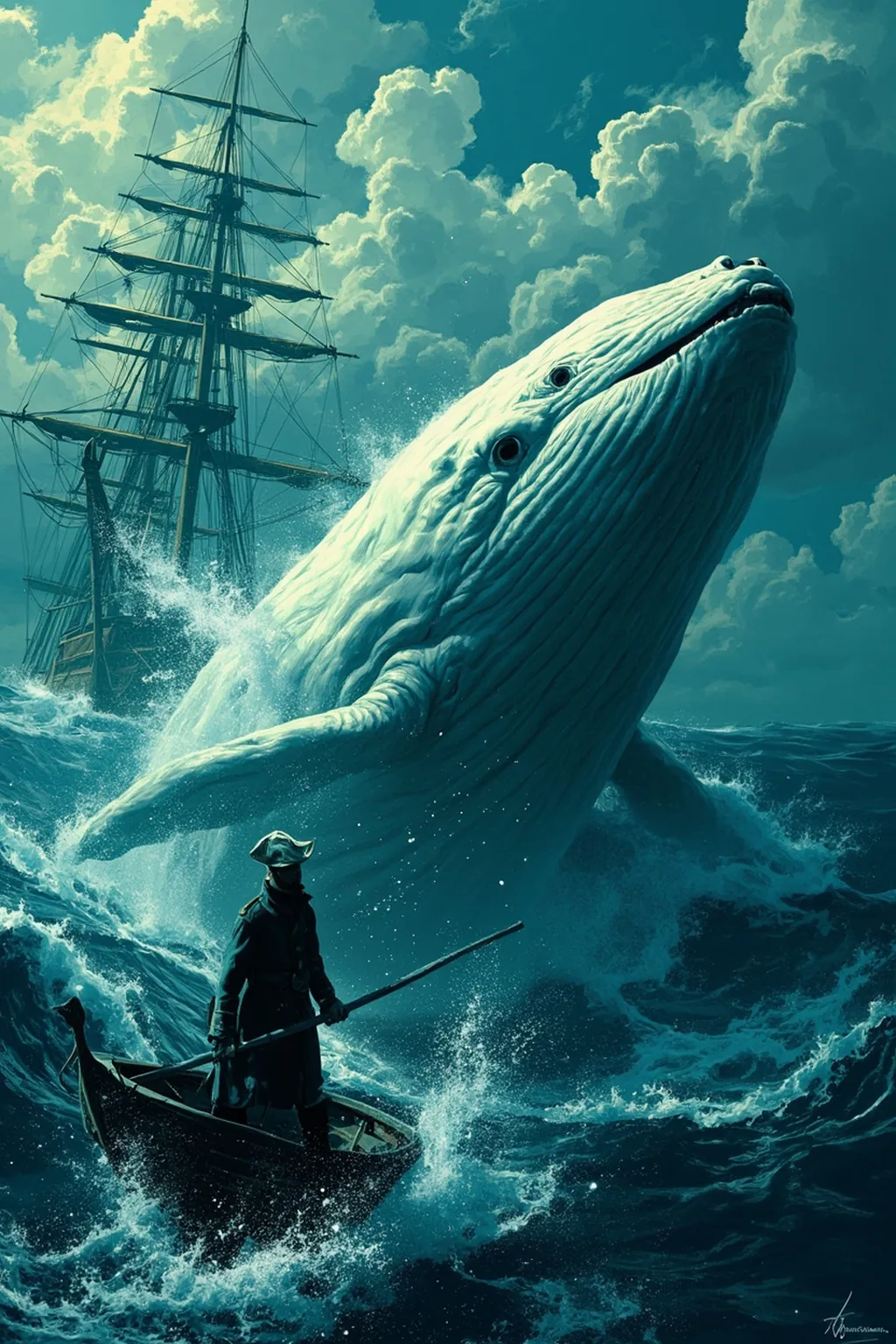
Fast-Fish and Loose-Fish
The chapter presents two fundamental laws of whaling: First, a Fast-Fish belongs to the party fast to it. Second, a Loose-Fish is fair game for anybody who can soonest catch it. However, the brevity of this masterly code necessitates extensive commentary to expound its meaning and application in specific cases.
What is a Fast-Fish?
A fish is technically fast when connected to an occupied ship or boat by any controllable medium—whether a mast, oar, cable, telegraph wire, or even a strand of cobweb. Additionally, a fish bears a waif or recognized symbol of possession, provided the party waifing it can demonstrate both ability and intention to take the fish alongside at any time. Some whalemen enforce these principles through “hard words and harder knocks,” though honorable fishermen make allowances for peculiar cases where claiming a previously chased or killed whale would constitute moral injustice.
The Whale-Trover Case
Approximately fifty years ago, an English case of whale-trover was litigated. Plaintiffs who had harpooned a whale were forced to abandon their lines and boat due to peril, only to watch defendants capture the whale before their eyes. The defendants even retained the plaintiffs’ attached line, harpoons, and boat. Lord Ellenborough presided, with Mr. Erskine defending. Erskine humorously compared the case to a “crim. con.” case involving a wife, arguing both demonstrated that abandonment makes one a “loose-fish.” The judge awarded the boat to plaintiffs for abandoning it to save their lives, but ruled the whale, harpoons, and line belonged to defendants, since the fish became a Loose-Fish at final capture and acquired property in the attached articles.
Possession and the Law
Lord Ellenborough’s decision established that the two principles of Fast-Fish and Loose-Fish are fundamentals of all human jurisprudence. Possession is often half the law, and sometimes the whole of it. The chapter extends this principle metaphorically to social and economic relations: serfs, slaves, widows’ mites, marble mansions, ruinous discounts, church incomes, and territorial holdings all function as Fast-Fish where possession determines ownership.
Loose-Fish in Society
The doctrine of Loose-Fish applies even more widely than Fast-Fish, internationally and universally. Historical and contemporary examples demonstrate this principle: America in 1492 (a Loose-Fish Columbus struck for Spain), Poland to the Czar, Greece to the Turk, India to England, and future implications for Mexico to the United States. Rights of Man, liberties of the world, opinions, religious beliefs, and even the great globe itself are all Loose-Fish. The chapter concludes by asking what the reader is but both a Loose-Fish and a Fast-Fish too.
CHAPTER 90. Heads or Tails.
CHAPTER 90. Heads or Tails. This chapter examines the ancient English law granting the monarch the head of any whale captured on English shores and the queen the tail. The opening Latin quote from Bracton establishes this royal division, which persists under modified form to Melville’s time. The narrator dedicates a full chapter to this “strange anomaly” in the law of Fast and Loose-Fish, comparing the arrangement to a courteous railway compartment reserved for royalty.
Legal Precedent for Royal Whale Division
Legal Precedent for Royal Whale Division The law originates from Bracton’s thirteenth-century treatise on the Laws of England, specifying that of all whales captured on English coasts, the King (as Honorary Grand Harpooneer) must receive the head and the Queen the tail. The narrator notes this division is “much like halving an apple; there is no intermediate remainder,” meaning the whale cannot be meaningfully separated between these two parts. This law remains in force in England during Melville’s era, and the chapter aims to provide curious proof of its continued existence.
Cinque Ports Mariners’ Seized Whale Case
Cinque Ports Mariners’ Seized Whale Case The narrator presents a recent incident involving honest mariners from one of the Cinque Ports (Dover or Sandwich) who successfully killed and beached a fine whale after a hard chase. The Lord Warden of the Cinque Ports—a position held directly from the crown and said to be “busily employed at times in fobbing his perquisites”—claimed the whale. Despite the mariners’ protests that they had borne all the trouble, peril, and expense, a learned gentleman seized the whale as the Lord Warden’s property. When asked repeatedly if the Duke (the Lord Warden at this time) might share even a quarter or half with them, the response was consistently “It is his.” The Duke of Wellington ultimately received all proceeds from the sale. A local clergyman interceded on the mariners’ behalf but was firmly rebuffed by the Duke, who stated he had already received the money and advised the clergyman to stop meddling.
The original text of this work is in the public domain. This page focuses on a guided summary article, reading notes, selected quotes, and visual learning materials for educational purposes.