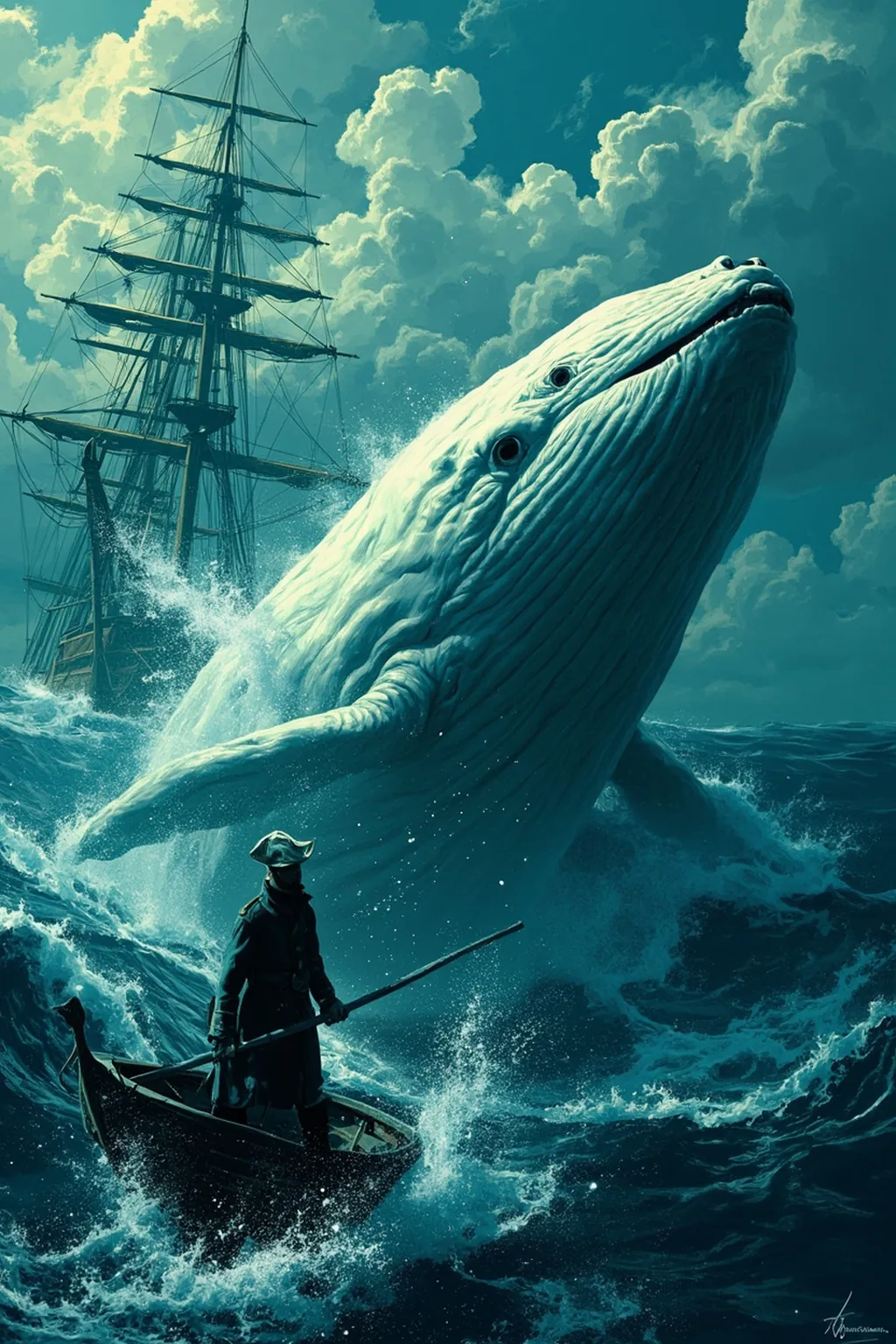
Ship’s Final Plunge into the Atlantic
The pilot boat and Pequod drift apart in the cold night wind, a screaming gull flies overhead, and the crew gives three heavy-hearted cheers. The Pequod then plunges blindly into the vast, lone Atlantic Ocean to begin its whaling voyage.
CHAPTER 23. The Lee Shore.
The chapter centers on Bulkington, a newly-landed mariner who, immediately after completing a four-year dangerous voyage, signs on to the Pequod and faces another tempestuous journey through the cold winter sea, unable to endure the safety and comfort of shore life. Melville uses an extended metaphor of a ship driven along a leeward land, wherein the port—representing safety, warmth, friends, and hearthstone—becomes the ship’s direst danger, compelling her to flee all hospitality and rush toward the lashed sea’s “landlessness” in pursuit of her own independence. The chapter argues that like the ship, the soul must resist the “treacherous, slavish shore” and that only in complete landlessness and defiance of all earthly comforts can one achieve the highest truth, comparing this struggle to a grim demigod’s apotheosis rising straight up from the spray of ocean-perishing.
Earlier Mention of Bulkington and His Return to the Pequod’s Helm
The chapter revisits the figure of Bulkington, a tall, newly-landed mariner who was first introduced earlier in the novel during Ishmael’s encounter with him at an inn in New Bedford. On a shivering winter’s night, just as the Pequod departed into hostile waters, Ishmael observed Bulkington standing at the ship’s helm. This sighting is remarkable because Bulkington had only just completed a four-year dangerous voyage, yet immediately thrust himself back into another tempestuous journey. Ishmael notes the extraordinary nature of this choice—the land itself seemed scorching to Bulkington’s feet, driving him inexorably back to sea despite any reasonable desire for rest.
Analogy of the Storm-Tossed Ship and the Peril of the Lee Shore
The narrator draws a powerful parallel between Bulkington’s situation and a ship driven by storms toward a leeward coastline. While the port offers obvious comforts—safety, warmth, friendship, and all the necessities of mortal life—these very comforts become the ship’s greatest danger when she is caught in violent weather. The land that should offer refuge threatens to dash her against the shore. The ship must flee from hospitality itself, keeping far from any touch of land even if that land might offer salvation. This creates a paradox where the ship fights against even favorable winds, seeking only the open, landless sea as her only means of survival against the treacherous shore that would destroy her.
Philosophical Reflection on Soul Independence and the Superiority of Perilous Landlessness
The chapter transitions into a profound meditation on the nature of the human soul. The text suggests that Bulkington’s experience reflects a deeper truth about consciousness—that all deep, earnest thinking is fundamentally an intrepid effort by the soul to maintain its independence and freedom. The soul must resist the “treacherous, slavish shore” of conformity and comfort, even as all the forces of heaven and earth conspire to cast it upon safe but limiting shores. Melville posits that highest truth resides in complete landlessness, in a shoreless and indefinite existence that mirrors the nature of God. This suggests that authentic spiritual freedom requires a willingness to embrace the terrifying uncertainty of the infinite rather than seeking the false security of the shore.
Exhortation to Bulkington and His Oceanic Apotheosis
The chapter concludes with an urgent, almost rapturous address to Bulkington, demanding whether he truly comprehends this “mortally intolerable truth” about soul independence. The narrator addresses the terrors of the terrible, questioning whether the agony of maintaining freedom is vain. The answer comes as a triumphant exhortation: the narrator urges Bulkington to take heart and bear himself grimly like a demigod. Rather than crawling cravenly to land like a worm, Bulkington is called to embrace his oceanic destiny. The climactic image is one of apotheosis—straight up from the spray of his ocean-perishing, Bulkington’s transformation into something divine is achieved through his unwavering commitment to the landless, infinite sea.
The original text of this work is in the public domain. This page offers a compressed quick-read summary for educational purposes.