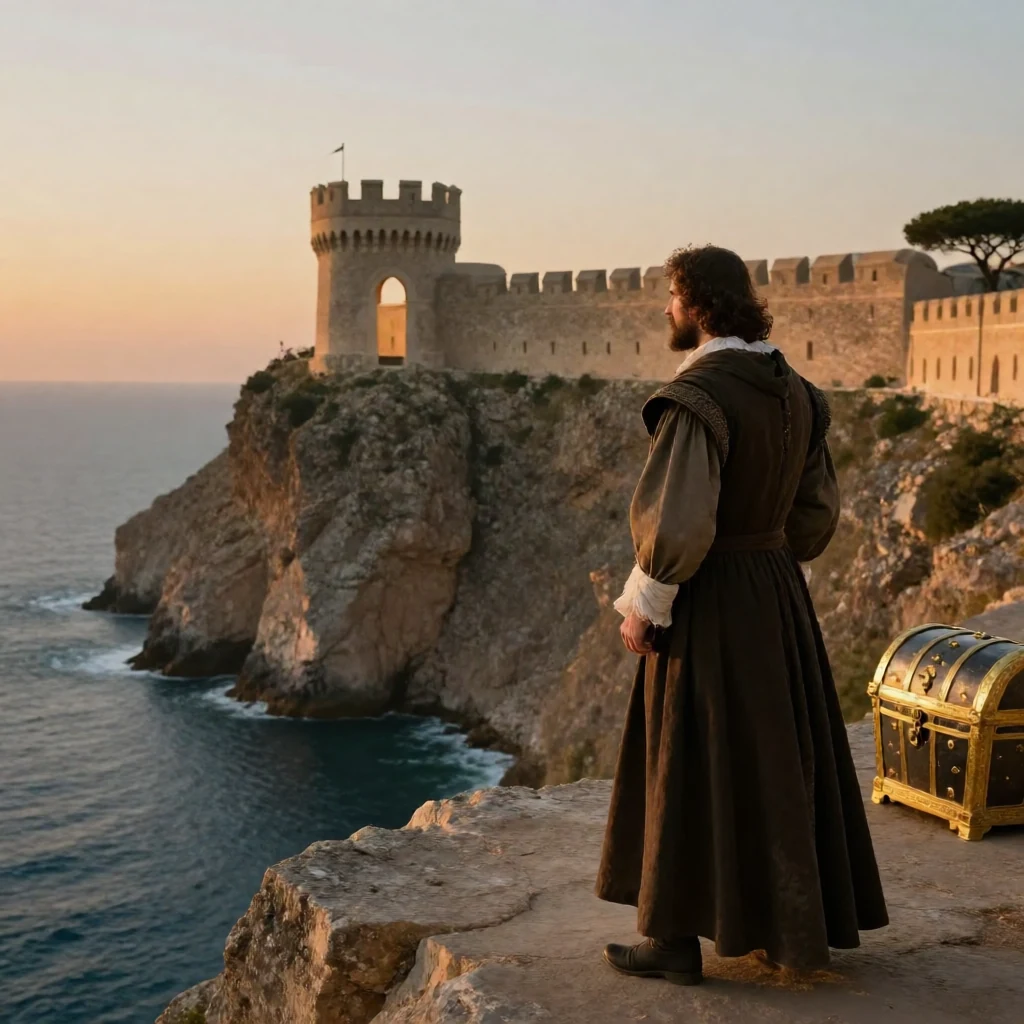
Monte Cristo Advises Andrea on Public Perception
Monte Cristo counsels Andrea on how to manage public perception of his past. He warns that reciting such a romantic history would mark Andrea as an upstart rather than a returned nobleman, and that society mistrusts romances “bound in living parchment.” He urges Andrea to adopt a single, consistent line of conduct and form respectable friendships to counter prejudice. He further explains the financial arrangements: the major will provide 50,000 francs annually, drawn through Lord Wilmore’s account at Danglars’ bank, and that the father will remain in Paris only a few days before returning to his service in Lucca.
Staged Reunion with Major Bartolomeo Cavalcanti
Andrea is led into the adjoining drawing-room where Major Bartolomeo Cavalcanti awaits. The two greet each other with theatrical effusion—speaking loudly so Monte Cristo can hear through a concealed panel, embracing in the exaggerated style of stage actors, and exchanging “reunited” sentiments. The major formally presents Andrea with documents certifying his parents’ marriage and his own baptism. Both men feign overwhelming emotion, performing the reunion for the benefit of their hidden observer.
Andrea and the Major Expose Their Scam
After receiving the documents, Andrea reads them with practiced ease and, in excellent Tuscan, drops the pretense by asking whether the galleys still exist in Italy—a pointed reference to forgery. He seizes the major’s arm and, speaking in Italian to ensure privacy, reveals that he himself is paid 50,000 francs a year to play the son. The major, after a moment of alarm, acknowledges he was paid 50,000 francs down for the same role. The two conspirators recognize each other as fellow mercenaries, and the major produces a handful of gold as proof of his reward, sealing their mutual exposure of the scam.
Chapter 56. Andrea Cavalcanti
In this chapter, Andrea Cavalcanti and his supposed father, the Major, compare notes on the mysterious letters they each received—one from Abbé Busoni and the other from Sinbad the Sailor (Lord Wilmore)—both directing Andrea to appear in Paris on May 26th at seven in the evening to claim the inheritance of the Marquis Cavalcanti from the Count of Monte Cristo, unaware that Monte Cristo himself engineered both letters. The two impostors then perform their rehearsed reunion for the Count, who plays along with the deception, discreetly slipping Andrea a packet of bank-notes under the pretense that the Major is providing for him, and finally inviting the pair to dinner at his country house in Auteuil on Saturday, complete with precise instructions on their attire and where to purchase horses and a phaeton. After the Cavalcantis depart arm in arm, Monte Cristo watches them from his window and remarks that it is a pity two such villains are not truly father and son, before turning his thoughts toward visiting the Morrels, finding disgust even more sickening than hatred.
Major and Andrea discuss Abbé Busoni’s letter
The Major reassures Andrea that he can rely on the Count of Monte Cristo’s promises, but insists they must continue to play their parts—the Major as a tender father and Andrea as a dutiful son. Andrea mentions that “they” sent letters to both of them, and the Major produces a letter he received from Abbé Busoni, which Andrea reads aloud. The letter explains that the Major is poor and facing a miserable old age; it instructs him to travel to Paris and demand of the Count of Monte Cristo, at Avenue des Champs-Élysées No. 30, the son he allegedly had with the Marchesa Corsinari, named Andrea Cavalcanti, taken from him at five years old. It encloses an order for 2,400 francs payable in Florence and a draft of 48,000 francs, and specifies arriving on 26 May at seven o’clock in the evening.
Andrea reveals his letter from Lord Wilmore
Andrea reveals that he, too, received a letter of similar intent, though not from Abbé Busoni but from an Englishman calling himself Lord Wilmore, who also goes by “Sinbad the Sailor.” Unlike the Major, Andrea claims to have met this correspondent once, though he refuses to disclose where. He then shows the Major his own letter, which mirrors the Busoni letter: Andrea is told he is poor, offered a name and wealth, instructed to find a post-chaise at the Porte de Gênes, travel through Turin, Chambéry, and Pont-de-Beauvoisin, and arrive at Monte Cristo’s address on 26 May at seven o’clock to claim the Major as his father. The letter encloses a draft for 5,000 livres payable in Nice and a letter of introduction to the Count, with instructions that the Count supply his needs.
The original text of this work is in the public domain. This page focuses on a guided summary article, reading notes, selected quotes, and visual learning materials for educational purposes.