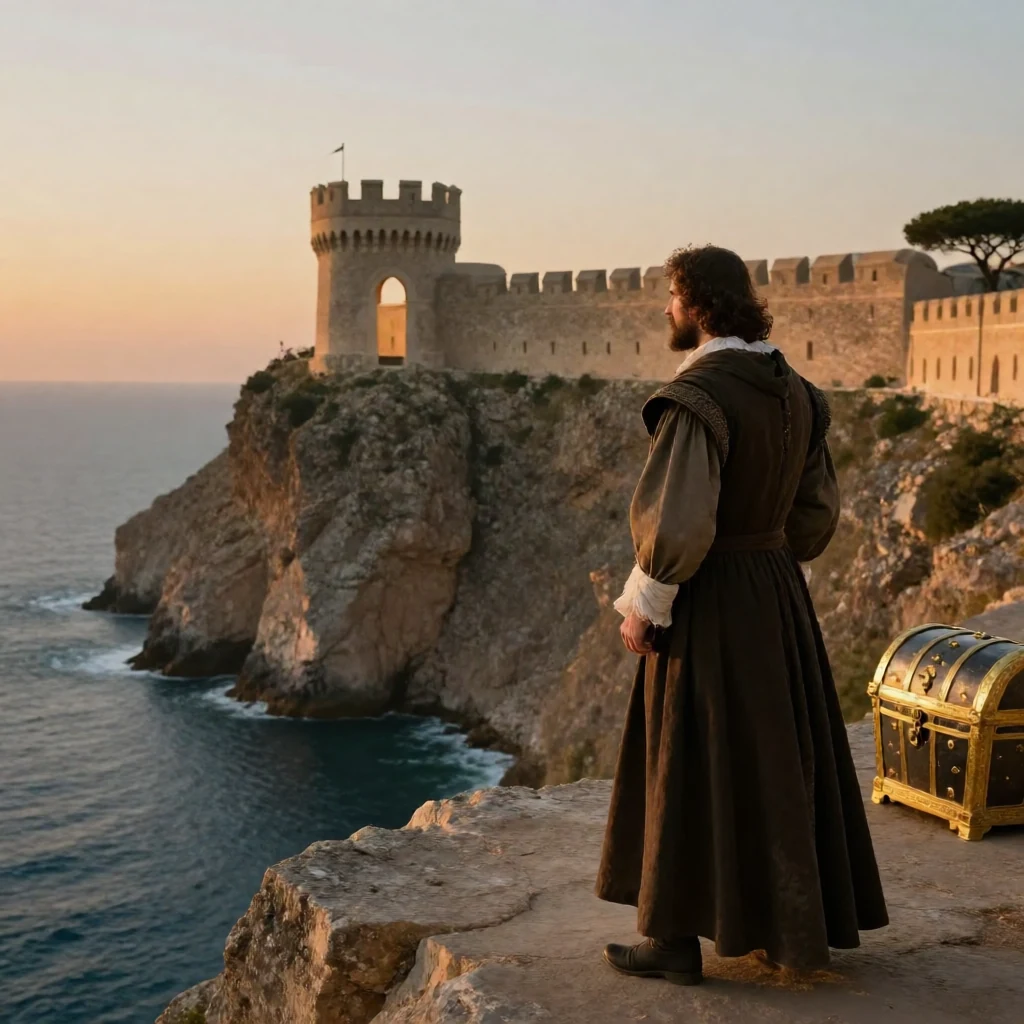
Reading Notes: The Count of Monte Cristo by Alexandre Dumas
Overview and Structure
The novel unfolds across 116 chapters, organized into several distinct movements that follow Edmond Dantès from naïve sailor to imprisoned victim to the figure of Monte Cristo. The book operates on two parallel clocks: a slow, psychological clock of vengeance and a faster clock of public scandal, social maneuvering, and converging revelations.
The structure falls roughly into these arcs:
- The Betrayal (early chapters): Dantès’s rise, the conspiracy of Danglars, Fernand, Caderousse, and Villefort, and the false accusation letter
- The Château d’If (Chapters 8–17): Imprisonment, the meeting with Abbé Faria, education, the treasure of Monte Cristo, and Faria’s death
- The Escape and Treasure (Chapters 18–25): The swap with the burial sack, the swim to Tiboulen, smuggling voyages, the discovery of the Spada fortune
- Reconstruction (Chapters 26–46): Multiple disguises, the early rewards (Morrel family), manipulation of the telegraph against Danglars, purchase of the Auteuil house
- The Return to Paris (Chapters 47–70): The slow positioning of weapons through Caderousse, Danglars, Villefort, and Morcerf, with side adventures in Rome
- The Reckoning (Chapters 77–110): Exposures, trials, poisonings, deaths, and final confrontations
- The Epilogue (Chapters 111–117): Departure, confession to Maximilian, and the final voyage
Central Characters and Arcs
Edmond Dantès / The Count of Monte Cristo
The protagonist undergoes three distinct identities. As Dantès, he is a young, honest sailor whose only sin is being loved by Mercédès and trusted by Captain Leclère. As prisoner number 34, he nearly loses his mind to despair before being saved by Abbé Faria’s intellectual companionship. As the Count of Monte Cristo, he constructs a new self out of patience, wealth, and the theatrical deployment of power. The novel’s deepest question is whether Dantès can complete his revenge without becoming monstrous, and the answer arrives in the chilling recognition that the answer is: not entirely.
Mercédès
The woman Dantès loved and lost, who becomes the moral compass of the novel. She marries Fernand under conditions Dumas carefully refuses to romanticize, and she eventually appears at Monte Cristo’s door the night before the duel with Albert to remind him that vengeance has human limits. Her son Albert becomes the unintended target, and her appeal is what cracks the Count’s resolve. She explicitly forgives Dantès and refuses the fortune he offers.
Abbé Faria
The Italian priest imprisoned in a neighboring cell. Faria is Dantès’s second father, teaching him classical languages, modern languages, history, and mathematics. He bequeaths both his scholarly methods and the secret of the Spada treasure, dying just as the escape plan was about to be attempted. The escape plan is then adapted: Dantès takes Faria’s place in the burial sack.
Maximilian Morrel
The son of the shipowner Dantès once saved. He is the moral reward of the entire novel, and the recipient of the Count’s last great gift: Valentine de Villefort, restored from apparent death through Monte Cristo’s intervention. His near-suicide on October 5 is the occasion for the final reunion.
Valentine de Villefort
Granddaughter to Noirtier, the paralyzed Bonapartist patriarch who cannot speak or move but whose eyes still command. She is being slowly poisoned by her stepmother Madame de Villefort, who stands to inherit her fortune. Noirtier’s secret administration of small doses of brucine has built up her tolerance, but a stronger dose nearly kills her. Monte Cristo watches over her from a hidden room in the adjacent house, intervening at the critical moment and substituting antidote for poison.
Danglars
The ship’s supercargo, ambitious and cold, who writes the denunciation letter in left-handed backhand. He rises to become Baron Danglars, banker, a peer of France, and a man of staggering wealth, all of which is stripped from him through the telegraph scheme, the Cavalcanti fraud, and finally his abduction by bandits who charge him five million francs in staged expenses. He leaves Rome with his hair turned white.
Fernand
The Catalan fisherman who loves Mercédès and betrays Dantès to clear his path. He becomes Colonel Fernand, then General Fernand, then Count de Morcerf, and finally a peer of France. His crimes at Yanina—selling Ali Pasha to the Turks and murdering the fire-keeper Selim—catch up with him when Haydée testifies in the Chamber of Peers. He commits suicide.
Villefort
The magistrate who destroys Dantès to protect his own political future, only to discover the letter he destroyed was addressed to his own father, the Bonapartist Noirtier. He is the most ironic of the targets, since Dantès’s revenge upon him operates through the very system of justice Villefort himself represents. The trial scene where Benedetto publicly identifies him as his father is the novel’s most devastating public exposure. His wife, whom he has accused of being a serial poisoner, kills herself and their son Edward rather than face the scaffold.
Haydée
The daughter of Ali Pasha of Yanina, sold into slavery after her father’s death and purchased by Monte Cristo. She is both witness and instrument: her testimony destroys Fernand, and her presence in the Paris opera scene is the trigger that begins Albert’s unraveling. She loves Monte Cristo as one loves a father, brother, and husband at once, and her declaration of this love is one of the novel’s quiet climaxes.
Themes
Providence, Justice, and the Limits of Personal Vengeance
The novel insists on a distinction between divine justice and human vengeance. Monte Cristo is constantly tempted to see himself as God’s instrument, but the deaths of Edward and the madness of Villefort make him question whether he has exceeded the bounds of any legitimate retribution. The final line of the novel, “wait and hope,” is a religious admonition that places the eventual resolution of suffering outside human hands.
The Inseparability of Identity and Disguise
Almost every major character wears a mask. Monte Cristo adopts the disguises of Abbé Busoni, Lord Wilmore, and Sinbad the Sailor. The elder Cavalcanti plays a role. Villefort the magistrate is a different person from the husband and father. Danglars’ public respectability conceals a man who cannot endure being contradicted by a wife. The novel suggests that the social self is always, in some sense, a fabrication, and the question becomes whether any honest identity is possible beneath the performance.
Education, Patience, and Self-Construction
Dantès is a blank page when he enters the Château d’If. Everything he becomes, he constructs through deliberate study and discipline. The education Faria gives him is the only true inheritance he receives, and it is the foundation on which everything else is built. The lesson is that patience and the slow accumulation of knowledge can overcome almost any obstacle, but that the transformation of self also carries a danger: one can become too powerful, too far removed from ordinary human feeling.
The Power of Money and Social Performance
Monte Cristo’s wealth is his primary instrument. The horses returned to Madame Danglars, the diamond at the opera, the unlimited credit at Thomson and French, the Auteuil house that becomes a stage for psychological torment, the rescue of Albert from the bandits: all operate through the strategic deployment of resources. The novel is acutely aware that the social world is a marketplace in which every gesture of generosity is also a form of leverage.
Notable Set Pieces
The Conspiracy at the Arbor (Chapter 4)
Danglars writes the denunciation letter under the arbor at La Réserve, his left hand producing handwriting unrecognizable as his own. Caderousse, drunk, half-understands what is happening but is too sodden to object effectively. The scene is one of the great studies of collective guilt in the novel: every man at that table knows, or suspects, what is being arranged, and not one of them raises a serious objection.
The Examination (Chapter 7)
Dantès confides in the very magistrate who will condemn him. The dramatic irony is excruciating: Villefort destroys the letter because it is addressed to his own father, then sends Dantès to prison. The young sailor is already on his way to becoming a ghost.
The Discovery of the Treasure (Chapters 23–25)
The excavation beneath the chapel of rock, the climbing of the cliff, the use of a sailing cap and floating timber to pass as a shipwreck survivor: the escape is half improvised, half designed. Dantès becomes a different person in the moment he touches the gold.
The Pont du Gard Inn (Chapters 26–27)
Monte Cristo in his Abbé Busoni disguise extracts from Caderousse the entire history of the conspiracy, using the lure of a supposedly valuable diamond. Caderousse, greedy and feckless, surrenders the truth in exchange for a stone of unknown value. The scene demonstrates Monte Cristo’s preference for manipulation over force.
The Telegraph Scheme (Chapters 60–61)
The most purely mechanical of the Count’s stratagems. By bribing a telegraph operator at Montlhéry, Monte Cristo sends a false report that Don Carlos has escaped, causing Danglars to sell all his Spanish bonds at a loss. The story’s “how a gardener may get rid of the dormice that eat his peaches” is one of the novel’s small perfections of comic framing.
The Dinner at Auteuil (Chapters 62–63)
Monte Cristo assembles all his victims under one roof: the man who wrote the letter, the man who delivered it, the man who judged it, the man who benefited from the marriage it prevented. The “sinister chamber” with red damask, the staircase, the discovery of a baby’s bones in the garden: the entire scene is a slow instrument of psychological torture.
The Roman Interlude (Chapters 31–37)
The Carnival, the Colosseum by moonlight, the opera, the catacombs of Saint Sebastian: a long detour that serves to introduce Albert, Franz, and Haydée, and to position Monte Cristo in Parisian society before the reckoning begins. The Roman scenes also establish the Count’s power over bandits, which is later used to abduct Danglars.
The Trial of Benedetto (Chapter 110)
The most theatrical public exposure in the novel. The murderer on trial reveals himself to be the legitimate son of the prosecutor, with the prosecutor’s own past complicity in infanticide as the foundation of the claim. Villefort’s public confession and immediate collapse is the moment the legal system devours itself.
The Architecture of Vengeance
The Count’s plan unfolds in waves. The first wave disposes of the elder enemies: Caderousse is left to be murdered by Benedetto, and Benedetto himself is then brought to justice through a confession extracted at the point of death. The second wave strips Danglars of his fortune through a series of frauds and finally through bandit extortion. The third wave destroys Morcerf’s reputation through the public testimony of Haydée. The fourth wave turns against Villefort through the cumulative weight of his wife’s crimes, which the Count has both observed and used.
The structure is not merely punitive. Each act of vengeance is paired with a corresponding act of grace: the Morrel family is saved and rewarded, Maximilian is given Valentine, Albert is given a fortune and a new identity, the old gardener at the telegraph is paid more than he could earn in years. The Count’s final codicil leaves twenty million francs to Maximilian and a hundred and fifty louis to Mercédès, money buried for her twenty-four years before. The novel is asking whether these gifts balance the harms, and refuses to give a clear answer.
A Final Reflection
Dumas wrote a book that is at once an adventure, a philosophical treatise on justice, a study in disguises, a romance of the Mediterranean, and a meditation on the difference between vengeance and mercy. Its long middle section, in which Monte Cristo manipulates a dozen characters without quite destroying any of them, is one of the great sustained performances in nineteenth-century fiction, and the final chapters pull the threads together with a discipline that is invisible because of its seamlessness. The novel’s closing line, “wait and hope,” is not a consolation but a discipline.