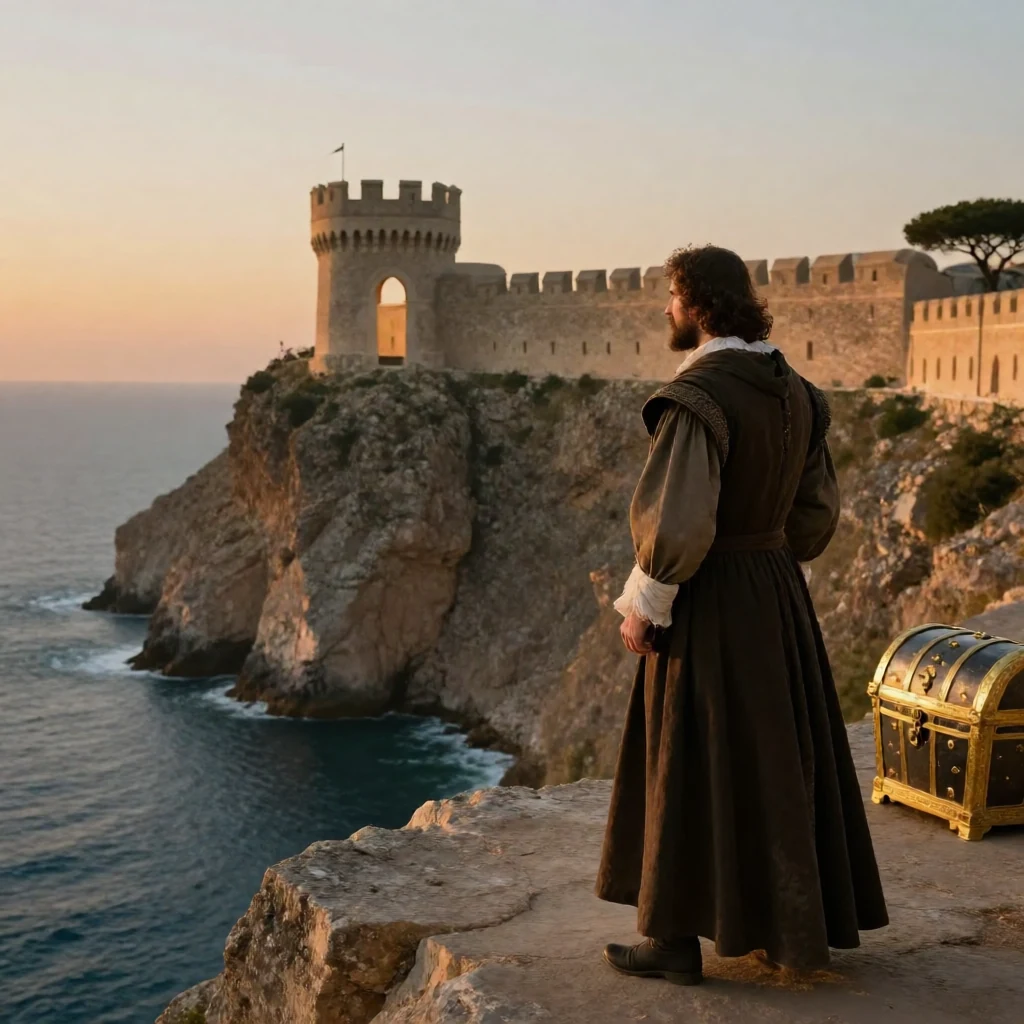
The Sycamore Recollection
Albert asks Haydée about her earliest memories beyond her first recollection of a pious pilgrimage for prisoners. Haydée describes sitting under sycamore trees on the edge of a lake as a small child, playing with her father’s long white beard and jeweled scimitar while he reclined on cushions with her mother at his feet. She notes a regular Albanian messenger would approach her father, who only ever responded to his reports with either “Kill” or “Pardon.” Albert remarks the account feels vivid and real, not like fictional performance, and asks how France appears to Haydée, who says she sees France as it truly is, while her memories of her homeland are tinted by the joy or sadness of her childhood experiences. When Albert asks if she has ever known suffering beyond the concept, Monte Cristo prompts her to speak, and Haydée observes that early childhood memories are the most indelible, with all her earliest recollections outside the two scenes she just described filled with deep sorrow.
Escape from Yanina Palace
Haydée recounts that she was four years old when her mother suddenly woke her in the middle of the night in the Yanina palace, snatching her from her cushions and rushing her out in terror. She describes a procession of servants carrying valuables, a guard of 20 armed Greek soldiers, and her father Ali Tepelini, the former pasha of Yanina who had made all of Turkey tremble, arriving last in his robes, leaning on his favorite Selim and driving the group forward like a shepherd with his flock. The group flees to the edge of a lake, where a waiting boat takes them to a distant kiosk, with the Palikares remaining on shore to cover their retreat. Haydée reveals her father was fleeing because the Yanina garrison, exhausted from long service, had made a deal with the Seraskier Kourchid, sent by the sultan to capture him. Ali had sent a trusted French officer to Constantinople before resolving to flee to his pre-prepared refuge, called a kataphygion. Albert asks for the French officer’s name, but Haydée says she does not remember it at that moment, and Monte Cristo silences Albert before he can speak his own father’s name, per his earlier promise.
Life in the Cavern
Haydée describes being led with her mother and the other women into a large subterranean cavern beneath the kiosk, which held 60,000 pouches of gold (totaling 25,000,000) and 200 barrels of gunpowder. Selim, her father’s favorite, stood watch day and night holding a lance with a lit slowmatch, with orders to blow up the entire kiosk, guards, women, gold, and even Ali Tepelini himself at the first signal from her father. Haydée recalls the slaves spending their days praying, crying, and groaning, convinced their lives were precarious, and that she rarely saw her father except when he summoned her and her mother to the kiosk terrace to scan the horizon for approaching boats. She describes the view of the Pindus mountains, the white Yanina castle across the blue lake, and the distant fir and myrtle trees. One morning, her father told them the sultan’s firman (decree) would arrive that day, and if it was not a full pardon, they would have to flee that night; he reassured them that Selim would handle any enemy pursuit. When he spotted approaching boats, he armed himself and told his wife and daughter to go to the cavern, pressing a final kiss to Haydée’s forehead before they left.
The Boats Approach
As Haydée and her mother descend to the cavern, they see four boats approaching the kiosk, and the 20 Palikares stationed there ready to defend against pursuit. Haydée watches her father pace anxiously, checking his watch and scanning the horizon, while the Palikares wait with inlaid long guns and scattered cartridges. She and her mother join Selim at his post in the cavern, where the only light is the flame of his lance. Her mother, a Christian, prays, while Selim periodically declares “God is great!” and vows to give war or death to any attackers who do not bring peace. Haydée, terrified as a small child by the prospect of fiery death, recoils from the thought of the imminent danger they face.
The original text of this work is in the public domain. This page focuses on a guided summary article, reading notes, selected quotes, and visual learning materials for educational purposes.