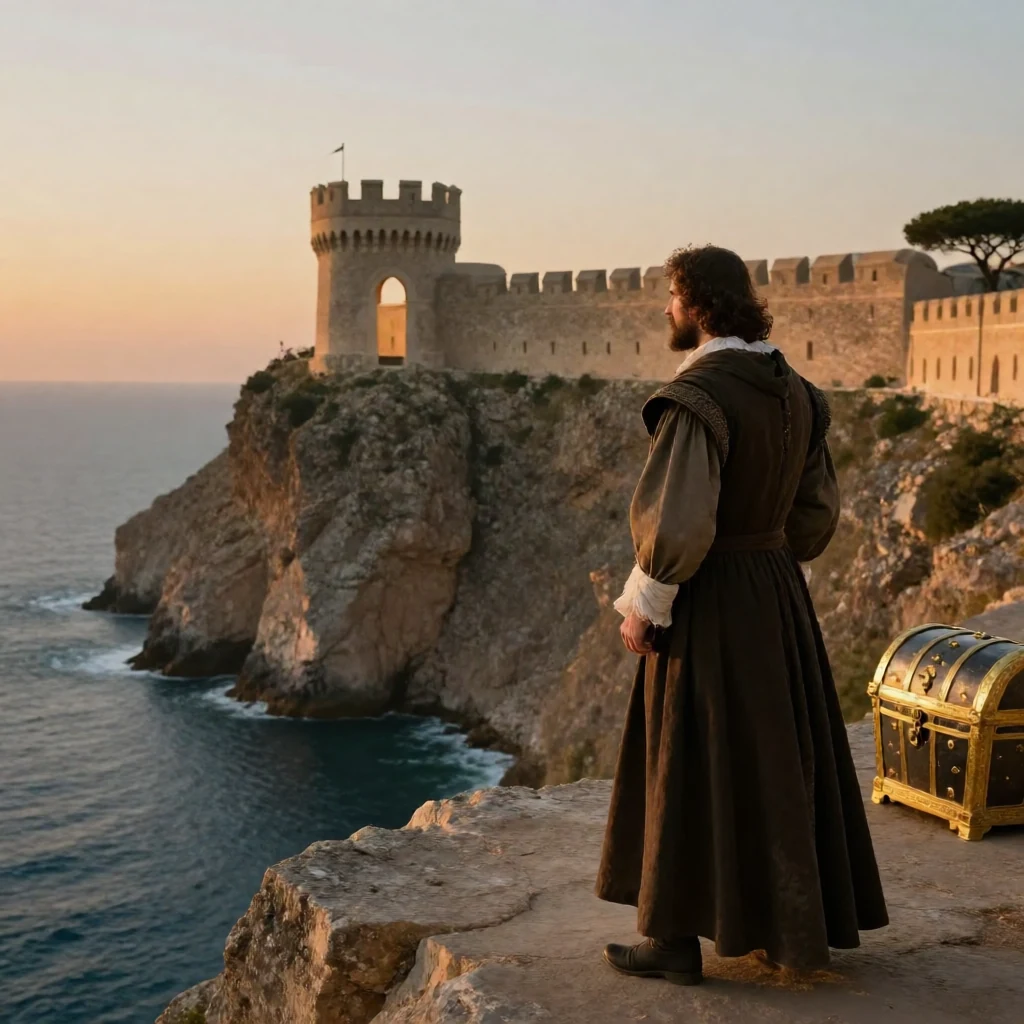
Beauchamp’s Warning
At the banker’s door, Beauchamp cautions Albert before they approach Monte Cristo. He reminds Albert that demanding satisfaction from a man who appears to be a true nobleman carries greater risks than challenging someone like Danglars, who is merely a money-lover. Beauchamp fears Monte Cristo will prove too formidable a foe, but Albert declares he would welcome death in his father’s stead, believing it would spare the family from disgrace. Beauchamp then reminds him that his mother would die of grief, causing Albert to pause briefly, his hand passing across his eyes.
Denied at the Count’s House
The two proceed to number 30 Champs-Élysées, where Albert insists on entering alone, claiming the unusual nature of their mission warrants a deviation from standard duel etiquette. Beauchamp accedes to his wishes and follows instead. Baptistin informs them that his master has just arrived but is in his bath and will not receive visitors. After his bath, Monte Cristo will dine, then sleep for an hour, and afterward attend the opera at eight o’clock precisely. Albert obtains this information and departs, instructing Beauchamp to arrange his evening accordingly and bring Château-Renaud along.
The Plan for the Opera
Beauchamp leaves to make arrangements while Albert sends invitations to Franz Debray and Maximilian Morrel to meet him at the opera. He also attempts to visit his mother, who has refused all visitors since the previous day’s humiliation and remains in her room, overwhelmed with grief.
Albert Visits Mercédès
Albert finds Mercédès in bed, weeping. She clasps his hand and sobs, her tears providing some relief. Albert stands silently beside her, his pale face and knitted brow betraying a weakening of his resolve for vengeance. He asks whether his father has any enemies, but notably does not say “my father.” Mercédès startles at this and observes that persons in the count’s situation have many secret enemies, and those known are never the most dangerous. Albert appeals to her superior penetration, noting that she surely noticed at their ball that Monte Cristo would eat nothing in their house—an Oriental custom of refusing hospitality from enemies to secure liberty for revenge. Mercédès grows pale at the mention of Monte Cristo’s name and protests that he has shown them only kindness, even saving Albert’s life. She begs him to retain the count’s friendship.
Monte Cristo Suspected
Albert suggests his mother has special reasons for urging him to befriend the count. When she denies this, Albert presses: “Is it not that he may never do us any harm?” Mercédès shudders at his words and studies him intently, asking why he speaks so strangely and what prejudices he has developed. She reminds him that only three days ago they returned from Normandy with Monte Cristo and considered him their best friend. An ironical smile crosses Albert’s lips, which Mercédès sees and understands from both a woman’s and a mother’s instinct. She conceals her sorrow and fear, being prudent and strong-minded. Albert remains silent, and when he prepares to leave, she asks him to stay and comfort her solitude, but he explains an urgent matter requires his departure that evening.
Mercédès Prepares for the Worst
Scarcely has Albert left than Mercédès summons a confidential servant and orders him to follow Albert wherever he goes that evening, reporting back immediately on what he observes. She then rings for her lady’s maid and, despite her weakness, dresses so as to be prepared for whatever may occur.
Waiting at the Opera House
At ten minutes to eight, Beauchamp arrives, having secured Château-Renaud’s presence in the orchestra. Both men enter Albert’s carriage, and Albert calls out their destination: the Opera. Impatience drives him to arrive before the performance begins. Château-Renaud is at his post, having been apprised of the circumstances by Beauchamp. He finds Albert’s conduct in seeking to avenge his father perfectly natural and offers renewed assurances of devotion. Debray has not yet arrived, though Albert knows he rarely misses an opera performance. Albert wanders through the theater seeking Monte Cristo in the lobby or on the stairs, but the bell summoning patrons to their seats calls him to the orchestra with his companions. Throughout the first act, his eyes remain fixed on the box between the columns, which remains closed.
The original text of this work is in the public domain. This page focuses on a guided summary article, reading notes, selected quotes, and visual learning materials for educational purposes.