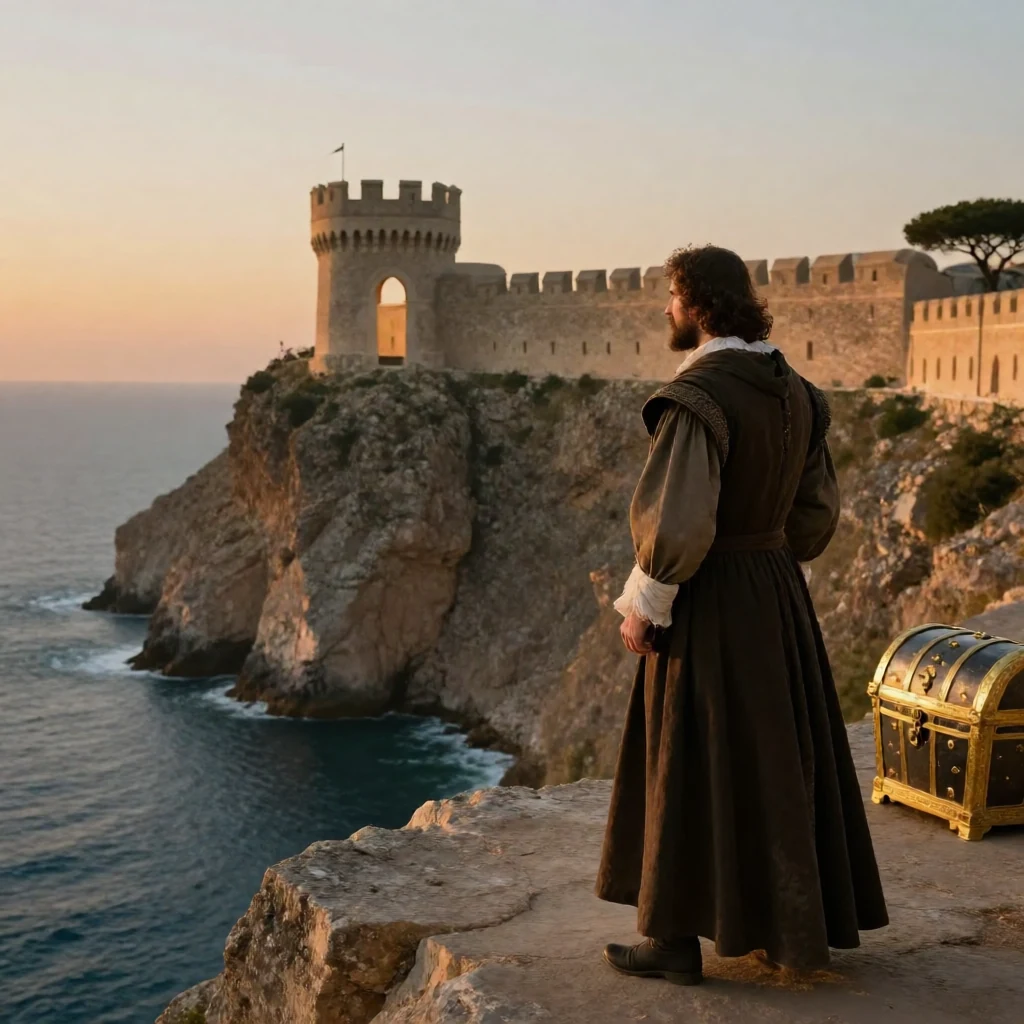
Chapter 90. The Meeting
Chapter 90, “The Meeting,” depicts the dramatic scene at the intended duel site where Albert de Morcerf, who had publicly challenged the Count of Monte Cristo, arrives looking pale and sleepless to face his adversary. Instead of a duel, however, Albert delivers a public apology, acknowledging that Monte Cristo was justified in exposing his father Fernand’s treachery. The Count, deeply moved, accepts the apology, while witnesses react with astonishment and Monte Cristo privately reflects on Mercédès’ sacrifice that prompted this reconciliation.
Albert’s Late Arrival at the Duel
Albert de Morcerf arrives late at the dueling ground, coming on horseback at full gallop followed by a servant. The witnesses—Château-Renaud, Beauchamp, Franz, Debray, and Morrel—comment on his imprudent attire and note his pale complexion, red and swollen eyes, and a melancholy gravity that seems unnatural to him. Albert thanks the gentlemen for complying with his request and invites Morrel to join them as well.
Albert Requests a Public Meeting with Monte Cristo
Albert asks the witnesses to apprise the Count of Monte Cristo of his arrival and signals that he wishes to speak to the Count. When Morrel prepares to fetch Monte Cristo, Albert stops the group and declares that he has two words to say to the Count of Monte Cristo, not in private but before all who are present. Morrel, rejoiced at this unexpected turn, goes to bring Monte Cristo, who has been walking in a retired path with Emmanuel.
Albert Publicly Apologizes to Monte Cristo
Approaching Monte Cristo, Albert addresses the Count publicly, declaring that he has learned Monte Cristo had the right to expose Fernand’s conduct—not because of the treachery toward Ali Pasha, but because of Fernand’s treachery toward the Count himself and the consequent miseries. Albert proclaims that Monte Cristo was justified in his revenge and that he, as Fernand’s son, thanks the Count for not using greater severity. He requests the Count’s hand, acknowledging his own fault while asserting that his conscience dictated his actions.
Monte Cristo Accepts Albert’s Apology
Monte Cristo, whose eyes rise toward heaven with an expression of infinite gratitude, is deeply moved by Albert’s declaration. With moistened eye and heaving breast, he extends his hand to Albert, who presses it with a sentiment resembling respectful fear. Monte Cristo accepts Albert’s apology, and Albert announces to the witnesses that the apology has been received and his fault repaired, daring anyone who would call him cowardly to challenge that judgment.
Onlookers React to the Unexpected Reconciliation
The witnesses react with astonishment to the unexpected reconciliation. Beauchamp asks Château-Renaud what happened during the night, and the baron responds that Albert’s behavior is either very despicable or very noble. Debray expresses confusion to Franz, noting that Monte Cristo’s dishonorable conduct toward Morcerf appears justified by the very son affected. The group struggles to comprehend the scene they have just witnessed.
Monte Cristo Reflects on Mercédès’ Sacrifice
Monte Cristo bows under the weight of twenty-four years’ reminiscences, his head bent and arms powerless. He does not think of Albert or the other witnesses, but of the courageous woman—Mercédès—who came to plead for her son’s life and who has now saved it by revealing a dreadful family secret capable of destroying every feeling of filial piety in her son. He murmurs that only now is he fully convinced of being the emissary of God, attributing the reconciliation to Providence.
Chapter 91. Mother and Son
After Albert returns home following the unexpected conclusion of his affair with the Count of Monte Cristo, he discovers his mother Mercédès preparing to leave as well, arranging her possessions with the same careful attention he has just given to his own rooms; their parallel efforts reveal a shared understanding that the family’s honor requires abandoning the house on the Rue du Helder and all its luxurious associations. When Mercédès learns that her son intends to forge a new existence without his father’s tainted name, she offers him her maiden name of Herrera, encouraging him to render it illustrious through his future achievements, though she declares that for her the grave awaits beyond the threshold of this house. As mother and son prepare to depart for humble lodgings, Bertuccio delivers a letter from Monte Cristo in which he reveals that he had buried treasure for his beloved Mercédès twenty-four years ago in the garden of his father’s house in Marseilles, and he insists that Albert spare his mother the suffering of poverty by accepting this black bread offered in place of the millions he wishes he could provide. Mercédès accepts the Count’s offering, declaring with an ineffable look toward heaven that he has the right to pay the dowry she will carry with her into a convent, and she descends the stairs with her son, strengthened by this mysterious provision for her future.
The original text of this work is in the public domain. This page focuses on a guided summary article, reading notes, selected quotes, and visual learning materials for educational purposes.