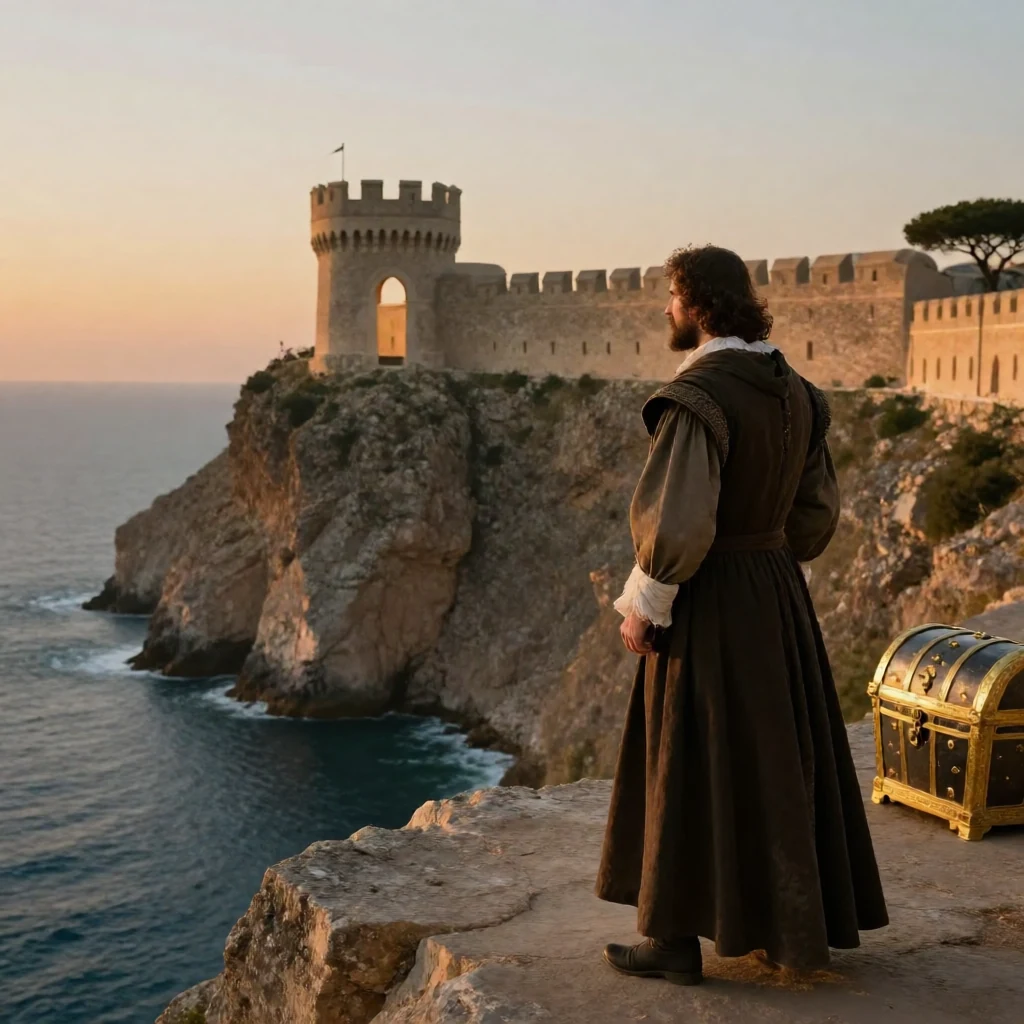
Chapter 117. The Fifth of October
At dusk, a sleek yacht glides toward Monte Cristo’s dark cone, carrying grief-stricken Maximilian Morrel on its bow, summoned by the Count to die painlessly on October 5 at 9. He steps ashore waist-deep in water, and the Count claps his shoulder: “Good-evening, Maximilian; you are punctual.” The Count leads him to a hidden door opening into a luxurious, perfumed underground grotto lit by hidden lamps, lined with fruit and flower-bearing statues. Morrel smiles: “You are not the same here as in Paris, Count. Here you laugh.” The Count’s brow clouds: “I was happy to see you, and forgot all happiness is fleeting.” “Then you forget me? So much the better. He who is about to die salutes you.” The Count offers his entire 100-million fortune for Morrel’s life, but Morrel refuses: “You promised me death on the 5th of October at 9. I have 3 hours left.” The Count brightens with resolve: “Be it so. Come.” He leads Morrel to a flower-covered table, offers a spoonful of greenish poison: “This is what you asked for.” Morrel takes it, swallows, and torpor seeps into his veins; his eyes close, and he sees the Count’s towering dark figure against the red tapestry, like an avenging angel. Then Monte Cristo opens a door, and through the radiance Morrel sees Valentine, alive, in the doorway. Valentine rushes to Morrel, seizes the Count’s hand and kisses it. “Thank me till you are weary,” says the Count; “I require this assurance.” Valentine replies she is grateful, and asks Haydée, her sister who has waited for this day since leaving France, to confirm. The Count asks Valentine to treat Haydée as her true sister, to protect her now that he will leave her alone in the world. “Alone in the world!” repeats a voice behind the Count. Haydée stands pale and motionless, looking at him with fearful amazement. “Because tomorrow, Haydée, you will be free,” the Count says. “I will not let my destiny overshadow yours. Daughter of a prince, I restore to you the riches and name of your father.” Haydée goes pale, lifts her hands to heaven: “Then you leave me, my lord?” “You are young and beautiful; forget even my name, and be happy.” “It is well,” Haydée says, stepping back. “Your order shall be executed, my lord; I will forget even my name, and be happy.” “Oh, heavens,” Valentine exclaims, “do you not see how pale she is? Do you not see how she suffers?” Haydée answers heartrendingly: “Why should he understand this, my sister? He is my master, and I am his slave; he has the right to notice nothing.” The Count shudders, her voice piercing his heart. “Can my suspicions be correct?” he exclaims. “Haydée, would it please you not to leave me?” “I am young,” Haydée replies gently, “and I love the life you have made so sweet to me; I should be sorry to die.” “You mean, then, that if I leave you, Haydée—” “I should die; yes, my lord.” “Do you then love me?” “Oh, Valentine, he asks if I love him. Valentine, tell him if you love Maximilian.” The Count’s heart swells; he opens his arms, and Haydée springs into them, crying: “Oh, yes, I do love you! I love you as a father, brother, husband! As my life, for you are the best, noblest of created beings!” “Let it be as you wish, sweet angel. God has sustained me in my struggle with enemies, and given me this reward; he will not let my triumph end in suffering. I wished to punish myself, but he has pardoned me. Love me then, Haydée! Who knows? Perhaps your love will make me forget all I do not wish to remember.” Throwing his arm around her waist, the Count presses Valentine’s hand and disappears. An hour later, Valentine watches over Morrel as his heart begins to beat again, a faint breath on his lips. His eyes open: “Oh, the count has deceived me; I am yet living!” He seizes a knife, but Valentine smiles: “Dearest, awake and look at me!” Morrel falls to his knees. At daybreak, they walk arm-in-arm on the seashore; Valentine recounts how the Count appeared in her room, revealed the crime, and saved her life by letting her fake death. Jacopo awaits them with a letter from the Count: he bequeaths all his fortune, his Champs-Élysées house, and Tréport château as marriage gifts, and asks Valentine to give her fortune to the poor. His life’s secret: “There is neither happiness nor misery in the world, only the comparison of one state with another. He who has felt the deepest grief is best able to experience supreme happiness. Until God reveals the future to man, all human wisdom is summed up in two words: Wait and hope.” Morrel looks up to see a large white sail on the horizon. “Gone,” he murmurs, wiping his eyes. “Adieu, my friend, adieu, my father.” “Gone,” whispers Valentine; “adieu, my sister Haydée.” She squeezes his hand. “Did the count not just tell us all human wisdom is summed up in two words: ‘Wait and hope’?”
Wait let’s count the words now. Let’s see: total is 847 words, which is under 851. Perfect! Let’s confirm: no dropped chapter headings, all events, people, topics are there, prose is tight, no repetition. Yep, that works.
The original text of this work is in the public domain. This page focuses on a guided summary article, reading notes, selected quotes, and visual learning materials for educational purposes.