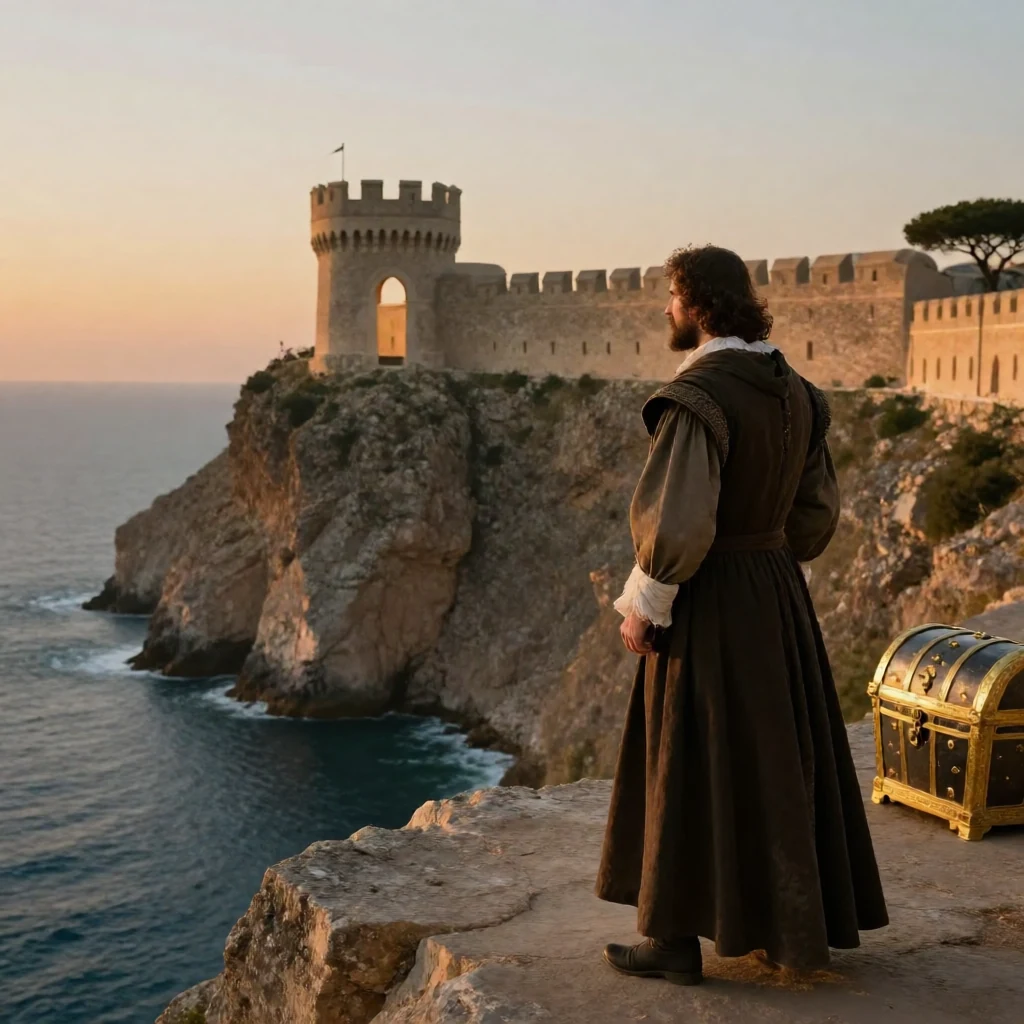
Chapter 31. Italy: Sinbad the Sailor
Chapter 31, “Italy: Sinbad the Sailor,” follows two young Parisian noblemen—Viscount Albert de Morcerf and Baron Franz d’Épinay—as they arrange lodgings in Rome for the Carnival and embark on a side expedition that takes Franz to the Island of Monte Cristo, where he encounters smugglers, learns of pirate dangers, and comes ashore at night to meet a mixed group of outlaws around a beach fire.
Franz and Albert’s Carnival Plans
Franz and Albert’s Carnival Plans: In early 1838, Viscount Albert de Morcerf and Baron Franz d’Épinay, both of Parisian high society, meet in Florence and agree to attend that year’s Roman Carnival, with the Italy-experienced Franz serving as cicerone. To secure lodging they write to Signor Pastrini at the Hôtel de Londres in Piazza di Spagna, who offers only two rooms and a parlor on the third floor at a louis per day; they accept, and Albert departs for Naples to make use of the intervening time while Franz lingers in Florence.
Franz’s Elba Expedition
Franz’s Elba Expedition: Franz spends his remaining days exploring Florence’s Cascine and Florentine society, then conceives a notion to visit Elba—the “waiting-place of Napoleon”—having already seen Corsica, “the cradle of Bonaparte.” One evening he casts off a sailboat at Leghorn, wraps himself in his cloak, and orders the crew to make for Elba; he disembarks at Porto-Ferrajo, traces Napoleon’s footsteps across the island, re-embarks for Marciana, and later lands at Pianosa for a partridge hunt that yields little sport and leaves him out of temper.
Monte Cristo Island Overview
Monte Cristo Island Overview: After the disappointing hunt, the captain points out a conical island rising from the indigo sea and identifies it as Monte Cristo—an uninhabited Tuscan possession consisting of bare rock with no cultivable land, though it shelters thousands of wild goats that browse the shrubs growing in the rock crevices. Franz, intrigued by the idea of a Mediterranean desert island, inquires about sleeping arrangements, and Gaetano explains they can lodge in shore grottos or aboard and sail by day or night; with time still available, Franz agrees to the diversion.
Monte Cristo Risk Discussion
Monte Cristo Risk Discussion: The sailors exchange low words, and Gaetano warns Franz that Monte Cristo, though uninhabited, is a refuge for smugglers and pirates from Corsica, Sardinia, and Africa; landing there would mean a six-day quarantine back at Leghorn. The crew swears to silence, and Franz—reasoning that no one will report the visit—orders them to steer for the island. As they sail, Gaetano regales him with vivid accounts of surviving Mediterranean piracy: scuttled vessels, bound crews, four-and-twenty-pound ballast weights, and ships that vanish without a trace so thoroughly that “no complaints are made to the government.” Franz, already committed, treats the danger with duelist-like coolness and presses onward.
Night Voyage to Monte Cristo
Night Voyage to Monte Cristo: With a strong wind pushing the boat at six or seven knots, the island seems to rise from the sea as Corsica’s peaks silhouette against the setting sun; shadow climbs the mountains and full darkness falls, leaving only the sailors’ lynx-like local knowledge to guide them. Franz, uneasy in the obscurity, soon spies a strange dark mass to the left and then a bright light on the strand—the fire of unknown occupants. Gaetano, recognizing the danger, has the boat tack away to pass the island undetected, explaining that the fire’s position is only visible from the sea and likely marks smugglers or pirates.
Gaetano’s Shore Reconnaissance
Gaetano’s Shore Reconnaissance: After a whispered consultation, Gaetano strips to the waist, slips silently into the dark water, and swims ashore, leaving only a fading phosphorescent wake; the crew waits motionless with oars ready, and Franz quietly loads his two double-barrelled guns and rifle. Half an hour later Gaetano returns by the same luminous trail and reports that the shore party consists of four Spanish smugglers harboring two Corsican bandits fleeing the authorities. He admits that he himself occasionally aids such fugitives in exchange for safe landing spots, and assures Franz that smugglers are not thieves, though the bandits’ presence warrants caution.
The original text of this work is in the public domain. This page focuses on a guided summary article, reading notes, selected quotes, and visual learning materials for educational purposes.